Legal Options for Fake Reviews: A Practical US Guide
When a fake or defamatory review hits your business profile, your first 72 hours matter more than any lawsuit you might file later. The immediate priority...
TL;DR:
- Prompted reviews or false statements posing as customer feedback can harm a business’s reputation, but quick action is essential within the first 72 hours. It is critical to preserve evidence, report to platform moderators, and assess whether the review asserts a false fact or protected opinion before considering legal steps. Legal remedies rely on proving false factual claims, with discovery and litigation reserved for cases of material, documented harm and identifiable reviewers.
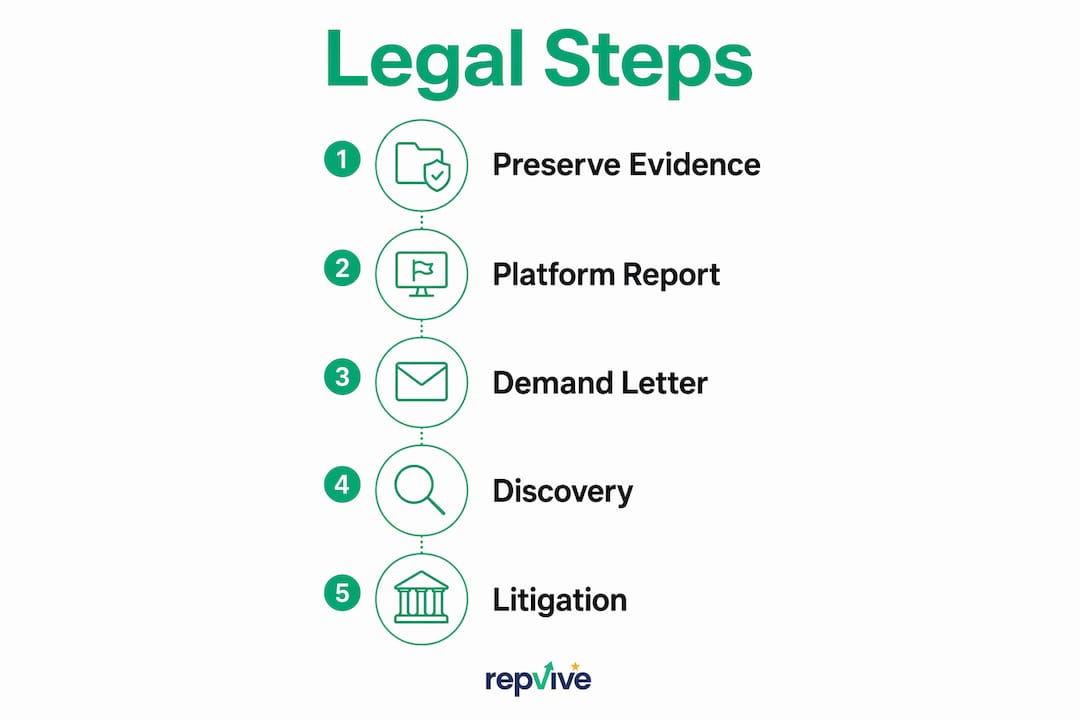
When a fake or defamatory review hits your business profile, your first 72 hours matter more than any lawsuit you might file later. The immediate priority is to preserve evidence, report to the host platform, assess whether the content states a false fact or merely expresses protected opinion, and decide whether a demand letter or legal discovery is warranted. That sequence, done in order, gives you the strongest position for every option that follows.
Here is what to do right now:
- Preserve everything first. Screenshot the review with the URL visible, capture the reviewer’s profile page, and save the timestamp. Do this before reporting, because some platforms remove content during review and you lose the record.
- Report to the platform. Google Business Profile, Yelp Business Manager, and Facebook Business Page each have native flagging tools. Use them with the correct category (Spam, conflict of Interest, or Legal Issue) to maximize removal odds.
- Report to the FTC at ReportFraud.ftc.gov. The FTC’s final rule under 16 CFR Part 465 prohibits the creation, sale, and purchase of fake reviews and carries civil penalties up to $51,744 per violation. Reporting supports systemic enforcement, though the FTC does not directly remove individual reviews.
- Triage: fact or opinion? A review that says “this contractor stole from me” asserts a fact. One that says “worst experience ever” is almost certainly protected opinion. Only false statements of fact can support a defamation claim.
- Consider a demand letter if the review contains a specific, provably false factual allegation and the reviewer can be identified. An attorney-led service like Repvive can handle this step with customized legal claims and direct platform channels.
- Pursue discovery only when the harm is material. Subpoenas to unmask anonymous reviewers are expensive and slow. Reserve that path for cases with measurable financial damage.
Table of Contents
- What makes a review legally actionable vs. just negative?
- How to preserve and document evidence before you do anything else
- How to report a fake review on Google, Yelp, and Facebook
- When and how to post a public response
- Cease-and-desist letters: when they work and when they backfire
- How to unmask an anonymous reviewer through legal discovery
- What legal claims are available and what you have to prove
- What platform takedowns, demand letters, and litigation actually cost
- When not to sue, and what to do instead
- How an attorney-led removal service works, and when to hire one
- Key Takeaways
- When escalation is actually worth it
- Repvive’s attorney-led removal service for fake reviews
- Useful sources and further reading
- FAQ
What makes a review legally actionable vs. just negative?
The single most important question in any fake-review dispute is whether the content states a false fact or expresses a subjective opinion. Courts have been consistent on this: opinions, even harsh ones, are generally protected speech under the First Amendment. A statement becomes potentially actionable when it asserts something specific and verifiable that is false and causes real harm.
Practical red flags for fake or inauthentic reviews:
- The reviewer has no prior review history or a newly created profile.
- The language mirrors other reviews almost word-for-word (a sign of coordinated posting).
- No transaction record exists for the reviewer in your customer database.
- The review appeared in a sudden cluster alongside several others, often within hours.
- The reviewer references details that do not match any real interaction with your business.
A review that says “Dr. Smith performed unnecessary surgery on me” is a factual claim that can be disproven with medical records. A review that says “I felt rushed and didn’t trust the doctor” is an opinion. That distinction determines whether you have a defamation claim, a business disparagement claim, or nothing legally actionable at all. Defamation requires a false statement of fact, publication to third parties, some level of fault (negligence for private figures, actual malice for public figures), and damages. Hyperbole and venting rarely meet that standard.
Pro Tip: Before contacting a lawyer, run a quick triage: write down the specific sentence in the review you believe is false, then ask yourself whether a court could verify its truth or falsity with evidence. If the answer is no, you are likely looking at protected opinion, and platform reporting is your best tool.
How to preserve and document evidence before you do anything else
Courts and attorneys need a clean evidentiary record. Platforms sometimes remove content during their own review process, which means your evidence can disappear before you need it most. Build your record the moment you spot a problematic review.
- Take a full-page screenshot that shows the review text, star rating, reviewer name, reviewer profile URL, and the date/time stamp. Use your browser’s built-in screenshot tool or a tool like Snagit to capture the entire page without cropping.
- Copy and save the direct URL to the review and to the reviewer’s profile page. Paste both into a secure document with the date you accessed them.
- Archive the page. Use the Wayback Machine (web.archive.org) to create a timestamped public archive, or save the page as a complete HTML file locally. This creates an independent record outside the platform.
- Export your business account data where the platform allows it. Google Business Profile, for example, lets you download review data. This export can corroborate timestamps.
- Capture the review ID and thread link if visible (some platforms display this in the page source or URL string). Note any prior replies your business made.
- Document your customer records. Pull any transaction history, service records, or communications that contradict the reviewer’s claims. A receipt, a signed work order, or a support ticket showing no complaint was ever filed can be decisive.
- Create a chain-of-custody log. In a single document, record every action you take: date, what you captured, where it is stored, and who has access. Store originals in a timestamped folder in a secure cloud service like Google Drive or Dropbox with access restricted to you and your attorney.
This record supports platform reports, demand letters, and, if it comes to it, a subpoena or litigation. Attorneys reviewing a case with a complete evidentiary file move faster and charge less.

How to report a fake review on Google, Yelp, and Facebook
Platform reporting is almost always faster than litigation and costs nothing. The key is using the right reporting category, because platforms filter reports by policy violation type, not by your legal theory.
Google Business Profile
Sign in to your Google Business Profile, navigate to the review in question, and click the three-dot menu next to it. Select “Flag as inappropriate.” Google’s review evaluation process assesses flagged reviews against its content policies. If the review is not removed after the initial evaluation, Google offers a one-time appeal through the Business Profile support channel. Choose the category that most accurately describes the violation: spam, off-topic, conflict of interest, or policy violation. Avoid labeling a review as “defamatory” in the flag form; platform teams respond to policy categories, not legal labels.
Yelp Business Manager
Log in to Yelp for Business, locate the review, and click “Report Review.” Yelp’s categories include “Contains false information,” “Conflict of interest,” and “Violates Yelp’s terms of service.” Yelp’s automated detection system runs independently of your flag, but flagging still triggers a human review in many cases. Document the date you flagged it.
Facebook Business Page
Go to the review on your Facebook Business Page, click the three dots in the upper right corner of the review, and select “Find support or report.” Choose the category that fits: “False information,” “Spam,” or “Doesn’t represent the community.” Facebook’s review team evaluates reports against its Community Standards.
After reporting on any platform, report the fake review to the FTC at ReportFraud.ftc.gov. The FTC does not remove individual reviews, but your report contributes to pattern detection that can trigger enforcement against coordinated fake-review operations.
Pro Tip: When flagging, write a brief, factual note in the comment field explaining the specific policy violation (e.g. “Reviewer has no transaction history with our business and profile was created the same day as the review”). Specific, policy-grounded language outperforms vague complaints in platform review queues.
When and how to post a public response
A public response is not always the right move. When a review is clearly opinion or when you want to demonstrate good faith to prospective customers, a calm, professional reply can reduce damage. When you are in active legal discovery or facing an extortion scenario, stay silent publicly.
When to reply:
- The review is clearly opinion and a measured response shows your professionalism.
- You have documentation that contradicts a factual claim and can reference it without disclosing private customer data.
- The review is visible to many potential customers and silence looks like admission.
A workable response template:
What to avoid:
- Admitting fault when the underlying facts are disputed.
- Threatening the reviewer publicly, which can trigger anti-SLAPP exposure and amplify the review’s visibility.
- Disclosing any private customer information, even to prove your point.
- Engaging in back-and-forth replies that keep the review active in search results.
For guidance on crafting responses that protect rather than expose you, Repvive’s defamatory review response guide covers tone, templates, and the specific phrases that tend to backfire.
Cease-and-desist letters: when they work and when they backfire
A demand letter can prompt a reviewer or platform to act when a legal or policy problem is clear. It is not a magic wand, and a poorly drafted one can make things worse.
What an effective demand letter includes:
- The exact URL and a description of the offending content, with screenshots attached.
- Factual evidence disproving the statement (transaction records, correspondence, service logs).
- A specific legal basis: defamation under state law, business disparagement, or a violation of the FTC’s final rule on fake reviews.
- A clear requested remedy: removal of the review by a specific date.
- The sender’s name, authority, and contact information.
The cautions matter as much as the content. Legal practitioners consistently warn that premature or unfounded legal threats often escalate disputes rather than resolve them. If the review is arguably protected opinion, a demand letter can draw media attention and trigger the Streisand effect, where the attempt to suppress content causes it to spread further. Anti-SLAPP statutes in states like California, Texas, and Washington can expose a business to the reviewer’s attorney fees if a court finds the demand was an attempt to silence protected speech.
A business owner can send a courteous, factual request for removal without legal threats. An attorney should draft and send the letter when the claim is legally grounded, the harm is material, and you are prepared to follow through.
Pro Tip: Before sending any demand letter, ask your attorney to confirm the review is not protected opinion under your state’s law and that your state does not have a broad anti-SLAPP statute that could turn the tables on you.
How to unmask an anonymous reviewer through legal discovery
Anonymous reviewers are not automatically protected forever. Courts can order platforms to disclose reviewer identity, but the process is slow, expensive, and not guaranteed.
- Send a preservation letter to the platform immediately. This requests that the platform preserve all data associated with the review (IP address, account creation date, login records) before it is deleted in routine data purges.
- File a John Doe lawsuit in the appropriate jurisdiction. You need a pending case to issue a subpoena.
- Issue a third-party subpoena to the platform (Google, Yelp, or Meta) requesting the reviewer’s identifying information.
- Expect platform resistance. Google, Yelp, and Meta typically notify the account holder of the subpoena, giving the reviewer an opportunity to file a motion to quash. Courts then apply a balancing test: your need to identify the speaker versus the reviewer’s right to anonymous speech.
- Respond to a motion to quash by demonstrating that your claim is legally viable (not a fishing expedition), that the identity is necessary to pursue the claim, and that the harm is real and measurable.
- Obtain the order and serve the platform. If the court rules in your favor, the platform produces the identifying data. Timeline from preservation letter to identity disclosure typically runs several months to over a year.
This path is proportionate only when the review contains clear, provably false statements of fact and the financial harm is significant enough to justify the cost. For most single-review disputes, platform reporting and demand letters are the better starting point.
What legal claims are available and what you have to prove
Litigation is appropriate when platform removal has failed, the harm is measurable, and the content is provably false. Here is a comparison of the main claims available to US businesses.
| Claim | What you must prove | Typical timeline | Cost range | Best use case |
|---|---|---|---|---|
| Defamation (state law) | False statement of fact, publication, fault (negligence or actual malice), damages | 1, 3 years | High | Identifiable reviewer, clear false facts, significant financial harm |
| Business disparagement | False statement, publication, actual malice, special damages (specific economic loss) | 1, 3 years | High | Competitor-driven fake reviews with provable lost revenue |
| Lanham Act | False statement in commercial advertising, likely consumer confusion, competitive harm | 1, 3 years | Very high | False statements that misrepresent your goods/services in a commercial context |
| Injunctive relief | Ongoing harm, likelihood of success on the merits, irreparable injury | Weeks, months for TRO | Moderate, high | Stop ongoing review campaigns while litigation proceeds |
The FTC’s enforcement rule under 16 CFR Part 465 adds a regulatory layer: businesses that buy or create fake reviews face civil penalties, and the FTC can pursue coordinated bad actors. That enforcement tool is not available to private plaintiffs directly, but it supports the argument that fake-review conduct is legally recognized as harmful.
For defamation, private-figure plaintiffs generally need to prove negligence; public figures must meet the higher “actual malice” standard (knowledge of falsity or reckless disregard for truth). Business disparagement requires proof of actual economic loss, which is a higher bar than general defamation damages. The Lanham Act applies primarily in commercial contexts where the false statement functions as advertising.
What platform takedowns, demand letters, and litigation actually cost
Setting realistic expectations upfront prevents expensive mistakes.
Platform reporting: Free. Timeline is days to weeks. Outcome is uncertain but possible without any legal expense.

Demand letter: Attorney drafting typically runs $500, $2,500 depending on complexity. A business owner’s own courteous request costs nothing but carries less legal weight. Timeline to response: days to weeks.
Subpoena and discovery to unmask a reviewer: Expect legal fees in the range of several thousand dollars for a straightforward subpoena, more if the reviewer contests it. Timeline: several months to over a year. Outcome is not guaranteed; platforms may comply partially or the reviewer may successfully quash.
Litigation: Full defamation litigation is expensive. Attorney fees through trial can reach tens of thousands of dollars or more, depending on jurisdiction and complexity. Timeline: one to three years. Monetary recovery is possible but not common for single-review cases unless damages are substantial and well-documented.
Pro Tip: Structure your response in phases. Start with preservation and platform reporting (free). Add a demand letter if the review is legally grounded ($500, $2,500). Escalate to targeted discovery only if the harm justifies the cost. Reserve full litigation for cases where documented financial losses clearly exceed expected legal fees.
When not to sue, and what to do instead
Most fake-review situations do not warrant litigation. Knowing when to stop is as important as knowing how to escalate.
Skip litigation when:
- The review is clearly subjective opinion with no verifiable false factual claim.
- The financial harm is minor or speculative.
- The reviewer is anonymous and the cost of unmasking exceeds any realistic recovery.
- Your state has a broad anti-SLAPP statute that could expose you to the reviewer’s legal fees.
- The publicity from a lawsuit would draw more attention to the review than the review itself.
What often works better:
A consistent strategy of soliciting genuine reviews from satisfied customers dilutes the impact of one or two fake ones. Responding publicly with a calm, factual reply signals professionalism to prospective customers. Platform reporting, done correctly with the right categories and specific supporting notes, removes a meaningful percentage of policy-violating reviews without any legal cost. Where contract terms permit, mediation or arbitration can resolve disputes with known parties faster than litigation.
For businesses dealing with a coordinated attack campaign, a reputation management approach that combines platform reporting with review monitoring and amplification often outperforms a takedown attempt that draws attention to the negative content.
Pro Tip: If you are unsure whether to escalate, calculate the documented revenue impact of the review. If you cannot quantify a specific financial loss, litigation is almost certainly not worth it. Focus on platform removal and reputation building instead.
How an attorney-led removal service works, and when to hire one
An attorney-led removal service handles the steps most businesses get wrong: evidence preservation, legally grounded claims tailored to the specific review, direct platform channels, and escalation to discovery or litigation when the situation warrants it.
The typical workflow:
- Intake and evidence audit. The service reviews your documentation, identifies the legal basis for removal, and assesses whether the review is policy-violating, defamatory, or both.
- Platform reporting with legal backing. Rather than a generic flag, the service submits a legally grounded report through direct channels, which increases removal odds.
- Demand letter drafting. If the reviewer is identifiable, a customized demand letter goes out with the specific legal basis and a clear remedy request.
- Targeted discovery. For anonymous reviewers in high-damage cases, the service manages the preservation letter, subpoena, and motion practice.
- Escalation to litigation. When platform removal and demand letters fail and the harm justifies it, the service coordinates with litigation counsel.
When to hire:
- You lack internal legal resources and the review contains specific false factual claims.
- The financial harm is measurable and documented.
- You are facing a coordinated attack campaign or an extortion scenario where someone is threatening to post more reviews unless paid.
- You have already tried platform reporting without success.
Hiring checklist for evaluating any attorney-led service or law firm:
- Does the firm have documented experience with online defamation and review removal specifically?
- Are licensed attorneys involved in drafting claims, or is it a non-attorney reputation service using legal-sounding language?
- What is the fee structure? No-upfront-fee or contingency arrangements reduce your financial risk.
- Can the firm provide case examples (even anonymized) showing successful removals?
- Does the service use direct platform channels, or does it rely solely on the same public flagging tools you could use yourself?
Pro Tip: Ask any prospective service to explain the specific legal basis they would use for your review before you sign anything. A vague answer (“we have relationships with Google”) is a red flag. A specific answer (“this review violates Google’s policy on fake engagement and potentially constitutes business disparagement under your state’s law”) signals genuine legal competence.
Key Takeaways
The fastest and most cost-effective path to removing a fake or defamatory review runs through evidence preservation and platform reporting first, with legal escalation reserved for cases where measurable harm and clear falsity justify the cost.
| Point | Details |
|---|---|
| Preserve evidence immediately | Screenshot, archive, and log every detail before reporting, since platforms may remove content during review. |
| Platform reporting is the first legal tool | Google, Yelp, and Facebook each have native flagging tools; use policy-specific categories to maximize removal odds. |
| Fact vs. opinion is the gating question | Only false statements of verifiable fact can support defamation or disparagement claims; opinions are protected speech. |
| Subpoenas are for high-damage cases only | Unmasking anonymous reviewers takes months and thousands of dollars; reserve this path for material, documented financial harm. |
| Repvive offers attorney-led removal | Repvive’s no-upfront-fee, attorney-led process crafts customized legal claims and uses direct platform channels. The service is recognized for its high success rate, though exact percentages are not published in primary sources. |
When escalation is actually worth it
Most businesses that call a lawyer after a bad review are not ready to sue. They are angry, and that is understandable. But anger is not a legal strategy.
The cases where escalation to discovery or litigation genuinely makes sense share a few specific features: the financial harm is documented and quantifiable, the false statement is specific and disprovable with evidence already in hand, and the reviewer is either identifiable or the platform has data that a subpoena could reach. Without all three, the math rarely works in the plaintiff’s favor.
What gets underestimated is the non-obvious friction. Even when a business has a strong defamation claim, jurisdictional costs matter. A small business in a state with aggressive anti-SLAPP statutes faces real exposure if the claim is not airtight. A reviewer who is judgment-proof makes a damages award meaningless even if you win. And the Streisand effect is not hypothetical: aggressive public legal threats have turned minor negative reviews into national news stories more than once.
The cases I find most worth escalating are the ones involving repeat offenders or coordinated campaigns, where the pattern itself becomes evidence of malice, and extortion scenarios, where someone is explicitly leveraging reviews for payment. Those situations have both the legal merit and the strategic justification to go further.
For everything else, a measured path, preserve, report, respond carefully, send a targeted demand letter when warranted, tends to produce better outcomes with less collateral damage than a lawsuit that takes two years and costs more than the harm it was meant to remedy.
Repvive’s attorney-led removal service for fake reviews
Fake reviews that survive platform reporting need a different approach. Repvive’s attorney-led removal service is built specifically for that gap: cases where a generic flag did not work and the review is causing real, ongoing damage to a local business’s reputation.
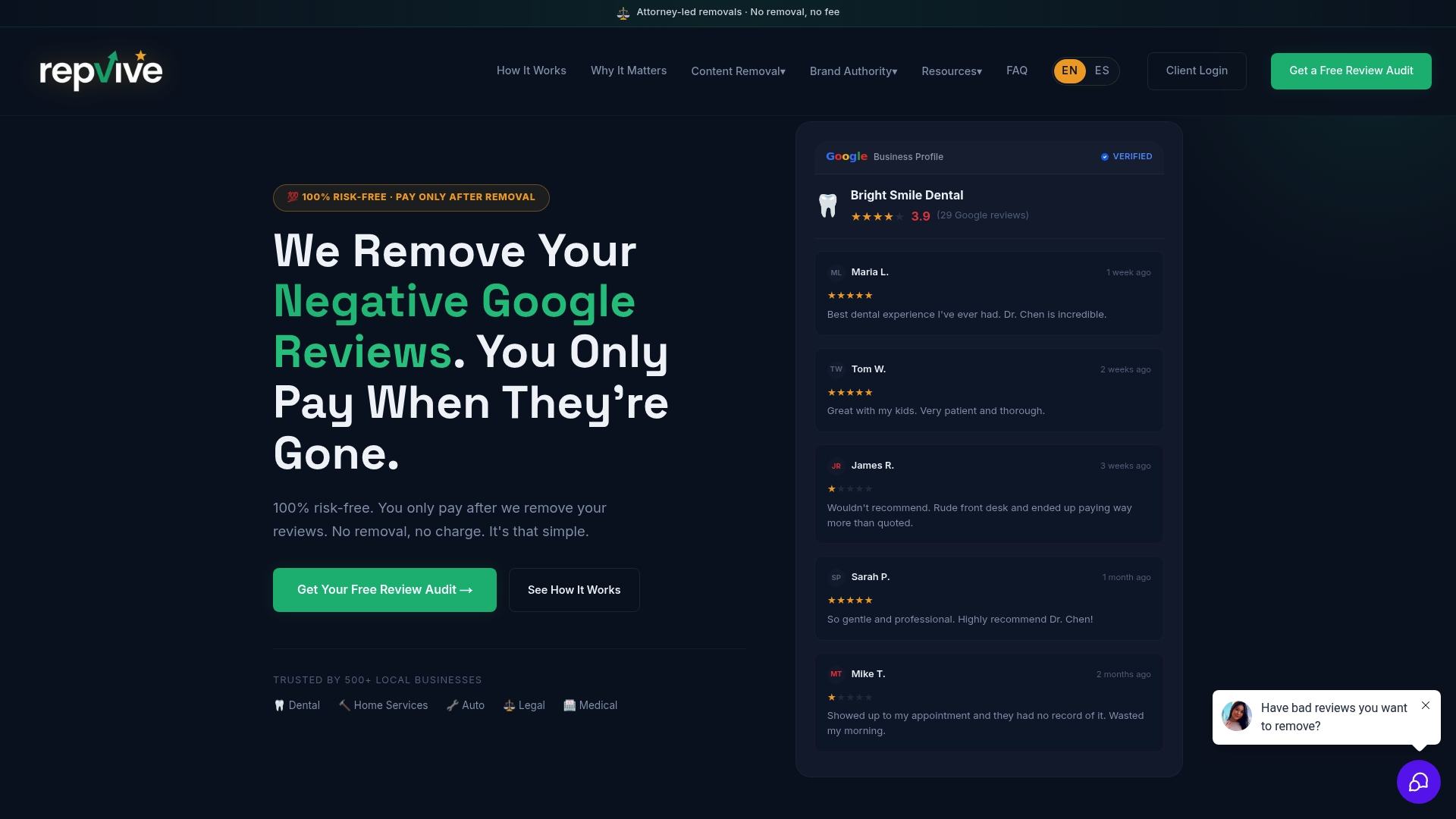
Repvive’s legal team reviews each case individually, crafts a customized legal claim tied to the specific review and platform policy, and submits removal requests through direct channels that go beyond the standard public flagging process. There are no upfront fees, and the service focuses on small and medium businesses across industries where a single damaging review can meaningfully affect customer trust and local search visibility. The reported 99% success rate reflects a process grounded in actual legal analysis, not generic reputation management templates.
If platform reporting has not worked, or if you are dealing with a coordinated attack or an anonymous reviewer causing measurable harm, request a case review at repvive.co to find out whether your review qualifies for attorney-led removal.
Useful sources and further reading
The sources below are the primary authorities referenced throughout this guide. Each one is worth bookmarking if you are managing a fake-review dispute or advising a client on one.
- FTC Final Rule: 16 CFR Part 465, the full text of the FTC’s rule prohibiting fake reviews, insider reviews without disclosure, review suppression, and fake social media indicators. This is the governing federal standard for commercial review manipulation.
- FTC Press Release on the Final Rule, summarizes the rule’s scope, including AI-generated fake reviews and civil penalty authority. Useful for understanding enforcement posture.
- FTC Consumer Guidance: How to Report Suspicious Online Reviews, Step-by-step reporting instructions for Google, Amazon, Walmart, and other platforms, plus the FTC’s own reporting path at ReportFraud.ftc.gov.
- Google Business Profile Help: Flagging Inappropriate Reviews, Google’s official guidance on the flagging process, evaluation criteria, and the one-time appeal option.
- Federal Register: FTC Final Rule Docket, the regulatory record documenting the FTC’s findings on fake-review prevalence and the rationale for civil penalties.
- 16 CFR § 465.2 via Cornell LII, the specific regulatory text prohibiting fake consumer reviews, useful for attorneys drafting demand letters that cite the federal standard.
Pro Tip: For businesses that want practical removal templates and managed services alongside these primary sources, Repvive’s fake review warning signs checklist is a useful starting point for triage before engaging legal counsel.
FAQ
Are there federal laws against fake reviews?
Yes. The FTC’s final rule under 16 CFR Part 465 prohibits creating, buying, or selling fake consumer reviews and carries civil penalties up to $51,744 per violation. State defamation and business disparagement laws provide additional remedies for individual businesses harmed by false reviews.
Can fake reviews be traced back to the person who posted them?
Platforms retain IP addresses, account creation data, and login records, but accessing that information requires a legal subpoena. Courts weigh the plaintiff’s need for the identity against the reviewer’s right to anonymous speech, so tracing is possible but not guaranteed and typically takes several months.
Is it legal to write a fake review in the United States?
No. Under the FTC’s rule, writing, buying, or selling a fake consumer review is an unfair or deceptive act or practice subject to civil penalties. Posting a false review that causes measurable harm to a business can also expose the reviewer to defamation or business disparagement claims under state law.
Is suing over a fake review worth it?
Litigation makes sense only when the review contains a provably false statement of fact, the financial harm is documented and substantial, and the cost of legal action is proportionate to the expected recovery. For most single-review disputes, platform reporting and a targeted demand letter produce better outcomes at a fraction of the cost.
Recommended
- How Review Manipulation Is Detected: Methods and Tools | Repvive
- Fake Review Impact on Local Rankings: 2026 Guide | Repvive
- Fake Review Warning Signs Checklist for Local Businesses | Repvive
- How to Address an Ethics Complaint Disguised Review | Repvive
If you would rather have this handled, our Google review removal service reviews each case first and charges only when the content comes down.