Fake Review Impact on Local Rankings: 2026 Guide
Fake reviews directly damage your local search rankings by corrupting the review signals Google uses to measure business prominence. The 2026 LocalImpact...
TL;DR:
- Fake reviews harm local search rankings by corrupting signals that influence Google’s algorithms. They can lead to profile suppression, revenue loss, and reputation damage if not properly managed. Protect your business by monitoring reviews, diversifying signals, and addressing fake reviews through legal and strategic methods.
Fake reviews directly damage your local search rankings by corrupting the review signals Google uses to measure business prominence. The 2026 LocalImpact Report found that 72% of businesses received at least one fake review in the past year, with 52% suffering star rating damage as a result. Review signals, including quantity, velocity, recency, and sentiment, account for 16, 20% of Google Local Pack ranking weight. That makes them the second most influential ranking factor after your Google Business Profile. Google’s Gemini AI now audits reviews retrospectively, meaning fake reviews you received months ago can still trigger suppression or profile penalties today. Understanding the fake review impact on local rankings is the first step toward protecting your business.
1. How fake reviews distort local SEO ranking signals
Google’s Local Pack ranking algorithm weighs three core pillars: relevance, distance, and prominence. Reviews live inside the prominence pillar, and they carry serious weight. Review signals represent 16, 20% of Local Pack ranking weight, with Google Business Profile signals accounting for roughly 32% and website signals around 15%.

Fake reviews corrupt this system in two directions. Fake positive reviews inflate your prominence score artificially. Fake negative reviews from competitors drag your star rating down and reduce your review sentiment score. Either way, Google’s algorithm receives distorted data and ranks your business on false signals.
The ranking effect is not absolute. Thirty fake reviews can shift rankings significantly in a market where competitors have low review counts, but those same 30 reviews barely move the needle when competitors have hundreds of authentic reviews. This means your exposure to fake review manipulation depends heavily on how competitive your local market already is.
| Ranking Signal | Approximate Weight | Fake Review Effect |
|---|---|---|
| Google Business Profile signals | ~32% | Indirect: profile suspension risk |
| Review signals (quantity, velocity, sentiment) | 16, 20% | Direct: inflated or suppressed prominence |
| Website signals | ~15% | None directly |
| Behavioral signals | ~10% | Indirect: click-through rate distortion |
| Citation signals | ~7% | None directly |
2. Google’s 2026 crackdown on fake and incentivized reviews
Google deployed Gemini AI to audit reviews at a scale that most business owners have not seen before. During mid-2026 audits, single businesses lost over 1,000 reviews in one sweep. Google is now also surveying users directly inside Google Maps, asking whether a business paid them for their review.
The crackdown targets incentivized reviews, review gating, and coordinated fake review campaigns. Gemini audits old reviews retrospectively, so a review from 18 months ago can be flagged and removed today. Businesses that accumulated fake positive reviews to boost rankings are now seeing those gains erased overnight.
The more dangerous consequence is false positives. Google’s AI filtering risks removing legitimate reviews when they arrive in patterns that resemble manipulation. A legitimate post-event review campaign that generates 40 reviews in one week can look identical to a fake review injection. Once removed, those reviews are extremely difficult to reinstate.
Businesses caught in the crackdown face three escalating consequences:
- Temporary suppression: Your Local Pack visibility drops while Google evaluates the review spike.
- Profile warning labels: Google can attach a public notice to your Business Profile stating that reviews are under investigation.
- Profile suspension: Repeated violations or severe manipulation can result in full suspension of your Google Business Profile.
Pro Tip: Space out your review requests over weeks, not days. Never ask all customers at once after an event or promotion. Gradual, consistent review acquisition looks natural to Gemini’s pattern detection.
3. How review spike suppression works
Google applies temporary suppression rather than an immediate penalty when it detects a sudden review spike. This is a critical distinction that most business owners misread as a permanent ban. Suppression means your Local Pack ranking drops while Google’s system evaluates whether the reviews are authentic.
During suppression, your organic search rankings for the same queries typically remain intact. This split-ranking pattern, where you lose Local Pack visibility but keep organic rankings, is a diagnostic signal. It tells you the problem is isolated to your review prominence score, not your overall website authority.
Suppression can last days or weeks. If Google determines the reviews are authentic, visibility often recovers. If the reviews are flagged as fake, they are removed and the prominence score recalculates at the lower baseline. Either outcome is better than a full profile suspension, but the lost visibility during the evaluation phase still costs you real customers.
4. Top consequences of fake reviews beyond rankings
The fake review impact on local rankings is the most visible damage, but the downstream effects on your business reputation run deeper.
Star rating degradation is the most immediate harm. Harvard Business School research shows that a one-star decrease in rating correlates with a 5, 9% revenue drop. A coordinated fake negative review campaign that drops your rating from 4.5 to 3.8 stars can cost you a measurable share of monthly revenue before you even notice the attack.
Administrative burden compounds the financial damage. The 2026 LocalImpact Report found that 40% of businesses spent significant time mitigating fake reviews. That time comes directly out of operations, marketing, and customer service.
Additional consequences include:
- Lost customer trust: Prospective customers read reviews before choosing a local business. A damaged star rating or suspicious review patterns reduce conversion rates even when your service quality is high.
- Manual penalties: Google’s human review team can apply manual actions to profiles with clear evidence of manipulation, which are harder to recover from than algorithmic suppression.
- Competitor advantage: Every fake negative review your competitor posts against you is a ranking advantage they gain at your expense.
Pro Tip: Check your fake review warning signs weekly. Catching an attack early limits the window of ranking damage and gives you documentation for a removal request.
5. Effective strategies to protect your local search rankings
Countering fake reviews requires a two-track approach: remove the bad reviews and strengthen the signals that fake reviews cannot replicate.
Build a sustainable review velocity
Ramping legitimate review acquisition gradually to no more than 3x your trailing six-month average is the recommended best practice for local SEO recovery. Sudden volume spikes, even from genuine customers, trigger the same Gemini filters that catch fake reviews. Consistent, incremental growth is both safer and more durable.
A natural rating distribution that includes 3-star and 4-star reviews alongside 5-star reviews signals authenticity to Google’s algorithm. A profile with 200 reviews and a 4.6 average looks more credible than one with 200 reviews and a perfect 5.0.
Strengthen non-review prominence signals
Local links, citations, and website authority are prominence signals that fake reviews cannot directly attack. Building these signals reduces your dependency on review scores alone. A business with strong citation consistency across directories, local press mentions, and a well-structured website can absorb review signal damage better than one that relies entirely on star ratings.
| Strategy | Benefit | Limitation |
|---|---|---|
| Gradual review acquisition | Avoids suppression triggers | Slow to rebuild after an attack |
| Local link building | Fake-review-proof prominence signal | Requires time and outreach effort |
| Citation cleanup | Strengthens GBP trust signals | Does not directly offset review damage |
| Paid search ads | Maintains visibility during suppression | Costs money; does not fix root cause |
| Legal review removal | Permanently removes fake reviews | Requires documentation and process |
Target long-tail local queries
Local content that targets specific service and location combinations reduces your reliance on Local Pack rankings for high-volume queries. A plumber in Austin who ranks organically for “emergency pipe repair Cedar Park TX” captures customers even when Local Pack visibility drops. Diversifying your traffic sources limits the damage any single ranking signal can cause.
Key takeaways
Fake reviews corrupt Google’s prominence signals and cause measurable ranking drops, revenue loss, and profile penalties that compound over time without active management.
| Point | Details |
|---|---|
| Reviews carry major ranking weight | Review signals represent 16, 20% of Local Pack ranking weight, making them a high-value attack target. |
| Ranking damage is relative | Thirty fake reviews can shift rankings significantly in low-competition markets but barely matter in high-review markets. |
| Suppression precedes penalties | Google suppresses visibility before issuing penalties, giving businesses a narrow window to respond. |
| Star rating drops cost revenue | A one-star rating decrease correlates with a 5, 9% revenue drop, per Harvard Business School research. |
| Diversify your prominence signals | Local links and citations protect your rankings when review signals come under attack. |
What I’ve learned from watching fake review attacks play out
The businesses I see struggle most with fake review attacks share one trait: they treat it as a one-time problem. They file a removal request, wait, and assume the issue is resolved. It rarely is.
Google’s Gemini audits have changed the game in a way that most local SEO advice has not caught up with yet. The algorithm does not just look at individual reviews. It looks at patterns across your entire review history. A business that received 50 fake positive reviews two years ago and never addressed them is now sitting on a time bomb. Those reviews can be flagged and removed in a single audit sweep, dropping the prominence score overnight.
The split-ranking diagnostic is one of the most underused tools I have seen. When a business loses Local Pack visibility but keeps organic rankings, that is a precise signal. The problem is in the review prominence score, not the website. Most owners panic and start rebuilding their entire SEO strategy when the fix is targeted and specific.
I have also seen businesses overcorrect. After a fake review attack, they launch aggressive review campaigns to rebuild their star rating fast. That triggers suppression again. The irony is that trying to recover too quickly can extend the damage. Patience and a steady pace of authentic review acquisition outperform any volume-based recovery attempt.
The most resilient local businesses I have observed treat their Google Business Profile audit as a monthly task, not an annual one. They monitor review velocity, flag anomalies early, and maintain strong citation and link profiles so that no single signal can take them down. That is the real long-term strategy.
, Jason
Repvive’s approach to protecting your local rankings
Fake reviews do not have to be a permanent problem. Repvive specializes in removing negative and fake Google reviews through an attorney-led process with a 99% success rate and no upfront fees. Each case gets a customized legal claim, not a generic dispute form.
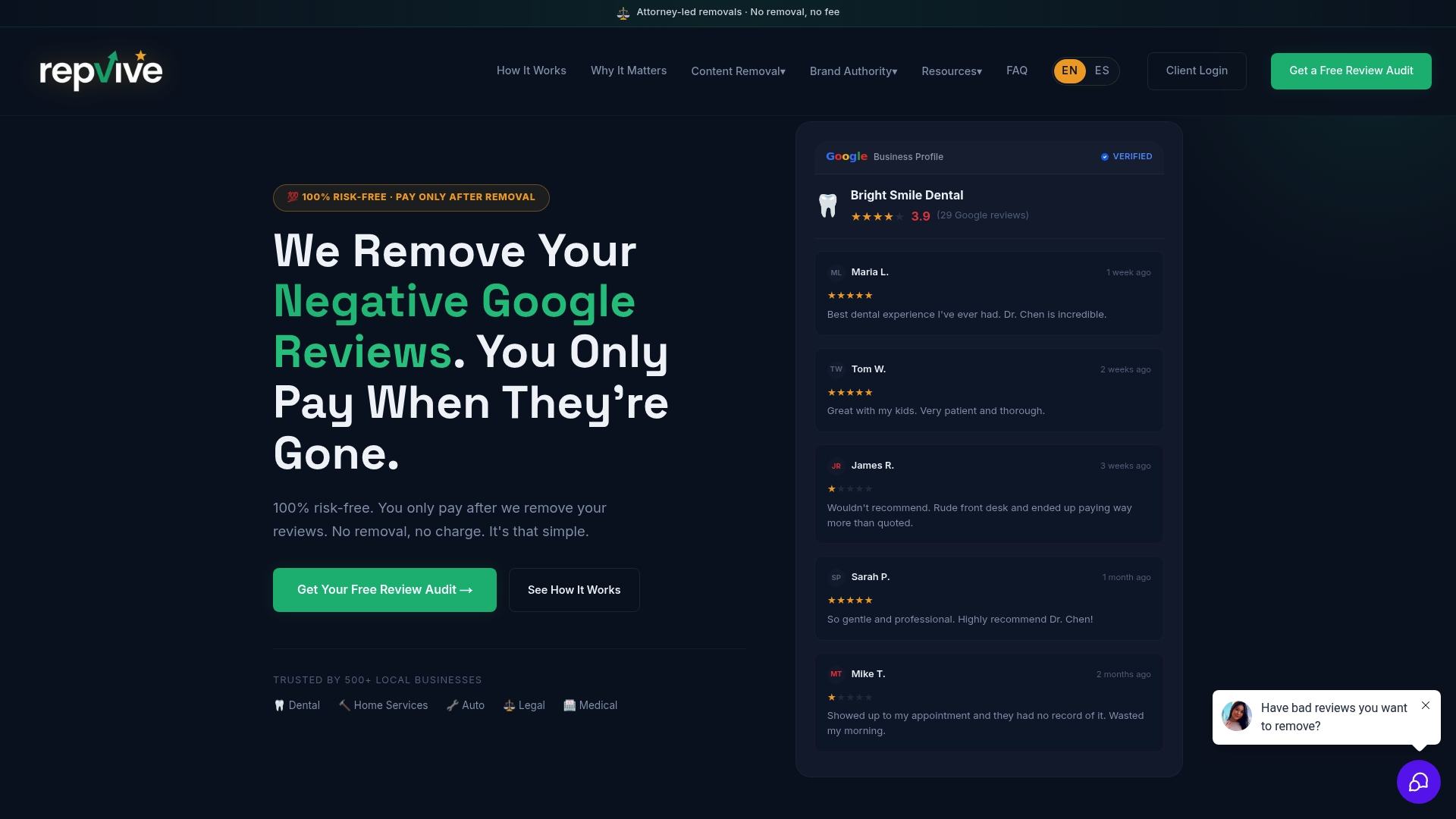
If your Google Business Profile has taken a hit from fake reviews, Repvive’s team can assess your situation and pursue removal through direct channels that generic reputation tools cannot access. You can also request a free GBP audit to identify which reviews are putting your rankings at risk. For businesses ready to act, Repvive’s review removal service handles the entire process from documentation to Google approval.
FAQ
How much do fake reviews affect local search rankings?
Review signals account for 16, 20% of Google Local Pack ranking weight. Fake reviews that inflate or suppress this signal can move your ranking position significantly, especially in markets where competitors have fewer than 100 reviews.
Can Google detect fake reviews automatically?
Google uses Gemini AI to audit reviews for patterns associated with manipulation, including sudden spikes, incentivized reviews, and coordinated negative campaigns. Single businesses have lost over 1,000 reviews in one mid-2026 audit sweep.
What is review spike suppression?
Review spike suppression is a temporary drop in Local Pack visibility that Google applies when it detects an unusual surge in reviews. It is an evaluation phase, not an immediate penalty, and visibility can recover if the reviews are confirmed as authentic.
Does a lower star rating directly reduce revenue?
Harvard Business School research shows that a one-star decrease in rating correlates with a 5, 9% revenue drop. Fake negative reviews that lower your star rating cause real financial damage beyond the ranking impact.
How do I recover from a fake review attack?
File removal requests with documented evidence, then rebuild review signals gradually at no more than 3x your trailing six-month average. Strengthen local links and citations in parallel so your prominence score does not depend entirely on review quantity.
Recommended
- Fake Review Warning Signs Checklist for Local Businesses | Repvive
- Reputation Management Blog | Repvive
- How to Protect Business Reputation Online in 2026 | Repvive
- Top 4 thereviewmediator.com Alternatives 2026 | Repvive
If you would rather have this handled, our Google review removal service reviews each case first and charges only when the content comes down.