How Review Manipulation Is Detected: Methods and Tools
Review manipulation is detected through a combination of statistical anomaly analysis, deep learning text classification, behavioral pattern recognition...

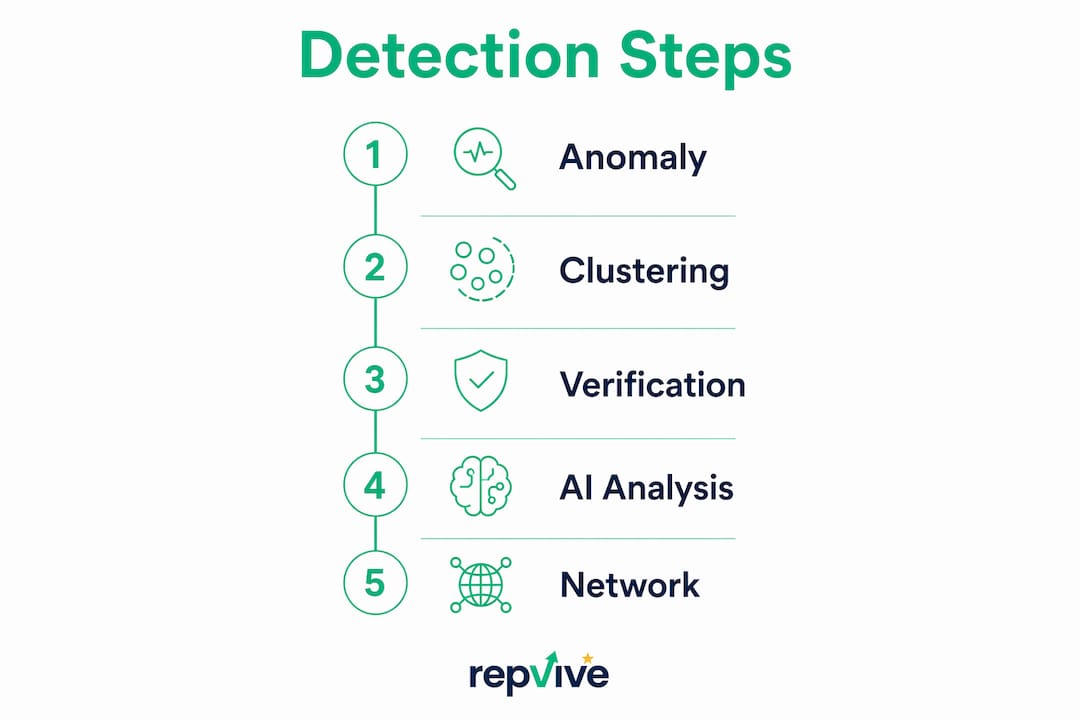
Review manipulation is detected through a combination of statistical anomaly analysis, deep learning text classification, behavioral pattern recognition, and network structure mapping. No single signal is definitive on its own. The most reliable detection systems fuse all four data streams, and deep learning models have emerged as the state-of-the-art approach across a survey of 25 research papers spanning 2018 to 2024.
How review manipulation is detected: a technical overview
Modern fake review detection draws on three distinct but complementary signal types. Statistical methods catch the “when” and “how many.” Textual and sentiment analysis catches the “what was written.” Behavioral and network analysis catches the “who did it and with whom.”
- Statistical signals: Abnormal rating distributions, sudden score spikes, and review bursts clustered within 24, 48 hour windows after long periods of silence
- Deep learning models: Frameworks like the KE-MLLM framework, which achieves a 94.3% F1-score on the YelpChi dataset by fusing textual and behavioral data with chain-of-thought reasoning
- Behavioral indicators: New accounts posting only one review, identical language across multiple submissions, and verified purchase rates that drop sharply during a spike
- Network analysis: Graph-based methods that map relationships between reviewers to expose coordinated buyer clusters
- Textual cues: Overly enthusiastic tone, generic praise, scene-setting narratives, and near-perfect grammar that signals AI or content farm origin
- Multimodal fusion: Cross-attention mechanisms that combine text embeddings with behavioral metadata, outperforming text-only classifiers
Tools like Pangram Labs apply these principles at scale, while Repvive’s attorney-led process uses detection findings as the basis for legally removing fraudulent reviews from Google.
What statistical patterns reveal about rating manipulation

Rating distribution analysis is the fastest first screen. A product with a legitimate review history typically shows a spread across star values, with a concentration in the 4, 5 star range but meaningful representation at 1, 3 stars. When a product suddenly accumulates dozens of five-star reviews over a weekend with almost no lower ratings, the distribution itself becomes evidence.
| Statistical Indicator | What It Signals | Detection Method |
|---|---|---|
| Review bursts clustered within a short window of hours | Orchestrated paid campaign | Temporal clustering analysis |
| Near-zero variance in star ratings | Artificial inflation | Distribution deviation scoring |
| Low verified purchase rate during spike | Fake accounts, no real transaction | Purchase verification cross-check |
| Sudden drop in average review length | Template or bot-generated content | Length and entropy analysis |
| Reviewer account age under one month | Disposable fake profiles | Account metadata filtering |
Temporal clustering is particularly telling. Legitimate review activity tends to be spread across weeks and months, loosely tied to sales volume. A burst of reviews following weeks of inactivity is a textbook signal of a pay-for-review campaign. Analysts typically flag these windows programmatically by calculating the standard deviation of daily review counts and marking dates that exceed a defined threshold.
Verified purchase rates add a second layer. When a spike in reviews coincides with a drop in the proportion of verified buyers, the gap between claimed purchases and actual transactions becomes statistically measurable. Platforms like Amazon and Yelp use this cross-check internally, though the exact thresholds are not publicly disclosed.
Deep learning and textual analysis: how AI classifies fake reviews
The KE-MLLM framework represents the current frontier in explainable fake review detection. It outperforms baseline models by 5.8 percentage points on the YelpChi dataset and, critically, provides human-readable reasoning for each fraud classification rather than a black-box verdict. That interpretability matters enormously for regulatory compliance and for building legal cases around removal.
- Knowledge-enhanced prompting: KE-MLLM injects domain knowledge into the model’s context window, helping it recognize product-specific language patterns that generic language models miss
- Multimodal fusion via cross-attention: The framework combines text embeddings with behavioral signals (posting frequency, account age, rating history) through cross-attention layers, producing richer feature representations than text-only models
- Chain-of-thought reasoning: A dedicated reasoning module generates step-by-step explanations for each classification decision, making the output auditable
- LoRA-adapted LLaMA-3-8B: Fine-tuning large language models with Low-Rank Adaptation allows researchers to adapt general-purpose models to fake review detection without retraining from scratch
- Sentiment-text mismatch detection: Graph convolutional approaches like FakeDetectionGCN model each review as a graph where nodes are words and edges carry sentiment scores, flagging reviews where stated sentiment contradicts the actual language used
- Aspect-based sentiment analysis (ABSA): By isolating sentiments tied to specific product features (food quality, service speed), ABSA catches reviews that praise the wrong attributes or assign positive sentiment to aspects the reviewer never actually described
The broader survey of detection techniques confirms that deep learning consistently outperforms traditional machine learning across accuracy, precision, recall, and F1-score metrics. Recurrent neural networks, convolutional neural networks, and transformer-based architectures each handle different aspects of the problem, and ensemble approaches that combine them tend to perform best in practice.
Pro Tip: When evaluating a detection model for production use, prioritize F1-score over raw accuracy. Fake reviews are typically a minority class in any real dataset, so a model that labels everything as genuine can still report high accuracy while missing nearly all fraud.
Behavioral and network analysis: finding coordinated manipulation
Behavioral red flags are often visible before any text analysis runs. A cluster of accounts created within days of each other, all posting their first and only review for the same product, is a pattern that network analysis catches quickly. The accounts themselves may look superficially legitimate, but their structural relationships expose the coordination.
- Review burst detection: Sudden spikes within days after long silences are a primary heuristic for paid campaigns
- Single-review accounts: Profiles with exactly one review, no profile photo, and a generic name (or a string of random characters) are consistent with disposable fake identities
- Network clustering: Graph-based methods map connections between reviewers who share IP ranges, device fingerprints, or review timing, then identify clusters that suggest a common buyer
- Reviewer overlap analysis: When the same set of accounts reviews multiple competing products in the same category within a short window, that overlap signals a review farm operating across clients
- Velocity anomalies: A reviewer who posts 15 reviews in a single day across unrelated product categories is statistically implausible as a genuine consumer
Research on detecting fake-review buyers using network structure shows that the social graph connecting reviewers to products contains structural signatures that distinguish organic activity from coordinated campaigns. Buyers of fake reviews tend to cluster in ways that organic reviewer communities do not, and those clusters are detectable even when individual reviews appear plausible in isolation.
Combining network signals with textual cues significantly improves detection robustness. A review that passes linguistic analysis but comes from an account embedded in a known fraud cluster should still be flagged. The two signals together are far more reliable than either alone.
Pro Tip: Cross-reference suspicious reviewer profiles against the product’s Q&A section. AI-generated spam concentrates in the review feed; genuine customer interaction tends to survive in Q&A threads, giving you a cleaner baseline for what real buyers actually ask about the product.
What fake reviews actually look like in the text
Fake reviews have recognizable writing patterns, and researchers have cataloged them in enough detail to build reliable classifiers. The most consistent finding from a Cornell University study is that fake reviewers set the scene rather than describe the product. A fraudulent hotel review might spend two sentences on “my husband’s business trip” before mentioning the hotel at all. A genuine reviewer skips the backstory and goes straight to the bed, the shower, or the noise level.
- Generic praise without specifics: “Amazing product, highly recommend!” with no mention of what the product actually does
- Scene-setting narratives: Irrelevant personal context that pads word count without adding product information
- Suspiciously perfect grammar: Near-perfect spelling and syntax in a review context where most genuine writers use contractions, typos, and casual phrasing, suggesting AI or content farm origin
- Extreme ratings with thin content: A five-star review with two words, or a one-star review with no explanation
- Mismatched sentiment and aspect scores: Positive overall rating paired with language that, at the word level, carries neutral or negative sentiment toward the product’s core features
- Identical phrasing across multiple reviews: Template-generated content that reuses the same sentence structures across different product listings
Readability metrics add another layer. Fake reviews from content farms often score unusually high on readability indexes because they are written to a formula. Genuine reviews vary wildly in sentence length, vocabulary, and structure. An analysis of ratings, readability, and sentiments found that these textual dimensions, taken together, provide measurable separation between authentic and fraudulent content. Checking for a fake review warning signs checklist can help analysts apply these criteria systematically.
Limitations and challenges in current detection methods
The core problem with most detection systems is opacity. A model that classifies a review as fake without explaining why is difficult to act on legally, and it erodes trust in the detection process itself. The KE-MLLM chain-of-thought module directly addresses this by generating human-readable reasoning, but most deployed systems still operate as black boxes.
AI-generated reviews are making the problem harder. Max Spero, CEO of Pangram Labs, notes that
now mimic human-like detail and coherence well enough that manual detection is increasingly ineffective without specialized software. A review written by a well-prompted large language model will include specific product details, varied sentence structure, and plausible personal context. It passes most of the heuristics that catch content farm output.
Fraudsters also adapt continuously. As detection models become public knowledge, review farms adjust their tactics to evade the known signals. This creates an adversarial dynamic where detection accuracy degrades over time without regular model retraining. The state-of-the-art review of detection techniques explicitly flags this as a core challenge: fraudsters incorporate new features into their reviews specifically to evade existing classifiers.
Pro Tip: Automated detection should be treated as a triage tool, not a final verdict. Flag candidates algorithmically, then apply human review to the highest-confidence fraud cases before taking any action. The cost of a false positive, especially in a legal context, is high.
Legal enforcement and professional review removal
Detection alone does not solve the problem. Once manipulation is identified, the path to removal runs through platform policies and, increasingly, federal law. The FTC’s 2024 rules ban paid or fake reviews outright, with penalties that can be substantial per violation (https://www.munizzilaw.com/blog/the-ftcs-fake-review-ban-what-businesses-need-to-know-in-2026). The rules also prohibit suppressing negative reviews, buying reviews, and misrepresenting a company-controlled site as independent.
- FTC prohibited conduct: Paying for positive reviews, posting fabricated reviews, suppressing negative feedback, and using bots to inflate social media metrics
- Platform reporting: Most major platforms allow abuse reports, but generic flagging rarely produces fast results without documented evidence of manipulation
- Attorney-led removal: Repvive’s legal team builds customized claims for each review, using direct channels to Google rather than generic dispute forms, with a reported 99% success rate
- No upfront fees: Repvive operates on a results-based model, which means businesses pay only when a removal is confirmed
Repvive’s approach treats each fraudulent review as a distinct legal matter. The firm’s attorneys analyze the specific content, identify the applicable violation, and craft a targeted claim rather than submitting a bulk removal request. That specificity is what gets reviews approved for removal by Google, where generic reports routinely fail.
When fake reviews are part of a coordinated campaign, the legal case is stronger. Detection data showing temporal clustering, network relationships, and linguistic fingerprints can support a claim that the reviews were orchestrated rather than organic. Combining technical detection output with legal expertise is the most effective path to protecting business reputation against sustained manipulation.
For businesses evaluating how social proof credibility is affected by fake reviews, the FTC enforcement framework provides a useful baseline for what constitutes actionable fraud versus a negative but genuine review.
Where detection data comes from
Effective detection depends on having the right data to analyze. The primary sources researchers and platforms draw from include:
Review platforms (Yelp, Amazon, Google, TripAdvisor) provide the raw text, star ratings, timestamps, and reviewer metadata that feed statistical and textual models. Labeled datasets like YelpChi, which pairs filtered (suspected fake) and recommended (genuine) reviews, are the standard benchmarks for training and evaluating classifiers.
Device and IP metadata, where accessible, adds behavioral depth. Shared IP addresses or device fingerprints across multiple reviewer accounts are strong signals of coordinated activity. Platforms with access to this data use it internally; third-party researchers typically work with anonymized behavioral proxies instead.
Product Q&A sections and seller feedback threads serve as comparison baselines. Because AI-generated spam concentrates in the review feed, Q&A content tends to reflect genuine customer interaction more reliably, giving analysts a cleaner reference point for authentic language patterns.
Graph databases built from reviewer-to-product relationships enable the network structure analysis described earlier. Researchers construct these graphs from publicly available review data, then apply community detection algorithms to identify clusters that deviate from organic reviewer behavior. The network structure approach has proven particularly effective at surfacing fake-review buyer networks that would be invisible to text-only classifiers.
Key Takeaways
Deep learning models fused with behavioral and network signals represent the most accurate current approach to detecting review manipulation, with frameworks like KE-MLLM reaching 94.3% F1-score on benchmark datasets.
| Point | Details |
|---|---|
| Statistical anomalies are the first screen | Review bursts in 24, 48 hour windows after inactivity are a primary signal of paid campaigns. |
| Deep learning leads detection accuracy | A survey of 25 papers confirms deep learning as the dominant method from 2018 to 2024. |
| KE-MLLM sets the benchmark | The KE-MLLM framework achieves a 94.3% F1-score and provides chain-of-thought explanations for each fraud decision. |
| Textual cues are identifiable | Scene-setting narratives, generic praise, and near-perfect grammar are consistent markers of fake reviews. |
| Legal action requires detection evidence | FTC penalties reach $51,744 per violation; attorney-led removal services like Repvive use detection data to build targeted claims. |
FAQ
Can fake reviews be traced back to their source?
Yes, in many cases. Network analysis, device metadata, and IP clustering can link multiple fake reviews to a single buyer or review farm, especially when accounts share behavioral fingerprints or post in coordinated bursts.
How do platforms like Google detect fake reviews?
Google uses automated systems that analyze reviewer behavior, account age, posting patterns, and text similarity to flag suspicious content. Reviews that cluster in short time windows or come from accounts with no prior activity are common removal targets.
What makes a review look fake to a detection algorithm?
Algorithms flag reviews based on a combination of signals: extreme ratings with thin text, near-perfect grammar inconsistent with casual writing, scene-setting language instead of product specifics, and account metadata suggesting a disposable profile.
Is buying or posting fake reviews illegal in the United States?
Yes. The FTC’s 2024 rules explicitly prohibit paid or fabricated reviews, with civil penalties of up to $51,744 per violation. The rules cover both positive fake reviews and suppression of negative ones.
What should a business do after identifying manipulated reviews?
Document the evidence, including timestamps, reviewer profiles, and any network patterns, then report through the platform and consult an attorney. Repvive’s review removal service uses that documentation to build legally grounded removal claims with direct Google channels.