Fake Review Warning Signs Checklist for Local Businesses
A fake review warning signs checklist is a systematic set of criteria that helps local business owners detect inauthentic reviews before they damage their...
TL;DR:
- Fake reviews often use generic language, overuse personal pronouns, and lack specific details about the service.
- Suspicious reviewer profiles typically have no history, are newly created, or review only one business category.
A fake review warning signs checklist is a systematic set of criteria that helps local business owners detect inauthentic reviews before they damage their reputation. Fake reviews are not rare. Approximately 8% of reviews on major platforms are fabricated, and in high-risk categories like electronics, that figure climbs to 35%. The FTC’s 2024 ruling now bans paid, created, or suppressed reviews, giving business owners a legal framework to act. Knowing the red flags for online reviews is no longer optional. It is the first line of defense for your reputation.
1. What are the top linguistic clues that signal fake reviews?
The language inside a review is the fastest signal of inauthenticity. Fake reviewers overuse personal pronouns like “I” and “me” to manufacture credibility, while genuine customers focus on product-specific nouns and concrete details. A real review of a plumber mentions the technician’s name, the pipe size, or the repair time. A fake review says “I had an amazing experience and I will definitely come back.”

Scene-setting language is another red flag. Phrases like “I was looking for a reliable service in my area” tell you nothing about the actual business. Genuine customers skip the setup and get straight to what happened. Watch for reviews that read more like a short story introduction than a service report.
Generic, repetitive wording is a strong signal of coordinated campaigns. When five reviews in a row use the phrase “exceeded my expectations” or “highly recommend to everyone,” the pattern is not coincidence. Fake reviewers avoid mundane details that real customers naturally include, like wait times, staff names, or specific product features.
Black-and-white emotional language is a defining trait of inauthentic reviews. A review that is either perfectly glowing or completely devastating, with no nuance, fits the fake review profile. Real customers acknowledge trade-offs. They mention what was good and what could improve.
Pro Tip: Copy a suspicious review phrase into a search engine. If the exact phrase appears across multiple businesses or platforms, you are likely looking at a template used by a fake review operation.
2. How to identify suspicious reviewer profiles and behavior patterns
A reviewer’s profile history tells you more than the review text itself. Profiles with no history, a single review, or a generic name are primary indicators of fake accounts. Real customers have varied histories that include travel, dining, retail, and services across months or years.
Watch for these specific profile red flags:
- Account created recently. An account that posted its first and only review about your business within the past week is a warning sign.
- Single-category reviewing. A profile that reviews only one type of business, or only one brand, suggests a coordinated effort rather than a real customer.
- No profile photo. Genuine reviewers on Google and Yelp frequently have photos. Blank avatars with generic names are common among fake accounts.
- Unnatural review velocity. A profile that posted 20 reviews in one day across different cities is not a real customer. Real people do not review at that pace.
- Repetition across platforms. The same review text appearing on Google, Yelp, and TripAdvisor from different account names signals a copy-paste campaign.
Genuine reviewers show diversified histories across products and time. When a profile lacks that breadth, treat the review with skepticism.
Pro Tip: On Google, click the reviewer’s name to see their full review history. If the profile has reviewed businesses in three different states on the same day, flag it immediately.
3. What rating distribution and timing patterns reveal fake review activity
Rating patterns expose manipulation that individual reviews hide. A business with 200 five-star reviews and almost no two-star or three-star reviews is statistically unusual. Clusters of five-star reviews posted within 24, 48 hours are the clearest sign of a coordinated fake review campaign. Natural review growth spreads over months or years, not sudden floods.
Look at the full rating histogram, not just the average. A healthy review profile shows a distribution that includes some two-star and three-star ratings. Those middle ratings signal that real customers, with real mixed experiences, left those reviews. Their absence is a red flag.
Timing spikes are especially telling after a business crisis. If a restaurant receives 40 five-star reviews in three days immediately after a negative news story, the pattern suggests reputation repair through fake reviews rather than genuine customer satisfaction. Black-and-white ratings with no middle range are statistically most likely to be fake.
Cross-referencing the timing of review spikes with product launches, press coverage, or competitor activity gives you context. A spike tied to a real event, like a grand opening, is less suspicious than a spike with no business explanation.
4. What external verification methods help authenticate reviews
No single platform tells the whole story. Verified purchase badges, cross-platform consistency, and independent sites like Reddit provide the most reliable signals of review authenticity. Platforms that are harder to manipulate give you a cleaner read on real customer sentiment.
Use these verification methods:
- Check for verified purchase or verified visit badges. Platforms like Amazon and some booking sites attach these to confirmed buyers. A review without this badge on a platform that offers it deserves extra scrutiny.
- Cross-reference Google Reviews, Trustpilot, and the Better Business Bureau. A business with glowing reviews on one platform and consistent complaints on another has a credibility gap worth investigating.
- Search Reddit and YouTube. These platforms are harder to flood with fake content because real communities push back on obvious promotion. Search the business name plus “review” or “experience” for unfiltered feedback.
- Look for photo and video evidence. Real customers attach photos of their actual experience. Stock-looking images or no images at all weaken a review’s credibility.
- Report suspicious reviews through official channels. The FTC’s 2024 ruling and platforms like Google and BBB offer reporting tools. Use them. Reporting creates a paper trail and triggers platform review.
Pro Tip: Use Repvive’s free Google Business Profile audit to get a professional assessment of your review credibility before taking action.
5. Why combining multiple red flags matters more than any single signal
No single warning sign confirms a fake review on its own. When three or more red flags appear together, timing, language patterns, and profile issues, the probability of manipulation rises sharply. Relying on one clue leads to false positives and missed fakes.
Think of the checklist as a scoring system. A review with generic language scores one point. Add a brand-new account with no history, and the score rises. Add a posting time that falls within a 48-hour spike, and you have a strong case for inauthenticity. Humans detect fake reviews only 52, 65% of the time when relying on instinct alone. A structured checklist closes that gap.
For low-risk categories, scanning a few verified, detailed reviews is usually enough. For high-value or high-fake-risk categories, a full multi-point audit across language, profile, timing, and cross-platform signals is necessary. The stakes justify the effort.
Build the habit of running this checklist weekly on your own business profile. Catching a fake review campaign early limits the damage and gives you time to report and respond before the false narrative takes hold.
Key takeaways
Fake reviews follow consistent, measurable patterns across language, reviewer profiles, rating distributions, and timing, and spotting three or more red flags together is the most reliable method of detection.
| Point | Details |
|---|---|
| Language is the fastest signal | Generic phrasing, overused pronouns, and scene-setting language indicate inauthenticity. |
| Profile history reveals intent | Accounts with one review, no photo, or single-category histories are high-risk flags. |
| Rating histograms expose manipulation | Missing two-star and three-star ratings in a large review set signals coordinated activity. |
| Timing spikes confirm campaigns | Clusters of five-star reviews posted within 24, 48 hours indicate coordinated fake review activity. |
| Multiple flags beat single clues | Combining three or more red flags gives a far more reliable picture than any one indicator alone. |
What I’ve learned after years of watching fake reviews evolve
The most common mistake business owners make is treating fake review detection as a one-time task. They spot a suspicious review, report it, and move on. That approach misses the bigger pattern.
Fake review campaigns are not random. They are coordinated, often timed to coincide with a competitor’s weakness or a business’s moment of vulnerability. I’ve seen businesses get hit with waves of one-star reviews within hours of a competitor’s promotional push. The timing is not accidental.
The rise of AI-generated review text has made linguistic detection harder. AI-written reviews are grammatically clean and structurally convincing. They lack the obvious tells of older fake reviews. That is why profile behavior and timing analysis have become more important than text analysis alone. The words may look real. The account behind them rarely does.
My practical advice is to build a simple weekly monitoring habit. Check your rating histogram every Monday. Look for new reviews from accounts created in the past 30 days. Flag any review that scores three or more checklist points and report it the same day. Tools like Repvive’s real-time review monitoring service, RepWatch, automate much of this process across more than 20 platforms, which makes the weekly habit far less time-consuming.
The business owners who protect their reputations most effectively are not the ones who react to fake reviews. They are the ones who catch them before they accumulate.
, Jason
When fake reviews need more than a checklist
Spotting fake reviews is the first step. Removing them is where most business owners hit a wall. Google’s standard reporting process rejects the majority of removal requests, and a single unresolved fake review can cost you customers every week it stays live. Use Repvive’s revenue risk calculator to see exactly what that ongoing damage costs your business in real dollars.
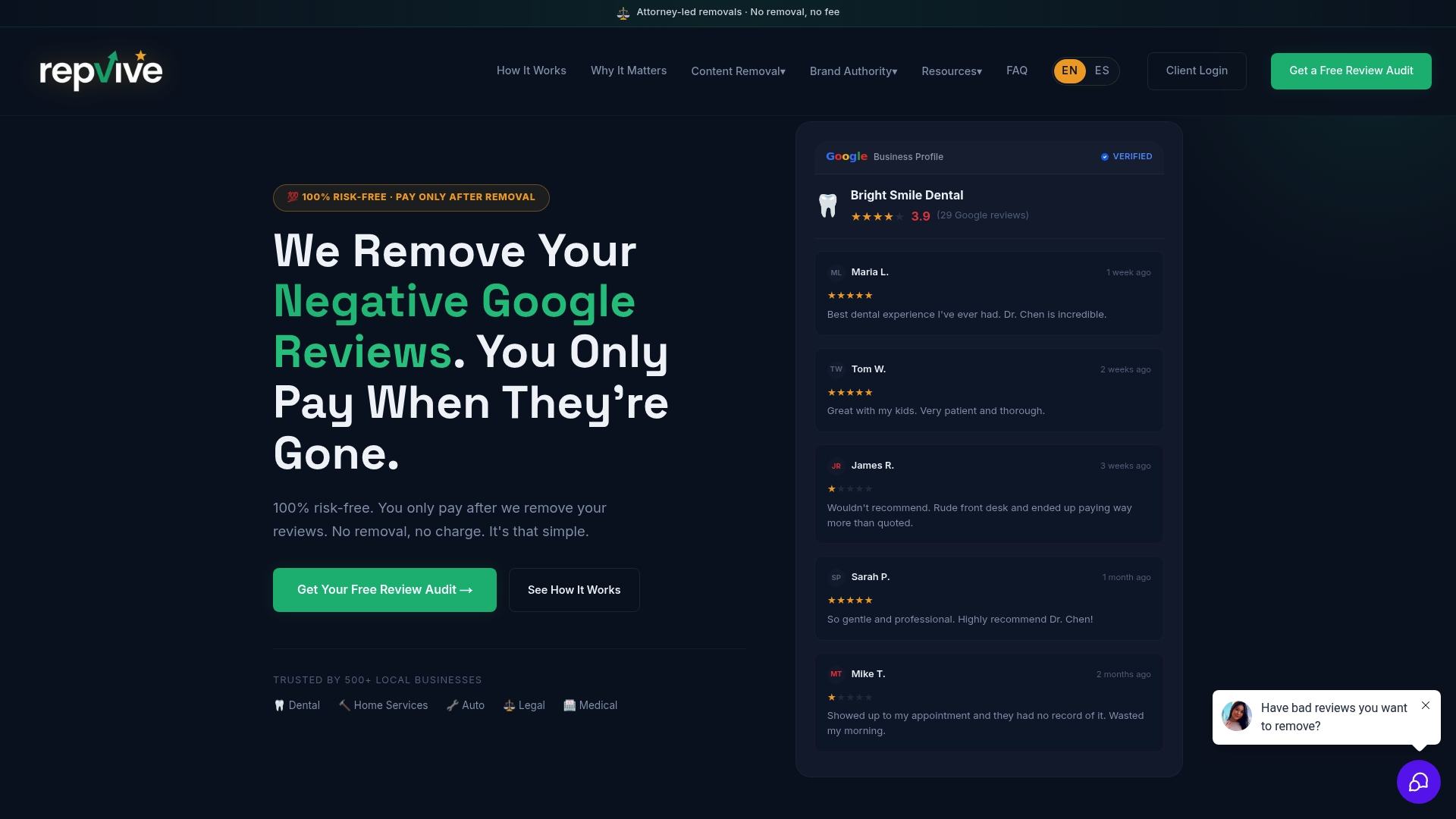
Repvive’s attorney-led approach handles the removal process from start to finish, with no upfront fees and a 99% success rate. The legal team builds a customized case for each review and works through direct channels to get Google’s approval. If you are dealing with fake or unfair reviews on Google, Yelp, or TripAdvisor, Repvive’s review removal services give you a clear, proven path to getting them taken down.
FAQ
What is a fake review warning signs checklist?
A fake review warning signs checklist is a structured list of criteria covering language, reviewer profiles, rating patterns, and timing that helps business owners identify inauthentic reviews systematically. Using multiple criteria together is far more reliable than relying on a single red flag.
How many red flags confirm a review is fake?
Three or more red flags appearing together signal probable manipulation. A single suspicious detail is not enough to confirm inauthenticity, but a combination of timing, language, and profile issues makes a strong case.
How common are fake reviews in 2026?
Roughly 8% of reviews across major platforms are fake, with certain categories like electronics reaching 20, 35%. That means one in every 10, 12 reviews a potential customer reads may be fabricated.
Can I report fake reviews to Google or the FTC?
Yes. Google offers a flagging tool directly on each review, and the FTC’s 2024 ruling bans paid or manufactured reviews, giving you a regulatory basis for complaints. The BBB also accepts reports of deceptive review practices.
What makes a reviewer profile suspicious?
A profile with no photo, a single review, a recently created account, or a history of reviewing only one brand or category is a strong indicator of a fake account. Real customers show varied, long-term review histories across multiple product types and time periods.
Recommended
- RepWatch: Real-Time Review Monitoring Across 20+ Platforms | Repvive
- Free Google Business Profile Audit | Repvive
- Reputation Management Blog | Repvive
- Online Review Removal Service & Reputation Management | Repvive
If you would rather have this handled, our Google review removal service reviews each case first and charges only when the content comes down.