The FTC Fake Reviews Rule: What U.S. Businesses Must Do Now
The FTC’s final rule bans businesses from creating, buying, selling, soliciting, or spreading fake or misleading consumer reviews, and it lets the agency...
The FTC’s final rule bans businesses from creating, buying, selling, soliciting, or spreading fake or misleading consumer reviews, and it lets the agency pursue civil penalties against violators who know better. If your business collects reviews on Google, Yelp, or your own site, this rule applies to you, your employees, and anyone you pay to manage your online reputation.
Here’s what to do this week:
- Stop any review campaign that pays for positive sentiment, uses fake identities, or pressures customers toward five stars.
- Audit your solicitation scripts and emails for language that nudges reviewers toward praise instead of honesty.
- Preserve records of past review campaigns, vendor contracts, and internal communications about reviews.
- Update vendor and freelancer contracts to require compliance with 16 CFR Part 465.
- Assign one person internally to own review compliance and monitor for violations.
Quick legal reference: the rule lives in the Federal Register final rule, is codified at 16 CFR Part 465, and the FTC’s own Questions and Answers guidance walks through examples of what’s allowed and what isn’t.
Key Takeaways
The FTC’s final rule bans fake, bought, or undisclosed insider reviews and gives the agency direct civil-penalty authority against businesses that knew or should have known better.
| Point | Details |
|---|---|
| Rule scope is broad | Businesses, managers, employees, relatives, and hired vendors can all be held liable under 16 CFR Part 465. |
| Warning letters come first | The FTC sent warning letters to 10 companies in December 2025 before pursuing formal action. |
| Disclosure is non-negotiable | Any material connection, payment, discount, or family tie must be disclosed clearly, not buried in fine print. |
| Documentation protects you | Logging solicitation practices and vendor contracts is your best evidence of good-faith compliance. |
| Remediation exists for existing problems | Repvive’s attorney-led, pay-per-removal service targets fake or defamatory reviews already live on 20-plus platforms. |
Table of Contents
- What the FTC Fake Reviews Rule Actually Prohibits
- Who and What This Rule Reaches
- Enforcement Timeline, Penalties, and What Triggers a Case
- How to Comply: A Step-by-Step Playbook
- Reviews vs. Testimonials: What Disclosure Actually Requires
- What’s Still Allowed: Safe Harbors and Compliant Solicitation
- Real Scenarios Businesses Are Facing Right Now
- How the FTC Actually Finds Violations
- If You’re Already Dealing With Suspect Reviews, Here’s Where Repvive Fits
- Sources
- FAQ
What the FTC Fake Reviews Rule Actually Prohibits
The rule breaks prohibited conduct into a handful of clear categories, and most businesses violate at least one without realizing it.
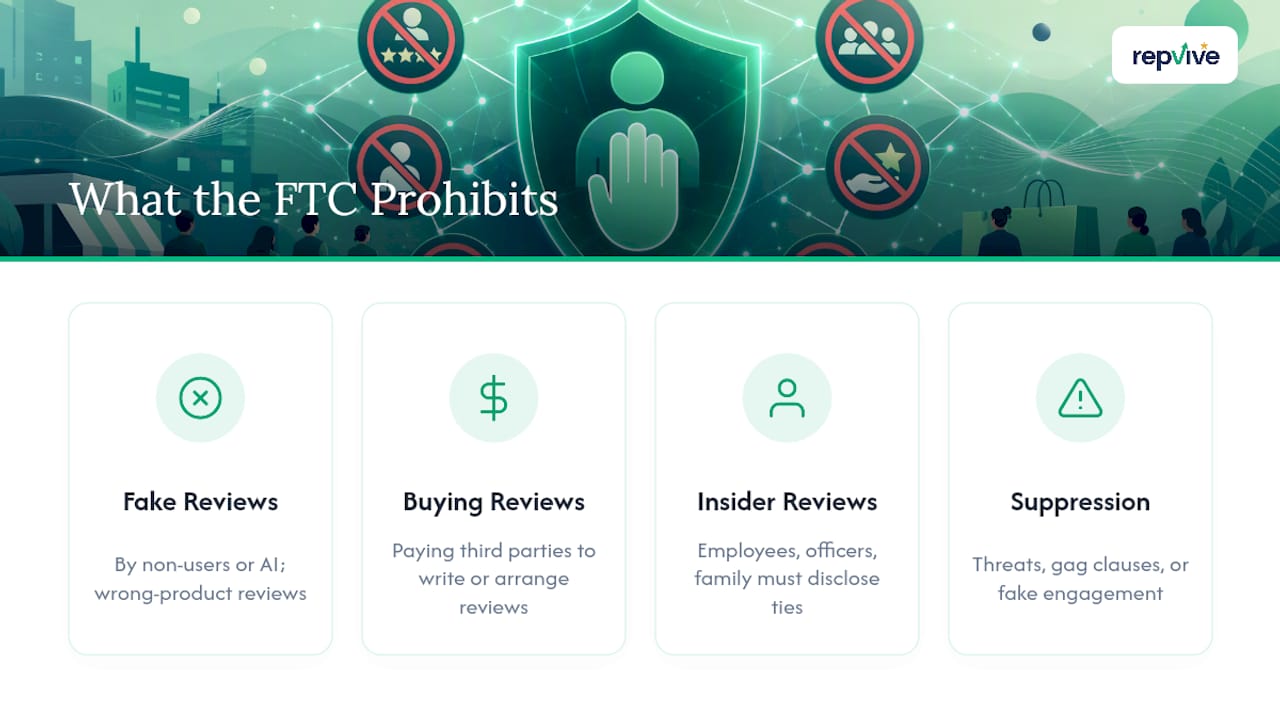
Fake or false reviews. A review is fake if it misrepresents the reviewer’s actual experience, including reviews written by someone who never used the product, reviews generated in bulk by AI tools with no real customer behind them, or reviews for a product a business doesn’t even sell. The FTC’s final rule announcement passed 5 to 0, signaling bipartisan agreement that this problem needed a hard rule rather than case-by-case guidance.
Buying, selling, or brokering reviews. Paying a third party to write, post, or arrange reviews on your behalf is prohibited, whether that third party is a freelance marketplace, a “reputation boost” service, or a review broker operating in bulk. The rule reaches the transaction itself, not just the finished review.
Insider reviews without disclosure. Company officers, managers, employees, and their immediate family members can leave genuine reviews, but only if the relationship is disclosed. An owner’s spouse posting a glowing five-star review with no disclosure is exactly the scenario the rule targets.
Suppression and fake indicators. Threatening customers who leave negative reviews, using contract clauses to silence critics, or inflating follower counts and engagement metrics to fake social proof all fall under the ban. The rule treats suppression as seriously as fabrication, because both distort what a shopper actually sees.
Who and What This Rule Reaches
The rule’s scope goes well beyond the business that publishes a review. It covers a chain of actors, and each one carries distinct exposure.
- Businesses, officers, and managers are directly liable for reviews they write, direct, or knowingly allow.
- Agents and immediate relatives of company insiders are covered when they post reviews without disclosing the relationship.
- Third-party vendors and review brokers are liable if they produce or arrange fake reviews, and businesses that hire them can’t claim ignorance if they “knew or should have known” the reviews were fabricated, a standard spelled out in 16 CFR § 465.2.
- Platforms that host reviews generally get a safe harbor, so long as they don’t actively create, edit, or manipulate the reviews themselves.
That last point matters more than most business owners realize. Hosting user-generated content is protected. Paying to boost certain reviews, quietly deleting negative ones outside normal moderation, or steering algorithms to hide complaints crosses the line from passive host to active participant. A restaurant that hires a marketing firm promising “guaranteed 4.8 stars” is exposed even if the firm, not the restaurant, wrote the fake reviews, because the “should have known” standard doesn’t require proof the owner personally typed the review.
Enforcement Timeline, Penalties, and What Triggers a Case
The final rule became enforceable 60 days after its Federal Register publication in August 2024, and the FTC has moved from publishing guidance to actually using it. In December 2025, the agency sent warning letters to 10 companies flagged for possible violations, confirming that warning letters are the FTC’s first move rather than an immediate lawsuit.
Civil penalties apply to knowing violators, and the rule gives the agency direct authority to seek them rather than relying solely on Section 5 of the FTC Act case by case. That’s a meaningful shift: previously, the FTC had to prove deception under a broader unfairness standard. Now it has a specific rule with defined prohibitions, which makes enforcement faster and penalties easier to calculate.
Enforcement typically follows this pattern:
- A warning letter identifying specific suspect conduct and giving the business a chance to correct it.
- An investigation if the conduct continues, often triggered by consumer complaints, competitor reports, or the FTC’s own monitoring.
- A civil action seeking penalties, injunctive relief, or both, usually reserved for repeat or egregious violators.
What actually triggers scrutiny? Sudden spikes in five-star reviews, reviews with suspiciously similar phrasing, and public complaints about pressured or fake feedback are common indicators the agency has flagged historically.
How to Comply: A Step-by-Step Playbook
Compliance isn’t complicated, but it does require documentation. Here’s a prioritized sequence any business, from a single-location dentist to a multi-state contractor, can run through.
- Write a reviews policy. Put in writing how your business solicits reviews, what employees can and can’t say, and how insider reviews get disclosed. A one-page policy beats no policy every time an investigator asks for one.
- Standardize your solicitation process. Send review requests through a neutral, automated system rather than letting individual employees ask customers directly, which reduces the temptation to cherry-pick happy customers or pressure hesitant ones.
- Verify reviewer identity where possible. Tie review requests to actual transaction records, so every review you solicit maps to a real purchase or service visit.
- Rewrite vendor contracts. Any agency or freelancer handling your reviews or online reputation needs a contract clause warranting compliance with 16 CFR Part 465, giving you audit rights, and indemnifying you if they violate it.
- Set incentive rules clearly. If you offer a discount or entry into a drawing for leaving a review, the incentive has to apply regardless of whether the review is positive or negative. Conditioning a reward on a five-star rating is a violation on its face.
- Log everything. Keep records of solicitation emails, vendor communications, and any customer complaints about pressure to leave reviews. This documentation is what separates a business that can demonstrate good faith from one that can’t. Repvive’s documentation guide breaks down what to preserve and for how long.
- Set an escalation path. Decide now who gets notified if a suspect review surfaces, whether that’s your marketing lead, your general counsel, or an outside attorney, and at what point you loop in legal counsel versus handling it internally.
Pro Tip: Don’t try to quietly delete years of old incentivized reviews the moment you read this. Mass deletion right after a new rule takes effect can itself look like evidence tampering if you’re ever investigated. Instead, audit legacy reviews, flag clearly fabricated ones for platform reporting, and document your remediation process as you go.
Legacy suspect reviews deserve a measured response rather than panic. If a review is old, ambiguous, or borderline, remediation through the platform’s own reporting tools is usually the right first move. If a review involves a clear paid arrangement or a documented insider who never disclosed the relationship, that’s when it’s worth consulting an attorney about formal removal, since the platform may not act on a report alone.
Reviews vs. Testimonials: What Disclosure Actually Requires
A consumer review is an independent account of someone’s real experience, offered without compensation and without direction from the business. A testimonial is different: it’s advertising content, often solicited or compensated, and it carries its own disclosure obligations under the FTC’s Endorsement Guides.
Disclosure is required whenever there’s a “material connection” between the reviewer and the business, meaning anything that could affect how much weight a reasonable consumer gives the review.
- A free product, discount, or payment in exchange for a review.
- An employment or family relationship with the business.
- Any relationship a typical customer wouldn’t expect or assume.
Sample disclosure language that meets the “clear and conspicuous” standard: “I received this product for free in exchange for my honest review” or “I’m the owner’s brother, and this is my real experience.” Vague disclaimers like “sponsored” buried in a hashtag string usually don’t satisfy the standard on their own.
What’s Still Allowed: Safe Harbors and Compliant Solicitation
Not every review-related practice is risky. The rule leaves plenty of room for normal marketing.
- Generalized solicitations asking all customers for honest feedback, with no direction toward positive sentiment, are fine.
- Hosting reviews on your own site or a third-party platform is protected, as long as you’re not editing or cherry-picking which ones appear.
- Incentivized reviews are legal if the incentive is disclosed and applies equally regardless of the review’s content.
Do this: offer a small discount for “leaving a review,” disclosed openly, with no mention of star rating. Don’t do this: offer the discount only after confirming the customer left five stars.
Pro Tip: Time your review requests close to the actual service or purchase. Requests sent weeks later, timed to holidays, or bundled with promotional emails can look manipulative even when the underlying review is genuine.
Real Scenarios Businesses Are Facing Right Now
The “reputation package” vendor. A marketing agency promises 50 new five-star reviews in 30 days for a flat fee. Red flag: any guarantee tied to a specific star rating. First steps: cancel the contract, preserve the agency’s sales emails, and check Repvive’s warning signs checklist against your existing reviews.

The manager who asks relatives to post. A store manager asks siblings and cousins to leave reviews without mentioning the family connection. Red flag: reviewer names matching known employee relatives, all posted the same week. First step: require disclosure retroactively or request removal.
The competitor flooding you with fake negative reviews. Red flag: sudden clusters of one-star reviews with generic complaints and no purchase history. Repvive’s guide to reporting competitor fake reviews covers documentation and platform reporting in detail.
How the FTC Actually Finds Violations
Investigators and researchers rely on a fairly predictable set of signals. Sudden spikes in review volume, especially clustered within a few days, are one of the clearest markers. Identical or near-identical phrasing across multiple reviews is another, since genuine customers rarely describe an experience in the same words. Academic research from UCLA Anderson has documented organized fake-review markets where sellers coordinate through private groups and pay reviewers contingent on posting positive content, exactly the pattern the FTC’s rule targets.
- Large, unexplained jumps in five-star reviews over a short window.
- Reviews with duplicate or templated language across different accounts.
- Reviewer histories that show no other activity, or activity only for competing businesses in the same niche.
Pro Tip: Structure your internal review monitoring so it produces a dated log, not just a mental note. If the FTC ever asks how you caught and handled a suspect review, “we noticed and documented it on this date” is a far stronger answer than “we think we noticed eventually.” Repvive’s breakdown of how review manipulation gets detected covers the specific patterns worth tracking.
Why compliance is a business imperative, not paperwork
Fake reviews don’t just risk a fine. They erode the trust that makes local commerce work at all, and they punish the honest competitor down the street who never cut that corner. Businesses that treat this rule as a checkbox exercise are missing the point: your customers are the ones being deceived when a review lies to them.
Assign someone to own this by the end of the week. Run the checklist above once, even if you’re confident you’re clean. The businesses that get warning letters are rarely the ones running obvious scams. They’re the ones who never checked.
If You’re Already Dealing With Suspect Reviews, Here’s Where Repvive Fits
Compliance going forward is one problem. Cleaning up reviews that are already live, whether they’re fake, defamatory, or posted by a competitor pretending to be a customer, is a different one, and it’s not something most business owners have time to fight platform by platform.
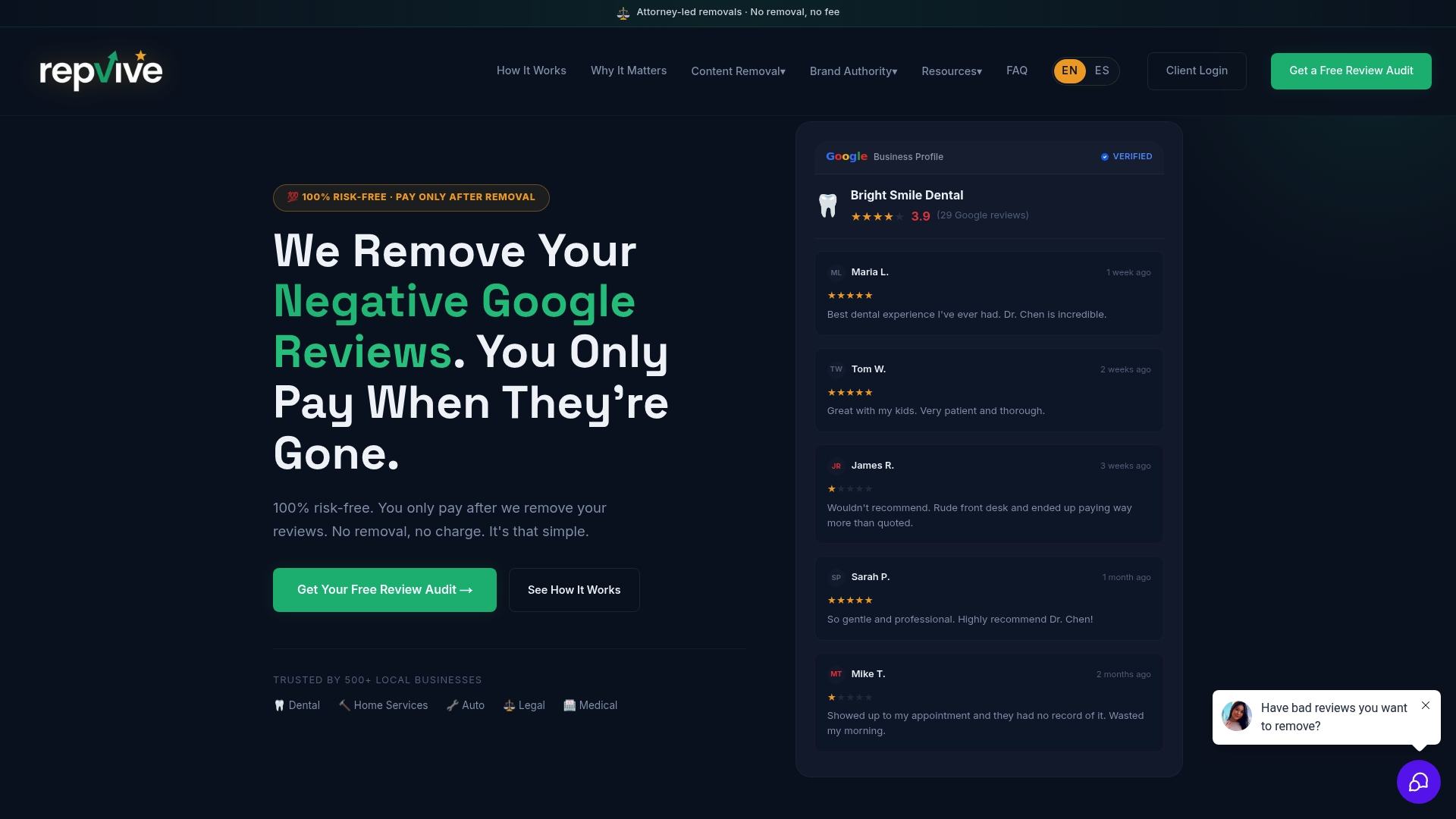
Repvive takes an attorney-led approach to getting fake and defamatory reviews removed from Google, Yelp, Facebook, TripAdvisor, Trustpilot, BBB, and more than 20 other platforms. Every claim is built for the specific review and platform, and Repvive only bills after a removal is confirmed, so there’s no upfront cost and no risk if a claim doesn’t succeed. That matters most when you’ve already tried reporting a review yourself and the platform refused to act, or when the evidence points to a competitor or a coordinated attack rather than a simple misunderstanding. Repvive also offers ongoing monitoring tools like RepWatch to flag new suspect activity before it snowballs. If you’re staring at reviews you know are fake and don’t know where to start, see how Repvive’s removal process works and get a read on your case.
Sources
- The Consumer Reviews and Testimonials Rule: Questions and Answers | Federal Trade Commission
- 16 CFR § 465.2, fake or false consumer reviews, consumer testimonials, or celebrity testimonials. | Electronic Code of Federal Regulations (e-CFR) | US Law | LII / Legal Information Institute
- Federal Register :: Trade Regulation Rule on the Use of Consumer Reviews and Testimonials
This article is general information, not a substitute for advice from a qualified lawyer. Consult a qualified legal professional about your own circumstances before acting on anything here.
FAQ
What are the FTC guidelines for reviews?
The FTC requires that reviews reflect genuine customer experiences, prohibits paying for reviews or suppressing negative ones, and requires disclosure of any material connection between a reviewer and the business, as detailed in the agency’s Q&A guidance.
What is the new FTC rule?
The new FTC rule, effective under 16 CFR Part 465, bans creating, buying, selling, or disseminating fake consumer reviews and allows the agency to seek civil penalties against knowing violators.
What are the FTC’s rules on false advertising?
Beyond the reviews rule, the FTC’s broader advertising rules require that marketing claims be truthful, substantiated, and not misleading, with testimonials treated as advertising subject to the Endorsement Guides disclosure standards.
Can you sue someone for a fake Google review?
Businesses can pursue defamation or platform-based removal claims against a fake Google review, particularly when it’s demonstrably false, and services like Repvive’s Google review removal process handle this through attorney-led claims rather than a personal lawsuit in most cases.