How Businesses Verify Review Authenticity in 2026
Review authenticity verification is the process of confirming that a customer review originates from a real, documented transaction before it influences...
TL;DR:
- Businesses verify review authenticity mainly by linking reviews to purchase records, using AI detection, and applying receipt verification with OCR. Verified purchase confirmation offers the strongest trust and the highest conversion boost, while transparent labeling improves credibility. Automated tools assist but require human judgment to effectively prevent fake reviews.
Review authenticity verification is the process of confirming that a customer review originates from a real, documented transaction before it influences your brand’s public reputation. Fake reviews cost businesses far more than a few lost stars. The UK’s Competition and Markets Authority found that 54% of 100 sites breached consumer protection laws on review authenticity as of mid-2025. That finding signals a systemic problem, not an edge case. Understanding how businesses verify review authenticity is now a core operational skill, not an optional extra. This article breaks down the technologies, standards, and practical steps that protect your reputation from fraudulent feedback.
How businesses verify review authenticity: core technologies
The most reliable verification methods tie a review directly to a confirmed purchase record. Order-confirmed verification, which links a submitted review to an actual transaction in your system, is the gold standard for authentic review confirmation. Email-based confirmation and self-attestation are weaker alternatives because they rely on the reviewer’s honesty rather than objective data.
AI and machine learning detection
Modern fake review detection uses transformer models and residual neural networks that analyze text, reviewer behavior, and images simultaneously. These systems achieve 94.2% accuracy when fusing multiple data sources. That accuracy rate far surpasses older text-pattern matching, which fraudsters learned to defeat years ago.

Walmart Marketplace’s AI-powered TrustGuard system illustrates what enterprise-level detection looks like. It uses over 847 data points to verify authenticity and has reduced fraudulent reviews by 94% since february 2026. The system detects coordinated fake review campaigns within 2.3 hours, compared to the prior 14-day manual process. That speed matters because fake review campaigns can shift star ratings within hours if left unchecked.
Receipt verification with OCR
Receipt verification systems use optical character recognition (OCR) to extract transaction data from uploaded receipts and match it against business records. These systems apply fuzzy matching algorithms to handle abbreviations, formatting differences, and minor discrepancies in business names. The fuzzy approach reduces false rejections, meaning real customers do not get blocked because their receipt says “Joe’s Café” instead of “Joe’s Cafe LLC.”
- Posting velocity analysis: Flags accounts that submit multiple reviews in a short window, a common pattern in coordinated fraud.
- Reviewer behavior scoring: Tracks account age, review history, and geographic consistency to build a credibility profile.
- Image authenticity checks: Analyzes uploaded photos for metadata inconsistencies or signs of stock image reuse.
- Confidence scoring: Assigns a numerical trust score to each review based on combined signals, allowing platforms to weight verified reviews more heavily.
Pro Tip: Set up automated verification emails that trigger immediately after a confirmed purchase. Customers who receive a prompt, personalized request are far more likely to submit a genuine, detailed review than those contacted weeks later.
What regulations require businesses to do
The Federal Trade Commission (FTC) in the United States and the Competition and Markets Authority (CMA) in the UK both mandate that businesses take active steps to prevent fake or incentivized reviews from misleading consumers. Compliance is not just a legal checkbox. Compliance with emerging regulations directly affects public perception and long-term business viability.
The consumer trust gap makes this urgent. Only 8% of consumers feel confident they can spot a fake review on their own. That means the vast majority of your potential customers are making purchase decisions based on reviews they cannot independently evaluate. Businesses that verify reviews fill that trust gap for them.
The Better Business Bureau recommends checking for a natural spread of ratings: 60, 70% four- and five-star ratings, with a visible presence of lower-star reviews. An unnatural distribution, such as a profile with 95% five-star reviews and nothing below four stars, is a primary red flag for manipulation. Businesses that monitor their own rating distribution can catch suspicious patterns before regulators or consumers do.
Key legal and industry requirements to track:
- FTC endorsement guidelines: Require clear disclosure of any incentive offered in exchange for a review.
- CMA consumer protection rules: Prohibit hosting or publishing reviews that the business knows, or should know, are fake.
- BBB rating distribution guidance: Encourages businesses to maintain a natural spread of ratings as a signal of authenticity.
- Platform-specific policies: Google, Yelp, and other major platforms each publish their own review content policies, which carry their own enforcement consequences.
How different verification methods compare
Not all verification approaches deliver the same results. The method a business chooses directly affects consumer trust and, ultimately, conversion rates.
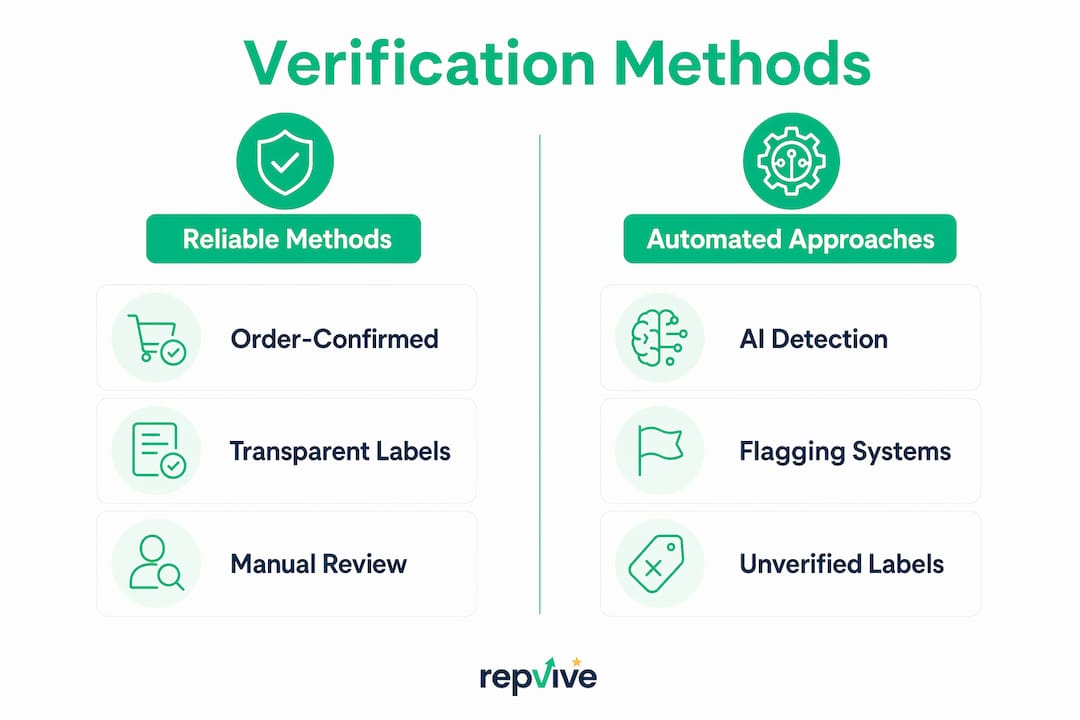
Verified-purchase badges linked to confirmed orders lift conversion rates by 5, 12% on average compared to unbadged reviews. That is a meaningful revenue difference for any business running on tight margins. Stores that mix verified and unverified reviews without clear labels risk a 5, 15% conversion loss because consumers distrust the ambiguity.
Transparent labeling systems address this directly. A transparency-first approach labels each review with a clear status: Verified Purchase, Pending, Unverified, or Flagged. Verified reviews contribute more weight to trust scores, increasing perceived credibility for the business. Consumers can then decide how much weight to assign each review rather than guessing.
| Verification method | Trust indicator | Conversion impact |
|---|---|---|
| Order-confirmed (transaction linked) | Highest | +5, 12% vs. unbadged |
| Receipt upload with OCR matching | High | Moderate to strong lift |
| Email confirmation (post-purchase) | Moderate | Some lift, lower than order-confirmed |
| Unverified with clear “Unverified” label | Low but transparent | Neutral to slight negative |
| Mixed verified/unverified, unlabeled | Lowest | 5, 15% potential loss |
Pro Tip: If you cannot implement full order-confirmed verification immediately, add a visible “Unverified” label to reviews that lack purchase proof. Transparency about verification status builds more trust than hiding the gap.
Automated tools also play a role in checking review validity, but they have real limits. Automated fake review checkers analyze linguistic patterns and assign suspicion scores, but they cannot definitively prove authenticity. They work best as triage filters, not final arbiters. A high suspicion score warrants human review, not an immediate public accusation.
Practical steps to build a verified review system
Building a working verification system does not require enterprise-level resources. Most businesses can implement the core elements with existing tools and a clear process.
- Connect reviews to purchase records. Integrate your review collection with your point-of-sale or e-commerce system so every review request links to a confirmed transaction. This is the single most effective step for authentic review confirmation.
- Automate post-purchase review requests. Send a verification email or SMS within 24 hours of a completed purchase. Include clear instructions for uploading a receipt if your platform supports it.
- Enable platform verification features. Google Business Profile, for example, allows businesses to flag reviews that violate policies. Use this feature consistently rather than waiting for the platform to act on its own.
- Monitor review patterns with analytics. Track posting velocity, reviewer account age, and rating distribution weekly. Sudden spikes in five-star reviews from new accounts are a reliable warning sign. Repvive’s real-time monitoring tool tracks review activity across 20+ platforms and flags suspicious patterns automatically.
- Respond transparently to flagged reviews. When a review looks suspicious, respond professionally and factually. Do not accuse the reviewer publicly. Instead, invite them to contact you directly to resolve any issue. This approach protects your reputation regardless of whether the review is genuine.
Additional best practices worth building into your workflow:
- Educate customers on what verification badges mean so they understand why their receipt upload matters.
- Use a fake review warning signs checklist to train staff on what suspicious activity looks like.
- Document every flagged review and your response in a log. This record protects you if a regulator or platform ever questions your practices.
- Audit your review profile quarterly against BBB’s natural distribution benchmark to catch drift early.
Key Takeaways
Businesses that combine order-confirmed verification, transparent labeling, and continuous monitoring build the most defensible and conversion-positive review profiles.
| Point | Details |
|---|---|
| Order-confirmed is the gold standard | Linking reviews to transaction records delivers the highest trust and conversion lift. |
| AI detection has real limits | Automated tools assign suspicion scores but require human follow-up before any action. |
| Transparency beats ambiguity | Labeling reviews as Verified, Pending, or Unverified builds more trust than hiding the gap. |
| Regulations carry real consequences | FTC and CMA rules require active steps to prevent fake reviews, not just passive monitoring. |
| Rating distribution signals authenticity | A natural spread of 60, 70% four- and five-star reviews is a credibility benchmark, not a ceiling. |
The uncomfortable truth about automated verification
Automated detection is genuinely impressive. A system that hits 94.2% accuracy across text, behavior, and image signals is not a toy. But I have seen too many business owners treat a high suspicion score as a verdict. It is not. Automated tools lack access to account-level data that platforms hold internally, so they are working with partial information by design.
The businesses I respect most in this space treat automation as the first filter and human judgment as the final one. They build a workflow where flagged reviews go to a real person before any response or removal request goes out. That extra step prevents two costly mistakes: publicly accusing a genuine customer, and ignoring a coordinated fraud campaign because the algorithm missed it.
The other thing I keep coming back to is transparency. Businesses that openly label their verification statuses, even when some reviews are unverified, consistently outperform those that hide the gap. Consumers are not naive. They know not every review is perfect. What they want is honesty about what they are reading. A clearly labeled “Unverified” review is more trustworthy than an unlabeled one, because the label itself signals that the business is paying attention.
Fake review tactics will keep evolving. The businesses that stay ahead are the ones that treat verification as a living process, not a one-time setup.
, Jason
When fake reviews require more than a flagging system
Flagging and monitoring catch most problems, but some fake reviews require direct removal to protect your business. Repvive’s review removal service uses an attorney-led process to remove damaging or fraudulent Google reviews with a 99% success rate and no upfront fees. The legal team builds a customized case for each review, using direct channels to get removals approved by Google rather than relying on generic dispute forms.
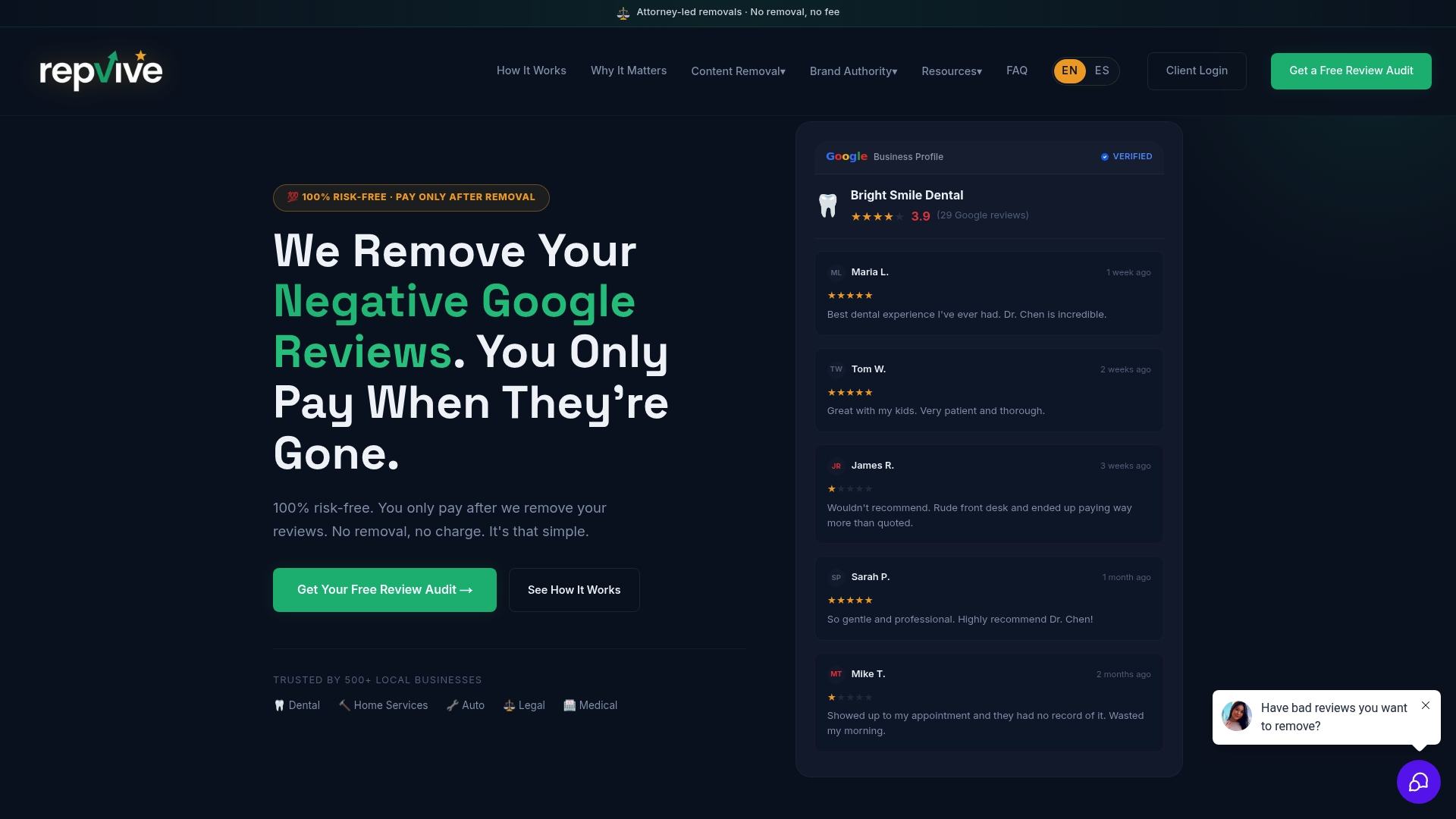
Repvive works with small and medium local businesses across industries, from restaurants to medical practices to auto shops. If a fake or unfair review is sitting on your profile and standard flagging has not worked, Repvive’s reputation management services offer a proven path to getting it removed. Your reputation is worth protecting with more than a form submission.
FAQ
How do businesses verify review authenticity?
Businesses verify review authenticity by linking reviews to confirmed purchase records, using AI-powered detection tools, and applying receipt verification systems with OCR matching. Transparent labeling of verification status is also a core part of the process.
What is the most reliable review verification method?
Order-confirmed verification, which ties a review directly to a transaction record, is the most reliable method and delivers the strongest conversion lift compared to email-based or self-attested approaches.
Can automated tools definitively identify fake reviews?
Automated tools can flag suspicious reviews with high accuracy but cannot definitively prove inauthenticity. Suspicion scores should trigger human review, not immediate public action.
What are the legal risks of ignoring fake reviews?
The FTC and CMA both require businesses to take active steps to prevent fake reviews. Failing to do so can result in regulatory fines and public enforcement actions that damage brand credibility far beyond the original fake review.
Do verified purchase badges actually improve sales?
Verified-purchase badges lift conversion rates by 5, 12% on average compared to unbadged reviews. Businesses that mix verified and unverified reviews without clear labels risk a 5, 15% conversion loss from consumer distrust.
Recommended
- Fake Review Warning Signs Checklist for Local Businesses | Repvive
- How to Protect Business Reputation Online in 2026 | Repvive
- Done-For-You 5-Star Review Collection | Repvive
- Reputation Management Blog | Repvive
If you would rather have this handled, our Google review removal service reviews each case first and charges only when the content comes down.