Documentation's Role in Fighting Fake Reviews
Documentation is the foundational defense against fake reviews, creating verifiable, auditable evidence that platforms accept when deciding whether to...
TL;DR:
- Documentation provides verifiable evidence that helps platforms and legal teams identify fake reviews. It is essential for building a chain of custody and supporting removal requests effectively. Regular audits and forensic captures strengthen your ability to dispute fraudulent content and protect your reputation.
Documentation is the foundational defense against fake reviews, creating verifiable, auditable evidence that platforms accept when deciding whether to remove fraudulent content. The role of documentation in fighting fake reviews goes far beyond saving a screenshot. It means building a chain of custody that proves a review is inauthentic, not just suspicious. Only 8% of consumers feel confident identifying fake reviews on their own. That gap makes your documented evidence the most powerful tool you have for protecting your business’s reputation.
What types of documentation are critical for fighting fake reviews?
Effective documentation captures every verifiable signal attached to a suspicious review. The goal is to build a case file that a platform moderator or attorney can act on immediately, without needing to take your word for anything.

Effective documentation must include the original review text, the reviewer’s profile data, timestamps, IP and geolocation anomalies, and any recorded policy violations, all organized inside a standardized audit log. Each element adds a layer of proof that is harder to dismiss than a single complaint.
The core evidence types you need to collect are:
- Review text and metadata. Save the exact wording, star rating, reviewer name, and the date and time the review was posted.
- Reviewer profile data. Note the account’s creation date, review history, and whether the account shows burst activity across multiple businesses.
- IP and geolocation anomalies. Flag reviews that originate from locations inconsistent with your customer base or that cluster around the same IP address.
- Audit logs. Record every capture attempt, the date you flagged the review, and any pattern you observe over time.
- Cryptographic evidence. Use forensic capture tools that generate SHA-256 hashes and blockchain timestamps to prove the content has not been altered since capture.
Screenshots lack authenticity proof and chain of custody. A forensic web capture with cryptographic hashing produces legally admissible evidence under Federal Rules of Evidence and eIDAS regulations. That distinction matters enormously when you escalate a dispute.
Pro Tip: Use a dedicated forensic capture tool rather than your phone camera or a browser screenshot. Tools that generate SHA-256 hashes create self-authenticating records that platforms and courts recognize as tamper-proof.
How does documentation strengthen fake review detection?
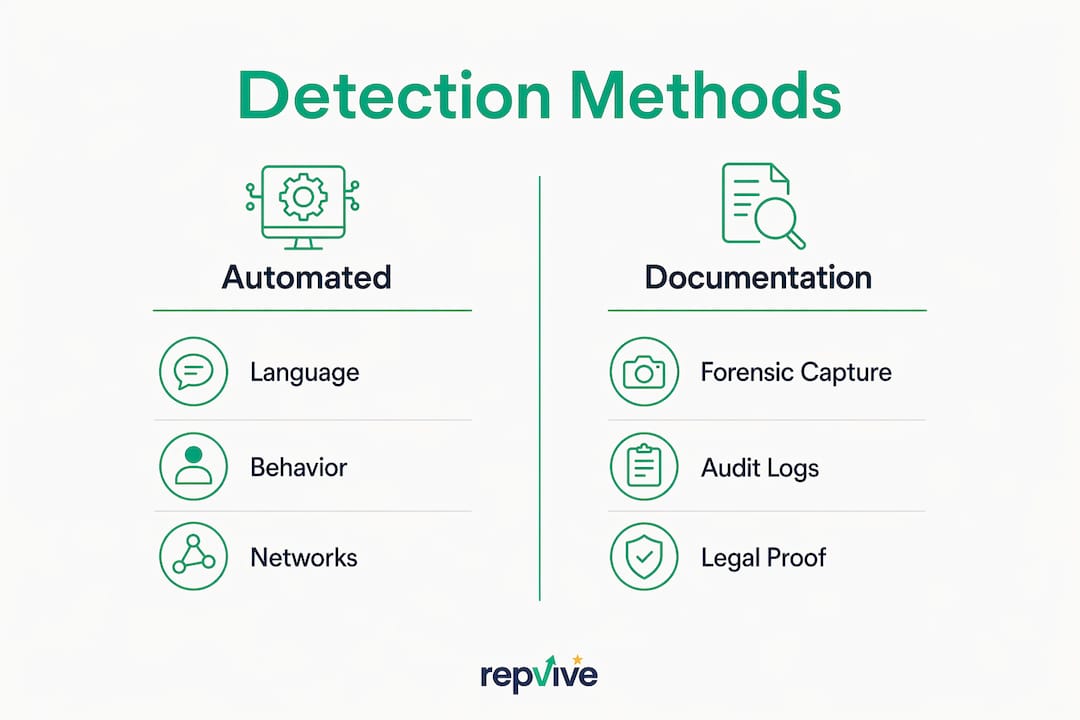
The most effective fake review detection strategy uses four layers: linguistics, behavioral analysis, network analysis, and metadata correlation. This four-layer detection model gives investigators a structured framework, but each layer depends on documented evidence to produce a finding that holds up to scrutiny.
Automated systems handle the first pass well. They flag unusual language patterns, review velocity spikes, and network clusters of accounts. The problem is that AI-generated fake reviews are increasingly plausible. They mimic natural language, avoid obvious errors, and pass basic text filters. Platforms struggle with plausible fake reviews because automated systems cannot always distinguish a well-written fake from a genuine customer experience.
Documentation fills that gap. When you submit a removal request backed by a forensic audit log, a moderator no longer has to rely solely on algorithmic signals. Your evidence gives them a concrete, data-backed case they can act on. Well-documented evidence helps escalate cases for human review and measurably improves removal success rates.
The table below shows how documentation and automated detection compare across key evaluation criteria.
| Evaluation criterion | Automated detection alone | Documentation-backed approach |
|---|---|---|
| Handles plausible AI-generated reviews | Weak | Strong |
| Produces platform-admissible evidence | No | Yes |
| Supports legal escalation | No | Yes |
| Identifies behavioral patterns over time | Partial | Full |
| Builds a reusable audit trail | No | Yes |
Pro Tip: Treat automated detection as your early-warning system and documentation as your closing argument. Neither works as well without the other.
What is the step-by-step process for disputing fake reviews with evidence?
A clear workflow removes the guesswork from combatting fraudulent online reviews. Follow these steps every time you identify a suspicious review.
-
Identify suspicious patterns. Look for burst activity, where multiple negative reviews appear within a short window. Check whether the reviewer has no prior history or only reviews businesses in your category.
-
Capture the full review page with metadata preserved. Use a forensic capture tool rather than a screenshot. Capture the page multiple times over several days to document that the review persists and has not been edited.
-
Generate cryptographic evidence. Chain of custody via forensic web capture with SHA-256 hashes and blockchain timestamps creates self-authenticating, court-admissible evidence. Run this step immediately after capture so the timestamp is tied to the original content.
-
Build your standardized audit log. Record the review URL, capture dates, hash values, reviewer profile details, geolocation anomalies, and any platform policy the review appears to violate. Keep this log in a format you can export and share.
-
File your removal request with the platform. Submit your audit log and forensic captures through the platform’s official dispute channel. Reference the specific policy violations your evidence supports. Vague complaints get dismissed; documented cases get reviewed.
-
Escalate if the initial request is denied. A documented audit log with removal decisions and evidence flags is critical when you escalate to a higher review tier or pursue legal action. Without it, you have no record of what you submitted or when.
The FTC’s guidelines on deceptive endorsements give businesses additional grounds to escalate fake review disputes beyond the platform level. Referencing those guidelines in your complaint signals that you understand the regulatory framework, which often prompts faster action.
How can local businesses build documentation into their routine?
Documentation and review authenticity do not happen by accident. They require a repeatable system that fits into your existing workflow without consuming hours each week.
Quarterly 30-minute recurring audits let businesses stay ahead of fake review activity systematically. Schedule these blocks on your calendar and treat them as non-negotiable. During each audit, scan your review base for new anomalies, update your audit log, and verify that previously flagged reviews have been addressed.
Practical habits that make documentation sustainable include:
- Use forensic capture tools for every flag. Free browser extensions that generate hashes exist, and dedicated services offer more complete audit trails. Build this into your flagging process from day one.
- Maintain a removal log. Record every action you take, the evidence you submitted, the date, and the platform’s response. Maintaining a removal log with detailed signal flags, action dates, and platform responses is critical for legal compliance and future escalation.
- Publish a transparent review moderation policy. Tell your customers how you verify reviews and what you do when you find fraudulent ones. Transparency builds trust and deters bad actors.
- Use verified purchase labels and account history signals. Provenance signals like verified purchase labels and account history are harder to fake than text alone. Incorporate these into your review collection process wherever your platform allows.
- Run a Google Business Profile audit. A free profile audit surfaces review anomalies and gives you a baseline for your documentation records.
Consumers rely on provenance signals more than text analysis alone. Businesses that document authenticity at multiple layers regain customer trust faster than those that rely on platform algorithms to sort things out.
Key Takeaways
Systematic, forensic documentation is the single most reliable method for detecting, disputing, and removing fake reviews from your business profile.
| Point | Details |
|---|---|
| Documentation beats screenshots | Forensic captures with SHA-256 hashes produce legally admissible evidence; screenshots do not. |
| Four-layer detection needs evidence | Linguistics, behavioral, network, and metadata analysis all depend on documented proof to support removal requests. |
| Audit logs enable escalation | A detailed removal log with dates, evidence flags, and platform responses is required if initial disputes are denied. |
| Quarterly audits prevent backlog | A 30-minute audit every quarter keeps your review base clean and your documentation current. |
| Provenance signals build trust | Verified purchase labels and account history create layered proof that text analysis alone cannot match. |
Why I think most businesses are fighting fake reviews the wrong way
Most local business owners I speak with treat fake reviews as a one-time problem. They see a suspicious review, report it through the platform’s basic form, and wait. When nothing happens, they feel stuck. That approach fails because it gives platforms nothing concrete to act on.
The uncomfortable truth is that AI-generated fake reviews have made gut instinct useless as a defense. A well-crafted fake reads exactly like a real customer complaint. Without documented behavioral patterns, geolocation data, and cryptographic proof, you are asking a moderator to make a judgment call with no evidence. They almost always default to leaving the review up.
What actually works is treating your review defense the same way you treat your bookkeeping. You do not wait until tax season to start tracking expenses. You record transactions as they happen. Documentation works the same way. Capture evidence the moment you flag a review, build your audit log consistently, and your removal requests become cases rather than complaints.
The businesses that protect their reputations most effectively are not the ones with the most followers or the best marketing. They are the ones with the most organized evidence files. That is a discipline any local business owner can build, starting this week.
, Jason
How Repvive’s attorney-led approach puts documentation to work for you
Repvive’s review removal service is built on the same forensic documentation principles this article covers, applied by an attorney-led team that knows exactly what platforms require to approve a removal.
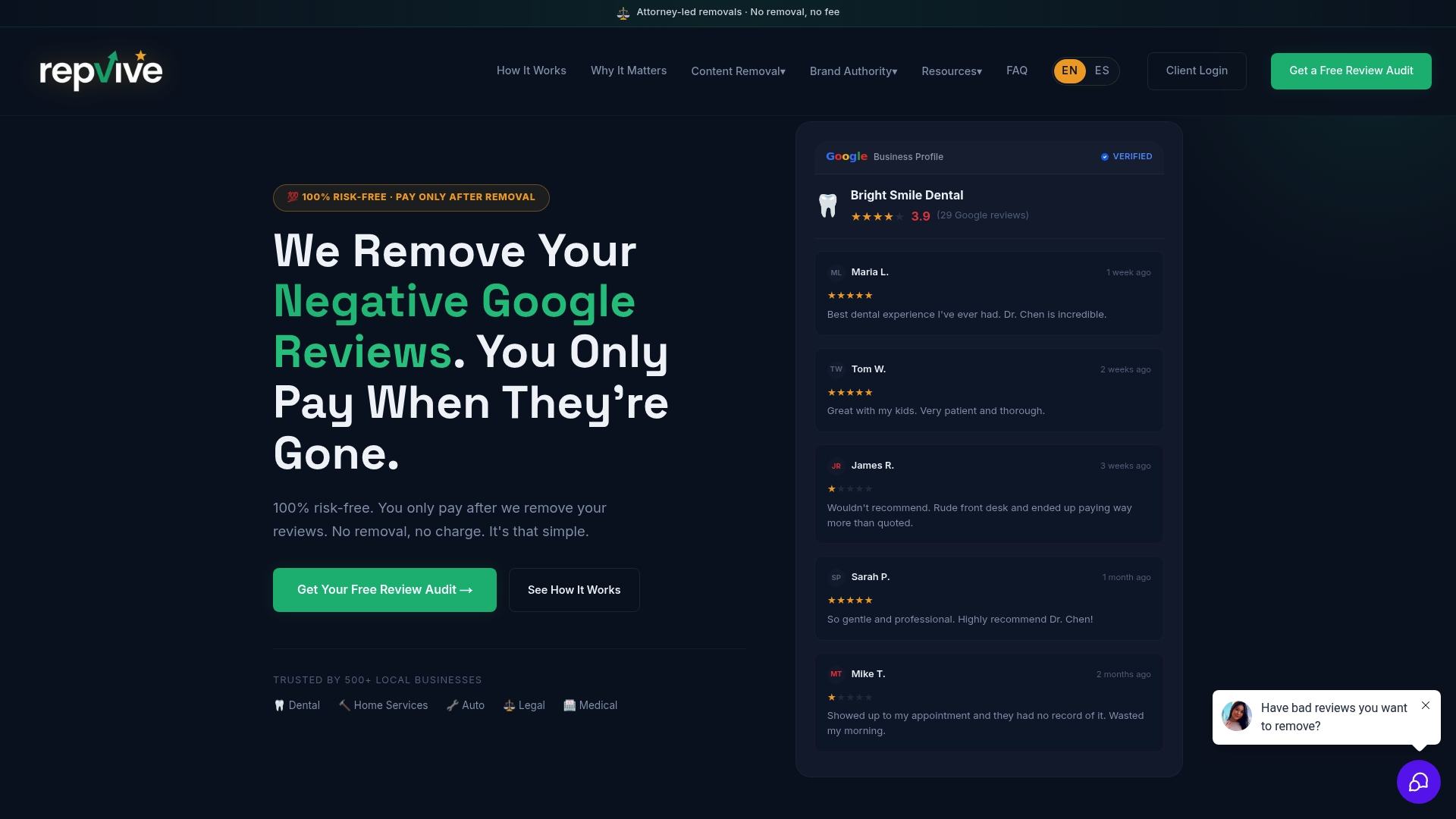
Repvive’s legal team prepares customized, evidence-backed claims for each review, using direct platform channels to maximize approval rates. Their Google review removal service carries a 99% success rate with no upfront fees, meaning you pay only when the review comes down. For businesses dealing with fraudulent reviews on multiple platforms, Repvive’s full reputation management services cover the complete documentation and dispute workflow so you do not have to build it from scratch.
FAQ
What is the role of documentation in fighting fake reviews?
Documentation creates verifiable, auditable evidence that proves a review is inauthentic. Platforms and legal teams require this evidence to approve removal requests.
Why are screenshots not enough to dispute a fake review?
Screenshots lack chain of custody and authenticity proof. Forensic captures with SHA-256 hashes and blockchain timestamps produce evidence that platforms and courts accept as tamper-proof.
How often should I audit my reviews for fake activity?
A quarterly 30-minute audit is the recommended cadence. It keeps your documentation current and lets you catch burst activity before it damages your reputation.
What should a fake review audit log include?
Your audit log should include the review URL, capture dates, hash values, reviewer profile data, geolocation anomalies, policy violations noted, and every platform response you receive.
Can documentation help if a platform denies my removal request?
Yes. A detailed audit log with evidence flags and removal decisions gives you the foundation to escalate to a higher review tier or pursue legal action under FTC guidelines.