How to Report Competitor Fake Reviews
File a platform report using the “Conflict of interest” category and build a timestamped evidence package before you do anything else. That combination...
TL;DR:
- Reporting reviews as a “Conflict of interest” in the appropriate platform category increases the chance of human review. Building a detailed evidence package with screenshots, records, and review patterns is essential for effective removal. Consistent proactive review management and public responses support reputation defense and can help outpace fake review attacks.
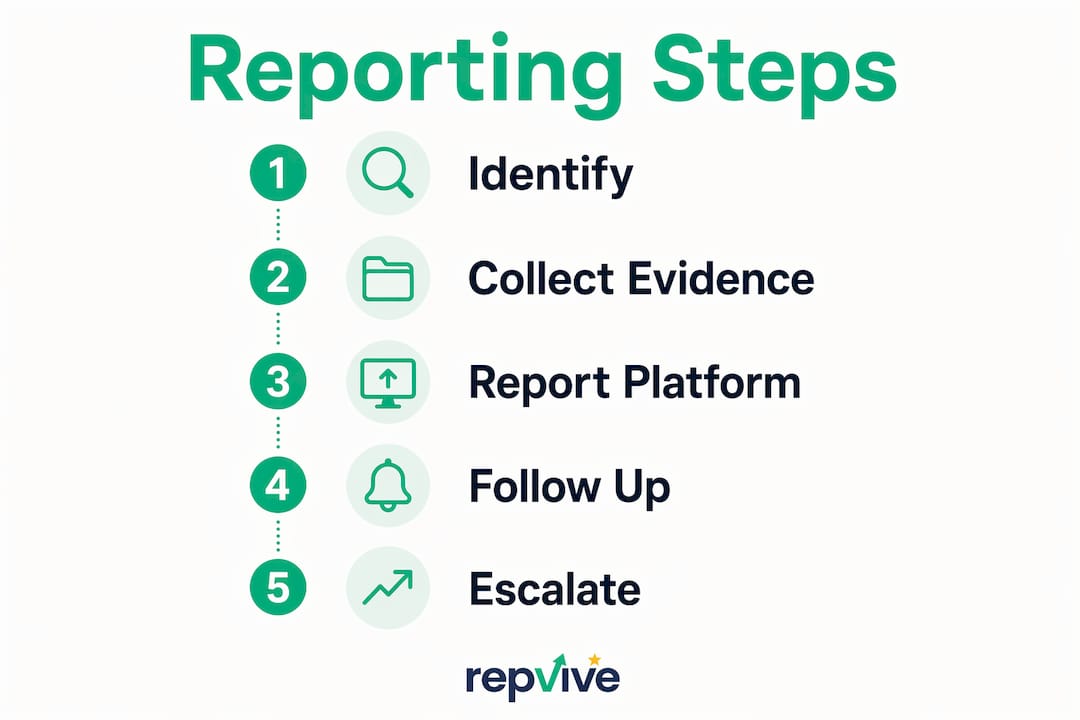
File a platform report using the “Conflict of interest” category and build a timestamped evidence package before you do anything else. That combination gives you the best shot at triggering human review rather than automated dismissal. Here’s what to do in the first hour:
- Flag the review through your Google Business Profile, Yelp, or Facebook dashboard immediately
- Screenshot everything: the review text, the reviewer’s profile page, and the posting timestamp
- Pull your CRM or booking records to confirm no matching transaction exists
- Note the velocity pattern: when did the review appear, and did others arrive in a cluster?
- Don’t re-report the same review repeatedly, that signals noise; open an escalation path instead
Pro Tip: Choose “Conflict of interest” rather than “Spam” when reporting a suspected competitor review. Spam flags trigger automated bot-detection filters. Conflict of interest routes the case to a human moderator, which is exactly where you want it.
Table of Contents
- How do major platforms define a “fake” or inauthentic review?
- What evidence should you collect before filing a report?
- Step-by-step reporting on Google, Yelp, Facebook, Amazon, Apple, and BBB
- How should you respond publicly while waiting for removal?
- When should you involve an attorney or a professional removal service?
- How do you make your profile resilient to future attacks?
- What timelines and success rates should you realistically expect?
- What red flags tell you a competitor is likely behind the reviews?
- Key Takeaways
- What most guides get wrong about fighting fake reviews
- Repvive’s attorney-led removal service for documented attacks
- Useful sources
- FAQ
How do major platforms define a “fake” or inauthentic review?
Every platform has its own policy language, but the categories that matter most for competitor sabotage are conflict of interest, spam, off-topic content, and restricted content. Choosing the wrong category is the single most common mistake business owners make when they report fake reviews.
Practitioner guidance consistently shows that flagging competitor-origin reviews as “Conflict of interest” produces higher removal success than the generic spam route, because spam filters look for bot signals. A well-written, human-crafted sabotage review will sail right past them.
A coherent, grammatically correct review written by a real person at a competing business will almost never trigger automated spam detection. It reads like a customer complaint. The only path to removal is a human reviewer who can weigh the circumstantial evidence you provide.
Here’s how each major platform categorizes the violation:
- Google Business Profile: “Conflict of interest” covers reviews from competitors or their employees. The Google Business Profile Help page lists prohibited content including fake reviews and reviews from people with a financial stake in the outcome.
- Yelp: Flags reviews as “Not a customer experience” or “Conflict of interest” under its Content Guidelines.
- Facebook/Meta: Business Page reviews can be reported for “False information” or “Spam.”
- Amazon: Seller feedback and product reviews can be flagged for “Competitor sabotage” under Amazon’s Community Guidelines.
- Apple App Store: Reports go through Apple’s developer portal under “Inappropriate review.”
- BBB: Complaints and reviews that appear fabricated can be disputed directly with the BBB’s dispute resolution team.
What evidence should you collect before filing a report?
Direct attribution to a competitor is rarely available. What wins cases is a well-organized circumstantial package. Practitioners build these packages from screenshots, CRM records, velocity charts, and any public social proof linking the reviewer to a competitor.
Gather these items before you file:
- Timestamped screenshots of the review and the reviewer’s full profile page
- The reviewer’s account age, total review count, and any other businesses they’ve reviewed
- CRM or booking records confirming no transaction matches the reviewer’s name, email, or date
- A velocity log: dates and times of all suspicious reviews, especially if they arrived in a cluster
- Public links connecting the reviewer to a competitor (LinkedIn, social media, Google Maps reviews praising a specific rival)
- Near-identical phrasing across multiple reviews, saved side by side
Pro Tip: Compile everything into a single, clearly labeled PDF with a chronology page at the front. That’s what human platform reviewers and legal counsel want to see, not a folder of loose screenshots.
Step-by-step reporting on Google, Yelp, Facebook, Amazon, Apple, and BBB

Workflows tested show initial automated decisions within days and human review outcomes within a few weeks when evidence is supplied.
Google Business Profile is the most detailed process:
- Go to your Business Profile and select “Read reviews”
- Click “Report” next to the review
- Select “Conflict of interest” (not “Spam”)
- If rejected, open the Reviews Management Tool and file a formal appeal
- Escalate to the GBP Help Community or verified phone support if the appeal stalls
| Platform | Best reporting channel | Typical initial response | Escalation option |
|---|---|---|---|
| Google Business Profile | GBP Reviews dashboard + Reviews Management Tool | A few days (automated); up to a few weeks (human) | GBP Help Community, phone support |
| Yelp | Business Owner account → “Report Review” | Several business days | Yelp Business Support ticket |
| Facebook/Meta | Business Page → Review → “Find support or report” | A few days | Meta Business Help Center |
| Amazon | Seller Central → “Report Abuse” | Several business days | Amazon Seller Support case |
| Apple App Store | Developer portal → “Report a concern” | Several days to a couple weeks | Apple Developer Support |
| BBB | BBB Business Profile → “Dispute this review” | Several business days | BBB dispute resolution team |
How should you respond publicly while waiting for removal?
Always reply. A public response shapes what future customers see and can serve as evidence of good-faith customer service in a platform appeal. Keep it short, professional, and free of any admission.
Three templates for common scenarios:
- Vague complaint: “We take every experience seriously and have no record of this visit in our system. Please contact us directly at [email] so we can look into this.”
- Fabricated service claim: “We don’t offer [claimed service], and we have no record of this transaction. We’d welcome the chance to connect and clarify.”
- Verified-purchase-looking claim: “Our records don’t show a matching order under this name or date. Please reach out directly and we’ll resolve this immediately.”
Never argue, never name-call, and never speculate publicly that the review is from a competitor. State the facts, invite offline contact, and move on.
When should you involve an attorney or a professional removal service?
Escalate when you can document a coordinated campaign, have strong circumstantial attribution, or when the fake reviews are materially affecting revenue and platform routes have stalled past 21 days.
Legal options include cease-and-desist letters, defamation claims, and formal legal removal requests that counsel packages for platform or court processes. These carry weight that a business owner’s self-filed report simply doesn’t. Reputation firms recommend simultaneous platform reporting, monitoring, legal escalation, and content displacement as the standard multi-track response to a documented attack.
Pro Tip: Attorney-led services build the evidence package, draft the legal notice, and submit through direct platform channels, all steps that individually increase removal odds. Repvive’s attorney-led model operates on a no-upfront-fee basis, which removes the financial barrier to escalation for small and mid-size businesses.
How do you make your profile resilient to future attacks?
The highest-impact defense is to outpace the attack. AI summarizers ingest review sentiment, so a temporary cluster of negative reviews can shape how your business appears in AI-generated search overviews. A steady stream of legitimate, verified reviews dilutes that signal fast.
- Send review invitations within 24 hours of a completed transaction
- Use receipt or transaction verification where the platform supports it, verified-purchase mechanisms make fraud more expensive and harder to scale
- Publish authoritative content (expert posts, local citations) that reinforces positive themes
- Monitor your profiles weekly with a tool like Google Alerts or a dedicated review management service
| Activity | Recommended cadence | Goal |
|---|---|---|
| Review invitation sends | Within 24 hrs of transaction | Steady verified review flow |
| Profile monitoring | Weekly | Catch new attacks early |
| Blog/local citation publishing | 2× per month | Displace negative narrative in AI summaries |
| Evidence package update | After each new suspicious review | Keep documentation current |
What timelines and success rates should you realistically expect?
Initial automated decisions typically arrive within 3, 7 days. Human review, when triggered by a conflict-of-interest flag or a formal appeal, runs 7, 21 days depending on the platform. BBB disputes can take up to 15 business days.
Removal rates for well-documented competitor attacks are notably higher when evidence is detailed and submitted through the right channel.
Follow-up cadence matters. Check report status after about a week. If no decision, post to the platform’s help community after two weeks. If still unresolved, escalate to legal counsel or an attorney-led removal service. Document every step with dates.
What red flags tell you a competitor is likely behind the reviews?
Not every suspicious-looking review is sabotage. A one-star review from a profile with no photo and one review could simply be a real customer who rarely uses Google. Look for a pattern, not a single data point.
Red flags that, in combination, suggest a coordinated attack:
- A spike of 3 or more negative reviews within 48, 72 hours
- Reviewer profiles that only review businesses in your exact niche
- Near-identical phrasing across multiple reviews, even from different accounts
- Reviewers who have left glowing 5-star reviews for a specific competitor
- Geographic clustering that doesn’t match your actual customer base
- Cross-platform replication: the same complaint appearing on Google, Yelp, and Facebook within days
“The tell isn’t one bad review. It’s the pattern: velocity, phrasing overlap, and a reviewer history that points somewhere specific.” Combine a velocity chart, a competitor activity log, and correlated positive spikes on the suspected rival’s profile to build your circumstantial attribution case. You can also check the fake review warning signs checklist for a structured reference.
Academic analysis found roughly 16% of restaurant reviews on platforms like Yelp were suspicious in early studies of review fraud, with suspicious activity concentrated in highly competitive local niches. That concentration is exactly why competitors view a star-rating drop as a quick win, and why marketing specialists warn it’s a short-sighted tactic that can trigger platform bans and consumer backlash against the perpetrator.
Key Takeaways
Reporting competitor fake reviews successfully requires the right platform category, a documented evidence package, and a parallel content strategy to protect how AI search tools portray your business.
| Point | Details |
|---|---|
| Choose the right category | Use “Conflict of interest,” not “Spam,” to route your report to a human reviewer. |
| Build an evidence package | Compile timestamped screenshots, CRM records, and velocity data into one labeled PDF before filing. |
| Expect 7, 21 days for human review | Automated decisions arrive in 3, 7 days; escalate to legal or help forums if unresolved by day 21. |
| Run proactive review collection | A steady flow of verified reviews dilutes attack clusters before they shape AI search summaries. |
| Repvive’s attorney-led model | Repvive’s legal team builds the evidence package and submits through direct channels, with a high success rate and no upfront fee. |
What most guides get wrong about fighting fake reviews
Most advice stops at “flag it and wait.” That’s not a strategy. The platform’s automated system was built to catch bots, not a real person at a competing business who writes a plausible complaint and posts it from a three-year-old Google account. That review will survive every spam filter you throw at it.
The owners who actually get these reviews removed treat it like building a legal case, not like filing a complaint form. They document the pattern, connect the dots between the reviewer and the competitor, and submit a package that gives a human moderator something to act on. When platforms stall, they escalate. When escalation stalls, they bring in counsel.
There’s also a second front most owners ignore entirely: the AI summary problem. Search engines now synthesize review sentiment into overviews that appear before a user ever clicks your profile. A cluster of negative reviews, even temporary ones, can shape that summary for weeks. The fix isn’t just removal. It’s publishing authoritative content and generating verified reviews fast enough to outpace the attack narrative. Both tracks have to run at the same time.
Repvive’s attorney-led removal service for documented attacks
When platform reporting stalls and the reviews are costing you real business, the gap between a self-filed report and an attorney-crafted removal claim is significant. Repvive’s legal team builds a customized claim for each review, submits through direct Google channels, and operates on a no-upfront-fee model, you pay only when the review comes down.
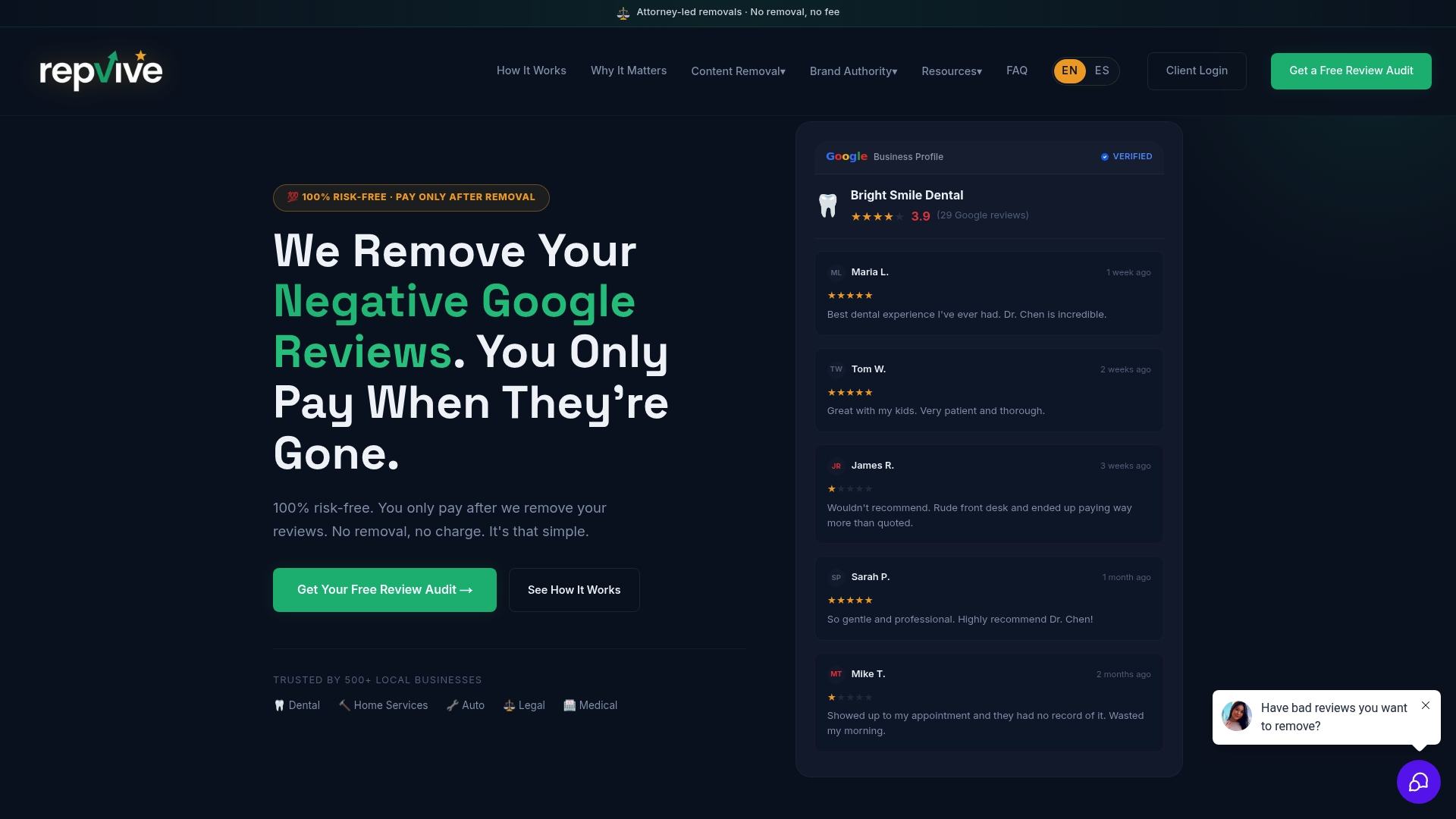
Repvive works with small and mid-size businesses across industries facing coordinated fake-review campaigns. The process covers evidence packaging, legal notice drafting, and direct platform escalation. With a 99% success rate on Google review removals, it’s the escalation path for cases where the standard reporting workflow has already failed. If you’re dealing with a documented attack, start your removal case at repvive.co today.
Useful sources
- Google Business Profile Help: Report inappropriate reviews, official Google policy on prohibited content and the step-by-step reporting and appeal process (supports Sections 2 and 4)
- KD Interactive: What to do when a competitor leaves a bad review, practitioner guidance on choosing “Conflict of interest” to trigger human review (supports Sections 1 and 2)
- TomatoTree Digital: How to report competitor fake reviews on Google, workflow guide with response timelines (supports Sections 4 and 8)
- ReviewPilot: How AI detects fake Google reviews, evidence package methodology and documented removal success rates (supports Sections 3, 6, and 8)
- FiveBlocks: Can ORM address competitor sabotage? Multi-track response strategy and AI summary risk (supports Sections 6 and 7)
- CoreVouch: Fake Reviews in 2026, coordinated attack tactics and verified-purchase defenses (supports Sections 7 and 9)
- SSRN: Research into review fraud, academic analysis of suspicious review concentration in competitive niches (supports Section 9)
- TrustGrowMedia: Why market actors write bad reviews about competitors, competitor motive analysis and platform sanction risk (supports Sections 9 and Perspective)
FAQ
What is the fastest way to report a fake competitor review on Google?
Go to your Google Business Profile, select “Read reviews,” click “Report” next to the review, and choose “Conflict of interest.” This routes the report to a human moderator rather than automated spam filters, which is the fastest path to an actual decision.
How long does Google take to remove a fake review?
Automated decisions typically arrive within 3, 7 days; human review after a conflict-of-interest flag or formal appeal runs 7, 21 days. If the review remains after 21 days, escalate through the GBP Help Community or file a formal appeal via the Reviews Management Tool.
Can I take legal action against a competitor for fake reviews?
Yes. Legal options include cease-and-desist letters, defamation claims, and unfair competition claims under state law. An attorney-led service like Repvive can package your evidence and pursue removal through direct legal channels when platform reporting has stalled.
What evidence do I need to get a fake review removed?
Timestamped screenshots of the review and reviewer profile, CRM records showing no matching transaction, a velocity log of suspicious review activity, and any public links connecting the reviewer to a competitor. Compiled into a single PDF, this package materially increases removal success rates.
Does responding to a fake review help my case?
A professional public response demonstrates good faith to future customers and can support a platform appeal. Keep it brief: state you have no record of the transaction and invite the reviewer to contact you offline. Never speculate publicly that the review is from a competitor.