U.S. Legal Playbook: Unmask an Anonymous Reviewer or Take Safer Steps
Yes, but only through a court order, and only after clearing a real evidentiary bar. U.S. courts will not unmask an anonymous reviewer just because a business owner is angry or embarrassed. Most jurisdictions demand a prima facie showing of defamation, or something close to it, before a subpoena to reveal the reviewer’s identity gets approved. Pure opinion stays protected under the First Amendment, and truth remains an absolute defense, so unmasking is possible but genuinely rare.
TL;DR:
- Courts require a strong evidentiary showing, such as proof of false factual statements and damages, before unmasking a reviewer through a court order.
- Filing for unmasking involves preserving all evidence, drafting specific subpoenas, and preparing for lengthy contested hearings that can last several months to over a year.
- Most cases rely on established legal standards like the Dendrite or Cahill tests, which demand a prima facie proof of defamation before revealing identities.
- Alternative approaches, such as platform policy enforcement and public factual responses, are usually faster, cheaper, and more effective in managing harmful reviews.
- Attorney-led review removal services offer a pay-per-removal model that can resolve fake or false reviews quickly without the risks and costs of litigation.
Table of Contents
- What Legal Standards Must You Meet to Unmask an Anonymous Reviewer?
- How Do You Actually File to Identify an Anonymous Reviewer?
- Which Court Cases Actually Decide These Disputes?
- Is Unmasking a Reviewer Worth the Cost and Risk?
- What Can You Do Instead of Suing to Unmask a Reviewer?
- What Do Legal Practitioners Say About Attorney-Led Review Removal?
- Why Restraint Usually Beats Litigation
- How Repvive Handles Reviews Without a Courtroom Fight
- Sources
- FAQ
What Legal Standards Must You Meet to Unmask an Anonymous Reviewer?
Courts treat identity disclosure as a serious intrusion on anonymous speech, so they built specific tests to filter out weak or retaliatory claims before a reviewer’s name gets handed over. Two frameworks dominate.
The Dendrite test, from Dendrite Int’l, Inc. v. Doe No. 3, requires the plaintiff to notify the anonymous poster, identify the exact defamatory statements, and present a prima facie case on every element of defamation before a judge even weighs the reviewer’s First Amendment interest against the business’s need for the name. The Cahill standard, from Doe v. Cahill, tightens that further in some jurisdictions by requiring evidence that could survive a summary judgment motion, essentially treating the disclosure request like a mini trial on the merits.
Some states skip judge-made tests entirely and rely on statutes with lower thresholds. Virginia’s approach has let plaintiffs use a state statutory procedure that doesn’t demand the same depth of evidence as Dendrite or Cahill, which is part of why the same review can survive in one state and lose protection in another, according to Moore Barlow’s analysis of unmasking cases.
Regardless of the test, plaintiffs still have to prove the underlying defamation elements:
- A false statement of fact, not opinion or hyperbole
- Publication to a third party (a public review qualifies)
- Identification of the plaintiff, even without naming them directly
- Fault, typically negligence for private businesses
- Actual or presumed damages tied to the statement
A review calling a contractor “the worst I’ve ever hired” is opinion. A review claiming “they took my $10,000 deposit and never showed up” is a factual claim a court can test for truth.
How Do You Actually File to Identify an Anonymous Reviewer?
Getting a court order takes preparation before you ever draft a subpoena. Courts and platforms both want to see that you did the groundwork.
- Preserve everything first. Screenshot the review with visible dates and timestamps, save the native URL, and pull business records (invoices, appointment logs, service tickets) that contradict the claim. Courts want a paper trail showing the statement is factually false, not just unflattering.
- Draft a narrowly tailored subpoena. Requests for “all records” get challenged. Ask instead for specific fields, such as account creation date and login IP addresses tied to a defined window, since narrow requests move faster and survive motions to quash more often, according to JD Supra’s coverage of Washington’s disclosure standard.
- File the motion to compel and expect resistance. Platforms rarely hand over identity data voluntarily. Many will notify the reviewer and give them a window to object, and some will fight the subpoena outright if it looks overbroad.
- Prepare for a hearing, and possibly an appeal. Contested unmasking motions can run several months to over a year once you account for briefing schedules and potential appellate review.
Platforms typically hold two kinds of data: account metadata (email, signup date, device type) and connection logs (IP addresses, login timestamps). Neither is unlimited. Federal privacy statutes and platform retention policies mean IP logs beyond a certain window may simply no longer exist, which can kill an otherwise solid case before it starts.
Which Court Cases Actually Decide These Disputes?
A handful of rulings shape almost every unmasking motion filed in the U.S. today, and each one answers a slightly different question about how much proof a plaintiff owes before a judge reveals a stranger’s identity.
- Dendrite Int’l, Inc. v. Doe No. 3 set the multi-step prima facie framework that many state courts still cite as the baseline test for anonymous speech cases.
- Doe v. Cahill pushed the bar higher in jurisdictions that adopted it, requiring evidence strong enough to survive summary judgment rather than just a plausible complaint.
- Thomson v. Doe, decided by the Washington Court of Appeals, refused to unmask a reviewer because the business relied on pleading alone instead of actual evidence, and the court explicitly favored the prima facie approach over a lower bar. The full opinion is available through Washington’s courts website.
- Yelp v. Hadeed ran through Virginia’s statutory process rather than Dendrite or Cahill, showing how a state law can override the judge-made tests and produce a different outcome for a similar fact pattern.
- The CrossFit peer-review case stands out as an outlier where a court ordered disclosure of anonymous reviewers in a research dispute. Commentary around that ruling stresses it turned on unusual facts and doesn’t function as broad precedent for retail or service-business review cases, per Science’s reporting on the decision.
Is Unmasking a Reviewer Worth the Cost and Risk?
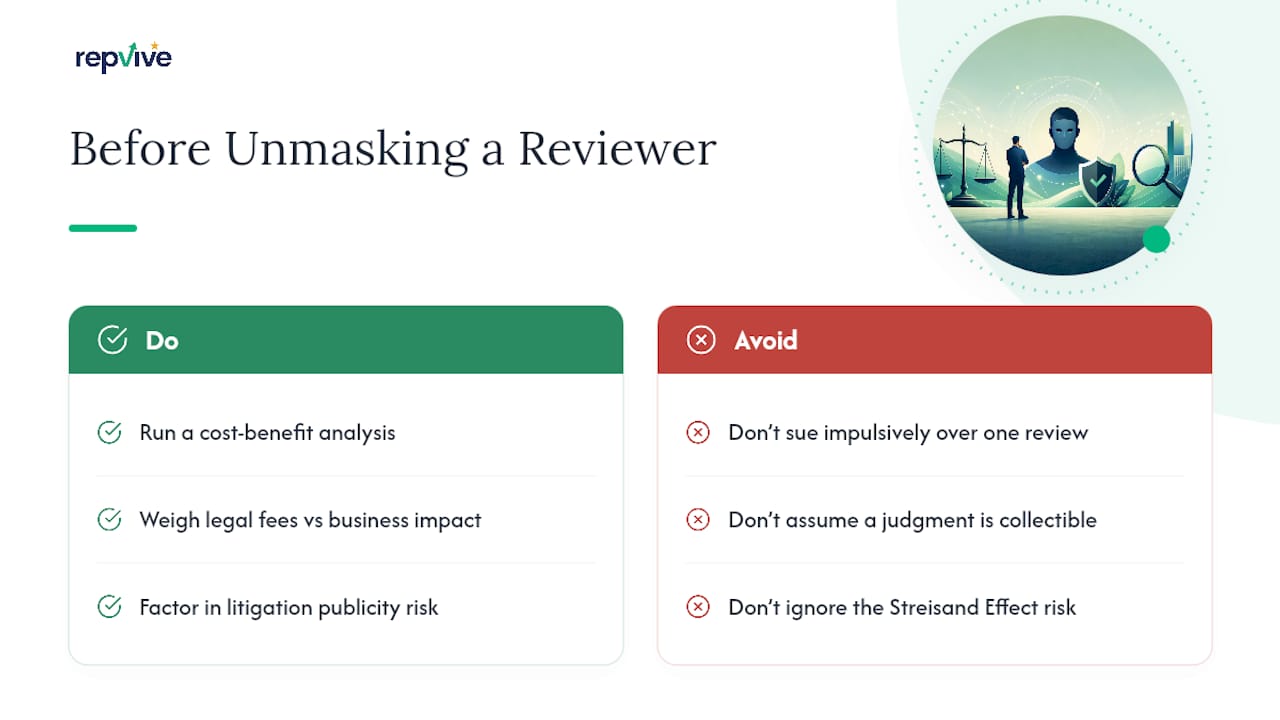
Filing suit to reveal a reviewer’s identity can backfire before you ever get a name. Litigation draws attention, and a lawsuit against an anonymous critic can turn a single one-star review into a news story, a phenomenon commonly called the Streisand Effect. Local reporters and industry forums have picked up small-business defamation suits and amplified the original complaint far past its original reach.
Costs run from several thousand dollars for a straightforward motion to well into six figures if the case gets contested and appealed. Even a successful unmasking doesn’t guarantee recovery. Judgment-proof defendants and reviewers who can’t be served can leave a business with a name, a legal bill, and nothing collectible.
Pro Tip: Before filing anything, run a cost-benefit analysis that weighs legal fees against the review’s actual business impact, factoring in the risk that litigation itself becomes the story people remember.
What Can You Do Instead of Suing to Unmask a Reviewer?
Most reputation damage gets resolved without ever learning who wrote the review. Platform policies and public responses tend to work faster and cost less than litigation, which is why most attorneys treat unmasking as a last resort rather than a first move.
- Use platform takedown policies. Google, Yelp, and similar platforms will remove reviews that violate their terms, including fake accounts, conflicts of interest, or verifiably false factual claims, if you document the violation clearly.
- Respond publicly with facts only. State what actually happened, offer to continue the conversation privately, and avoid language that reads as an admission of fault. A calm, factual reply often does more for prospective customers than the original review did damage. A guide on responding to a defamatory review walks through the wording that tends to work.
- Escalate through an attorney-led removal claim. A law firm can submit a legal claim directly to the platform citing specific policy violations or defamation elements, often resolving the issue without a subpoena or a lawsuit at all.
- Combine both tracks when the stakes justify it. Some businesses send a platform escalation first and hold litigation in reserve if the review causes measurable revenue loss.
Courts also tend to look more favorably on plaintiffs who tried less intrusive remedies before filing suit, so a documented takedown attempt can strengthen a later legal claim rather than waste time.
What Do Legal Practitioners Say About Attorney-Led Review Removal?
Attorney-led removal services build legal claims around specific platform violations, such as false factual statements or fake accounts, and escalate them directly to the platform rather than filing suit. An attorney-led removal service uses this model with a pay-per-removal structure, meaning businesses pay only after a review actually comes down. That approach fits business owners who want resolution without the cost or exposure of a defamation lawsuit.
When the goal is removal rather than identity, escalating a specific legal claim to the platform often resolves the problem faster than any subpoena would.
Choosing counsel for an unmasking case is its own decision. Look for a lawyer with actual internet-discovery experience, not just general litigation background, since subpoena drafting and platform negotiation are specialized skills.
Why Restraint Usually Beats Litigation
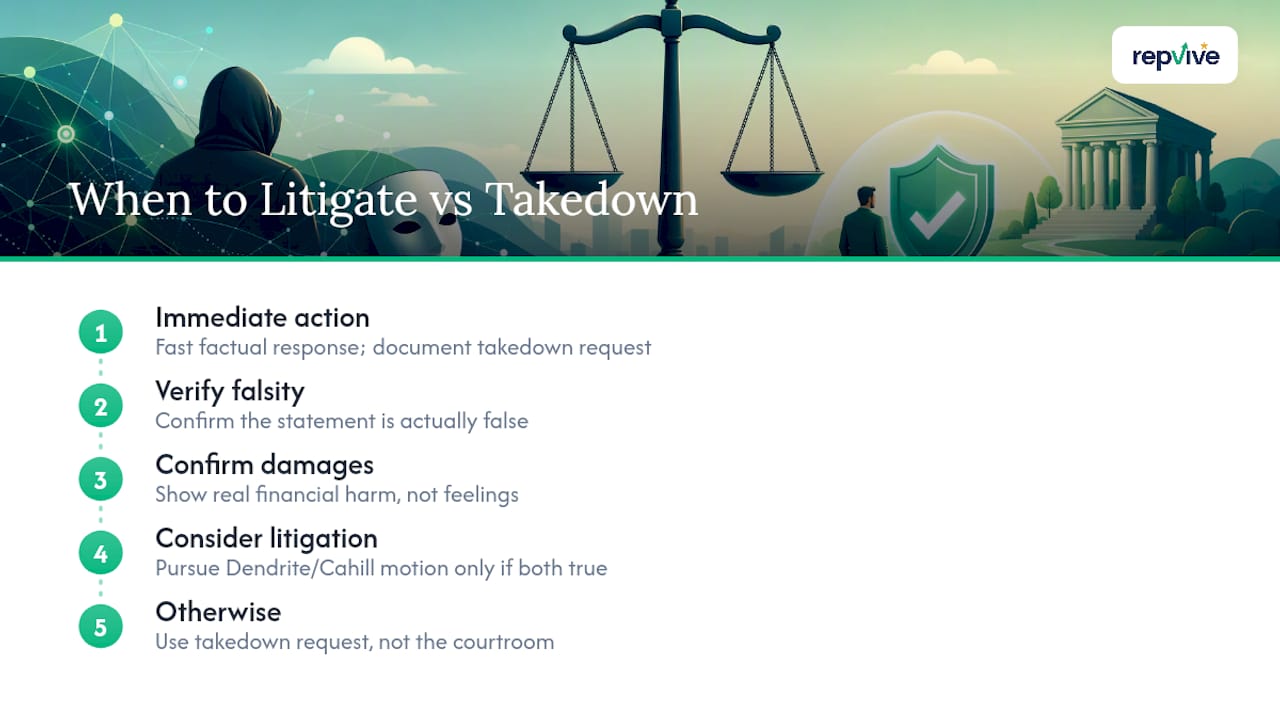
Most businesses that come to me asking about unmasking a reviewer don’t actually need a subpoena. They need a fast, factual response and a documented takedown request. Save litigation for cases with real evidence of falsity and real financial damage. A defamation suit without both is a bad bet dressed up as vindication.
For counsel advising business owners: verify the statement is factual and false, confirm damages exist beyond hurt feelings, and only then discuss the cost of a Dendrite or Cahill motion. Anything short of that belongs in a takedown request, not a courtroom.
— Jason
How Repvive Handles Reviews Without a Courtroom Fight
Litigation to unmask a reviewer can take months, cost tens of thousands of dollars, and still leave you without a collectible judgment. Repvive skips that entire process. Its attorney-led team builds a customized legal claim for each negative review and escalates it directly through Google, Yelp, Facebook, TripAdvisor, Trustpilot, BBB, and over twenty other platforms, aiming for removal rather than identification.
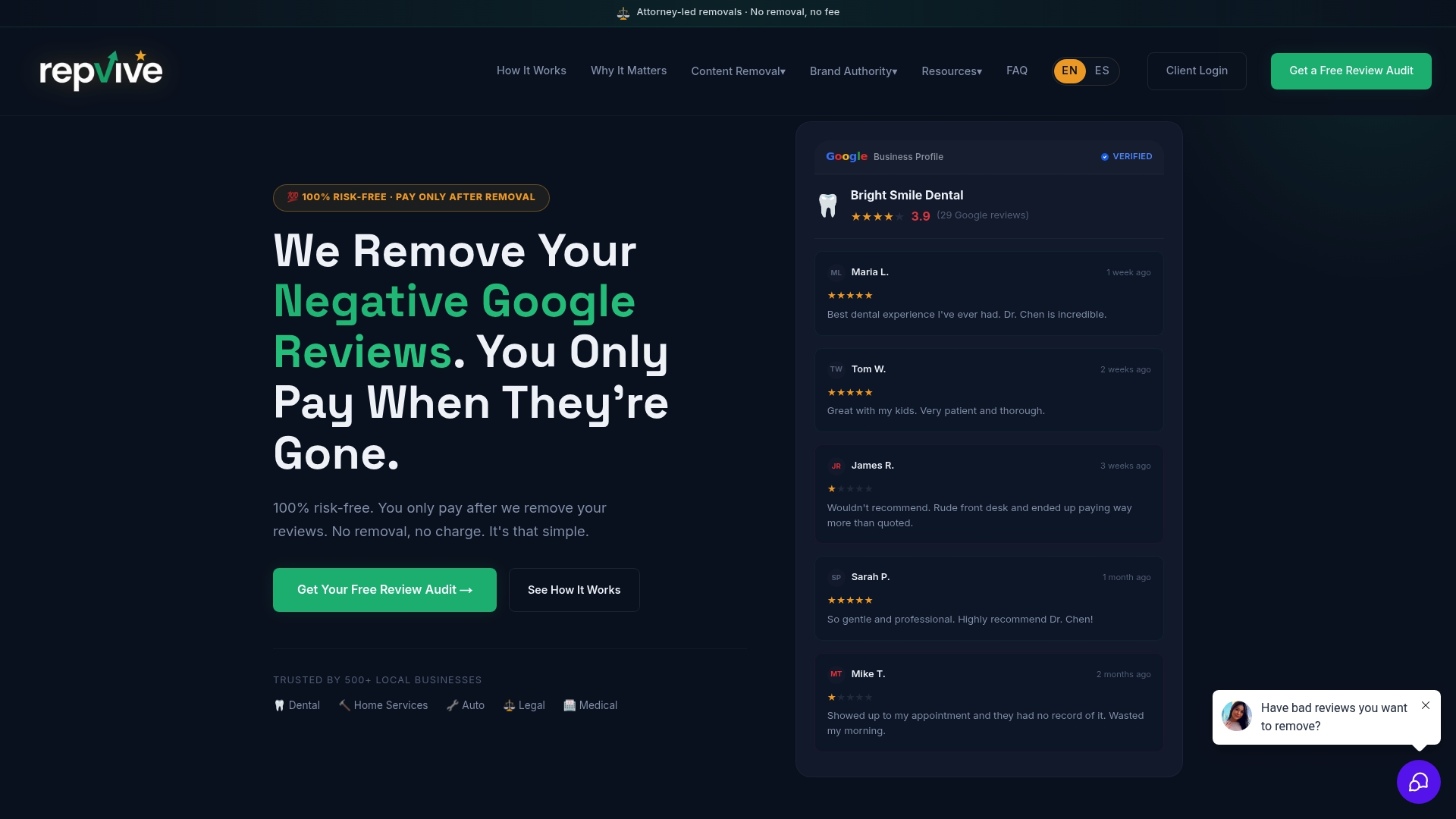
The pay-per-removal model means no upfront fees. You pay only after a review is confirmed gone, tracked through a real-time dashboard so you can see exactly where each claim stands. This fits business owners who want the false or unfair review handled quickly, without the Streisand Effect risk or the legal spend that comes with a full unmasking lawsuit. If a factual response and a documented takedown request haven’t cleared the problem, Visit the removal service website to see whether an attorney-led claim can get the review removed instead.
This article is general information, not a substitute for advice from a qualified lawyer. Consult a qualified legal professional about your own circumstances before acting on anything here.
Sources
- Washington State Court Refuses to Unmask Anonymous Online Reviewer | JDSupra
- In unusual move, judge grants CrossFit’s request to unmask anonymous peer reviewers | Science
- Thomson v. Doe (Washington Court of Appeals opinion)
FAQ
Can a business legally unmask an anonymous reviewer?
Yes, but only through a court order after meeting an evidentiary standard like the Dendrite prima facie test or the stricter Cahill summary-judgment standard.
Is a negative review automatically defamation?
No. A review must contain a false statement of fact, not opinion, and must cause provable harm; truth is an absolute defense.
How long does an unmasking lawsuit take?
Contested cases commonly run several months to over a year once briefing, hearings, and potential appeals are factored in.
What information do review platforms actually have on reviewers?
Platforms typically hold account metadata like signup dates and device type, plus login IP logs, though retention windows limit how far back that data goes.
Is there a faster alternative to suing to remove a bad review?
Yes. Attorney-led removal services like Repvive submit legal claims directly to platforms under a pay-per-removal model, often resolving fake or false reviews without litigation.