Lawyer Checklist: Court Orders to Remove a Review for U.S. Owners
Lawyer Checklist: Court Orders to Remove a Review for U. S.
Lawyer Checklist: Court Orders to Remove a Review for U.S. Owners
A narrowly drafted court order that names the exact URL, quotes the exact text, and includes a judicial finding that the statement is unlawful is the only court route that reliably prompts Google to remove a review. Everything looser than that either gets ignored or takes months longer than simply reporting the review through Google Business Profile. Litigation makes sense when you can prove specific facts are false and identify who wrote them. If you can’t clear that bar, platform reporting is faster, cheaper, and often just as effective.
TL;DR:
- A specific court order that includes the exact URL, quoted text, and a legal finding of unlawfulness is the most effective way to prompt Google to remove a review within a short timeframe.
- Litigation is only justified if you can identify the reviewer, prove the false statement, and demonstrate measurable harm, as vague or anonymous reviews are typically protected opinion.
- Building a comprehensive evidence record, including screenshots, business records, and communication logs, is essential before initiating legal action or reporting to Google.
- Orders should be narrowly drafted, targeting only the specific review and statement, with exact language and certified copies, to avoid rejection by Google’s legal team.
- Most disputes should be resolved through platform reporting, direct outreach, or strategic responses, reserving court action for provable, serious harm cases.
Table of Contents
- How Google Evaluates a Court Order to Remove a Review
- When Should You Pursue Legal Action Against a Negative Review?
- The Legal Route to Removing a Review: A Step-by-Step Workflow
- What a Court Order Must Say to Get Google’s Attention
- Submitting the Order to Google and What Happens Next
- Section 230, Case Law, and the Real Limits of Legal Action
- Alternatives That Often Work Faster Than a Lawsuit
- How an Attorney-Led Removal Process Actually Works
- What Business Owners Should Actually Expect
- Get Attorney-Led Review Removal Without the Guesswork
- Where to Verify the Rules Yourself
- Sources
- FAQ
How Google Evaluates a Court Order to Remove a Review
Google’s legal team reviews removal requests voluntarily, and it treats them very differently from a standard content-policy flag. A policy complaint (spam, harassment, off-topic content) goes through Business Profile support. A legal removal request, the kind backed by a court order, goes through a separate legal webform built specifically for that purpose.
The form asks for two things Google will not compromise on: the exact URL of the offending review and the exact text you want removed. An order that says “remove all negative reviews about [Business]” gets rejected. An order that says “remove the review at [specific URL] containing the sentence ‘[exact quote]’” has a real shot.
To improve your odds before you ever file anything:
- Capture a dated, unaltered screenshot of the review, including the reviewer’s profile name and the URL bar.
- Log the review’s posting date and any changes it undergoes over time.
- Save internal business records (appointment logs, invoices, service tickets) that contradict the reviewer’s claims.
- Note whether the reviewer ever transacted with your business at all.
Courts and Google both want specificity. Vague requests waste everyone’s time.
When Should You Pursue Legal Action Against a Negative Review?
Litigation is a tool for provable falsity, not for hurt feelings. Before you call a lawyer, run through this quick gut check:
- Do you know who wrote it? If the reviewer used their real name or you can identify them through prior business dealings, you have a defendant to name.
- Can you prove the core claim is false? “Worst service ever” is opinion. “They stole my credit card number” is a factual claim you can potentially disprove with records.
- Did it cause measurable harm? Lost bookings, canceled contracts, or a documented revenue dip strengthen your case far more than general embarrassment.
If the review is anonymous, purely a star rating with no text, or reads as subjective opinion (“I didn’t like the food”), a court order to remove a review probably won’t help. Section 230 and basic defamation law protect opinion speech, and judges know it.
Timeline and cost vary widely. Emergency injunctive relief can move in a matter of weeks if a judge agrees the harm is urgent and immediate. Full-blown defamation litigation, including discovery and a final judgment, commonly runs several months to over a year, with legal fees that can be significant and may exceed any estimated revenue lost due to the review.
Pro Tip: Before spending a dollar on legal action, calculate what the review is actually costing you in lost business. If you can’t point to a number, a court order to remove a review is probably the wrong tool for the job.
The Legal Route to Removing a Review: A Step-by-Step Workflow
Getting a court order isn’t a single filing, it’s a sequence of moves that build a record a judge can act on.
1. Build your evidence file first. Before contacting anyone, assemble:
- Screenshots of the review with visible URL and timestamp
- Business records that contradict the claims (receipts, appointment books, communication logs)
- Any prior correspondence with the reviewer
- A record of the business impact, if measurable (cancellations, refund requests tied to the review)
2. Send presuit notices while pursuing platform options in parallel. A demand letter to the reviewer, if you know who they are, sometimes resolves things without ever seeing a courtroom. A preservation letter reminds the platform and the reviewer not to delete evidence. None of this stops you from also flagging the review through Google Business Profile’s reporting tool at the same time. Running both tracks costs nothing extra and sometimes resolves the problem before litigation even starts.
3. Use subpoenas to unmask anonymous reviewers. If you don’t know who left the review, your attorney can file a petition for pre-suit discovery or issue a subpoena to Google or the hosting platform to reveal account information tied to the post. This step is frequently skipped by business owners trying to shortcut the process, and it’s usually the reason a case stalls. Subpoena readiness, meaning having the right forms drafted before you need them, speeds this stage considerably.
4. File the complaint and request injunctive relief. Once you have a named defendant and documented falsity, your attorney files a complaint (commonly for defamation, false light, or tortious interference) and requests a preliminary injunction ordering removal. If the reviewer doesn’t respond, you may be able to secure a default judgment that still carries the injunctive language Google requires.
The entire chain, evidence, notice, subpoena, filing, judgment, is what separates an order Google acts on from one that sits in a queue.
What a Court Order Must Say to Get Google’s Attention
The single biggest reason legitimate court orders get rejected isn’t fraud, it’s sloppy drafting. Google’s legal team is looking for specific language, and generic boilerplate from a template doesn’t cut it.
Your order needs:
- The exact URL of the review, not just the business profile page.
- The verbatim text of the statement being ordered removed, quoted directly, with the original screenshot attached as an exhibit.
- A judicial finding that the statement is unlawful, and why (defamation, impersonation, false statement of fact), not just an agreement between parties.
- Narrow scope language limited to the specific post and statement, not “any future negative content” or similarly open-ended phrasing.
- A certified copy with the clerk’s signature and case number, since uncertified or informal copies raise red flags for platform legal reviewers.
Pro Tip: Ask your attorney to draft the order using the same language Google’s webform asks for, exact URL, exact text, and a finding of unlawfulness, before it ever goes in front of a judge. Retrofitting a vague order after the fact costs more time than getting it right the first time.
Submitting the Order to Google and What Happens Next
Once you have a signed order, it goes through Google’s dedicated legal removal webform, not the general Business Profile complaint tool. Attach the certified copy, the exact URL, and a clear explanation of what the court found.
A few things to expect:
- Google’s legal team may take days to weeks to respond, and it commonly follows up by email asking for clarification or a certified copy if you didn’t submit one originally.
- If your Business Profile is also involved, you can escalate through Business Profile support to track status alongside the legal submission.
- If Google declines to act, your options include going back to the court for clarified or amended language, filing an enforcement motion against the reviewer directly, or narrowing the order’s scope and resubmitting.
Monitor your email closely during this window. Missing a clarification request from Google’s legal team is one of the most common reasons a valid order stalls for months.
Section 230, Case Law, and the Real Limits of Legal Action
The Communications Decency Act’s Section 230 gives platforms broad immunity from liability for content users post, which is precisely why Google can simply ignore a court order aimed at the platform itself rather than the reviewer. Your order has to target the unlawful statement, not demand that Google police its own site.
Hassell v. Bird, decided by the California Court of Appeal, is the case every attorney working this space knows. A business owner won a default judgment against a former client for defamatory reviews and then tried to force Yelp to remove them under that judgment. The court found Yelp wasn’t a party to the original suit and couldn’t be bound by an order it never had a chance to contest, reinforcing that removal orders need to be narrowly tied to the specific defendant’s statements, not blanket demands directed at the platform.
That ruling, along with later federal opinions applying Section 230, sets clear boundaries:
- Orders demanding removal of “any future negative content” invite reversal as improper prior restraints.
- Platforms that weren’t party to the underlying suit can resist compliance entirely.
- The narrower and more specific your order, the less exposure it has on appeal.
Practitioners consistently frame litigation as a tool of last resort, reserved for provable, serious harm, not routine reputation friction. Most disputes never need a courtroom at all.
Alternatives That Often Work Faster Than a Lawsuit
Before you file anything, exhaust the free and low-cost options:
- Flag the review through Google Business Profile and use the one-time appeal if it violates content policy.
- Reach out to the reviewer directly and ask for an edit or removal, especially if the dispute stems from a misunderstanding rather than malice.
- Contact the site owner if the content lives outside Google, some smaller platforms respond to direct outreach faster than Google does.
- Solicit new, legitimate reviews consistently so a handful of bad ones don’t dominate your rating.
- Respond publicly and professionally to every negative review, since prospective customers read your responses as closely as the reviews themselves.
Remember that under the Consumer Review Fairness Act, you cannot use contract language to penalize customers for honest reviews, so any strategy has to stay on the right side of that line.
How an Attorney-Led Removal Process Actually Works
Getting from “this review is hurting my business” to “Google removed it” requires legal precision most business owners aren’t equipped to handle alone. A process that starts with attorney evidence review, checking whether the review contains provably false statements, impersonation, or other unlawful content before any legal action begins.
From there, the workflow typically includes:
- Identifying whether a subpoena is needed to unmask an anonymous reviewer.
- Drafting removal orders using the exact URL, exact text, and unlawfulness-finding language Google’s legal team requires.
- Submitting through Google’s official legal channels and following up on clarification requests.
- Tracking every submission through a real-time dashboard so business owners aren’t left guessing about status.
The difference between a DIY complaint and an attorney-led one usually comes down to exactly the drafting precision Google’s system demands.
What Business Owners Should Actually Expect
The court order to remove a review path exists for a narrow category of harm: provably false statements, identifiable authors, and measurable damage. It was never built for legitimate criticism, and it shouldn’t be used to silence a customer who simply had a bad experience.
If you’re in that narrow category, the smartest first moves are the least dramatic ones: document everything, preserve the evidence before it disappears, and talk to counsel before you talk to a judge. Most business owners who skip straight to litigation end up spending more time and money than the review ever cost them. The ones who build the record first, then decide whether court action is warranted, get better outcomes and spend less doing it.
If your situation genuinely fits, an attorney-led intake process built around this exact workflow is worth exploring before you draft anything yourself.
— Jason
Get Attorney-Led Review Removal Without the Guesswork
Repvive is built for exactly the scenario this guide walks through: false, damaging reviews that meet the legal bar for removal but need precise, attorney-drafted language to actually get through Google’s process. Instead of a flat fee for a form letter, Repvive works on a pay-per-removal model, no upfront cost, and you pay only once a review is confirmed removed.
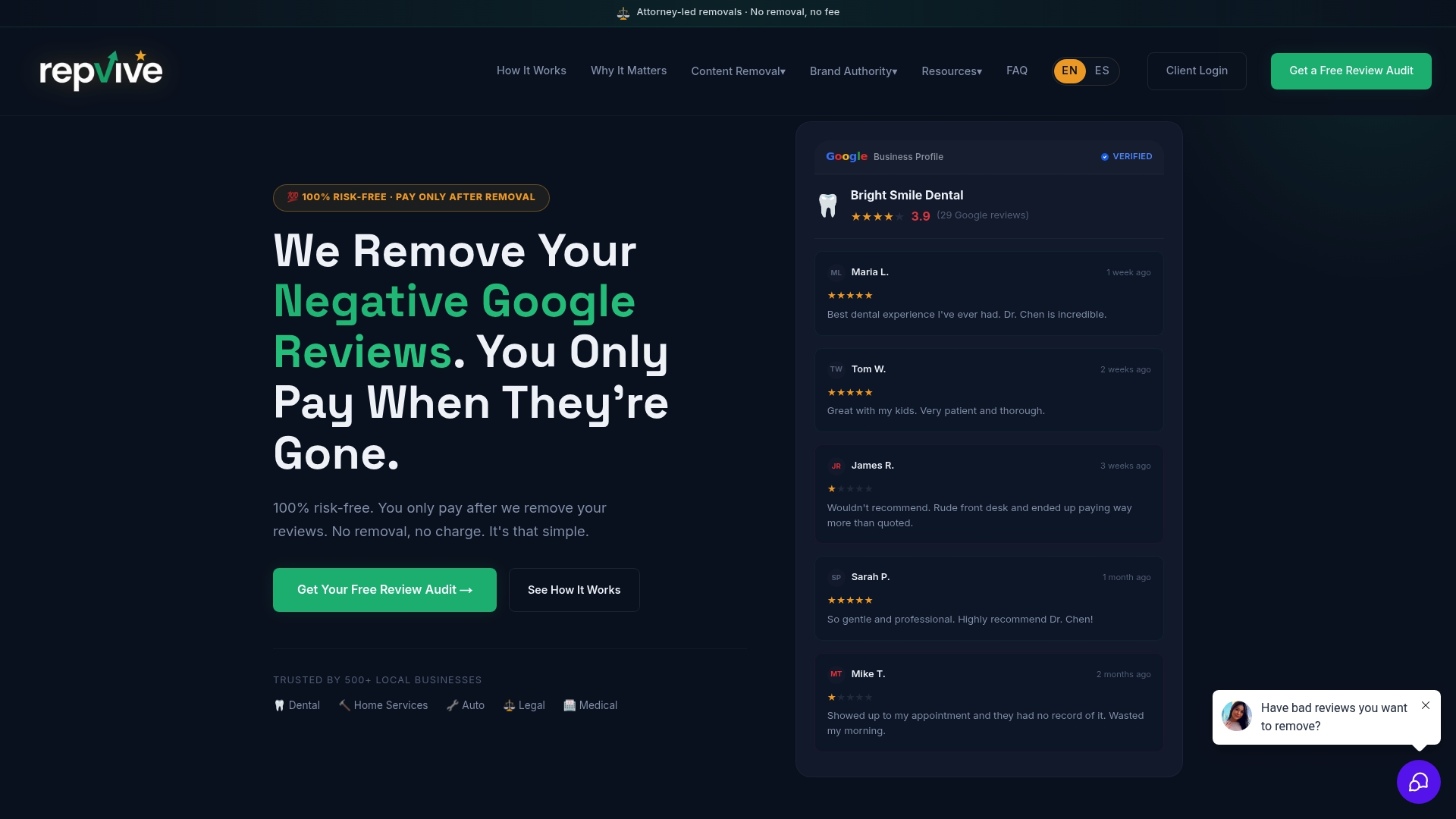
Every claim gets reviewed by a legal team who determine whether a review qualifies for legal removal, platform appeal, or a combination of both, then handle the drafting, submission, and follow-up with Google directly. If you run a restaurant, law firm, auto shop, or medical practice, industry-specific guidance is available too, including for restaurants and hospitality businesses navigating a similar problem. Start by having your case reviewed through Repvive’s Google review removal service to find out whether your situation qualifies before you spend anything on legal fees.
Where to Verify the Rules Yourself
- Google’s legal removal webform explains what a court order must contain to be considered.
- Google Business Profile’s review reporting page covers flagging and appeals.
- FTC’s Consumer Review Fairness Act guidance outlines what businesses cannot do to suppress honest reviews.
- MSBA’s lawyer-authored guide walks through practitioner-level strategy.
Sources
- Report Content for Legal Reasons - Legal Help (Google Support)
- Report inappropriate reviews on your Business Profile - Google Business Profile Help
- It’s illegal to ban or penalize customers for honest reviews (FTC Business Guidance)
- A Lawyer’s Guide to Removing False Google Reviews (Maryland State Bar Association)
FAQ
Is It Legal to Remove a Bad Review?
Yes, when the review contains false statements of fact or unlawful content like defamation or impersonation, removal through a properly drafted court order or platform appeal is legal.
Is It Illegal to Hide or Suppress Honest Reviews?
Yes. Under the Consumer Review Fairness Act, businesses cannot use contracts or penalties to suppress or hide honest customer feedback.
Can I Sue Someone Over a Bad Google Review?
You can sue if the review contains a false statement of fact that caused measurable harm, but pure opinion, like “I didn’t enjoy my meal,” generally isn’t grounds for a defamation claim.
Is It Illegal to Leave a Negative Review?
No. Leaving a truthful, opinion-based review is protected speech; it only becomes legally actionable when it contains knowingly false factual claims.
How Long Does a Court Order to Remove a Review Take?
Emergency injunctive relief can take a few weeks, while full litigation through judgment commonly runs several months depending on court schedules and whether the reviewer contests the case.