Can You Sue for Fake Reviews? What U.S. Owners Need to Know
Yes, but only when the review makes a provably false statement of fact that caused you measurable harm. A reviewer’s negative opinion about your food...
Yes, but only when the review makes a provably false statement of fact that caused you measurable harm. A reviewer’s negative opinion about your food, service, or attitude is protected speech, no matter how unfair it feels. If you can show the claim is factually false, that it was published to others, and that it cost you real money, litigation becomes realistic. Start by preserving every piece of evidence now, then weigh a platform complaint or a lawyer for fake reviews before filing anything.
TL;DR:
- A fake review qualifies as defamation only if it contains provably false factual claims, was published to others, caused measurable harm, and was written with negligence or malice.
- Strong evidence, including screenshots, review URLs, private messages, and internal records, is essential before filing a complaint or lawsuit to ensure case viability.
- Most fake review issues are better resolved through platform policy enforcement and detailed reporting, as legal action against platforms is limited by Section 230 protections.
- Legal remedies include demand letters, subpoenas for anonymous reviews, and monetary damages, but anti-SLAPP statutes can dismiss weak or retaliatory claims.
- The best approach depends on the strength of the falsity and damages, with documented proof and timely evidence preservation being key to successful resolution.
Table of Contents
- When Does a Fake Review Qualify as Defamation vs. Protected Opinion?
- What Evidence Do You Need Before Filing a Complaint?
- What Legal Options Exist Beyond a Lawsuit?
- Can You Force a Platform to Remove a Fake Review?
- What Are the Risks of Suing Over a Bad Review?
- How Do Attorneys Evaluate a Fake Review Case?
- The Legal Threshold Gets Misunderstood More Than It Should
- How Repvive Handles Fake Review Removal for You
- Where to Verify the Legal Details Yourself
- Sources
- FAQ
When Does a Fake Review Qualify as Defamation vs. Protected Opinion?
Courts draw a hard line between opinion and fact, and that line decides whether you can sue for fake reviews at all. “The food was overpriced” is opinion. “This restaurant served me food that gave me salmonella poisoning” is a factual claim you can prove true or false. If it’s false, you may have a case for defamation.
To win a defamation from fake reviews claim, you generally need to prove four things:
- Falsity: the statement is objectively untrue, not just harsh
- Publication: it was shared with at least one third party (a public review site counts)
- Fault: the reviewer acted negligently or, in some states, with actual malice
- Damages: you suffered quantifiable harm, like lost bookings or revenue
Most states set a statute of limitations for defamation between one and three years, and some start the clock the moment the review posts rather than when you discover it. Waiting months to act can quietly kill a valid claim.
Certain accusations get treated as defamation per se, meaning damages are presumed without extra proof. False claims that you committed a crime, have a contagious disease, or engaged in professional misconduct (a doctor accused of malpractice that never happened, for instance) often fall into this category.
What Evidence Do You Need Before Filing a Complaint?
Evidence quality decides whether a platform removes a review or a court takes your case seriously. Grab everything before a reviewer edits or deletes their post, because edited history rarely survives on its own.
- Take full-page screenshots showing the date, reviewer name, star rating, and full text.
- Save the direct review URL and archive it through a service like the Wayback Machine.
- Capture the reviewer’s profile page, especially if it shows a pattern of similar attacks on competitors.
- Preserve any private messages between you and the reviewer, including timestamps.
- Pull internal records that contradict the claim: POS logs, booking confirmations, staff schedules, or security footage timestamps.
- Document your financial impact with simple before-and-after numbers, like a week-over-week booking drop.
Pro Tip: Export your POS or booking software’s timestamp logs immediately after spotting a fake review. Many systems only retain detailed records for 90 days, and that data becomes critical if you later pursue a John Doe subpoena.
Also log every attempt you made to resolve the issue, including dates you flagged the review to the platform and any offer you extended to the reviewer to fix their complaint.
What Legal Options Exist Beyond a Lawsuit?
A demand letter is usually the first move. A well-drafted cease-and-desist identifies the false statement, cites the harm, and gives the reviewer a narrow window to retract before litigation starts. Many reviewers take posts down the moment they realize a lawyer is watching.
When the reviewer is anonymous, a John Doe action lets you file suit against an unnamed defendant while you subpoena the platform or the reviewer’s internet service provider for identifying information. Courts don’t grant this lightly. Most jurisdictions apply standards drawn from the Dendrite and Cahill line of cases, requiring you to show a legitimate, good-faith basis for the claim before a platform is forced to unmask the poster.
Once you know who wrote the review, or if you’re suing a known defendant, your complaint centers on defamation or business disparagement. Available remedies include:
- Monetary damages tied to provable lost revenue or reputational harm
- An injunction ordering the review taken down or barring further false statements
- In rare cases, punitive damages if the reviewer acted with clear malice
Settlement or a court-ordered takedown resolves most of these cases long before trial. Full damages awards are rarer and usually reserved for cases with hard financial proof.
Can You Force a Platform to Remove a Fake Review?
Rarely, and almost never through a lawsuit against the platform itself. Section 230 of the Communications Decency Act shields platforms like Google and Yelp from liability for content their users post, so suing Google directly over a fake review almost always fails.
Your leverage instead comes from policy violations and federal law. When you report a review to Google, cite specific policy violations, such as conflict of interest, impersonation, or off-topic content, rather than just calling it “false.” Documentary proof (staff schedules showing the reviewer was never a customer, for example) moves requests forward faster than a defamation argument alone.
- Frame removal requests around platform policy language, not just “this is fake”
- Attach your evidence file directly to the report where the platform allows it
- Escalate to a business support channel if the standard flagging tool stalls
The FTC’s Trade Regulation Rule on consumer reviews, codified at 16 CFR § 465.2, makes it illegal to write, buy, or procure fake reviews. The FTC has signaled civil penalties can exceed fifty thousand dollars per violation, giving businesses a federal complaint path when they suspect a coordinated review-buying scheme rather than a single angry customer.
What Are the Risks of Suing Over a Bad Review?
Suing the wrong review can cost you more than the review itself. Most states have anti-SLAPP statutes designed to dismiss lawsuits that target protected speech, and if a court finds your claim was really an attempt to silence legitimate criticism, you may owe the defendant’s attorney’s fees.
Common defenses reviewers raise include truth (the statement was accurate), opinion (no factual claim was made), and lack of causation (your revenue dropped for reasons unrelated to the review). Weak claims built on hurt feelings rather than provable falsity are exactly what anti-SLAPP statutes exist to catch.
- Only pursue litigation when you can point to a specific false factual claim, not just a low star rating
- Quantify damages before filing; vague harm invites a quick dismissal
- Ask whether a demand letter or platform escalation could solve this without court exposure
- Weigh legal fees against the actual revenue at stake before committing
How Do Attorneys Evaluate a Fake Review Case?
Attorneys who handle these cases run a fast intake checklist: which state’s law applies, how much time is left on the statute of limitations, what documentary evidence exists, what the financial damages actually add up to, and who the likely defendant is (a real competitor, an anonymous troll, or a review-farm operation).
From there, the typical workflow runs preserve, demand, subpoena if needed, then motion or settlement. Most cases resolve at the demand or platform-escalation stage without ever reaching a courtroom.
- Gather your evidence file before the first attorney call, not after
- Ask any prospective lawyer for fake reviews how they price cases: flat fee, hourly, or contingency
- Confirm whether they’ve handled John Doe unmasking petitions before, since not every litigator has
Pro Tip: If your evidence points to a single obviously fabricated review rather than a broad coordinated attack, a DIY platform report paired with an attorney-led removal request often resolves the situation faster and cheaper than a full lawsuit.
The Legal Threshold Gets Misunderstood More Than It Should
Most guidance on this topic swings too hard in one direction. Either it tells owners to “lawyer up” over every one-star rating, or it tells them fake reviews are simply an unfortunate cost of doing business. Neither is right, and the research backs a narrower, more useful answer: litigation works when the falsity is specific and provable, and it backfires when it’s used to punish someone for having a bad opinion.
The overlooked piece is timing. Owners spend weeks arguing with a reviewer in the comments before they think to preserve a screenshot, and by then the reviewer has often edited or deleted the post entirely. Evidence preservation should be the first move, every time, before you’ve even decided whether to sue.
I’d also push back on the instinct to treat a lawsuit as the serious option and a platform report as the lightweight one. In practice, a well-documented policy complaint to Google resolves more fake reviews, faster, than most defamation suits ever will. Save litigation for the cases where the facts are strong and the damages are real.
, Jason
How Repvive Handles Fake Review Removal for You
Repvive is built for exactly the businesses this article describes: owners sitting on a fake review that’s clearly false but don’t want to gamble on a courtroom. The service is attorney-led, charges no upfront fees, and you pay only after a review is actually removed. That structure matters because it puts the financial risk on Repvive, not on you.
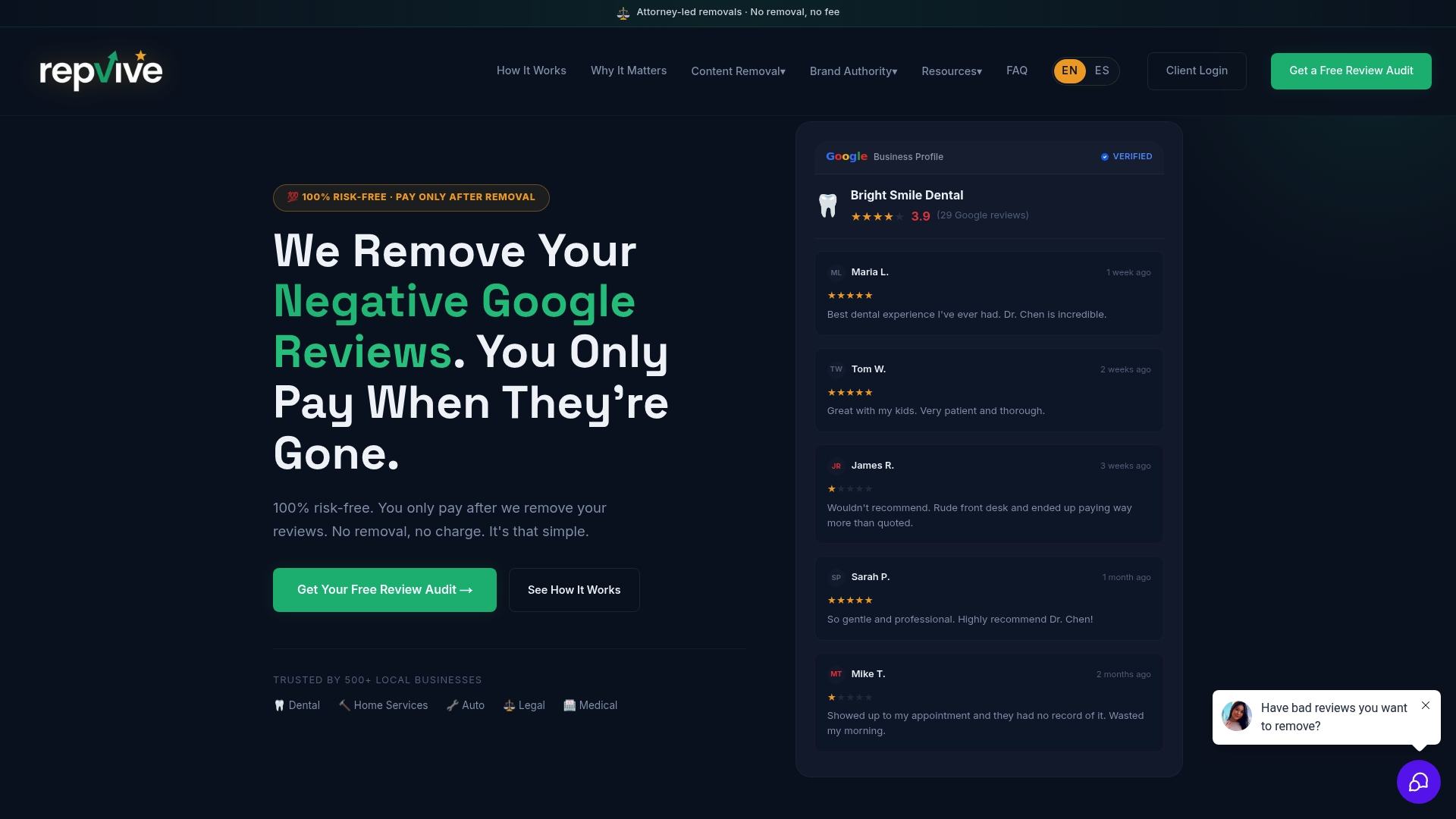
The strongest fits are anonymous fake reviews you can’t unmask on your own, coordinated competitor campaigns hitting your listing from multiple fake accounts, and reviews containing a specific, demonstrable lie, like a fabricated health violation or an accusation of fraud that never happened. Before reaching out, pull together your screenshots, the review URL, and any internal records (booking logs, staff schedules) that contradict the claim.
If a review is costing you customers and you can point to a concrete false statement, start with Repvive’s review removal service and let the legal team build the claim.
Where to Verify the Legal Details Yourself
For the underlying rules discussed here, review the FTC’s own consumer reviews rule guidance, the regulatory text at 16 CFR § 465.2, and the practitioner walkthrough in Catalyst Legal’s guide to proving a fake review case.
This article is general information, not a substitute for advice from a qualified lawyer. Consult a qualified legal professional about your own circumstances before acting on anything here.
Sources
- The Consumer Reviews and Testimonials Rule: Questions and Answers | Federal Trade Commission
- Defamation | Legal Information Institute (LII) / Cornell Law
- A Lawyer’s Guide to Removing False Google Reviews | Maryland State Bar Association
- Suing fake: what your business needs to prove | Catalyst Legal
FAQ
Can I sue someone for fake reviews?
Yes, if the review contains a false statement of fact (not opinion) that was published and caused measurable financial harm to your business.
Can I be sued for giving a bad review?
You can be sued if your review states false facts presented as true, but honest opinions and accurate accounts of your experience are protected speech and rarely support a defamation claim.
Is it worth suing for defamation over a fake review?
It’s worth it when you have strong documentary proof of falsity and quantifiable damages; without both, anti-SLAPP statutes and attorney’s fees can make litigation cost more than the harm itself.
Which companies are being investigated for fake reviews?
The FTC has authority to investigate and fine businesses or review brokers that create, buy, or sell fake reviews under its 2024 Trade Regulation Rule, though it does not publish a running public list of every target.
Recommended
- Legal Options for Fake Reviews: A Practical US Guide | Repvive
- The FTC Fake Reviews Rule: What U.S. Businesses Must Do Now | Repvive
- How to Report Competitor Fake Reviews: A Business Owner’s Guide | Repvive
- Fake Review Warning Signs Checklist for Local Businesses | Repvive
If you would rather have this handled, our Google review removal service reviews each case first and charges only when the content comes down.