U.S. Owners: Cease and Desist for Reviews Is Not a Court Order
A cease-and-desist letter demanding you take down a review is a private legal threat, not a court order. It carries no automatic power to force anything....
A cease-and-desist letter demanding you take down a review is a private legal threat, not a court order. It carries no automatic power to force anything. Preserve the review, the letter, and any related messages exactly as they are, and don’t touch the post while you sort out what’s true. Talk to an attorney only if the review states false facts, not opinion, and those false statements caused measurable harm.
TL;DR:
- Cease-and-desist letters for reviews are private legal threats that have no immediate legal power and should not trigger deletion unless false facts are proven.
- Legal action is difficult because most opinions are protected and factual claims must be proven false with measurable harm, making lawsuits often costly and risky.
- When a review contains false facts, businesses should gather evidence, avoid public responses, and consider legal options, but deleting or editing opinions can be seen as suspicious.
- Platforms like Google and Yelp will remove reviews only if they violate policies, but legal removal requires documented proof and often a subpoena, especially for anonymous posters.
- Engaging a lawyer is advisable only if the false statement can be proven, harm is quantifiable, and there is a feasible path to identifying the reviewer; otherwise, documenting and responding privately is best.
Table of Contents
- Cease and Desist for Reviews: Your First-Move Checklist
- What Is a Cease and Desist Letter for a Bad Review, Legally?
- Can a Review Actually Be Defamation?
- Should You Take Down the Review or Leave It Up?
- How to Respond Without Making It Worse
- Can Platforms Remove the Review for You?
- When Does This Need an Attorney?
- Balancing Legal Action and Public Perception
- Removing a False Review Without the Legal Gamble
- Sources
- FAQ
Cease and Desist for Reviews: Your First-Move Checklist
Panic makes people delete things they shouldn’t and say things they’ll regret. Slow down and work through these steps in order.
- Screenshot everything with a timestamp, the review itself, the C&D letter, and the envelope or email header it arrived in.
- Leave the review untouched. Editing or deleting it can look like consciousness of guilt later, even if your original intent was innocent.
- Stop responding publicly while you figure out your next move; any private contact from the sender or their lawyer should go into a separate folder, dated and labeled.
- Reread the review and sort fact from opinion. “Worst service I’ve ever had” is an opinion. “They billed me twice and never refunded it” is a factual claim someone could try to disprove.
That last distinction decides almost everything that follows.
What Is a Cease and Desist Letter for a Bad Review, Legally?
A cease-and-desist letter for a review typically follows a predictable format: it quotes the specific language the sender claims is false, sets a deadline (often 5 to 14 days), demands removal or retraction, and threatens litigation if you don’t comply. Serious ones arrive on law firm letterhead, because a credible demand letter documents the alleged false statement with dates, URLs, and a clear legal theory rather than vague outrage.
None of that makes it enforceable on its own. A C&D is a pre-litigation demand, a warning shot meant to get compliance without the cost of a lawsuit. Only a judge’s order compels you to do anything.
A few legal guardrails matter here for U.S. readers:
- The Consumer Review Fairness Act voids contract clauses that penalize customers for posting honest reviews, so a business can’t rely on a signed waiver to threaten you.
- The FTC’s Consumer Reviews and Testimonials Rule, which took full effect in October 2024, gives the FTC authority to pursue civil penalties against businesses that manipulate reviews deceptively, which cuts both ways if the sender is trying to suppress honest criticism.
- Aggressive legal letters sent to silence a critic often draw more attention to the original complaint than it ever had. That backfire dynamic, often called the Streisand effect, is a real risk for whoever sends the letter, not just the recipient.
Can a Review Actually Be Defamation?
Sometimes, but the bar is higher than most people assume. To win a defamation claim, a business generally has to prove five things: a false statement presented as fact (not opinion), publication to a third party, that you can be identified as the source, the right fault standard (often negligence, sometimes actual malice for public figures), and actual damages.
“This dentist is a scam artist” reads as opinion in most contexts. “This dentist billed my insurance for a procedure I never had” is a factual claim that’s either true or it isn’t. Courts distinguish between the two constantly, and that gap is where most review disputes live or die.
Some categories count as defamation per se, meaning damages are presumed rather than proven from scratch:
- Falsely accusing someone of a crime
- Claiming someone has a contagious or loathsome disease
- Attacking someone’s fitness for their profession
- Alleging sexual misconduct
Even with a strong claim on paper, suing over a review is harder than it sounds. Reviewers often post anonymously, platforms are shielded from liability by Section 230, and unmasking an anonymous poster usually requires a formal subpoena process. On top of that, many states have anti-SLAPP laws that can shift the losing plaintiff’s legal fees to the business that sued, sometimes tens of thousands of dollars. That risk alone stops a lot of businesses from ever filing suit, even when they believe they’re right.
Should You Take Down the Review or Leave It Up?
Run the review through a quick filter. If it’s opinion, leave it alone, opinions aren’t defamation no matter how harsh. If it states a fact and the fact is true, leave it alone, truth is a complete defense. If it states a fact and the fact is false, that’s when you weigh a correction against getting legal advice.
Deleting a review outright can look like you’re hiding something, especially if the business later points to the deletion as evidence you knew it was true. Editing it to soften language while keeping your core account intact is usually safer than erasing it entirely.
Pro Tip: If you’re updating a review rather than removing it, anchor every sentence to your own experience: “I waited 45 minutes past my appointment time” instead of “they never see patients on time.” Personal, specific, and verifiable claims are far harder to challenge than sweeping generalizations.
How to Respond Without Making It Worse
Your response matters as much as the review itself. Here’s a sequence that keeps you out of trouble.
- Go private first. A short, neutral message, “I saw your letter and I’m reviewing my post, can we talk offline?”, costs you nothing and buys time. Save a copy of everything you send.
- If you must respond publicly, keep it boring on purpose. Acknowledge the interaction happened, offer to discuss it directly, and stop there. “I stand by my experience and I’m happy to discuss it directly, feel free to reach out” does the job without adding fuel.
- Never repeat the disputed factual claim in a new comment. Restating “they overcharged me” in a reply to the C&D just republishes the statement and gives the sender a fresh clock to work with.
- Don’t post the cease-and-desist letter itself online. It feels satisfying, and it’s also a fast way to escalate a private dispute into a public one nobody wins.
Avoid profanity, admissions like “maybe I exaggerated,” and counter-accusations. Attorneys and ethics experts consistently advise neutral, fact-based public replies paired with private outreach as the lowest-risk path, and that guidance holds whether you’re the reviewer or the business being reviewed.
Pro Tip: If the sender’s lawyer contacts you directly, respond in writing, not by phone. A written reply creates its own record and keeps you from saying something in the moment that gets quoted back at you later.
Can Platforms Remove the Review for You?
Google, Yelp, and similar platforms will remove reviews that violate their own content policies, spam, hate speech, personal information, obvious fake accounts, but they won’t remove a review just because a business disagrees with it. That distinction trips up a lot of business owners who assume a strongly worded report will do the trick.
A useful takedown request typically includes:
- Dated screenshots of the review and the platform’s relevant policy language
- Documentation that directly disproves a factual claim, such as receipts or appointment records
- Transaction records tying the reviewer to (or clearing them from) your business
If the reviewer is anonymous and the platform won’t act, legal process, not another report, is usually the only path to identifying them. Platforms typically respond to takedown requests within days to a few weeks; if denied, escalate through the platform’s formal dispute process before considering legal options.
When Does This Need an Attorney?
Bring in a lawyer when you can point to a provably false statement, quantifiable harm (lost bookings, canceled contracts), and either an identified poster or a realistic path to unmasking one. Vague hurt feelings over an unflattering but true review usually aren’t enough to justify legal fees.
A typical attorney-led process looks like this:
- Evidence intake: screenshots, communications, financial records tied to the harm
- Anti-SLAPP risk assessment before any letter goes out, since a weak claim can trigger fee-shifting against you
- A formal attorney letter, followed by a John Doe subpoena if the poster is anonymous and identification is necessary
- Litigation or settlement, weighed against the cost of the fight itself
Anti-SLAPP fee awards in some states run well into five figures when a plaintiff loses, which is exactly why most attorneys run that analysis before drafting anything. For businesses dealing with a genuinely false, damaging review rather than pursuing a lawsuit, an attorney-led removal service that only charges on confirmed success is often a more practical fit than litigation.
Balancing Legal Action and Public Perception
Getting a legal threat over a review triggers a fight-or-flight response in most people. Resist both instincts. The businesses and reviewers who come out ahead are the ones who document everything and say almost nothing publicly while they sort out the facts.
Evidence is the only currency that matters if this ever reaches a courtroom or a subpoena. A heavy-handed letter with no paper trail behind it tends to invite more scrutiny, not less. If you’ve hit the escalation criteria above, stop handling it alone and get professional guidance on the defamatory review itself.
, Jason
Removing a False Review Without the Legal Gamble
Litigation over a bad review is slow, expensive, and carries real anti-SLAPP exposure even when you’re in the right. Repvive built its removal process around a simpler premise: pay only when a review actually comes down, with an attorney building the claim, not a form letter and a hope.
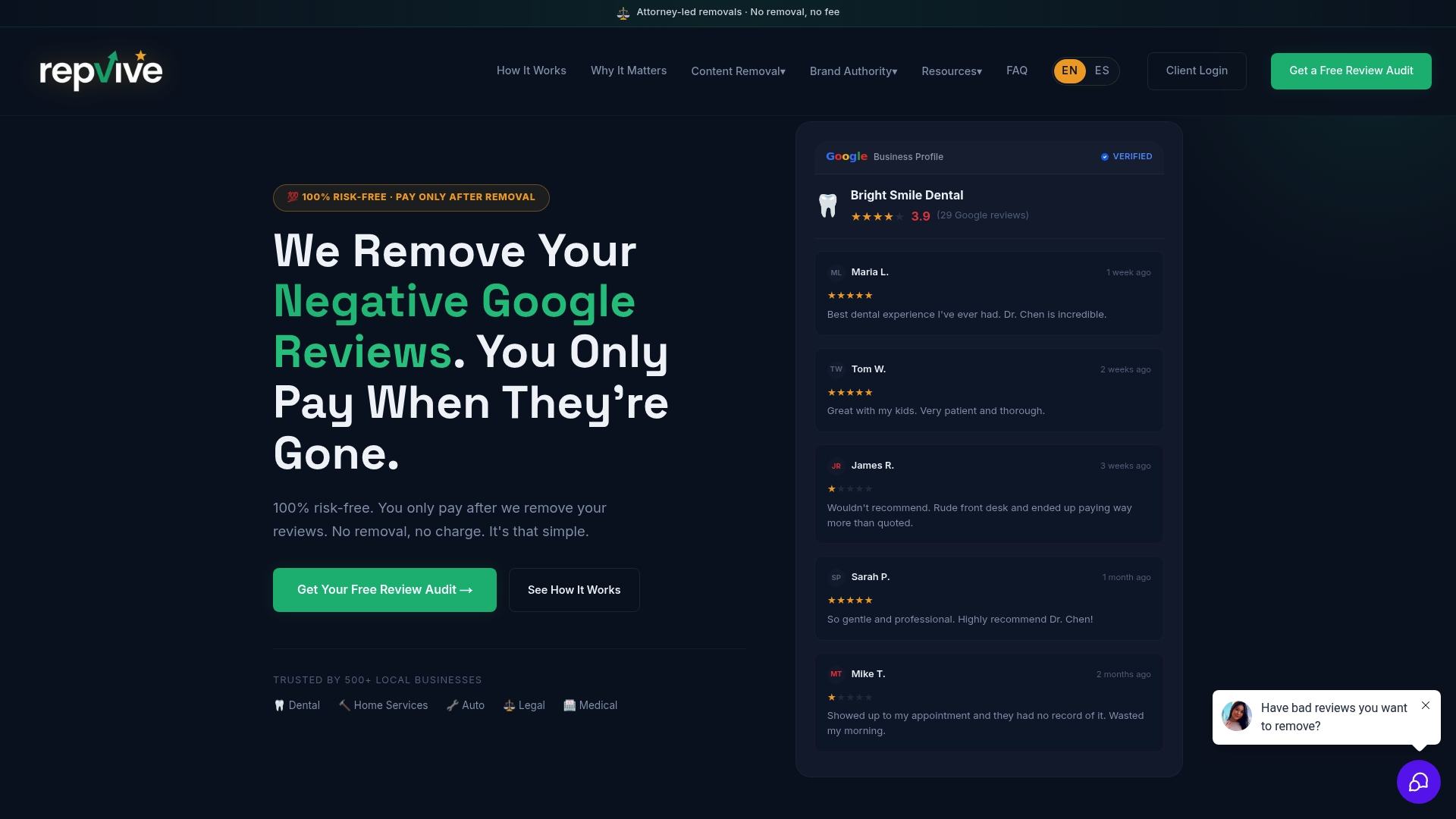
Repvive’s team drafts a customized legal claim for each disputed review, tied to the specific platform policy or legal theory that applies, and works direct channels with Google, Yelp, and 20-plus other platforms to get it approved rather than stuck in an automated review queue. That approach fits situations where you’ve confirmed a review contains false statements, where you’d need a subpoena to identify an anonymous poster, or where you’d simply rather have an attorney handle the escalation than draft a cease-and-desist yourself. The process starts with evidence intake, moves through letter drafting and platform coordination, and tracks progress on a live dashboard, with no upfront fee and payment due only after a confirmed removal. If you’re dealing with a review that meets the false-statement bar covered above, see how Repvive’s removal service works and what your case would involve.
Sources
For deeper reference: the FTC’s Consumer Reviews and Testimonials Rule Q&A, the FTC’s fake-review warning letter template, and Repvive’s guide to the Consumer Review Fairness Act and businesses’ compliance obligations under the FTC fake reviews rule.
This article is general information, not a substitute for advice from a qualified lawyer. Consult a qualified legal professional about your own circumstances before acting on anything here.
- FTC: Consumer reviews and testimonials rule, questions & answers
- How to ethically respond to negative online reviews, american Bar Association
FAQ
Can Google reviews be considered defamation?
Yes, if a review states a false fact rather than an opinion, identifies your business, and causes measurable harm. Vague criticism or subjective complaints almost never meet that bar.
Is it illegal to hide bad reviews?
Businesses can’t use contract clauses to punish customers for honest reviews under the Consumer Review Fairness Act, and manipulating or suppressing reviews deceptively can trigger FTC enforcement. Removing reviews through legitimate platform policy violations or attorney-verified false statements is different from illegally suppressing honest feedback.
Can a person be sued for leaving a bad review?
Technically yes, but only if the review contains a false statement of fact, not opinion, and the business can prove publication, identification, fault, and real damages. Anonymity, section 230 protections for platforms, and anti-SLAPP laws make these suits harder and riskier than most businesses expect.
Is it illegal to threaten bad reviews?
Threatening to post a false review as leverage, or as extortion, can expose the person making the threat to legal liability. A truthful, factual review based on real experience is not illegal to post or to threaten to post.
Recommended
- Is Paying for Reviews Illegal in the United States?
- The FTC Fake Reviews Rule: What U.S. Businesses Must Do Now
- Can You Sue for Fake Reviews? What U.S. Owners Need to Know
- Legal Options for Fake Reviews: A Practical US Guide
If you would rather have this handled, our Google review removal service reviews each case first and charges only when the content comes down.