Is Paying for Reviews Illegal in the United States?
Short answer: yes, in most cases. Paying for reviews that are conditioned on a specific sentiment, such as a promised discount for a five-star write-up, is...
Short answer: yes, in most cases. Paying for reviews that are conditioned on a specific sentiment, such as a promised discount for a five-star write-up, is prohibited by the FTC’s final rule on fake reviews and testimonials, and it separately violates Google Business Profile policy. The consequences are not hypothetical. The FTC can pursue civil penalties, and Google can suspend or remove a business profile entirely, cutting off the local visibility that keeps customers walking through the door. What follows is a plain-English breakdown of the rule, the platform risks layered on top of it, and the lawful paths that actually protect your reputation.
TL;DR:
- Paying for reviews conditioned on specific sentiments, such as five-star ratings, is illegal under federal law and violates Google’s review policy, risking severe penalties.
- Businesses are responsible for deceptive practices by their agents or vendors, and commissioning fake or incentivized reviews can lead to fines, profile suspension, or removal from search results.
- Offering incentives to all customers regardless of rating remains lawful if disclosures are clear, whereas rewarding only positive reviews directly breaches legal and platform rules.
- Rapid enforcement by Google can suspend or de-list business profiles within days of detection, often faster than federal action takes, making compliance essential for ongoing visibility.
- Proper review management involves neutral requests, transparent disclosures, documented evidence, and legal procedures for authentic review removal, not incentivization or manipulation.
Table of Contents
- Is Paying for Reviews Illegal Under Federal Law?
- How Google’s Review Policy Adds a Second Layer of Risk
- Nine Practices That Cross the Line
- What Penalties Actually Look Like
- Who Actually Gets Held Responsible
- The Lawful Way to Build and Protect Your Reviews
- How We Got Here: A Short History of Review Regulation
- Do State Laws or Other Countries Handle This Differently?
- What Enforcement Actions Have Actually Looked Like
- Where Ethical Incentives End and Illegal Solicitation Begins
- Why This Matters for Consumer Trust, not Just Legal Exposure
- What I’ve Learned Watching Businesses Get This Wrong
- How Repvive Removes Reviews the Legal Way
- Key Takeaways
- Sources
- FAQ
Is Paying for Reviews Illegal Under Federal Law?
Yes, when the payment or incentive is conditioned on what the reviewer says. The FTC’s Consumer Reviews and Testimonials Rule, finalized in 2024, bans buying or selling fake reviews outright and prohibits offering compensation tied to a particular sentiment.
The operative language sits in 16 CFR § 465.4, which makes it “an unfair or deceptive act or practice” for a business to provide compensation or another incentive in exchange for a review, if that compensation is conditioned on the review expressing a particular sentiment, positive or negative. That word “conditioned” is doing all the legal work here.
- Offering a $10 gift card to anyone who leaves a review, regardless of star rating, is generally allowed if disclosed.
- Offering a $10 gift card specifically for a five-star review crosses the line.
- Paying a customer to delete or alter a truthful negative review can also violate the rule, according to the FTC’s own Q&A guidance.
The FTC treats these practices as deceptive because they distort what a shopper thinks they’re seeing: an honest snapshot of customer experience, not a manufactured one.
How Google’s Review Policy Adds a Second Layer of Risk
The FTC rule is federal law. Google’s policy is a private contract you agreed to when you claimed your Business Profile, and it’s stricter in practice because Google doesn’t need to prove deception in court. It just needs to decide you broke the rules.
Google explicitly prohibits offering incentives like discounts, free products, or cash in exchange for reviews. Violations can trigger:
- Removal of the specific reviews Google flags as incentivized or fake.
- Suspension of the entire Business Profile, hiding your listing from Maps and Search.
- Permanent loss of profile privileges for repeat violations.
Here’s the distinction that trips up a lot of owners: the FTC’s civil enforcement process can take months, but Google can act within days of a flag or algorithmic detection. You could be fully compliant with federal law on a technicality and still lose your listing over a policy read differently by Google’s trust and safety team.
Nine Practices That Cross the Line
Some of these are obvious. Others catch well-meaning owners off guard because the tactic feels like ordinary customer outreach until you look at the mechanics.
- Paying for five-star reviews specifically, whether in cash, gift cards, or free services, rather than rewarding participation regardless of rating.
- Paying a customer to delete or edit a negative review once it’s already posted, especially when the payment is contingent on the change.
- Buying reviews in bulk from a broker who supplies fake accounts or recruits reviewers who never used your product.
- Publishing AI-generated reviews attributed to fictitious customers, a practice the Federal Register rule names directly as prohibited.
- Posting insider reviews without disclosure, such as an employee or owner reviewing their own business without identifying the relationship.
- Threatening a customer with legal action or harassment to force removal of a truthful negative review.
- Gating review requests so only customers who indicate a positive experience are funneled to a public review site.
- Using a third-party “reputation” vendor that fabricates reviews on your behalf, even if you never touch the fake accounts yourself.
- Swapping reviews with other businesses in an informal “I’ll review yours if you review mine” arrangement, which still counts as compensation under the rule.
What Penalties Actually Look Like
The FTC’s final rule preamble lays out the enforcement rationale, and it treats fake and incentivized reviews as consumer harm on par with other deceptive marketing violations, meaning civil penalties are on the table for violators.
Platform sanctions arrive faster and hit differently:
- Google can suspend a Business Profile within days of a detected violation.
- Lost visibility in Maps and local search can happen before you even know you’ve been flagged.
- Reinstatement after a suspension isn’t guaranteed and often requires a formal appeal.
Enforcement intensity has climbed largely because detection has gotten easier. Review brokers now advertise openly, AI-generated review text is easy to spot at scale with pattern detection, and platform sanctions are increasingly treated as a parallel track to federal enforcement rather than a substitute for it. Regulators and platforms are no longer waiting for each other to act.
Who Actually Gets Held Responsible
Hiring an outside marketing agency to “handle” your reviews does not transfer the legal risk. The FTC and courts have consistently held businesses accountable for the deceptive acts of their agents and contractors, a principle legal commentary on the rule confirms applies squarely to review manipulation.
That means the owner, the marketing manager who signed the vendor contract, and sometimes corporate officers can all be named in an enforcement action, not just the vendor who ran the campaign.
- Ask any review-management vendor for a written compliance warranty before signing.
- Require the vendor to disclose its exact solicitation methods in the contract.
- Build in an indemnification clause covering deceptive practices the vendor commits on your behalf.
- Audit vendor tactics periodically rather than assuming a one-time sign-off covers you forever.
Pro Tip: Before onboarding any reputation vendor, ask them directly whether any incentive they use is ever conditioned on star rating. A vendor who hesitates or gives a vague answer is a liability, not a solution.
The Lawful Way to Build and Protect Your Reviews
You can absolutely encourage customers to leave reviews. You just can’t tell them what to say or pay them to say something specific.
- Ask in neutral language. “We’d appreciate your honest feedback on Google” is compliant, as explained in helpful guidance on neutral review-request templates that support lawful outreach. “Leave us a five-star review and get 10% off” is not.
- Disclose any incentive. If you offer a small reward for participation, offer it to everyone who leaves a review regardless of rating, and say so clearly in your request.
- Document before you escalate. If a review is fake, defamatory, or violates platform policy, collect timestamps, screenshots, and proof the reviewer was never a customer before filing a takedown request.
- Respond publicly and specifically. A calm, factual public reply to a negative review often does more for your reputation than a suppressed one ever would, since prospective customers read your response as much as the complaint itself.
- Escalate borderline cases with a tailored legal claim rather than a generic platform report, since customized claims tend to succeed where template requests stall, according to attorney-led removal guidance.
Pro Tip: Save every review request template you use. If a dispute ever arises, showing that your outreach language never mentioned rating or sentiment is your strongest evidence of good faith.
How We Got Here: A Short History of Review Regulation
Fake review complaints predate the FTC’s 2024 rule by well over a decade. Early enforcement relied on the general deception authority in Section 5 of the FTC Act, the same statute used against misleading ads since the 1970s. The agency brought cases against individual businesses and marketing firms for astroturfing, planting fake reviews to look like grassroots customer sentiment, but each case required proving deception from scratch, with no clear regulatory line for businesses to check against.
That changed as review fraud scaled. Review-selling operations moved from informal favor trading to organized brokers advertising bulk five-star reviews for a fee. The FTC brought a wave of settlements through the 2010s and early 2020s against specific companies for buying reviews or paying incentivized reviewers without disclosure, but each action was a one-off, and businesses had no single rulebook.
The 2024 final rule changed that. Instead of case-by-case deception findings, the FTC codified specific prohibited conduct into 16 CFR § 465.4, giving the agency a direct enforcement path and giving businesses an actual checklist instead of a gray area. That’s the regulatory environment you’re operating in now: less ambiguity, more direct liability.
Do State Laws or Other Countries Handle This Differently?
The FTC rule is federal and applies nationwide, but a handful of states layer additional consumer-protection statutes on top of it. California’s Unfair Competition Law and New York’s General Business Law both give state attorneys general independent authority to pursue deceptive review practices, sometimes with different penalty structures than federal civil penalties. If you operate in multiple states, a practice that draws a federal warning could also trigger a separate state action.
Internationally, the picture varies more sharply. The European Union’s Unfair Commercial Practices Directive similarly bans fake and incentivized reviews, but enforcement runs through national consumer protection agencies in each member state rather than a single federal body like the FTC. The United Kingdom’s Competition and Markets Authority has pursued its own fake review cases under separate consumer protection law, with different penalty caps than either the U.S. or EU framework.
For a U.S. business, the practical takeaway is simpler than the patchwork suggests: the federal rule sets your floor everywhere you operate domestically, and state law rarely gives you more room to maneuver, only less. If you serve customers across state lines or internationally, don’t assume a practice permitted in one jurisdiction is safe in another. Build your review solicitation process around the strictest applicable standard, which for most U.S. small businesses will be the federal rule itself.
What Enforcement Actions Have Actually Looked Like
Before the 2024 rule, the FTC’s enforcement pattern under Section 5 showed a consistent theme: companies paying for reviews without disclosure, or suppressing negative ones through payment, drew settlements that included consent orders barring the practice going forward and, in several cases, monetary penalties tied to the scale of the deception.
The rule’s own preamble points to fake reviews, undisclosed insider reviews, and incentivized sentiment-conditioned reviews as the core categories the FTC has pursued and expects to continue pursuing, now with a codified rule rather than a case-by-case deception argument. That shift matters for how fast future cases can move. Instead of building a deception case from the ground up, the FTC can point directly to a violation of § 465.4 and skip much of the argument about whether the conduct was actually misleading.
Google’s enforcement pattern runs on a separate, much faster track. Profile suspensions tied to detected review manipulation typically happen through automated and human review flagging rather than a public case record, meaning most platform-level actions never make headlines even though they cause immediate, tangible harm to the business involved. That asymmetry is worth sitting with: you’re far more likely to face a quiet Google suspension than a public FTC case, but the suspension can cost you customers just as fast.

Where Ethical Incentives End and Illegal Solicitation Begins
The line comes down to one question: is the incentive tied to what the customer says, or just to the fact that they said something?
Ethical incentivizing looks like this: you offer a small thank-you, entry into a raffle, or a discount code to every customer who leaves a review, positive or negative, and you disclose the incentive in your request. The reviewer’s opinion doesn’t change what they get.
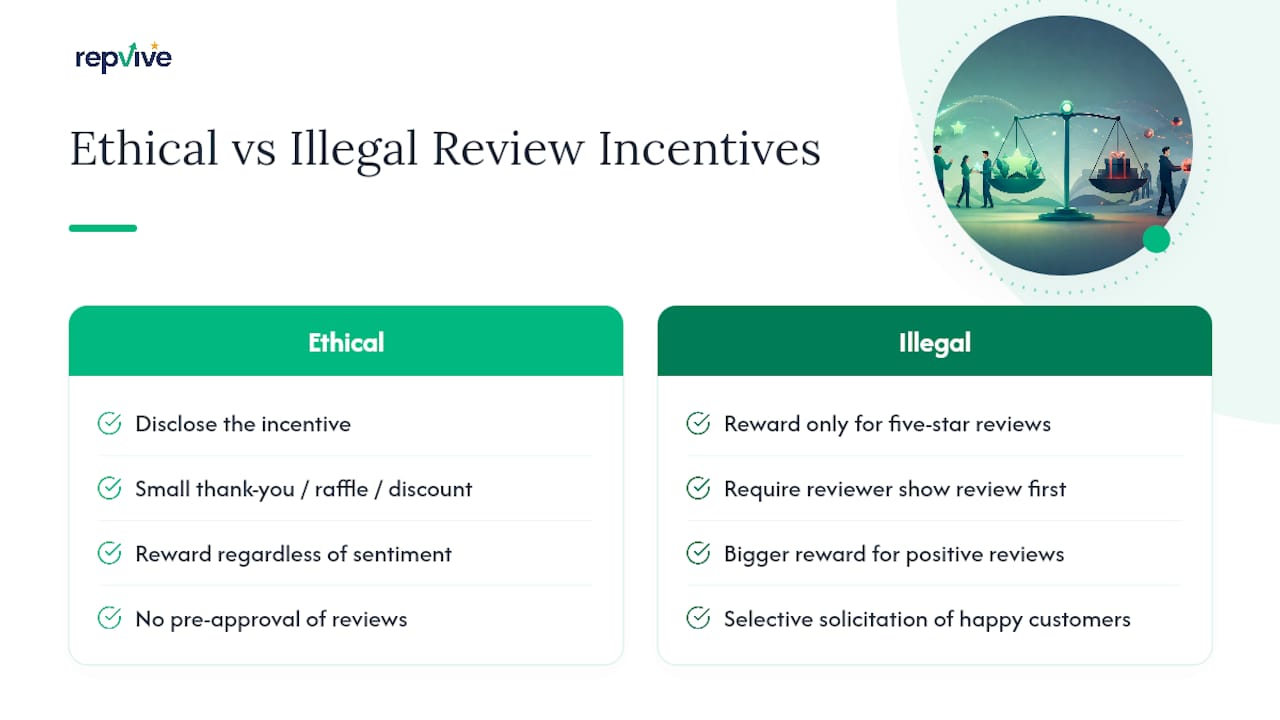
Illegal solicitation looks like this: you offer the reward only if the review hits five stars, you ask customers to show you the review before posting so you can approve it, or you offer a bigger reward for a “detailed positive review” than a short one. Each of these ties compensation to sentiment, which is exactly what 16 CFR § 465.4 prohibits.
A gray zone worth naming: asking happy customers by name to leave a review while ignoring or discouraging unhappy ones from doing the same. No money changes hands, but the selective solicitation still distorts the aggregate picture the FTC’s rule is designed to protect. If your review request process filters by sentiment before the review is even written, you’re skating close to the same violation the rule targets, incentive or not.
Why This Matters for Consumer Trust, not Just Legal Exposure
Fake and incentivized reviews don’t just risk a fine. They corrode the exact asset they’re meant to build. A five-star average built partly on paid reviews eventually meets a customer whose real experience doesn’t match the rating, and that gap does more reputational damage than a handful of honest three-star reviews ever would.
The FTC’s own framing treats this as a trust problem before it is a legal one: manipulated reviews distort consumer perception at scale, which is precisely why the agency has authority to act under its unfair-and-deceptive-practices mandate. From a legal standpoint, a pattern of inflated ratings followed by customer complaints can itself become evidence in an investigation, since regulators increasingly look at the gap between review sentiment and other public complaint data as a red flag worth examining.
The businesses that come out ahead over time are the ones treating reviews as an accurate mirror, not a marketing lever. That’s not just good compliance. It’s also the version of your reputation that survives contact with a real customer.
What I’ve Learned Watching Businesses Get This Wrong
The mistake I see most often isn’t malicious. It’s a well-meaning owner who offers a discount “for a great review” without realizing that phrase alone violates the conditioning rule, then panics when a review disappears or a profile gets flagged.
Documentation is what separates a fixable situation from a costly one. When a review is genuinely fake or violates platform policy, a specific, evidence-backed legal claim tends to succeed where a generic report form gets ignored. That’s the gap attorney-led removal exists to close: not helping anyone game the system, but giving legitimate businesses a real path to remove content that shouldn’t be there in the first place.
, Jason
How Repvive Removes Reviews the Legal Way
Every claim is customized to the specific review and platform, using direct channels that route requests to actual review approval, rather than a generic mass-reporting template that platforms routinely ignore. The pricing model removes the financial risk entirely: Repvive charges nothing upfront and only bills after a review is confirmed removed, so you’re never paying for an attempt that doesn’t work. If a review on your Google Business Profile, Yelp, or one of over 20 other platforms is fake, defamatory, or violates platform policy, start a review removal request with Repvive and get a real-time look at your case before you commit to anything.
Key Takeaways
Paying for reviews is illegal under federal law when the payment is conditioned on sentiment, and it separately violates platform policy even when the FTC doesn’t get involved.
| Point | Details |
|---|---|
| Conditioning is the trigger | Incentives tied to star rating or sentiment violate 16 CFR § 465.4, regardless of how small the reward is. |
| Two enforcement tracks exist | The FTC pursues civil penalties while Google can suspend a Business Profile independently and faster. |
| Vendors don’t shield liability | Businesses remain responsible for deceptive practices committed by hired agencies or reputation vendors. |
| Neutral solicitation is safe | Disclosed incentives offered to every reviewer regardless of rating stay compliant with federal rules. |
| Attorney-led removal is the compliant fix | Repvive’s pay-per-removal, no-upfront-fee model targets fake or policy-violating reviews without incentivizing anyone. |
This article is general information, not a substitute for advice from a qualified lawyer. Consult a qualified legal professional about your own circumstances before acting on anything here.
Sources
- Federal Trade Commission Announces Final Rule Banning Fake Reviews and Testimonials
- 16 CFR § 465.4, buying positive or negative consumer reviews
- Tips to get more reviews, Google Business Profile Help
- Trade Regulation Rule on the use of consumer reviews and testimonials (Federal Register)
FAQ
Is It Illegal to Buy Good Reviews?
Yes. Buying reviews, whether fake or written by real customers paid specifically for positive sentiment, violates the FTC’s final rule and can carry civil penalties.
Is It Legal to Pay Someone for a Google Review?
Only if the payment isn’t conditioned on what they say and you disclose it; paying specifically for a five-star Google review violates both federal law and Google’s own policy.
Is It Illegal to Give Discounts for Reviews?
Not automatically. A disclosed discount offered to every customer who leaves a review, regardless of rating, is generally compliant, but the same discount offered only for a positive review is not.
Can You Pay People for Reviews?
You can pay for participation in a review campaign as long as the reward isn’t tied to sentiment and the relationship is disclosed, since incentivized reviews are treated as testimonials under the FTC rule.
Can I Get a Fake Review Removed Legally?
Yes. Documented evidence and a tailored legal claim, the approach Repvive uses, can get fake or policy-violating reviews removed without violating any incentive rules yourself.
Recommended
- Legal Options for Fake Reviews: A Practical US Guide | Repvive
- Revenue Risk Calculator: How Much Bad Reviews Cost You | Repvive
- Google Review Removal Cost: What Local Businesses Pay | Repvive
- How Review Manipulation Is Detected: Methods and Tools | Repvive
If you would rather have this handled, our Google review removal service reviews each case first and charges only when the content comes down.