Benefits of Removing Negative Reviews for Local Businesses
The benefits of removing negative reviews are concrete and measurable. When fake or policy-violating reviews disappear from your Google Business Profile...
TL;DR:
- Removing fake or policy-violating reviews improves ratings, rankings, and revenue by restoring credibility and visibility.
- Focusing on removing only reviews that violate policies and responding professionally to legitimate feedback builds a trustworthy online reputation.
Removing negative reviews restores ratings, rankings, and revenue
The benefits of removing negative reviews are concrete and measurable. When fake or policy-violating reviews disappear from your Google Business Profile, your star rating recovers, your listing regains visibility, and potential customers stop bouncing before they ever call you. One Miami restaurant hit with a coordinated fake review attack saw its rating crater and its Google listing suppressed entirely, a direct revenue crisis, not just a PR problem.
The financial stakes are real. A Harvard Business School study found that a single star increase in rating can substantially increase annual restaurant revenue. That same Miami case documented tens of thousands in lost covers over just two weeks following a rating drop from 4.8 to 3.1 stars.
Key advantages of removing policy-violating reviews:
- Star rating restoration that directly lifts conversion rates
- Local search ranking improvement as harmful sentiment signals are cleared
- Listing reinstatement after suppression caused by fake review spikes
- Stronger first impressions for customers researching your business
- Reduced talent risk, since only a small fraction of job seekers would consider applying to a one-star business
Table of Contents
- How review quality shapes your local search ranking
- Best practices for managing negative reviews professionally
- Legal-backed removal gives you a real advantage
- Long-term benefits of a balanced online reputation
- Professional strategies for policy enforcement and balanced management
- Balanced reputation management vs. absolute removal
- Risks and ethical considerations of removing negative reviews
- Responding to negative reviews as a reputation strategy
- Tools for monitoring and managing your online reviews
- Repvive removes the reviews that are actually hurting you
- Key Takeaways
- FAQ
How review quality shapes your local search ranking
Google’s local search algorithm treats review signals as roughly 16, 20% of total ranking weight, and that weight goes to quality and sentiment, not just raw count. A business with 200 reviews averaging 3.2 stars will typically rank below a competitor with 80 reviews averaging 4.6 stars.
Spikes of sudden negative reviews from new accounts trigger Google’s spam detection. When that happens, the algorithm may suppress your listing rather than just lower your rank. Maintaining a steady cadence of authentic reviews, combined with removing reviews that violate platform policies, keeps your sentiment profile clean and your ranking stable. For a deeper look at how fake reviews affect local rankings, the pattern is consistent across industries.

Best practices for managing negative reviews professionally
Removing every negative review is not the goal, and attempting it backfires. Reputation experts recommend targeting only reviews that violate platform policies, fake accounts, spam, harassment, conflict of interest, while responding professionally to legitimate criticism.
A balanced approach looks like this:
- Flag only reviews with a clear policy violation; document your reasoning before reporting
- Respond to genuine negative feedback within 24, 48 hours, calmly and without defensiveness
- Invite resolution offline by sharing a direct email or phone number in your public reply
- Run an ongoing campaign asking satisfied customers for reviews after positive interactions
- Monitor your profile daily so you catch coordinated attacks before they compound
Pro Tip: When dealing with a coordinated fake review attack involving multiple reviews posted in a short window, submit a bulk removal request with behavioral evidence, account creation dates, posting velocity, and reviewer overlap across businesses. Individual flags rarely succeed against organized campaigns; structured evidence does.
Legal-backed removal gives you a real advantage
Most business owners flag a review, get a form denial, and give up. That’s where a legal-backed process changes the outcome. Repvive’s attorney-led approach crafts customized claims for each review, aligning the removal argument precisely with Google’s content policies rather than submitting a generic report. The result is a 99% success rate with no upfront fees, a meaningful contrast to DIY flagging, which succeeds inconsistently even on clear violations.
| Removal method | Typical success rate | Avg. timeline |
|---|---|---|
| DIY flagging (single review) | Low to moderate | Days to weeks |
| Reviews Management Tool + appeal | Moderate | , |
| Legal-backed bulk removal | High (Repvive: 99%) | Faster with structured claims |
Repvive’s legal team also provides reputational safeguards. Mass flagging without proper evidence can trigger Google’s automated detection and get your Business Profile suspended, a worse outcome than the original review. A structured legal approach avoids that risk while building a documented case that supports permanent removal and listing reinstatement.
Long-term benefits of a balanced online reputation
Clearing harmful reviews is the start, not the finish. Businesses that combine removal of policy-violating content with consistent authentic review generation build a reputation that compounds over time.
- Balanced ratings with a mix of positive reviews and professionally addressed feedback read as credible
- 67% of consumers suspect businesses with only perfect reviews as inauthentic.
- Consistent review activity signals ongoing engagement to Google’s algorithm, supporting ranking stability
- Constructive feedback that stays visible (when legitimate) shows accountability and drives service improvement
- Higher average ratings translate directly to more clicks, calls, and conversions month over month
Professional strategies for policy enforcement and balanced management
Effective removal starts with knowing exactly which reviews qualify. Google’s content policies cover spam, fake or misleading content, conflict of interest, hate speech, off-topic posts, and harassment. A review that is simply harsh or unfair does not qualify, and reporting it anyway wastes your credibility with the platform.
For law firms and professional service businesses, the stakes of a mishandled removal attempt are especially high. The right sequence: read the platform’s policy, identify the specific violation category, gather evidence (account age, posting patterns, transaction records), then submit a structured report referencing that exact category. Emotional language in a report weakens your case; factual specificity strengthens it.
Balanced reputation management vs. absolute removal
Trying to scrub every negative review creates a different problem. Purchase likelihood peaks between 4.2 and 4.5 stars, not at 5.0. A perfect rating raises red flags for experienced shoppers, and Yelp data shows that 88% of consumers are likely to look past a bad review when the business responds well. The goal is a credible, active profile, not a sanitized one.
Absolute removal attempts also carry legal risk. Suppressing honest reviews violates the FTC’s Consumer Review Rule which includes potential penalties per violation. Focus removal efforts on reviews that break platform rules; let legitimate criticism stand and answer it well.
Risks and ethical considerations of removing negative reviews
Not every removal attempt is appropriate, and the consequences of getting it wrong are serious. Mass flagging can trigger Google’s spam detection and suspend your Business Profile, removing the negative review, yes, but taking your entire listing offline with it.
Ethically, removing genuine customer feedback undermines the trust that review platforms exist to create. It also tends to backfire: shoppers notice implausibly clean profiles and discount them. The only defensible removal is one targeting a clear policy violation, applied consistently to positive and negative reviews alike.
Responding to negative reviews as a reputation strategy
A well-written response to a negative review often does more than removal ever could. For handling difficult patient or client reviews, the structure is consistent: acknowledge the experience, apologize without excuses, offer a path to resolution, and move the conversation offline.
Future customers read your responses as much as the reviews themselves. A calm, specific reply signals that you take feedback seriously and treat people fairly, which is exactly what a prospective customer wants to see before making a decision.
Tools for monitoring and managing your online reviews
Staying ahead of reputation damage requires daily visibility into your review activity. Google Alerts can notify you of new mentions, while Google Business Profile’s built-in dashboard tracks incoming reviews. For businesses managing multiple locations, platforms like Birdeye or Podium centralize review monitoring across Google, Yelp, and Facebook in one dashboard.
The critical habit is speed. Evidence tied to fake reviews, account creation dates, posting patterns, linked profiles, can disappear within days of the review going live. Catching a coordinated attack early gives you the documentation you need to build a successful removal case.
Repvive removes the reviews that are actually hurting you
When a fake or policy-violating review is dragging down your rating and you’ve already tried flagging it yourself, Repvive is the direct path to getting it removed. Unlike generic reputation services, Repvive’s attorneys build a customized legal claim for each review, targeting the specific policy violation rather than submitting a boilerplate report.
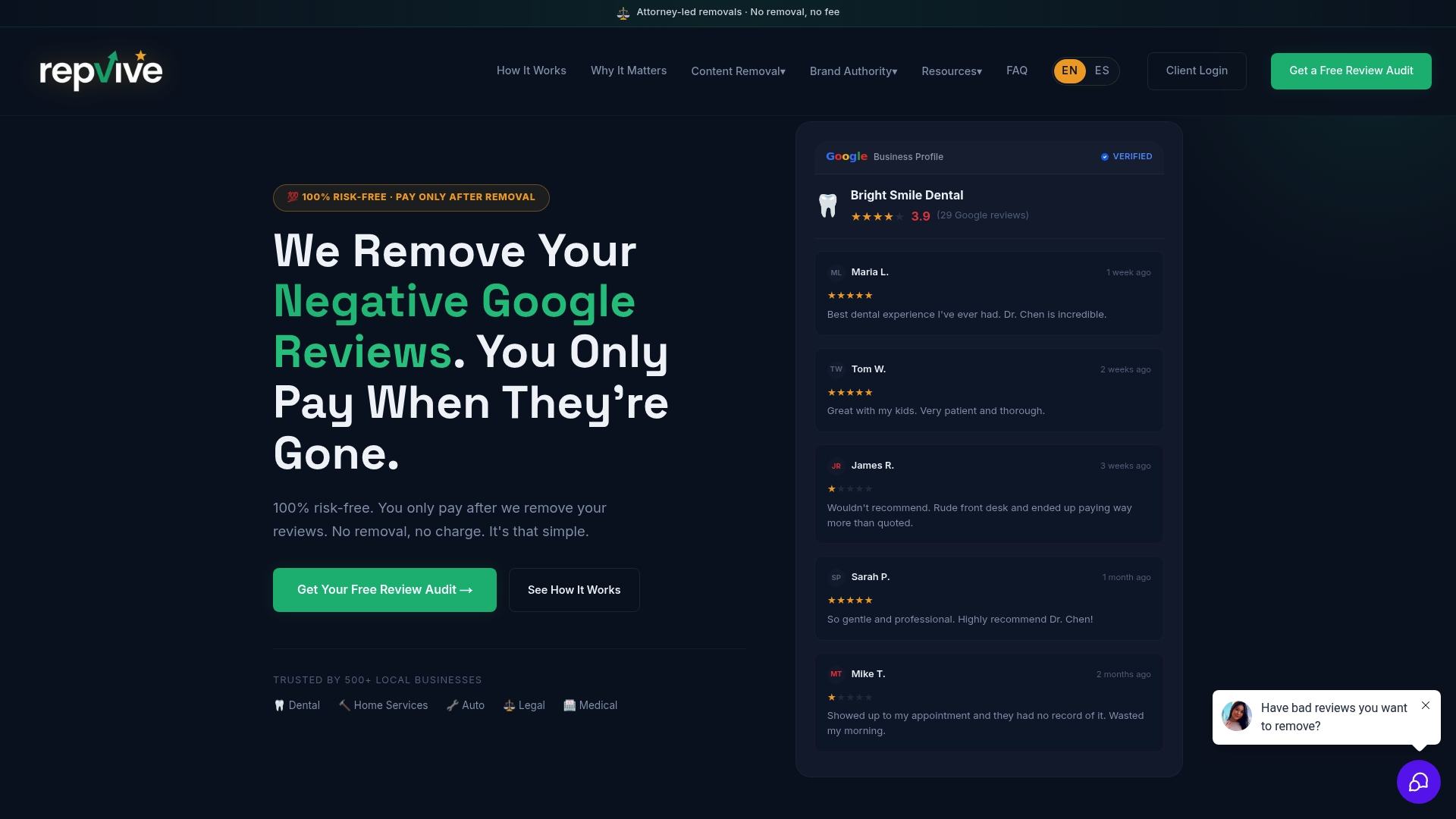
No upfront fees. A 99% success rate. And a process designed specifically for small and mid-size local businesses that can’t afford to wait weeks for a DIY appeal to fail. If your Business Profile is being hurt by fake or fraudulent reviews, start your removal case with Repvive today.
Key Takeaways
Removing policy-violating reviews restores star ratings, improves local search rankings, and protects revenue, but only when paired with authentic review generation and professional responses to legitimate feedback.
| Point | Details |
|---|---|
| Financial impact of ratings | A single star increase in rating can substantially increase annual restaurant revenue. |
| Review signals in local search | Review quality and sentiment account for roughly 16, 20% of Google’s local ranking signal. |
| Balanced ratings build trust | 67% of consumers suspect businesses with only perfect reviews as inauthentic… |
| Removal risks | Mass flagging without evidence can trigger profile suspension, worse than the original review. |
| Repvive’s approach | Attorney-led removal with customized claims and a 99% success rate, no upfront fees required. |
FAQ
Can you legally remove negative Google reviews?
You can only remove reviews that violate Google’s content policies, spam, fake content, harassment, or conflict of interest. Honest negative reviews cannot be removed, and attempting to suppress them violates the FTC’s Consumer Review Rule.
How do removed reviews improve a restaurant’s rankings?
Removing fake or policy-violating reviews clears harmful sentiment signals from your profile. Since review quality and sentiment account for roughly 16, 20% of Google’s local ranking signal, a cleaner profile typically improves your position in local search results.
What is Repvive’s success rate for review removal?
Repvive reports a 99% success rate using an attorney-led process that crafts customized legal claims for each review, with no upfront fees required.
Does removing negative reviews make your rating look fake?
Not when done correctly. Removing only policy-violating reviews while leaving legitimate feedback in place keeps your profile credible. A rating between 4.2 and 4.5 stars tends to perform better with consumers than a perfect 5.0.
What should you do if a review can’t be removed?
Respond publicly, calmly, and with a clear path to resolution. Yelp data shows 88% of consumers are likely to look past a bad review when the business responds well, making a strong reply one of the most effective reputation tools available.
Recommended
- Online Review Removal Service & Reputation Management | Repvive
- Customized Review Removal Claims: A 2026 Guide for Local Businesses | Repvive
- Top 4 thereviewmediator.com Alternatives 2026 | Repvive
- How to Protect Business Reputation Online in 2026 | Repvive
If you would rather have this handled, our Google review removal service reviews each case first and charges only when the content comes down.