Customized Review Removal Claims: A 2026 Guide for Local Businesses
A customized review removal claim is a structured, evidence-based submission that maps a specific negative review to a named Google content policy...
What is a customized review removal claim?
A customized review removal claim is a structured, evidence-based submission that maps a specific negative review to a named Google content policy violation, rather than simply flagging it as “unfair.” That distinction is everything. Generic complaints that say “this review is untrue” almost always fail, while claims that cite the exact policy breach, attach supporting documentation, and explain the connection give Google’s review team something concrete to act on.
The core logic works like this:
- Spam or fake content: The reviewer has no record of visiting your business, or the account shows a pattern of mass negative reviews across unrelated businesses.
- Conflict of interest: The reviewer is a competitor, a former disgruntled employee, or someone with a clear financial stake in damaging your reputation.
- Off-topic content: The review describes a dispute unrelated to your actual products or services, such as a billing disagreement handled outside your business.
- Restricted or illegal content: The review contains threats, personal attacks, or content that violates local law.
- Hate speech or harassment: The review targets you or your staff based on protected characteristics.
Google’s official escalation forms produce a 40, 60% success rate when evidence is clear and properly matched to a policy violation. That number drops sharply when the claim is vague. A customized legal removal claim treats the process as a technical audit, not a customer service complaint, and that framing is what separates successful removals from ignored flags.
Which reviews actually qualify for removal under Google’s policies?
Not every bad review can be removed, and understanding that boundary saves you time. Google’s content policies protect negative opinions as legitimate speech. A one-star review that says “the service was slow and the staff was rude” is almost certainly staying up, even if you believe it is exaggerated or unfair.
What qualifies for removal is a review that violates a specific policy category:
- Fake or purchased reviews: Accounts created solely to post a single negative review, or reviews that appear coordinated across multiple businesses at once.
- Competitor-posted reviews: A direct competitor or their employee posting as a customer is a textbook conflict-of-interest violation.
- Reviews about a different business: If the reviewer clearly visited the wrong location or confused your business with another, that is an off-topic violation.
- Doxxing or personal attacks: Any review that includes private personal information or targeted harassment crosses into illegal content territory.
- Promotional content from a competitor: A review that promotes a rival business by name is a policy violation, not just a bad review.
What does not qualify: a customer who genuinely had a bad experience and wrote about it honestly, even if their account is one-sided. Google’s stance is that authentic negative feedback, however harsh, is protected. Documenting the facts around a review before you flag it is the only way to know whether you have a real claim.
Pro Tip: Cross-reference the reviewer’s Google Maps profile before flagging. A reviewer with dozens of one-star reviews posted across unrelated businesses in a short window is strong evidence of a spam or fake-content violation.

How to submit a strong, customized removal claim step by step
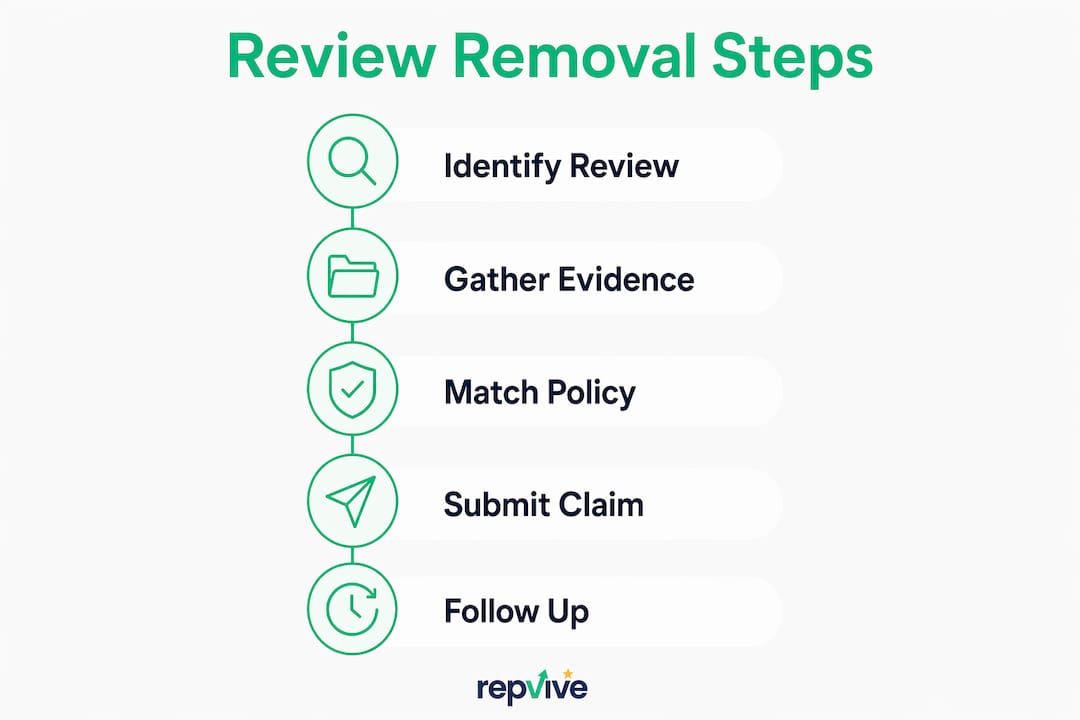
A well-built claim follows a clear sequence. Skipping steps is the most common reason businesses get rejected.
- Collect the evidence first. Screenshot the review with the date, reviewer name, and star rating visible. Check the reviewer’s public profile for posting history, account age, and any patterns that suggest fake or coordinated activity.
- Match the review to one specific policy category. Do not list three possible violations and hope one sticks. Pick the strongest match and build your entire claim around it. Reviewers who map to the spam or conflict-of-interest categories tend to have the clearest paper trails.
- Flag through Google Business Profile. Log into your Google Business Profile manager, locate the review, and use the flag icon to report it. This is the primary submission channel and the one Google’s team monitors most actively.
- Use the official escalation form for stronger cases. If the review involves legal content violations or a clear fake-account pattern, Google’s Business Profile support form allows you to submit additional documentation that the standard flag tool does not accept.
- Write a precise claim statement. State the policy violated, explain the evidence, and keep it factual. “This review was posted by a competitor’s employee, as confirmed by their LinkedIn profile, which lists employment at [competitor name] during the review date” is far stronger than “this review is fake.”
- Document everything you submit. Keep a timestamped record of your flag, the evidence package, and the submission date. You will need this if the claim is denied and you appeal.
- Wait for Google’s response. Typical response times run 7, 21 business days. Do not re-flag the same review during this window. Repeated flags before a decision is issued can signal bad-faith reporting.
Pro Tip: For online review best practices by industry, the storage and professional services sector offers a useful model for documenting and appealing negative reviews that applies across many local business types.
How to appeal a denied review removal request
Denial is not the end. Most first-time claims fail because of insufficient evidence or a mismatched policy category, both of which are fixable.
- Read the denial carefully. Google occasionally provides a reason. If it cites insufficient evidence, your next submission needs more documentation. If no reason is given, assume the policy match was unclear.
- Wait before re-flagging. Submitting again immediately after a denial reduces your chances. A strategic cooldown period before re-flagging with sharper, more detailed documentation improves your odds considerably. Use that time to build a stronger evidence package.
- Sharpen the claim. Add new documentation: a screenshot of the reviewer’s profile showing suspicious activity, a business record showing the reviewer was never a customer, or a LinkedIn profile confirming a competitor connection.
- Use Google’s Reviews Management Tool. This tool, available through Google Business Profile, allows you to track flagged reviews and submit follow-up information more formally than a standard re-flag.
- Escalate through official support channels. Google’s Business Profile support team can be reached via chat or email for cases involving clear policy violations that were incorrectly denied. Community forums and Google’s official Twitter/X support account are secondary options when direct channels stall.
- Avoid mass-flagging. Submitting inaccurate or bad-faith flags can trigger penalties and damage your standing with Google. Every flag you submit should be defensible.
Unethical tactics in review removal and why they backfire
The review removal industry has a real problem with bad actors, and local business owners are often the ones who pay for it.
- Paying for removal services with no legal basis: Companies that promise guaranteed removal for a flat fee, with no attorney involvement and no policy-based claim, are almost always selling false hope. The review stays up, and your money is gone.
- Misusing DMCA takedown notices: Shady operators sometimes file DMCA notices against reviews that contain no copyrighted material, hoping the automated process will trigger a removal. Google has tightened its review of these filings, and submitting a fraudulent DMCA notice carries legal risk for the filer.
- Fake counter-reviews: Flooding your profile with fabricated positive reviews to dilute a negative one violates Google’s policies and can result in your entire review profile being penalized or removed.
- Impersonating a legal authority: Sending a fake cease-and-desist letter to a reviewer to pressure them into deleting their review is not just unethical. It can expose your business to legal liability.
The pattern across all of these tactics is the same: they substitute pressure or deception for a legitimate claim. Google’s systems are built to detect manipulation, and the consequences, including reduced visibility and account flags, tend to outlast whatever short-term benefit the tactic was supposed to deliver. Protecting your business reputation online means staying on the right side of the platform’s rules.
Advanced tactics that actually move the needle on removal success
The businesses that consistently win removal claims treat the process the way a good attorney treats a case: with documentation, precision, and patience.
Mapping a reviewer’s full account history against your business records is one of the most effective techniques available. If a reviewer claims to have visited your restaurant on a Tuesday evening but your reservation system shows no record of that name, and their Google Maps history shows reviews posted from three different cities on the same day, that combination of evidence is far stronger than any single data point alone.

Forensic cross-referencing works similarly for conflict-of-interest claims. A reviewer whose LinkedIn profile lists employment at a direct competitor, whose review was posted within days of a competitive bid you won, and whose account has no other review history is a textbook case. Each piece of evidence reinforces the others.
Repvive’s attorney-led approach is built around exactly this kind of claim construction. Rather than submitting a generic flag, Repvive’s legal team builds a case file for each review, matching the content to the specific policy violation and submitting through direct channels. The result is a 99% success rate on removal claims, compared to the 40, 60% success rate typical of Google’s official escalation submissions when evidence is clear and properly matched to a policy violation.
Pro Tip: After a denial, treat the re-submission as a new case. Start from the evidence, not from the original claim. A fresh review of the reviewer’s profile often surfaces new details that were not visible at the time of the first submission.
Legal considerations that govern review removal in the United States
The legal framework around online reviews is more layered than most business owners realize. Section 230 of the Communications Decency Act gives platforms like Google broad immunity from liability for third-party content, which means you generally cannot sue Google for hosting a negative review. Your legal options are directed at the reviewer, not the platform.
Defamation law is the most relevant tool. A review that states a false fact as though it were true, and causes measurable harm to your business, can support a defamation claim against the reviewer. The bar is higher than most people expect: the statement must be factually false (not just unfair), the reviewer must have known it was false or acted with reckless disregard for the truth, and you must be able to show actual harm. Pure opinions, even harsh ones, are protected speech under the First Amendment.
DMCA takedown notices apply only when a review contains copyrighted material you own, such as a photo taken by your business. They are not a general-purpose removal tool, and misusing them carries legal risk. For false Google reviews, an attorney can help you assess whether a defamation claim is viable and whether a formal legal demand to the reviewer might prompt a voluntary deletion.
How review removal processes differ across major platforms
Google, Yelp, and Facebook each handle removal requests differently, and the strategy that works on one platform will not automatically transfer to another.
Google Business Profile uses a policy-violation framework. Claims must be tied to a specific content policy category, submitted through the Business Profile manager or an escalation form, and supported by evidence. The reporting process is documented publicly, and Google’s team makes the final call. Business owners cannot remove reviews unilaterally.
Yelp operates under a “recommended reviews” algorithm that automatically filters reviews it deems unreliable, including those from new accounts or accounts with limited activity. Yelp’s removal process for policy violations follows a similar flag-and-review model, but Yelp is notably resistant to removing reviews based on business owner requests alone. Their content guidelines prohibit promotional content, conflicts of interest, and irrelevant material, but enforcement is less consistent than Google’s.
Facebook (Meta) allows business owners to report reviews through the page management tools, with violations assessed against Meta’s Community Standards. Facebook also gives business owners the option to turn off the reviews feature entirely, which Google does not allow. That option is a blunt instrument, since it removes all reviews, positive and negative alike.
The common thread across all three platforms is that evidence-based, policy-specific claims outperform vague complaints. The custom review removal process that works on Google, with clear policy citation and documented evidence, translates well to Yelp and Facebook with platform-specific adjustments.
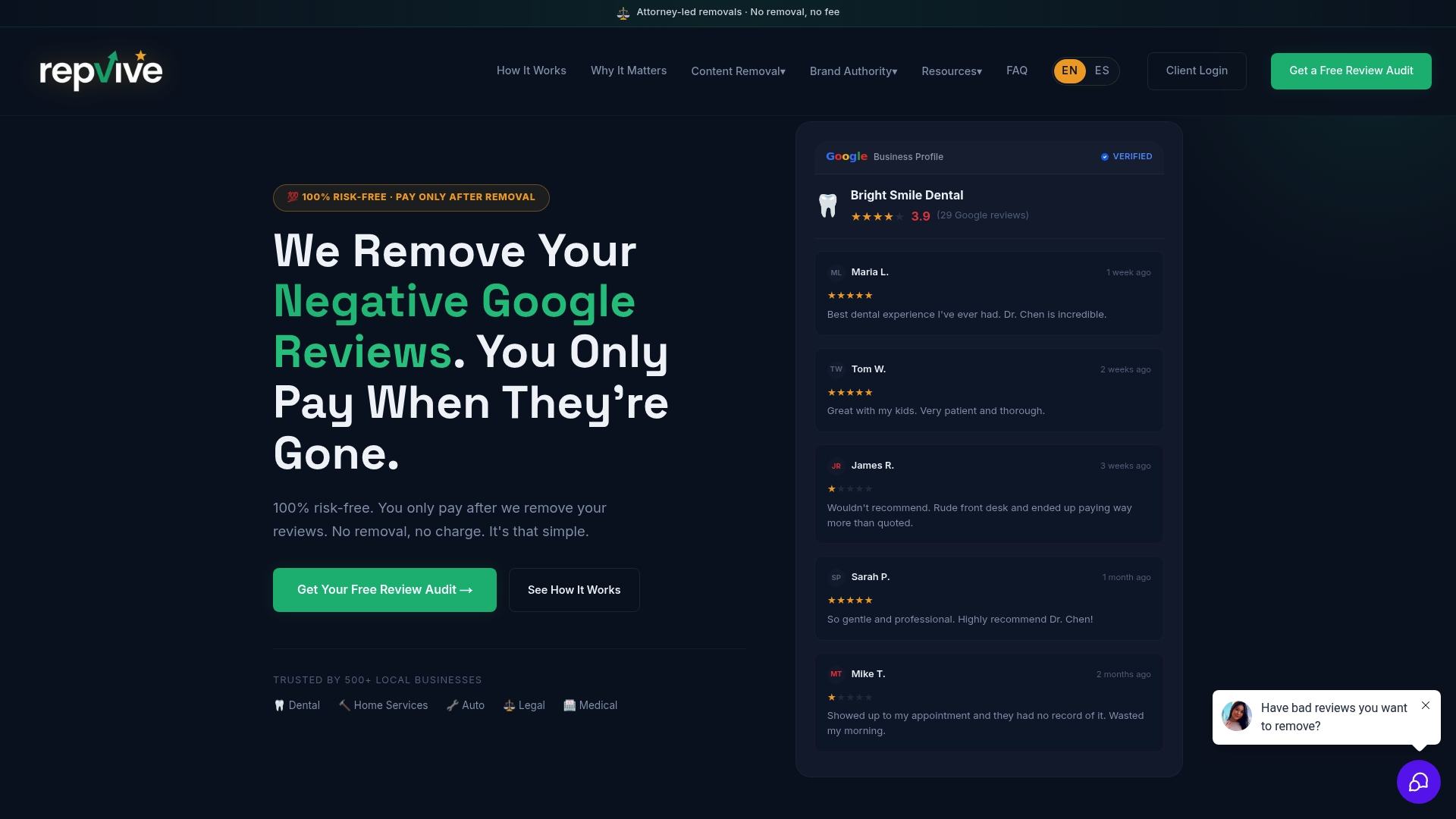
Repvive offers a free Google Business Profile audit for local business owners who want to identify which reviews on their profile may qualify for removal. The attorney-led team handles the entire claim process, from evidence collection to submission, with no upfront fees and a 99% success rate. If a review stays up, you pay nothing.
Key Takeaways
A customized review removal claim succeeds when it maps a specific review to a named Google policy violation with clear, documented evidence, not when it simply argues the review is unfair.
| Point | Details |
|---|---|
| Policy match is mandatory | Every successful claim names the exact Google policy violated, such as spam, fake content, or conflict of interest. |
| Evidence quality determines outcomes | Google’s escalation forms produce a 40, 60% success rate when evidence is clear and properly matched to a policy violation. |
| Opinions are protected speech | Negative but honest reviews cannot be removed; only reviews that breach a specific content policy qualify. |
| Cooldown before re-flagging | After a denial, waiting and rebuilding the evidence package before re-submitting improves removal chances. |
| Unethical tactics carry real risk | Bad-faith flagging and DMCA misuse can trigger Google penalties and legal liability for the business owner. |
FAQ
What is a customized review removal claim?
A customized review removal claim is an evidence-based submission that ties a specific negative review to a named Google content policy violation, such as spam, fake content, or conflict of interest, rather than simply reporting it as unfair.
How much does it cost to get a bad Google review removed?
Repvive charges no upfront fees and operates on a results-only basis. Generic third-party removal services vary widely in cost and rarely guarantee outcomes.
Can a company remove your review from Google?
A business cannot delete a review directly. They can flag it for Google to review, and Google removes it only if it violates a specific content policy.
How do you get a negative review removed from Google?
Flag the review through Google Business Profile, match it to a specific policy violation with documented evidence, and submit through the official escalation form. Response times usually take a few weeks of business days.
Can a business pay someone to remove a bad review?
Paying a service to remove a review through pressure, fake DMCA notices, or deceptive tactics violates Google’s policies and can result in penalties for the business. Legitimate removal relies on policy-based claims, not payments to intermediaries.