How Response Strategy Shapes Restaurant Reputation
Your response strategy is one of the most direct levers you have over your restaurant’s reputation online. Research confirms that responding to reviews...
TL;DR:
- A consistent response strategy enhances restaurant reputation by building trust and demonstrating attentiveness to reviews. Combining legal removal of fake reviews with thoughtful replies addresses both genuine feedback and malicious content effectively. Prioritizing quick, targeted responses and integrated legal action improves overall review management and customer perception.
Your response strategy is one of the most direct levers you have over your restaurant’s reputation online. Research confirms that responding to reviews, especially negative ones, increases customer trust and improves financial performance. Many diners choose where to eat based on online reviews, so the gap between responding well and not responding at all shows up directly in your revenue.
The role of response strategy in restaurant reputation goes beyond damage control. A well-executed approach signals to every prospective diner reading your reviews that management is attentive, accountable, and worth trusting. That signal is public, permanent, and visible to hundreds of people who never wrote a review themselves.
Key components of an effective response strategy:
- A defined owner for responses (who replies, on what timeline)
- Separate protocols for negative, neutral, and positive reviews
- Tone guidelines that stay consistent across all platforms
- Escalation paths for serious complaints (food safety, staff conduct)
- Integration with legal review removal for fake or unfair content
Stat to know: 94% of diners say online reviews influence where they eat. Your response pattern is part of what they’re reading.
Table of Contents
- Why a patterned response strategy outperforms random replies
- How attorney-led removal of fake reviews restores your reputation
- How to build a response strategy that actually works
- What successful response strategies look like in practice
- The real risks of getting your response strategy wrong
- The case for combining response strategy with legal removal
- Key Takeaways
- A sharper take on restaurant reputation management
- Repvive removes the reviews your responses cannot fix
- FAQ
Why a patterned response strategy outperforms random replies
Research identifies four response archetypes restaurants fall into: no response, strategic selective (responding only to extreme reviews), full response (replying to everything), and no strategy (random, inconsistent replies). Studies show that any defined, patterned approach outperforms the “no strategy” condition on competitive performance metrics.
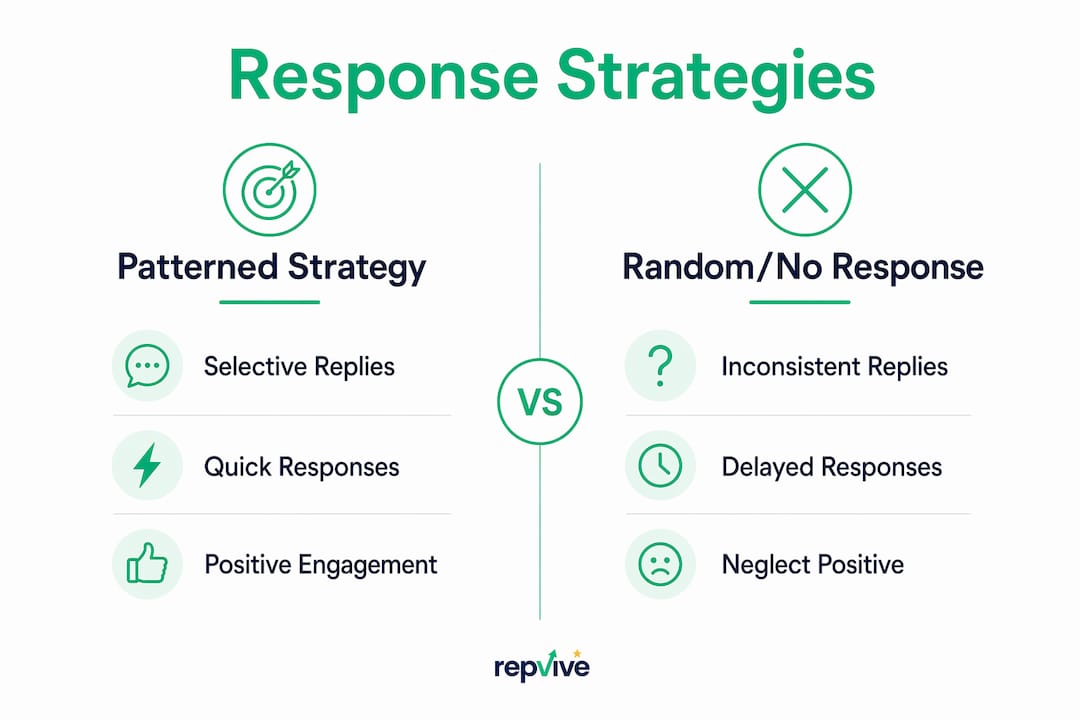
What makes patterned responses so effective? They reduce information asymmetry. A potential diner reading your reviews can’t taste your food before booking. Your response pattern is one of the few observable signals of how you actually run your operation.
Advantages of a patterned strategy over ad hoc replies:
- Prospective diners can form a reliable impression of your service culture
- Consistent tone builds brand credibility across platforms
- Selective responding to extreme reviews is often more efficient than replying to every single post
- Defined protocols reduce the risk of reactive, emotional replies
- Patterns of response influence future review scores and complaint volume
How attorney-led removal of fake reviews restores your reputation
Not every bad review reflects a real experience. Fake reviews, competitor attacks, and reviews that violate platform policies cause real damage, and a well-crafted response cannot fix a review that should not exist in the first place. This is where legal removal becomes part of the reputation management picture.
Repvive takes an attorney-led approach: each review is analyzed individually, a customized legal claim is built around it, and removal requests go through direct channels to Google. The result is a 99% success rate on removals, with no upfront fees required.
Fake or unfair reviews don’t just lower your star rating. They erode the trust of every diner who reads them before deciding whether to book.
Benefits of attorney-led removal over DIY attempts:
- Legal claims are tailored to each review, not templated
- Direct channels to Google improve approval rates
- No upfront cost means no financial risk to the restaurant owner
- Attorneys understand platform policy in ways generic removal tools do not
- Removal is permanent, not a suppression workaround
Pro Tip: Combine legal removal with a strong response strategy. Removing a fake review eliminates the damage; responding well to real ones builds the reputation that replaces it.
For guidance on handling negative feedback professionally while pursuing removal, Repvive’s blog covers both sides of the equation.
How to build a response strategy that actually works
-
Set up systematic monitoring. Use a centralized tool to track reviews across Google, Yelp, Facebook, and delivery platforms. Real-time monitoring across 20+ platforms prevents reviews from sitting unanswered for days.
-
Prioritize speed on negative reviews. Target 24, 48 hours for negative reviews, 72 hours for neutral, and within a week for positive reviews. An interim acknowledgment within the first hour signals attentiveness even before a full resolution is ready.
-
Match your response to the complaint type. Research on review responses shows that rational, fact-based replies to procedural complaints outperform emotional apologies. Acknowledge the specific issue, commit to investigating it, and provide a direct contact path.
-
Write internal guidelines. Assign clear ownership of responses, define tone standards, and create an escalation path for high-stakes complaints involving food safety or staff conduct.
-
Analyze patterns, not just individual reviews. Track response rate per platform, average response time, and shifts in review sentiment over time. Restaurants that treat reputation data as a business input, not just a PR task, tend to outperform those that treat it as reactive cleanup.
-
Integrate legal removal where appropriate. When a review is fake, violates platform policy, or is clearly malicious, a response is not enough. Flag it for attorney-led removal as part of your standard process.
What successful response strategies look like in practice
Restaurant industry leaders respond to 94% of their reviews and do so in roughly 1.21 days on average, compared to an industry average of 2.66 days. That gap in speed and volume is not accidental. It reflects a deliberate internal system, not individual effort.

A multi-location brand that consolidates reviews into a single dashboard, assigns location-level response ownership, and uses AI to draft replies while keeping human review for sensitive complaints can maintain consistency at scale. The AI handles volume; the human handles judgment. This model works because it separates the two tasks rather than conflating them.
Responding to positive reviews matters too. Brands that only reply to complaints train diners to see them as purely defensive. Acknowledging a specific, detailed positive review signals attentiveness without looking performative. Pair that with a strong physical presence, including well-designed exterior signage, and your reputation signals extend beyond the screen.
The real risks of getting your response strategy wrong
A response strategy can backfire. The most common failure mode is inconsistency: replying to some negative reviews but ignoring others sends a worse signal than no response at all, because it looks selective in a self-serving way.
Emotional or defensive replies to negative reviews are another documented risk. Research on service failure responses shows that an apology-only reply to a technical failure (wrong order, food quality issue) does not improve recovery satisfaction. Diners expect either compensation or a substantive explanation, not a generic “we’re sorry you felt that way.”
Over-responding carries its own cost. Replying to every review indiscriminately consumes staff time and can produce templated, hollow responses that erode trust rather than build it. The selective approach, focused on extreme reviews and high-visibility complaints, tends to deliver better outcomes per hour invested.
The case for combining response strategy with legal removal
Most reputation management advice focuses entirely on how you respond. That framing misses half the problem. A restaurant owner who crafts thoughtful replies to every review still loses ground when fake reviews sit unchallenged in the feed. The response strategy handles what is real; legal removal handles what should not be there.
Repvive’s attorney-led model is built specifically for this gap. The legal team reviews each case individually, which is why the success rate holds at 99%. Generic removal tools submit bulk requests and accept whatever Google returns. An attorney who has built a specific legal argument for a specific review operates on different footing entirely.
Protecting your online reputation in 2026 means treating both levers as part of the same system, not choosing between them.
Key Takeaways
A patterned, attorney-backed response strategy is the most effective way to build and defend a restaurant’s reputation against both real complaints and fake reviews.
| Point | Details |
|---|---|
| Patterned strategy wins | Any defined response approach outperforms random or no-strategy replies on competitive performance. |
| Speed matters most | Target 24, 48 hours for negative reviews; an interim reply within the first hour outperforms a delayed thorough one. |
| Match response to complaint type | Rational, fact-based replies to procedural complaints outperform emotional apologies in improving future review scores. |
| Legal removal fills the gap | Fake or unfair reviews require removal, not just a response; attorney-led removal achieves a 99% success rate. |
| Repvive’s approach | Repvive combines customized legal claims with direct Google channels, no upfront fees, and achieves about a 99% removal success rate. |
A sharper take on restaurant reputation management
The conventional advice tells you to respond to every review, stay positive, and the ratings will follow. That is not wrong, but it is incomplete in a way that costs restaurant owners real money.
The research is clear that any patterned strategy beats no strategy. But the more interesting finding is what responses actually do for prospective diners. They are not reading your reply to the person who complained. They are reading it to decide whether you are the kind of operation that takes its customers seriously. That is a fundamentally different audience, and most response templates are written for the wrong one.
The other thing most guides skip: a well-crafted response to a fake review is still a loss. You have acknowledged a review that should not exist, given it more visibility, and spent time on a problem that had a legal solution. The restaurants that protect their reputations most effectively treat response strategy and legal removal as two parts of one system, not competing options.
Repvive removes the reviews your responses cannot fix
When a fake or malicious review is dragging down your rating, a thoughtful reply is not enough. Repvive’s attorney-led removal service builds a customized legal case for each review and submits it through direct channels to Google, with a 99% success rate and no upfront fees.
This is not a generic flagging tool. Every removal request is handled by a legal team that understands platform policy and constructs arguments specific to your review. Restaurant owners who have tried the DIY route know how rarely it works. Repvive’s approach is different because the legal argument is different every time.
If fake or unfair reviews are costing you customers, start your removal with Repvive today. No upfront cost, no guesswork on whether it will work.
FAQ
How does response strategy affect restaurant reputation?
Responding to reviews, especially negative ones, increases customer trust and improves competitive performance. A consistent, patterned approach signals attentiveness to every prospective diner reading your reviews.
How quickly should a restaurant respond to negative reviews?
Target 24, 48 hours for negative reviews, with an interim acknowledgment within the first hour when possible. Industry leaders respond in roughly 1.21 days on average, about half the industry average.
Can you legally remove fake restaurant reviews?
Yes. Attorney-led services like Repvive analyze each review individually, build a customized legal claim, and submit removal requests through direct channels to Google, achieving a 99% success rate.
What is the biggest mistake restaurants make when responding to reviews?
Inconsistency is the most damaging pattern: replying to some negative reviews while ignoring others signals selective, self-serving engagement. Research also shows that apology-only responses to technical failures do not improve customer recovery satisfaction.
Should restaurants respond to positive reviews too?
Yes. Responding to detailed positive reviews signals attentiveness without appearing defensive. Brands that only reply to complaints train diners to see them as reactive rather than customer-focused.
Recommended
- Why Proactive Reputation Management Matters for Shops | Repvive
- Auto Shop Reputation Management Checklist for 2026 | Repvive
- How to Protect Business Reputation Online in 2026 | Repvive
- How to Handle a Disgruntled Patient Review Effectively | Repvive
If you would rather have this handled, our RepWatch review monitoring reviews each case first and charges only when the content comes down.