Why Proactive Reputation Management Matters for Shops
Proactive reputation management is the practice of actively monitoring, shaping, and protecting your shop’s online presence before problems take root. Most...
TL;DR:
- Proactive reputation management helps shops improve online ratings, attract more customers, and boost revenue.
- Regular review responses and operational insights from feedback strengthen trust and improve search rankings.
Proactive reputation management is the practice of actively monitoring, shaping, and protecting your shop’s online presence before problems take root. Most shop owners treat reviews reactively, responding only after damage is done. That approach is costly. 97% of consumers read online reviews before choosing a local business, and over 90% avoid businesses with negative feedback. Those two numbers alone explain why proactive reputation management matters for shops at every stage of growth. The industry term for this discipline is online reputation management, or ORM, and it covers everything from review monitoring to search presence to how AI systems describe your business.
Why proactive reputation management matters for shops’ revenue
A shop’s star rating is not just a vanity metric. A one-star improvement on Yelp can increase revenue by 5, 9% for independent businesses. That is a direct, measurable financial return from managing how customers perceive you online.

Active engagement with reviews drives that improvement. 89% of consumers read business responses to reviews, including negative ones. A well-written response to a one-star review can shift a potential customer’s perception from “this shop has problems” to “this shop cares about fixing them.”
The benefits of proactive reputation compound over time. Fresh, consistent reviews signal to new customers that your shop is active and trustworthy. Repeat customers who see their feedback acknowledged feel valued and return more often. Shops that build this cycle early create a reputation that works as a sales tool around the clock.
- A higher average star rating directly increases foot traffic and online inquiries.
- Responding to reviews publicly demonstrates accountability to every reader, not just the reviewer.
- A steady flow of new reviews prevents one bad experience from dominating your profile.
- Consistent engagement signals reliability, which converts browsers into buyers.
What operational insights shops gain from monitoring online feedback
Reviews are operational data, not just public relations noise. Retail consultants consistently emphasize treating reviews as data points that reveal staffing gaps, service speed problems, and product quality issues. A shop that reads its reviews this way fixes root causes instead of just managing appearances.
The pattern is straightforward. If three reviews in one month mention long wait times at checkout, that is a staffing or process problem. If five reviews mention a specific product being out of stock, that is an inventory signal. Fixing the underlying issues that repeatedly appear in reviews stabilizes ratings faster than any response strategy alone.
Pro Tip: Set up a simple spreadsheet to tag recurring themes in your reviews each week. After 30 days, you will have a clear picture of your top three operational problems, ranked by customer frequency.
Here is a practical process for turning reviews into operational improvements:
- Read every review within 48 hours of posting.
- Tag each review with a category: service speed, staff behavior, product quality, cleanliness, or pricing.
- Count category frequency at the end of each month.
- Bring the top two categories to your next team meeting as agenda items.
- Track whether the category frequency drops after you make changes.
This process costs nothing and produces a feedback loop that most shops never build. The shops that do build it see faster rating improvements because they are solving real problems, not just writing polite replies.
Why timely engagement with reviews matters in 2026
Speed is now a trust signal. 53% of customers expect businesses to respond to online reviews within 24 hours. A shop that replies within hours signals that it is attentive and professional. A shop that takes two weeks to respond signals the opposite.
Fast responses also limit the damage from negative reviews. A one-star review that sits unanswered for a week shapes every reader’s impression during that time. A prompt, professional response reframes the narrative immediately. It shows prospective customers that your shop takes feedback seriously.
- Responding within 24 hours meets the expectations of the majority of customers.
- A professional response to a negative review demonstrates accountability to every future reader.
- Timely replies to positive reviews reinforce loyalty and encourage repeat visits.
- Review response activity is a confidence signal that search engines and AI systems register.
89% of consumers read review responses, which means your reply is not a private conversation. It is a public statement read by hundreds of potential customers. Write every response as if your next 50 customers will read it, because they will.
Pro Tip: Create three or four response templates for common review types: a glowing five-star, a neutral three-star, and a critical one-star. Templates save time and keep your tone consistent, but always personalize at least one sentence so the response feels genuine.
How reputation management influences local search and AI-driven discovery
Search engines and AI systems do not rank shops on star ratings alone. Search engines and AI favor confidence signals such as recent reviews, consistent business listings, and owner responses. A shop with a 4.2-star rating and 200 recent reviews with owner replies will outrank a shop with a 4.8-star rating and 12 old reviews and no responses.
AI systems like ChatGPT and Google Gemini synthesize scattered online information to describe businesses to users. If your Google Business Profile is incomplete, your social listings are inconsistent, and your reviews are old, AI systems will either describe you inaccurately or skip you entirely. Proactive ORM ensures the information those systems pull is accurate and favorable.
Keeping business listing information accurate across Google, social platforms, and directories directly affects your reputation signals and local SEO rankings. A mismatched phone number or outdated address across listings creates confusion for both customers and algorithms.
| Reputation Signal | Why It Matters | How to Manage It |
|---|---|---|
| Recent reviews | Signals active, relevant business | Request reviews consistently after purchases |
| Owner responses | Builds trust and shows engagement | Reply to all reviews within 24 hours |
| Consistent listings | Improves local SEO and AI accuracy | Audit Google, Yelp, and social profiles monthly |
| Review volume | Increases credibility and ranking weight | Use automated review request tools |
| Accurate business info | Prevents AI and search errors | Update all platforms when details change |
For shops that want to understand how AI platforms specifically interpret their reputation, Repvive’s AI reputation management guide covers how ChatGPT, Gemini, and Perplexity read and summarize local business profiles.
Steps for local shops to build a proactive reputation management system
Building a proactive system does not require a large budget. It requires consistency. Only 28% of small businesses actively invest in structured reputation management. That gap is a direct competitive opportunity for any shop willing to commit to a weekly routine.
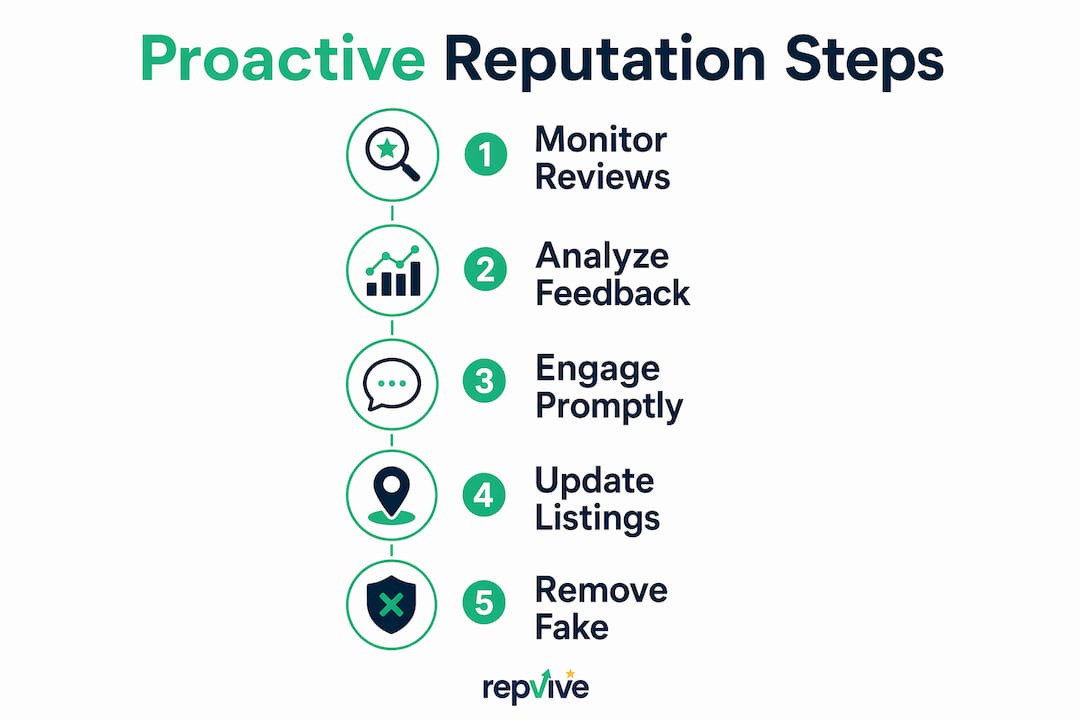
- Monitor weekly. Check Google, Yelp, and Facebook reviews every Monday. Use a tool like Repvive’s real-time review monitoring service to catch new reviews across 20+ platforms automatically.
- Respond to every review. Reply to positive reviews with a thank-you that references something specific. Reply to negative reviews within 24 hours with a calm, professional acknowledgment and an offer to resolve the issue.
- Generate new reviews consistently. Ask satisfied customers for a review at the point of sale or via a follow-up text. Automated review collection tools remove the awkwardness of asking manually.
- Use review data operationally. Tag and categorize feedback monthly. Bring recurring themes to your team and track whether changes reduce complaints.
- Address fake or unfair reviews directly. Not every negative review is legitimate. Fake reviews from competitors or disgruntled non-customers can be removed through legal channels. Repvive’s attorney-led process has a 99% success rate for removing reviews that violate Google’s policies.
Pro Tip: Use your revenue risk calculator to estimate how much your current star rating is costing you in lost revenue. The number is usually larger than shop owners expect, and it makes the case for investing in reputation management immediately.
The auto shop reputation management checklist from Repvive offers a practical framework that applies to most retail and service shops, not just auto businesses.
Key Takeaways
Proactive reputation management is the single most cost-effective growth tool available to local shops, directly connecting online perception to foot traffic, sales, and search visibility.
| Point | Details |
|---|---|
| Reviews drive revenue | A one-star rating improvement can increase shop revenue by 5, 9%. |
| Speed builds trust | 53% of customers expect a review response within 24 hours. |
| Reviews are operational data | Recurring review themes reveal staffing, product, and service problems to fix. |
| AI reads your reputation | Search engines and AI systems favor recent reviews, owner responses, and consistent listings. |
| Most shops skip this | Only 28% of small businesses invest in structured ORM, creating a clear competitive gap. |
The discipline most shop owners overlook
I have worked with dozens of local shop owners who treat reputation management as something to deal with after a crisis. A bad review appears, they panic, they respond poorly or not at all, and the damage compounds. The shops that grow consistently do the opposite. They treat ORM as a weekly operational task, the same way they treat inventory or payroll.
The most counterintuitive thing I have learned is that negative reviews, handled well, often build more trust than five-star reviews alone. A shop with 200 reviews, a 4.3-star average, and thoughtful responses to every complaint looks more credible than a shop with 15 perfect reviews and no engagement. Customers are not looking for perfection. They are looking for evidence that you will show up when something goes wrong.
The shops that win in local search in 2026 are not the ones with the most advertising spend. They are the ones with the most consistent, recent, and well-managed review profiles. That is a discipline any shop can build, and the cost of not building it shows up directly in your revenue.
, Jason
How Repvive helps shops protect and build their reputation
Reputation problems rarely fix themselves. Fake reviews, unfair complaints, and outdated listings quietly cost shops customers every day.
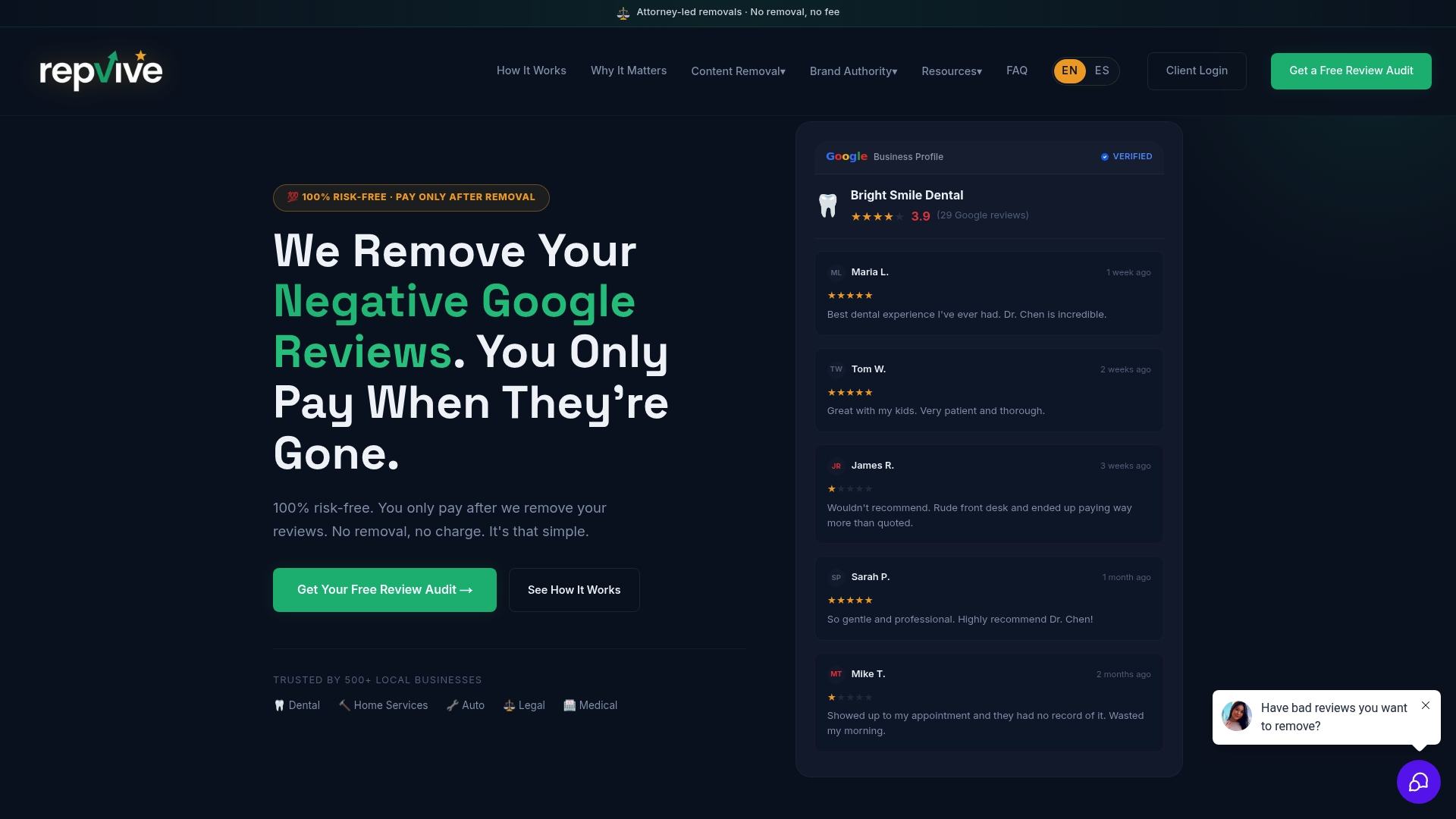
Repvive offers an attorney-led review removal service with a 99% success rate and no upfront fees. The legal team crafts a customized claim for each review, using direct channels to get removals approved by Google. Beyond removal, Repvive’s services cover real-time monitoring, automated review collection, and AI reputation management, giving shop owners a complete system rather than a patchwork of tools. If you want to see what your current reputation is costing you before committing to anything, the free revenue risk calculator on the Repvive website gives you a concrete number in under two minutes.
FAQ
Why does proactive reputation management matter for shops?
Proactive reputation management matters because 97% of consumers read reviews before choosing a local business. Shops that actively manage their online presence attract more customers and recover faster from negative feedback.
How much can a better star rating increase shop revenue?
A one-star improvement on Yelp increases revenue by 5, 9% for independent businesses. That makes star rating improvement one of the highest-return activities a shop owner can pursue.
How fast should shops respond to reviews?
53% of customers expect a response within 24 hours. Responding within that window limits reputational damage and signals professionalism to every future reader.
Can fake or unfair reviews be removed?
Yes. Reviews that violate Google’s content policies can be removed through a formal dispute process. Repvive’s attorney-led approach achieves a 99% removal success rate for qualifying reviews, with no upfront cost to the shop owner.
How do reviews affect local search rankings?
Search engines weight confidence signals like recent reviews, owner responses, and consistent listings alongside star ratings. A shop with active engagement consistently outranks a shop with a higher rating but no recent activity.
Recommended
- Auto Shop Reputation Management Checklist for 2026 | Repvive
- Review Removal Service & Online Reputation Management | Repvive
- How Reputational Harm Is Measured: A Business Guide | Repvive
- AI Reputation Management: ChatGPT, gemini & Perplexity | Repvive
If you would rather have this handled, our reputation management services reviews each case first and charges only when the content comes down.