Extortion Review Removal for Local Businesses: Act Now
If your Google Business Profile is being targeted with extortion-based negative reviews, do not pay. Document everything, then file Google’s Merchant...
If your Google Business Profile is being targeted with extortion-based negative reviews, do not pay. Document everything, then file Google’s Merchant Extortion report immediately.
Here are your first five moves in the next 30, 60 minutes:
- Stop all communication with the person making demands
- Screenshot every review and the extortion message, including timestamps
- Copy the URL of each suspicious review from your browser’s address bar
- Submit the Merchant Extortion form at Google Business Profile Help
- Contact GBP support if multiple reviews appeared within hours of each other
Pro Tip: Google’s extortion form asks for the date of first threat, the communication method (WhatsApp, Telegram, email), and the sender’s details. Capture the sender’s username, phone number, or email address before they delete their account, that metadata is harder to recover later than the review text itself.
Key Takeaways
Extortion review removal requires immediate evidence preservation, platform reporting through Google’s Merchant Extortion form, and legal escalation when self-help fails.
| Point | Details |
|---|---|
| Do not pay or negotiate | Paying incentivizes further extortion and provides no guarantee of removal. |
| Preserve evidence immediately | Capture screenshots, review URLs, reviewer profiles, and full communication threads before anything is deleted. |
| Use Google’s Merchant Extortion form | File at Google Business Profile Help with dates, sender details, and review links for the strongest outcome. |
| Escalate legally when needed | Cease-and-desist letters, john Doe subpoenas, and court orders are available when platform reporting fails. |
| Repvive for professional removal | Attorney-led, pay-per-removal service covering 20+ platforms with no upfront fees and real-time tracking. |
Table of Contents
- What does review extortion look like, and how do you spot it?
- How to preserve evidence so it holds up legally
- How to report extortion to Google step by step
- When and how to approach an identifiable reviewer
- What are your legal options when platform reporting is not enough?
- How do you decide whether to challenge a review or respond publicly?
- Ongoing monitoring and recovery after an extortion attempt
- When should you hire an attorney-led removal service?
- The evidence-first approach is always the right one
- Repvive’s attorney-led removal service: what to expect
- Sources
- FAQ
What does review extortion look like, and how do you spot it?
Review extortion is a specific form of online abuse where someone posts, or threatens to post, negative reviews on your Google Business Profile and demands money, free services, or other favors in exchange for removing them. It is distinct from a customer who is simply unhappy. The key difference is the demand.
Red flags that separate extortion from a legitimate complaint:
- A sudden cluster of 1-star reviews appearing within hours, often from accounts with no prior review history
- A direct message (via WhatsApp, Telegram, email, or your contact form) demanding payment or free services before the reviews disappear
- Explicit timelines: “You have 48 hours to respond or more reviews will follow”
- Multiple reviews using nearly identical phrasing, suggesting coordinated accounts
- A reviewer who has never been your customer but references your business by name with specific-sounding but unverifiable claims
A legitimate complaint, even a harsh one, rarely comes with a payment demand attached. When it does, you are no longer dealing with a dissatisfied customer. You are dealing with a crime, and your response strategy changes entirely. Framing your report correctly matters: Google’s removal categories include spam/fake content, harassment, and conflict of interest. Flagging within those policy buckets is more effective than labeling something “defamation” without supporting documentation.
How to preserve evidence so it holds up legally
Evidence quality determines whether Google acts on your report and whether an attorney can build a case. Capture these items before anything is edited or deleted:
| Evidence Item | What to Capture | Why It Matters |
|---|---|---|
| Full-page screenshots | Entire review with star rating, reviewer name, date, and your business name visible | Proves content and timing |
| Review URL | Copy from browser address bar while on the review | Required by Google’s extortion form |
| Reviewer profile snapshot | Profile photo, review history, account creation date | Shows coordinated or fake account patterns |
| Extortion communications | Full message thread with timestamps and sender ID | Core proof of the demand |
| Internal records | Booking logs, CRM entries, transaction receipts | Confirms or refutes the reviewer’s claimed experience |
| Business listing URL | Your GBP URL at the time of the attack | Ties the incident to your specific listing |
Beyond screenshots, capture the page source URL from your browser and note the exact time and time zone. Name files systematically: YYYY-MM-DD_ReviewerName_Platform_Item.png. Store everything in at least two locations, one of which should be a cloud service with version history (Google Drive or Dropbox with file recovery enabled). If you anticipate litigation, avoid editing or deleting any original files. Courts and Google both expect this level of documentation when evaluating extortion claims.
Pro Tip: If the extortion demand came via WhatsApp or Telegram, export the full chat thread (Settings → Export Chat) before blocking the sender. That export includes timestamps and the sender’s phone number, both of which Google’s form requests.
Involve an attorney early if the financial impact is significant or if you receive a second wave of reviews after the first report. Chain of custody matters in court, and an attorney can advise you on how to store evidence in a format that is admissible.

How to report extortion to Google step by step
Follow this sequence exactly. Skipping steps or refiling the same flag without new documentation slows the process.
- Flag each review individually. Open your Google Business Profile, find the review, click the three-dot menu, and select “Report review.” Choose the most accurate policy category: “Spam or fake” or “Off-topic” for coordinated attacks, “Conflict of interest” if the reviewer has a business relationship with a competitor.
- Wait for the automated review. Google’s system typically processes flags within 3, 14 days. Do not refile the same flag during this window. Check status in the Reviews Management Tool inside your GBP dashboard.
- If the review is not removed, escalate to GBP support. Contact Google Business Profile support directly, reference your case ID, and attach your evidence package (screenshots, review URLs, communication thread). Ask explicitly for human review.
- Submit the Merchant Extortion form. This is a separate, dedicated channel for extortion specifically. The form asks for: date of first threat, communication method, sender details, the specific demand, a summary of the incident, screenshots, and the review links. Be factual and specific. Sample language that works: “On [date], I received a message via [platform] from [sender ID] demanding [specific demand] in exchange for removing a 1-star review posted to my Google Business Profile on [date]. I did not comply. I am submitting screenshots of the demand and the review as evidence.”
- Escalate via the GBP Community Forum if support is unresponsive. GBP Product Experts in the Community Forum can escalate complex cases when you provide clear documentation and a case ID. This is not a guaranteed path, but it has worked for coordinated attacks.
Coordinated review-bombing is best reported as a single incident with all review links bundled together and a clear explanation of the pattern, rather than separate flags for each review. Google’s automated systems remove large volumes of policy-violating reviews, but targeted extortion campaigns often require human escalation to resolve.
After submission, expect an initial automated response within a few days and a final decision within 1, 3 weeks for escalated cases. Google will not always notify you of the outcome directly; check your listing regularly.
When and how to approach an identifiable reviewer
If you can identify the reviewer as an actual customer, a measured customer-service response is sometimes the right move. If the extortion demand is explicit, it is not.
Do:
- Reach out once, calmly, through a private channel if the person appears to be a real customer with a genuine complaint
- Acknowledge the issue factually without admitting liability
- Offer a specific resolution (refund, follow-up appointment, direct conversation)
Do not:
- Threaten legal action in a first message
- Post a public accusation naming the reviewer
- Engage repeatedly if they do not respond or escalate demands
Customer-service outreach template (for genuine customers): “Hi [Name], I saw your review and want to make this right. Could you reach out to us directly at [contact] so we can resolve this? We take every experience seriously.”
Counsel-style demand template (when extortion is clear and the reviewer is identifiable): “We have documented your communications and the reviews posted to our Google Business Profile. We are prepared to pursue all available legal remedies if the reviews are not removed and the demands cease. This letter is for informational purposes and does not waive any rights.”
The second template should be sent by or reviewed by an attorney before delivery. Responding to a defamatory review publicly without legal guidance can worsen your position if litigation follows.
Pro Tip: Never respond to the extortion demand itself, even to say “no.” Any response signals that the channel works and may invite escalation. Silence plus documentation is the correct posture until you have counsel involved.
What are your legal options when platform reporting is not enough?
Platform reporting resolves many cases. When it does not, the legal path follows a clear sequence.
- Cease-and-desist letter. An attorney sends a formal demand to stop the extortion and remove the reviews. Cost: typically $500, $1,500 for a straightforward letter. Timeline: 1, 2 weeks to draft and send. This works when the reviewer is identifiable and wants to avoid legal exposure.
- John Doe subpoena. When the reviewer is anonymous, an attorney files a John Doe lawsuit and petitions the court for a subpoena to compel Google or the relevant ISP to disclose identifying information. Courts require a preliminary evidentiary showing before ordering this discovery, balancing First Amendment concerns against the plaintiff’s right to pursue a claim.
- Defamation litigation and court-ordered takedown. If the reviewer is identified and refuses to remove the content, a defamation suit can result in a court order directing Google to remove the review. Google typically complies with authenticated court orders, though the process can take months and cost several thousand dollars in legal fees.
Know the limits before you commit. Section 230 of the Communications Decency Act shields Google from liability for third-party content, which means you cannot sue Google to force removal, you can only obtain a court order against the reviewer and present it to Google. The Streisand Effect is a real risk: a public lawsuit can draw more attention to the review than the review itself ever would. Weigh the revenue impact of the review against the cost and publicity of litigation before proceeding.
The FTC’s fake-review enforcement portal gives businesses another reporting route, but FTC action is enforcement-focused and slow. File there in parallel with platform reporting, not instead of it. Legal experts consistently recommend a combined approach: preserve evidence, use platform channels, and send formal legal notices when the financial stakes justify it.
How do you decide whether to challenge a review or respond publicly?
Not every negative review warrants a removal attempt. The wrong move here can backfire badly.
Work through these questions in order:
- Is the reviewer verifiable as a real customer? Check your CRM, booking system, and transaction records.
- Does the review contain a false factual claim (not just a negative opinion)? Opinions are protected; false statements of fact are actionable.
- Is this part of a coordinated attack? Check for review velocity, account age, and similar phrasing across multiple reviews.
- Does challenging this review risk drawing more attention to it than it currently has?
If the answer to questions 2 or 3 is yes, escalate to Google reporting and consider legal counsel. If the review is likely genuine, a professional public response is your best tool.
Public response template for a genuine negative review: “Thank you for sharing your experience. What you described doesn’t reflect our standards, and we’d like to make it right. Please contact us at [contact] so we can address this directly.”
When to stop DIY efforts:
- Multiple reviews appeared within 24 hours from accounts with no review history
- You have received a direct demand for payment
- Your initial flag was denied and GBP support has not responded within two weeks
At that point, the case has moved past what self-help can reliably resolve.
Ongoing monitoring and recovery after an extortion attempt
The best defense against future attacks is a review profile that is too healthy to damage with a handful of fake reviews. Build that buffer now.
- Set up Google Alerts for your business name and check your GBP listing daily for new reviews
- Monitor review velocity: a sudden spike of more than two or three reviews in a single day warrants immediate investigation
- Ask satisfied customers for reviews ethically, by sending a follow-up message after a completed service with a direct link to your GBP review page
- Respond to every review, positive or negative, within 24 hours to signal active management
- Document your baseline star rating and review count monthly so you can demonstrate harm if extortion recurs
- Use proactive reputation-building strategies to maintain a steady inflow of authentic reviews that dilute any coordinated attack
A staged reputation-repair approach combines authentic review generation, professional responses to legitimate complaints, and velocity monitoring. Paid monitoring services make sense for businesses with high review volume or prior extortion history; in-house processes work fine for smaller operations with a clear daily checklist.
When should you hire an attorney-led removal service?
Self-help works for isolated fake reviews. It often falls short for coordinated campaigns, anonymous defamatory statements, or situations where the financial impact is significant enough to justify professional intervention.
Attorney-led removal is most effective when:
- Multiple reviews appeared simultaneously from unverifiable accounts
- The reviewer is anonymous and platform reporting has failed
- The content contains specific false factual claims that are damaging revenue
- You have already filed a Merchant Extortion report and received no resolution
Repvive handles exactly these cases. The service uses attorney-crafted claims customized to each review, submitted through direct channels to Google. The pay-per-removal model means you pay only after a review is successfully removed, with no upfront fees. Repvive covers Google, Yelp, Facebook, TripAdvisor, Trustpilot, BBB, and more than 20 other platforms. The real-time tracking dashboard shows you exactly where each removal stands. For ongoing protection, RepWatch and RepBoost monitor your listings and help generate new authentic reviews.
Before hiring any removal service, ask these questions:
- What is your documented success rate, and can you show case examples?
- Do you use attorney-crafted claims or generic templates?
- How do you handle evidence, and who has access to my documentation?
- What is your pricing model, per removal, subscription, or retainer?
- What is the typical timeline from submission to removal?
- What happens if a removal attempt fails?
The cost of professional review removal varies by provider and model. Pay-per-removal pricing, like Repvive’s, aligns the provider’s incentive with your outcome. Retainer-based models charge regardless of results.
The evidence-first approach is always the right one
The instinct to pay, negotiate, or fire back publicly is understandable when your reputation is under attack. Every one of those moves makes your situation worse. Paying signals that the tactic works and invites more attempts. Public accusations without documentation can expose you to counter-claims. Ignoring the situation while it compounds is equally costly.
The businesses that come out of extortion attempts in the best position are the ones that treated the first hour as a documentation exercise, not a crisis. They preserved the evidence, filed the right forms, and let the process work before escalating. Volume and velocity of real reviews is the long-term defense. A business with 200 authentic reviews absorbs a coordinated 5-review attack far better than one with 20.
Repvive’s attorney-led removal service: what to expect
When platform reporting stalls and the financial stakes are real, Repvive gives local businesses a clear path forward. Every removal starts with an attorney-crafted claim built specifically for that review, not a generic template. You pay only after the review comes down.
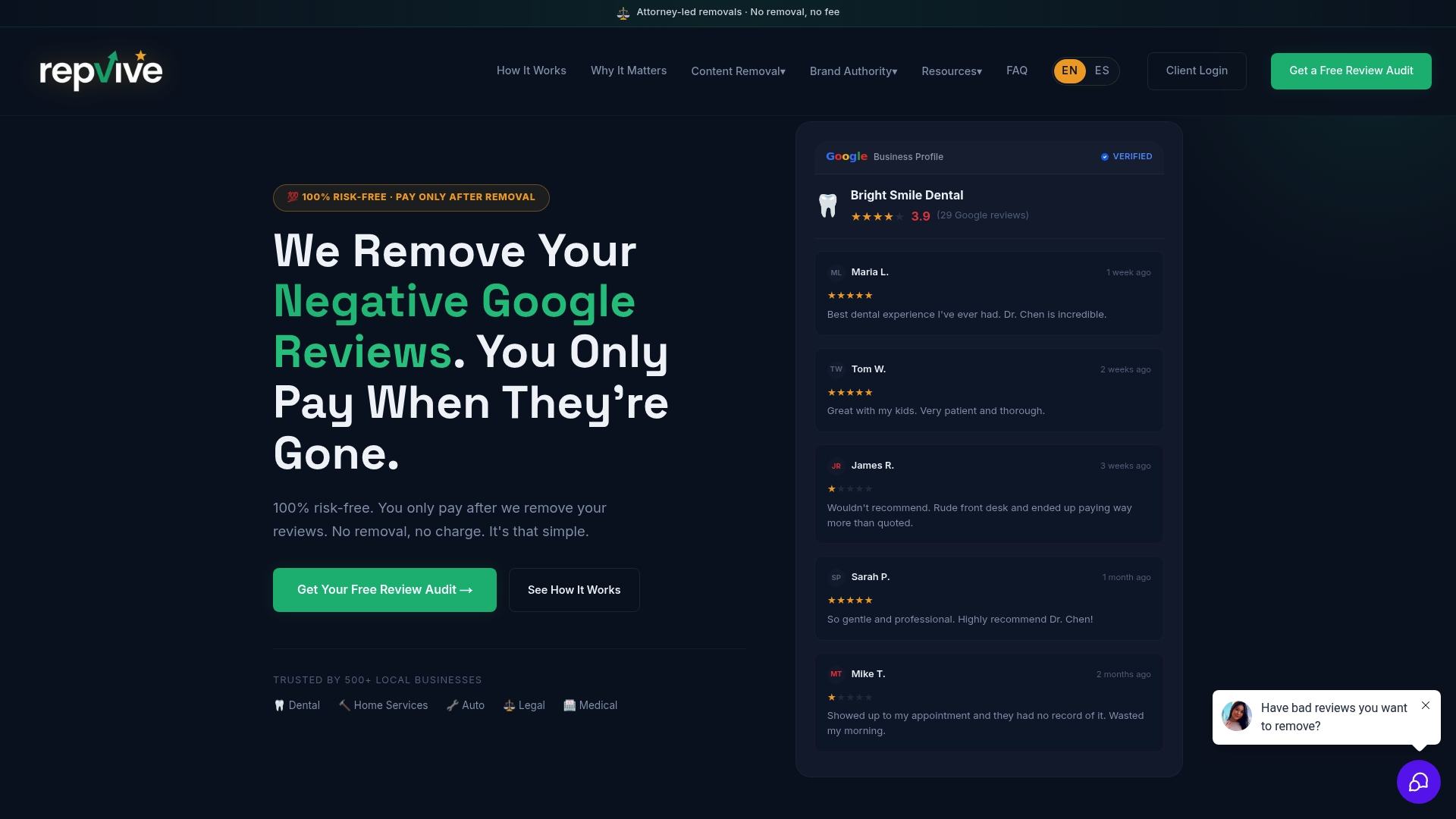
Repvive covers Google, Yelp, Facebook, TripAdvisor, Trustpilot, BBB, and more than 20 platforms. When you contact the team, they walk you through an evidence checklist, give you a timeline estimate based on the platform and review type, and handle the submission and escalation process. RepWatch monitors your listings for new threats, and RepBoost helps you build the authentic review volume that makes future attacks less damaging.
Start your extortion review removal with Repvive today. No upfront fees, no guesswork about whether it worked.
Sources
These are the official pages and legal resources you will need to file reports and learn more:
- Report negative review extortion scams on your Business Profile, Google Business Profile Help
- How to Handle Defamatory Google Reviews: A Legal Guide for Businesses | Chambers and Partners
- How to Remove Fake Google Reviews: The Complete 2026 Process | Flento
This article is general information, not a substitute for advice from a qualified lawyer. Consult a qualified legal professional about your own circumstances before acting on anything here.
FAQ
What is review extortion?
Review extortion is when someone threatens to post, or has already posted, negative reviews on your business listing and demands money, free services, or other favors in exchange for removing them. It differs from a negative review in that the demand is explicit and tied directly to the review.
How do you get a fake or extortion-based review taken down?
Flag the review via the three-dot menu in your Google Business Profile, then submit Google’s Merchant Extortion form with screenshots, review URLs, and the sender’s details. If the automated review does not remove it within 3, 14 days, escalate to GBP support with your case ID and documentation.
Is it illegal to pay someone to remove a review?
Paying an extortionist to remove a review is not a recognized legal remedy and may constitute participation in extortion or fraud depending on the circumstances. Google explicitly advises against it, and paying provides no enforceable guarantee of removal.
How many reports does it take to get a review removed?
There is no fixed number. A single well-documented report through the Merchant Extortion form, with clear evidence of the demand and review links, carries more weight than multiple generic flags. Coordinated attacks reported as a single incident with all review links bundled together are more likely to trigger human review than separate flags filed one at a time.
When does it make sense to hire a professional removal service like Repvive?
When platform reporting has failed, the reviewer is anonymous, or multiple reviews appeared simultaneously as part of a coordinated attack, an attorney-led service like Repvive is worth considering. Repvive’s pay-per-removal model means you only pay after a review is successfully removed, which removes the financial risk of trying professional help.
Recommended
- Customized Review Removal Claims: A 2026 Guide for Local Businesses | Repvive
- Online Review Removal Service & Reputation Management | Repvive
- Best Removify.com Alternatives for Small Businesses 2026 | Repvive
- Google Review Removal Cost: What Local Businesses Pay | Repvive
If you would rather have this handled, our Google review removal service reviews each case first and charges only when the content comes down.