Best Removify.com Alternatives for Small Businesses 2026
For most U.S. small businesses, the smartest path isn’t paying a high fee per review to a specialist firm. A DIY monitoring setup paired with subscription...


For most U.S. small businesses, the smartest path isn’t paying a high fee per review to a specialist firm. A DIY monitoring setup paired with subscription tooling handles routine policy violations at a fraction of that cost. For legally complex cases, defamation, coordinated attacks, or high-value regulated industries, Repvive’s attorney-led approach is the strongest alternative to Removify among paid services.
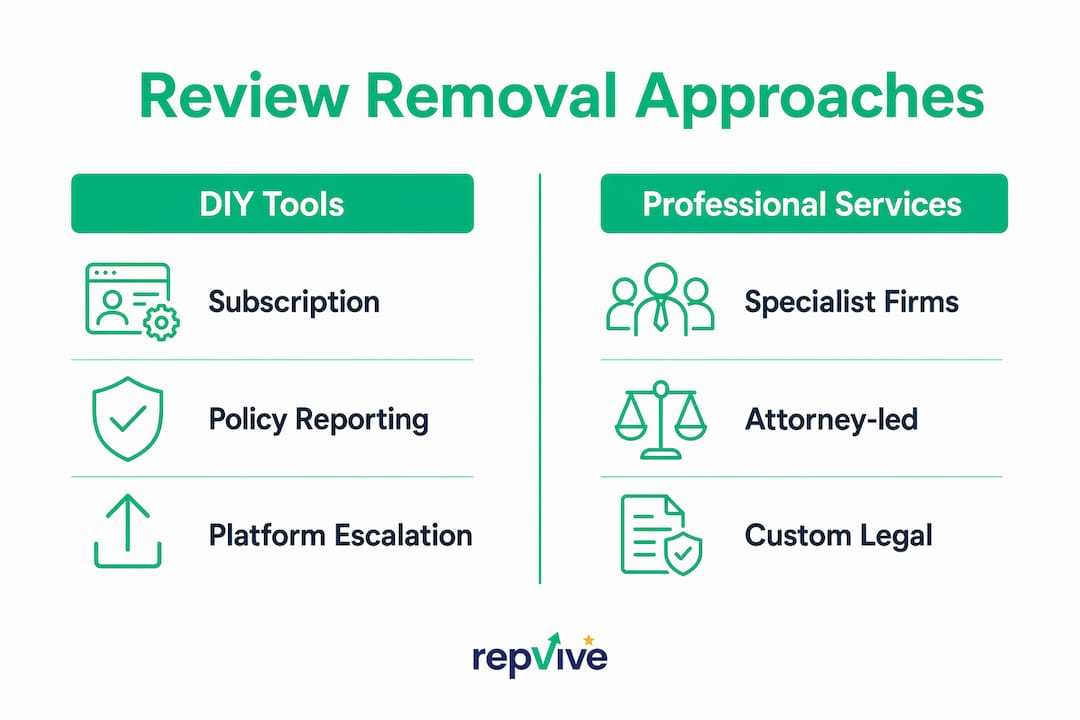
Three paths worth knowing:
- Subscription monitoring + DIY reporting: Best for businesses with occasional unfair reviews and identifiable policy violations. Costs roughly $99/month for subscription tooling, which is substantially less than typical per-removal fees of $500, $1,500 charged by specialist firms.
- Specialist per-removal firms (Erase.com, guaranteed Removals, NetReputation, WebiMax, consumer Fusion, Unreview): Best when you want hands-off handling and can absorb per-review pricing. Selectivity and deposit terms vary widely.
- Attorney-led services (Repvive): Best when the review crosses into defamation, involves coordinated attacks, or sits in a regulated industry where legal leverage matters.
Choose DIY when volume is low and violations are clear. Move to a paid specialist when time is short or volume is high. Escalate to attorney-led when legal exposure is real.
Table of Contents
- What are the best Removify.com alternatives?
- How each approach actually removes reviews
- What does review removal actually cost?
- Which approach fits your situation?
- When DIY makes sense and how to do it
- How to vet any removal vendor before you pay
- Why Repvive’s attorney-led approach is different
- What most SMBs should do next
- Key Takeaways
- A note on how these recommendations were made
- Repvive’s consultation: what to expect
- Useful sources
- FAQ
What are the best Removify.com alternatives?
The table below maps each category across the dimensions that matter most for U.S. SMBs. Pricing reflects industry-reported ranges for 2025, 2026.
| Category | Platforms covered | Approach | Typical pricing | Turnaround | Best for | Selectivity |
|---|---|---|---|---|---|---|
| Subscription tooling | Google, Yelp, Facebook, niche sites | Monitoring + policy-matched DIY reports | ~$99/month | Ongoing | Low-to-moderate volume, recurring issues | None, self-serve |
| Specialist per-removal firms | Google, Yelp, Facebook, Trustpilot, niche | Policy escalation, platform disputes, publisher takedowns | $500, $1,500 per review | a turnaround time of several weeks | Hands-off, moderate-to-high volume | Often prefer multi-review or enterprise accounts |
| Attorney-led services | Google, multi-platform | Legal demand letters, attorney-crafted policy claims, formal escalation | No upfront fee or refundable deposit; success-based | a turnaround time of a few weeks | Defamation, coordinated attacks, regulated industries | Case-by-case legal assessment |
Named providers by category:
- Subscription tooling: Platforms with automated flagging and report templates
- Specialist firms: Erase.com, guaranteed Removals, NetReputation, WebiMax, consumer Fusion, Unreview
- Attorney-led: Repvive
Pro Tip: If you’re dealing with a single unfair review, weight the “approach” and “pricing” columns heavily. For a coordinated attack across multiple platforms, the “platforms covered” and “attorney-led” rows matter far more than cost per review.
U.S. businesses should confirm that any provider covers state-specific defamation law, since enforcement and legal leverage differ between California, Texas, Florida, and other states.
How each approach actually removes reviews
Not all removals work the same way, and knowing the difference saves you from paying for a service that can’t actually help your situation.

Policy-based reporting is the most common method. A specialist identifies which platform rule the review violates, fake reviewer, conflict of interest, off-topic content, spam, and files a report that matches the violation to the exact policy category. Accuracy matters enormously here. A report filed under the wrong category gets rejected automatically. Firms that do this at volume develop pattern recognition that individual business owners rarely have time to build.
Platform escalation kicks in when the first report fails. This means filing appeals, opening support tickets, or contacting publisher relations teams directly. Most platforms require multiple attempts before acting, which is why professional removal firms often handle cases that DIY attempts couldn’t crack, not because the violation was different, but because persistence and escalation paths were used.
Legal demand letters and attorney involvement are a different category entirely. When a review contains false statements of fact, doxxing, or is part of a coordinated defamation campaign, an attorney can send a formal demand that carries legal weight a standard platform report does not. Publishers and platforms respond differently to legal notices than to user-submitted flags.
SEO suppression is not removal. It uses content production and link-building to push negative items down in search results. It’s a long-term play, typically months of ongoing investment, and it’s the right call when removal is genuinely unlikely. Any firm that leads with suppression when you asked about removal is selling you a different product.
- Policy-based removal works when: the review violates a specific, documented platform rule
- Escalation works when: the first report failed but the violation is real
- Legal paths work when: content is defamatory, anonymous, or hosted outside the platform
- Suppression works when: removal is not viable and you need to manage search visibility over time
Pro Tip: Before contacting any vendor, screenshot the review and note which platform rule it likely violates. If you can’t identify one, suppression may be more realistic than removal, and a good vendor will tell you that upfront.
What does review removal actually cost?
The per-removal economics are the most important thing to understand before you sign anything. One paid removal typically costs $500, $1,500, often more than a full year of subscription tooling at ~$99/month.
| Tier | Model | Typical range | What’s included |
|---|---|---|---|
| Entry-level / DIY | Monthly subscription | ~$99/month | Monitoring, policy-flag alerts, report templates |
| Mid-tier specialist | Per-removal, success-based | $500, $1,500 per review | Hands-off filing, escalation, appeals |
| Attorney-led | Success-based or refundable deposit | Varies by case complexity | Legal demand letters, attorney-crafted claims, multi-platform coverage |
What drives cost up:
- Case complexity: Anonymous reviewers, off-platform content, or defamation claims require more work and often legal involvement.
- Platform: Google removals follow different rules than Yelp or Trustpilot. Some platforms are simply harder to move.
- Volume: Firms often discount for 10+ reviews, but small businesses rarely hit that threshold.
- Jurisdiction: State-specific defamation law affects what legal leverage is available.
- Timeline: Expedited handling, when offered, costs more.
Pricing example for 5, 10, and 20 reviews (category averages):
| Reviews | Subscription tooling (annual) | Mid-tier specialist | Attorney-led (estimate) |
|---|---|---|---|
| 5 reviews | , | , | Varies; case-assessed |
| 10 reviews | , | , | Varies; case-assessed |
| 20 reviews | , | , | Varies; case-assessed |
The subscription row stays flat because at ~$99/month, the cost doesn’t scale with volume. That’s the core argument for DIY tooling when violations are identifiable and volume is manageable.
Which approach fits your situation?
| Scenario | Recommended category | Notes |
|---|---|---|
| Single unfair or fake review, clear policy violation | DIY + subscription tooling | File the report yourself; escalate if rejected twice |
| 3, 10 reviews, no time to manage internally | Specialist per-removal firm | Confirm deposit terms and refund policy before signing |
| Coordinated attack across Google, Yelp, and Facebook | Attorney-led (Repvive) | Multi-platform legal leverage is the differentiator |
| Defamatory content with false statements of fact | Attorney-led (Repvive) | Legal demand letters carry weight platform reports don’t |
| Regulated industry (healthcare, legal, financial) | Attorney-led or specialist with legal team | Compliance risk makes attorney involvement worth the cost |
| Removal unlikely; long-term visibility concern | SEO suppression specialist | Different product, set expectations accordingly |

Multi-location businesses and agencies managing multiple clients should negotiate volume pricing with specialist firms and confirm whether a single contract covers all locations or requires separate agreements per location.
U.S.-specific note: platform policy enforcement is not uniform across states. Google’s review removal team applies the same global policy, but legal demand letters are more effective in states with stronger defamation statutes. A provider that understands California’s anti-SLAPP law, for example, will approach a case differently than one that doesn’t.
When DIY makes sense and how to do it
DIY is the right call when you have one to three reviews with identifiable policy violations and you’re willing to invest two to four hours per case. Here’s the exact process:
- Set up monitoring. Use a tool that alerts you within hours of a new review appearing on Google, Yelp, Facebook, and any niche sites relevant to your industry. Speed matters, the faster you catch a review, the more context you have.
- Triage the review. Read it against the platform’s content policy. Is it from someone who was never a customer? Does it contain false statements of fact? Is it spam or off-topic? If you can’t match it to a specific policy rule, note that, it changes your path.
- Collect evidence. Screenshot the review with timestamp. If you can document that the reviewer was never a customer (no transaction record, no appointment), save that too.
- File a matched policy report. Use the platform’s official reporting tool and select the category that matches the violation exactly. Vague reports get rejected. Specific, documented reports get reviewed.
- Follow up and appeal. If the first report is rejected, appeal with additional evidence. Most platforms allow at least one appeal. Document every submission with a ticket number or confirmation email.
- Escalate if needed. After two failed attempts with solid evidence, consider a specialist or attorney-led service. At that point, the case likely needs escalation paths you don’t have access to as an individual business owner.
Estimated time per case: two to four hours for the initial report, plus 30, 60 minutes per follow-up. For a business handling one or two reviews per quarter, that’s manageable. For five or more per month, the math shifts toward a paid service.
How to vet any removal vendor before you pay
The top-list methodology for review removal services varies widely, and some rankings reflect referral relationships more than performance. Here’s what to ask before you sign anything.
Questions to ask every vendor:
- What is your documented success rate, and how do you measure it?
- Can you show redacted platform responses or Google support ticket IDs as proof of removal activity?
- Is your deposit fully refundable if the removal attempt fails, or is part of it retained as an administrative fee?
- Do you include appeal attempts in the base price, or are those billed separately?
- Have you handled cases similar to mine, same platform, same review type, same industry?
- Is an attorney involved, and if so, at what stage?
Red flags:
- Opaque pricing with no written quote
- “Guaranteed removal” claims with no documented evidence or case studies
- High-pressure upsells during the first call
- No explanation of methodology, just a success rate number
- Refund policy buried in fine print or absent entirely
Before you pay a deposit, ask this: “If your first removal attempt fails, is my deposit fully refundable, or is any portion retained as an administrative fee?” Most pay-on-success models still include setup fees or nonrefundable administrative charges. Confirm the exact refund terms in writing before any money changes hands.
Affiliate-driven content can push certain providers to the top of comparison lists regardless of performance. When you see a “top 10” list, check whether the ranking methodology is explained and whether the site discloses referral relationships. Independent reviews on G2 or Capterra are more reliable than anonymous blog rankings.
Why Repvive’s attorney-led approach is different
Most review removal services file platform reports and escalate through standard support channels. Repvive’s legal team does something structurally different: attorneys craft customized claims for each review, using direct channels that carry legal weight with Google and other platforms.
The practical difference is leverage. A policy report filed by a business owner and a formal legal claim filed by an attorney are not the same document in Google’s review process. Attorney involvement is most valuable when content crosses into defamation, involves doxxing, or is part of a coordinated multi-platform attack, situations where a standard platform report has already failed or is unlikely to succeed.
Repvive’s model includes no upfront fees, with a refundable-deposit structure, and a reported 99% success rate on cases accepted. The firm focuses on U.S. small and medium businesses across industries including healthcare, legal, home services, and hospitality, sectors where a single damaging review can cost thousands in lost revenue.
What attorney involvement actually changes: Legal demand letters can compel publisher responses that platform reports cannot. When a review contains false statements of fact, an attorney-crafted claim creates a paper trail that matters if the case escalates further, and it signals to the platform that the business is serious.
Trust signals to look for in any attorney-led firm:
- Bar admission of the attorneys involved (verifiable through state bar directories)
- Published methodology explaining how claims are crafted and submitted
- Transparent success metrics with a clear definition of what “success” means
- No-upfront-fee or fully refundable deposit policy in writing
For regulated industries, Repvive’s approach is particularly relevant. A dentist, law firm, or financial advisor facing a defamatory review has compliance exposure beyond just reputation, and an attorney who understands both the platform policy and the regulatory context is worth the premium over a standard removal service. See how this plays out specifically in review removal for dentists and similar regulated fields.
What most SMBs should do next
For the majority of small businesses, start with DIY monitoring and a subscription tool. If you have one or two reviews with clear policy violations, file the reports yourself. The cost-effectiveness of subscription tooling versus per-removal pricing is hard to argue with for routine cases.
For legally complex or high-value situations, Repvive is the strongest attorney-led option available to U.S. SMBs, no upfront fee, legal expertise built into the process, and a focus on cases where standard platform reports have already failed or are unlikely to work.
Immediate next steps (do these within 72 hours):
- Audit every review platform where your business appears and flag any reviews that may violate platform policy
- Set up a monitoring alert so you catch new reviews within hours, not days
- For any review you want removed, document the violation category before contacting any vendor
- Request written quotes from at least two providers, including deposit and refund terms
- If the review contains false statements of fact or is part of a coordinated attack, contact an attorney-led service first
Stop DIY and escalate when: two appeal attempts have failed with solid evidence, the review is part of a coordinated campaign, or the content is defamatory and the business operates in a regulated industry.
Key Takeaways
For most U.S. SMBs, subscription monitoring plus targeted DIY reporting (~$99/month) is the most cost-effective path for routine review issues, while attorney-led services like Repvive are the right call when legal leverage is needed.
| Point | Details |
|---|---|
| DIY tooling beats per-removal pricing | Subscription tooling at ~$99/month costs less than a single paid removal ($500, $1,500) for most small businesses. |
| Attorney-led is not just more expensive | Legal demand letters create leverage that standard platform reports cannot, especially for defamation or coordinated attacks. |
| Deposit terms are non-negotiable | Always confirm in writing whether a deposit is fully refundable if the removal attempt fails before paying anything. |
| Vendor rankings can be biased | Top-list methodology varies; prioritize G2 or Capterra reviews and ask vendors for documented case evidence. |
| Repvive fits legally complex cases | Repvive’s attorney-crafted claims and no-upfront-fee model make it the strongest option for high-value or legally exposed SMBs. |
A note on how these recommendations were made
The comparison above is built around one question: what actually works for a small business owner who doesn’t have a reputation management team on staff? The answer isn’t always the most expensive option, and it’s rarely the first result on a “top 10” list.
Repvive is the publisher of this article, and it’s also the attorney-led service recommended for legally complex cases. That’s a conflict worth naming directly. The recommendation stands because the attorney-led model genuinely produces different outcomes than standard policy reporting, not because it’s the publisher’s product. For routine, low-volume cases, DIY tooling is still the better economic choice, and saying otherwise would waste your time and money.
What most comparison articles miss is the suppression-versus-removal distinction. Businesses often pay for removal when suppression is the only realistic outcome, or pay for suppression when removal was actually achievable. The right vendor tells you which one applies to your case before you pay. If they don’t, that’s the most important red flag on the list.
Repvive’s consultation: what to expect
If the review you’re dealing with involves false statements, a coordinated attack, or a platform that’s already rejected your reports, Repvive is worth a direct conversation. The consultation covers the specific review, the platform, the likely policy category, and whether attorney involvement changes the odds.
Repvive’s process starts with a case review at no upfront cost. The legal team assesses whether the review qualifies for attorney-crafted removal, outlines the approach, and confirms the deposit and refund terms in writing before any work begins. Typical timelines run two to six weeks depending on platform and case complexity.
Visit Repvive’s review removal service to submit your case details and get a written assessment. Before you confirm, ask specifically about the refund policy if the first removal attempt doesn’t succeed, the answer tells you everything about how the firm operates.
Useful sources
The following sources were used to build the comparisons, pricing ranges, and vendor guidance in this article.
- Top 5 Google Review Removal Service Providers (Ranked For 2026), independent ranking with pricing data and provider trade-offs; third-party analysis.
- Removify vs Erase.com vs Guaranteed Removals vs DIY: An Honest Look, honest cost comparison including the DIY + subscription tooling math; third-party editorial.
- Google Review Removal Services Cost, pricing breakdown and deposit/refund term guidance; third-party analysis.
- Top 10 Removify Alternatives and Competitors in 2026, G2’s user-sourced competitor list; independent platform data.
- Top-5 Reputation Management Firms, industry overview of leading reputation management providers; third-party editorial.
- View comparisons of major competitors for Removify, agency ranking page with methodology notes; use with awareness of potential referral relationships.
- Online Review Removal Service and Reputation Management | Repvive, Publisher’s own service page; primary source for Repvive brand claims and consultation process.
- Top 4 golegalmark.com Alternatives 2026, Third-party comparison of review removal providers; useful cross-reference for evaluation criteria.
FAQ
What is the best alternative to Removify for small businesses?
For most U.S. small businesses, a DIY monitoring subscription handles routine policy violations at roughly a monthly subscription fee. For legally complex cases involving defamation or coordinated attacks, Repvive’s attorney-led service is the strongest paid alternative.
Is Removify worth it for U.S. businesses?
Removify operates in the U.S. and offers policy-based removal across multiple platforms, but it was acquired by Software Combined in May 2025 and is headquartered in Australia. U.S. businesses should confirm current service terms, pricing, and whether attorney involvement is available for their specific case type.
How much does review removal typically cost?
Per-removal pricing from specialist firms typically runs $500, $1,500 per review, while subscription monitoring tools cost ~$99/month. Attorney-led services are priced by case complexity and often use a refundable-deposit or success-based model.
Is Erase.com a legitimate review removal service?
Erase.com is a real, operating service that handles review and content removal across multiple platforms. As with any vendor, ask for documented case evidence, confirm deposit and refund terms in writing, and check independent reviews on G2 or Capterra before committing.
Can I remove a fake Google review myself?
Yes, if the review clearly violates Google’s content policy, spam, fake reviewer, conflict of interest, off-topic content. File a report through Google’s official flagging tool, match the violation to the exact policy category, and appeal if the first attempt is rejected. If two appeals fail with solid evidence, escalate to a specialist or attorney-led service.