Why Anonymous Reviews Are Hard to Fight in 2026
Anonymous reviews are feedback posted without verifiable identification, and that structural gap makes them one of the most persistent threats in reputation...
TL;DR:
- Anonymous reviews are difficult to combat because they lack accountability and often stay on platforms unless they violate specific policies. Legal efforts to unmask reviewers are costly, slow, and rarely successful unless the damage is substantial and coordinated. Building a strong base of authentic reviews offers the best defense against malicious anonymous feedback.
Anonymous reviews are feedback posted without verifiable identification, and that structural gap makes them one of the most persistent threats in reputation management. A business owner cannot confront a reviewer they cannot identify, cannot verify a claim they cannot trace, and cannot satisfy a platform’s removal criteria without clear evidence of a policy violation. The FTC enforces its Consumer Review and Testimonials Rule with penalties up to $53,088 per fake review violation, yet enforcement targets the poster, not the platform. Understanding why anonymous reviews are hard to fight starts with recognizing that anonymity is a feature, not a flaw, of how most review systems are built.
Why anonymous reviews are hard to fight: the accountability gap
Anonymous reviews are defined in reputation management as feedback where the poster’s real identity cannot be confirmed by the business, the platform, or the public. This is the standard industry term: “anonymous review.” The broader challenge is often called “review accountability failure” by legal and platform policy professionals. Platforms detect roughly 85% of fake reviews, but that still leaves millions of fabricated reviews active and influencing purchase decisions. That gap falls hardest on small businesses, where a handful of false one-star ratings can shift a star average visibly.

The core problem is that anonymity removes social consequence. A reviewer who attaches their real name to a false claim risks defamation liability. A reviewer hiding behind a throwaway account faces none of that pressure. The result is a structural imbalance: the business bears the reputational cost while the reviewer bears no risk. This is why the challenges of anonymous reviews are not simply a moderation problem. They are a design problem built into how open review ecosystems operate.
How do platform policies handle anonymous review removal?
Google and most major review platforms operate on a content policy model, not an identity verification model. A review stays live unless it violates a specific written rule, such as spam, conflict of interest, or off-topic content. The reviewer’s anonymity is irrelevant to that determination. Automated flags often conclude no violation, but manual reviews remove clear policy violations within 2, 14 days. Complex cases can take up to 30 days.
The appeal process rewards precision. Automated moderation misses nuance, and human appeals with precise policy mapping maximize chances of removal. That means citing the exact policy clause the review violates, not just flagging it as “unfair.” Appeals that include detailed evidence, such as metadata, timestamps, and account signals, close nearly twice as fast as unsupported appeals.
A practical removal attempt follows this sequence:
- Screenshot the review immediately, including the reviewer’s profile, star rating, and timestamp.
- Identify the specific Google policy the review violates (spam, fake engagement, conflict of interest, or off-topic).
- Submit a flag through Google Business Profile with the policy violation named explicitly.
- If the automated review returns “no violation,” escalate to a manual appeal with supporting documentation.
- For reviews involving coordinated attacks or legal violations, prepare a Recovery Report with metadata before escalating further.
Pro Tip: Time is the most underrated factor in review removal. Reviewer data and account signals vanish quickly after posting. Capture everything within the first 24 hours, even if you are not ready to file an appeal yet.
What legal barriers exist to unmasking anonymous reviewers?
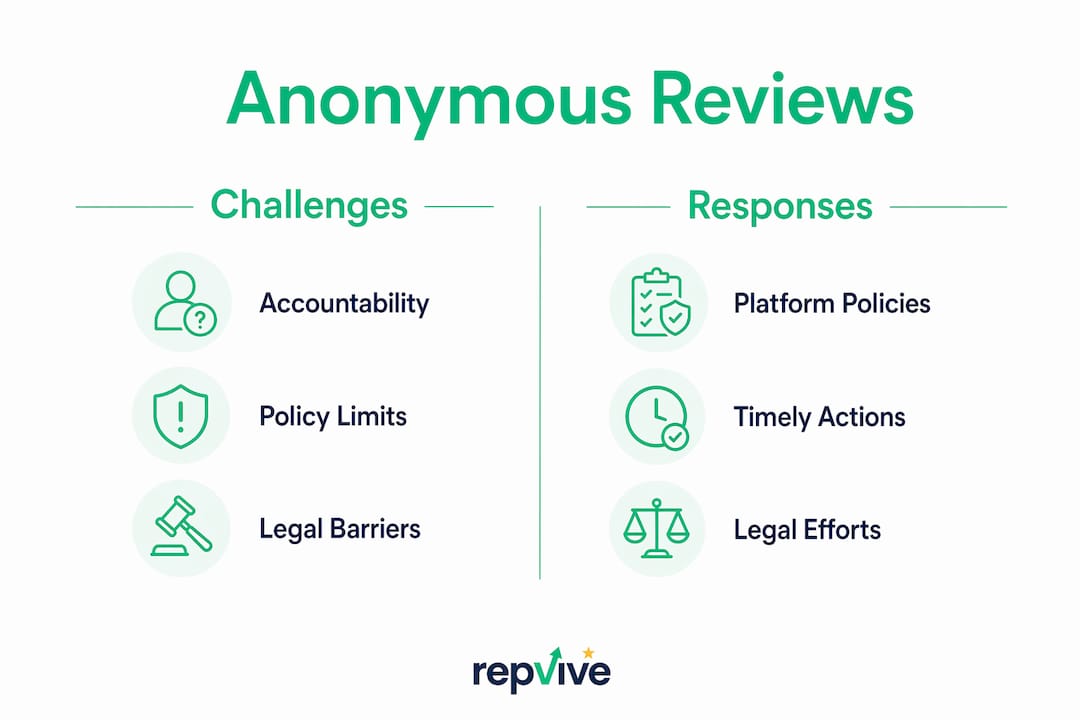
The legal path to identifying an anonymous reviewer is long, expensive, and frequently unsuccessful. The Dendrite-Cahill legal test sets the standard in most U.S. jurisdictions. To compel a platform to reveal a reviewer’s identity, a business must demonstrate a good-faith legal basis, show the identity is materially relevant to the claim, and prove it has exhausted other means of identifying the person. Courts treat anonymous speech as a First Amendment right, not a loophole.
Even when a business clears that bar, additional obstacles appear:
- Anti-SLAPP laws in over 30 states can halt unmasking efforts if the reviewer argues the review addresses a matter of public concern.
- Data retention limits mean platforms and ISPs may no longer hold the IP address or account data needed to identify the poster.
- Subpoena costs for a single defamation case routinely run into thousands of dollars before any court ruling.
- Platform resistance is common. Platforms often contest subpoenas to protect user privacy, adding legal fees and delays.
“Anonymity protections create a high bar for unmasking to balance free speech against reputational harm. Businesses pursuing legal identification of anonymous reviewers must meet strict judicial standards, and courts will not lower that bar simply because the review is damaging.”
Legal experts on anonymous online speaker standards
The practical implication is that legal unmasking is a last resort, not a first response. Most businesses that pursue it spend more in legal fees than the review’s reputational damage would have cost to absorb. The exception is coordinated smear campaigns where the financial harm is documented and substantial.
Why does anonymity encourage malicious and low-quality reviews?
Anonymity lowers the cost of dishonesty to zero. A competitor, a disgruntled former employee, or a bad-faith actor can post a damaging review in minutes with no social or legal repercussion. Anonymous reviews encourage poor-quality and malicious feedback precisely because reviewers face no consequences. That is not a fringe behavior. It is a predictable outcome of any system where identity is optional.
The technical evasion methods make detection harder. Coordinated attacks often use aged accounts, residential proxies, and rotating IP addresses to mimic genuine reviewer behavior. These methods undercut platform detection algorithms that rely on behavioral signals. A single bad actor can simulate the appearance of multiple independent reviewers, and the platform’s automated systems may never flag the pattern.
The impact lands differently depending on business size. Consider the contrast:
| Business profile | Review volume | Impact of one fake 1-star review |
|---|---|---|
| Established business, 400+ reviews | High | Minimal star average shift; buyers trust broad experience |
| Small local business, under 20 reviews | Low | Visible star average drop; disproportionate credibility damage |
A single fake negative review is far less impactful for businesses with hundreds of authentic reviews. That asymmetry explains why managing untraceable reviews is a more urgent problem for small and mid-sized businesses than for large enterprises.
Pro Tip: Check your fake review warning signs regularly. Throwaway accounts often share patterns: no profile photo, no review history, and a posting date clustered with other suspicious reviews.
What can business owners do to respond effectively?
The most durable defense against anonymous negative reviews is a large volume of genuine positive reviews. Bad reviews that do not violate policies generally stay, so the practical goal is to dilute their impact rather than eliminate every one. Buyers trust profiles with broad, authentic experience. A business with 300 real reviews absorbs a fake one-star rating far better than a business with 15.
Beyond volume, these practices reduce the damage from reviews that cannot be traced or removed:
- Respond publicly and calmly. A measured, factual reply signals professionalism to future readers. It does not need to address the reviewer directly. It addresses the audience reading the exchange.
- Document everything. Screenshot the review, the reviewer’s profile, and any related accounts immediately. This evidence supports both platform appeals and potential legal action.
- Map violations to specific policies. Generic “this is fake” reports fail. Naming the exact policy clause (spam, conflict of interest, off-topic) dramatically improves removal odds.
- Monitor in real time. Reputation damage compounds when reviews go unanswered for days. Real-time monitoring through tools like RepWatch catches new reviews the moment they post.
- Treat your review profile as an asset. Experts advise businesses to manage their review ecosystem as a defensible asset, not a passive scoreboard.
Pro Tip: When writing a public reply to a suspicious anonymous review, keep it under three sentences. Acknowledge the concern, state your standard of service, and invite direct contact. Long defensive replies often read as confirmation of the complaint.
Key Takeaways
Anonymous reviews remain structurally hard to fight because anonymity removes accountability, limits platform removal criteria, and raises the legal bar for unmasking to a level most businesses cannot practically clear.
| Point | Details |
|---|---|
| Anonymity removes accountability | Reviewers with no verifiable identity face no social or legal consequence for false claims. |
| Platform removal requires policy violations | A review stays live unless it breaks a specific written rule; being unfair is not enough. |
| Legal unmasking is costly and slow | The Dendrite-Cahill test and anti-SLAPP laws make court-ordered identification rare and expensive. |
| Volume is the best defense | Businesses with hundreds of authentic reviews absorb fake negatives far better than those with few. |
| Speed matters in evidence capture | Reviewer data disappears fast; screenshot everything within 24 hours of a suspicious review posting. |
The uncomfortable truth about fighting anonymous reviews
I have worked with enough business owners to know the most common mistake: treating every anonymous negative review as a battle worth fighting. It is not. The structural reality is that most anonymous reviews that do not violate a specific policy will stay up, and pursuing each one through appeals, legal channels, or mass-reporting campaigns wastes time and can actually hurt your standing with the platform.
What actually works is building a review profile so strong that a handful of bad actors cannot move the needle. That requires consistent effort, not reactive scrambling. The businesses I have seen recover fastest from coordinated smear campaigns are the ones that already had 200-plus authentic reviews before the attack hit. The fake reviews looked like outliers, not patterns.
The other thing I have learned is that the legal route is almost never worth it unless the financial harm is documented, substantial, and ongoing. Spending $15,000 in legal fees to unmask a reviewer who posted one bad review is a losing trade in almost every scenario. Save that energy for cases where the damage is real, measurable, and part of a coordinated effort. For everything else, the answer is documentation, precise policy-mapped appeals, and a relentless focus on measuring reputational harm so you know when a situation crosses from manageable to serious.
, Jason
How Repvive helps businesses tackle anonymous and fake reviews
Anonymous reviews do not have to be a permanent fixture on your profile. Repvive’s attorney-led review removal service is built specifically for the structural challenges described in this article.
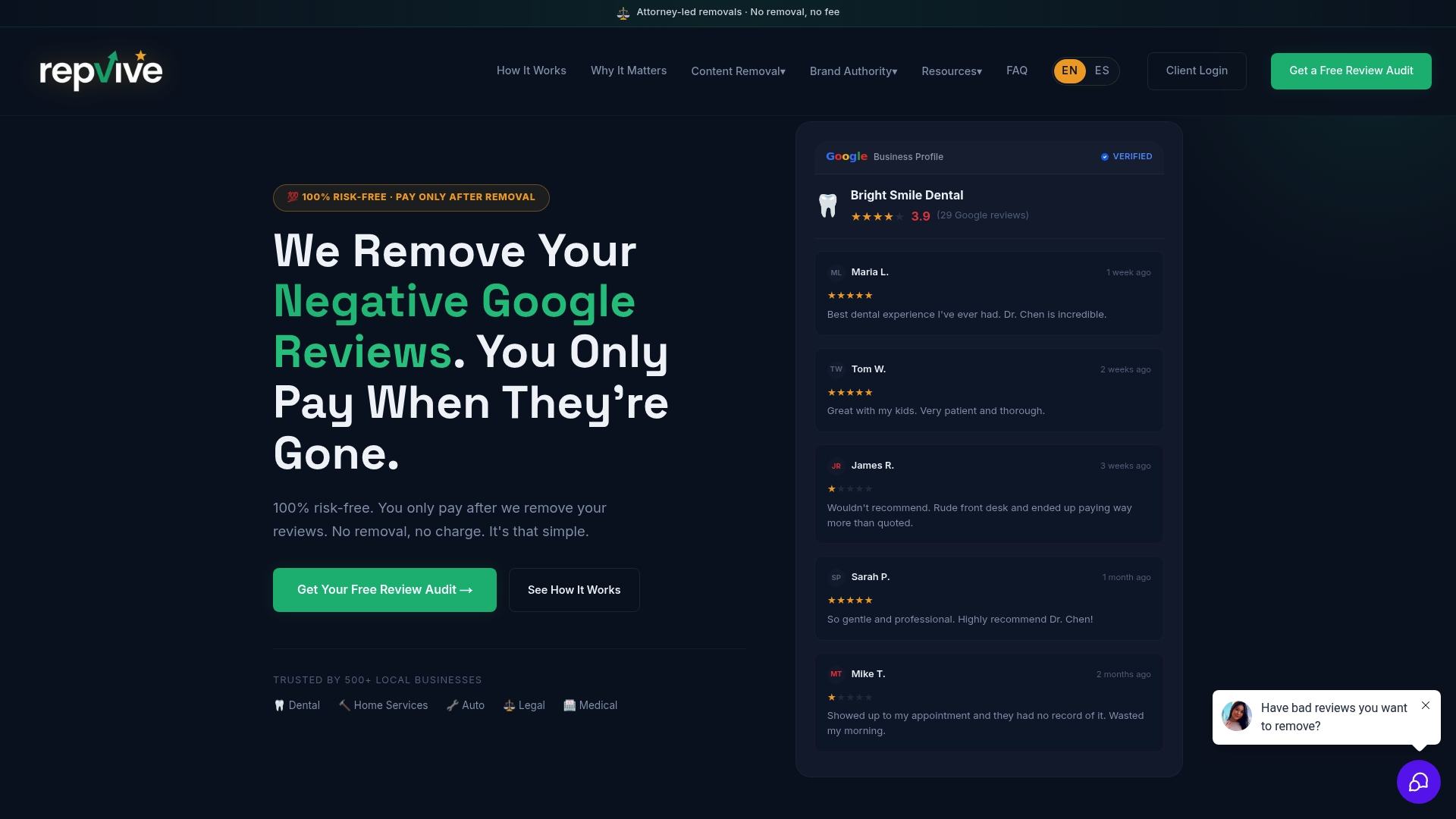
Repvive’s legal team maps each review to the exact platform policy it violates, crafts a customized removal claim, and works through direct channels with Google to get the decision approved. With a reported 99% success rate and no upfront fees, the process is designed for small and mid-sized businesses that cannot afford to absorb reputational damage while waiting on generic appeals. For reviews that require legal escalation, Repvive’s attorneys handle the process from documentation through resolution. If anonymous or fake reviews are affecting your business, explore Repvive’s services or visit repvive.co to start a case review.
FAQ
Why can’t businesses simply remove anonymous reviews?
Platforms only remove reviews that violate specific content policies. Anonymity alone is not a policy violation, so reviews stay live unless they contain spam, conflicts of interest, or other prohibited content.
What is the Dendrite-Cahill test?
The Dendrite-Cahill test is the legal standard most U.S. courts use to decide whether a platform must reveal an anonymous reviewer’s identity. It requires a business to show a good-faith legal basis and prove it has exhausted other identification methods first.
How long does Google take to remove a flagged review?
Google’s manual review process typically takes 2, 14 days for clear policy violations. Complex cases can take up to 30 days, and appeals with detailed evidence resolve faster than unsupported flags.
Do anti-SLAPP laws protect anonymous reviewers?
Anti-SLAPP laws in over 30 states can block or delay unmasking efforts if the reviewer argues the review addresses a matter of public concern. This makes legal identification of anonymous reviewers significantly harder in most U.S. jurisdictions.
What is the fastest way to reduce the impact of a fake anonymous review?
Build a high volume of genuine positive reviews so that any single fake review has minimal effect on your overall star rating. A calm, factual public reply also signals professionalism to future customers reading your profile.
Recommended
- Fake Review Warning Signs Checklist for Local Businesses | Repvive
- RepWatch: Real-Time Review Monitoring Across 20+ Platforms | Repvive
- Reputation Management Blog | Repvive
If you would rather have this handled, our Google review removal service reviews each case first and charges only when the content comes down.