2.7M Reviews Blocked: TripAdvisor Review Policy for Business Owners
TripAdvisor requires reviews to be first-hand, submitted within a year of the experience, and free of AI generation or incentives. Enforcement runs through...
TripAdvisor requires reviews to be first-hand, submitted within a year of the experience, and free of AI generation or incentives. Enforcement runs through automated filters, human moderators, and community flags. Breaking the rules can mean a removed review, a red badge, or an award disqualification for a business, but TripAdvisor won’t erase a review just because a business disagrees with it. If the review passes the platform’s authenticity tests, it stays up.
TL;DR:
- Reviews must be based on a firsthand experience and submitted within 12 months of the visit, with only one review allowed per experience or listing.
- AI-generated content, incentivized reviews, and promotional or plagiarized material are strictly prohibited and lead to removal or account suspension.
- TripAdvisor relies on automated detection, human moderation, and community flags to identify and remove fake or policy-violating reviews, with most reviews passing through all layers successfully.
- Business owners can flag problematic reviews and respond professionally through the Management Centre, but factual, policy-compliant negative reviews typically stay regardless of disputes.
- Removing a review is only possible if it clearly breaches policies, such as being fake or containing private information; legal escalation is reserved for defamatory or privacy-violating content.
Table of Contents
- Understanding TripAdvisor’s Review Policy: Who Can Post and When
- What Content TripAdvisor Bans: AI Text, Incentives, and Self-Promotion
- How TripAdvisor Detects Fake Reviews: Automation, Moderators, and Community Flags
- How to Report a Review and Use the Management Centre
- Penalties Businesses Face for Policy Violations
- Requesting a Review Removal: What Actually Works
- Media, Privacy, and Formatting Rules for Reviews
- When Professional Removal Help Makes Sense
- Your Data and Your Words: Privacy and Ownership in TripAdvisor Reviews
- Who Owns a Review Once You Post It
- The Real Gap Between TripAdvisor’s Rules and How People Use Them
- Sources
- FAQ
Understanding TripAdvisor’s Review Policy: Who Can Post and When
TripAdvisor’s core posting rule is simple to state and easy to violate without realizing it: you must have actually experienced the business, either as the guest or as part of the traveling party, and the review has to reflect that first-hand encounter. Writing on behalf of a friend, using someone else’s account, or reviewing a place you never set foot in all violate the platform’s Review Guidelines.
Timing matters more than most people assume. A review submitted more than 12 months after the trip generally falls outside the eligibility window, and TripAdvisor limits contributors to one review per experience or listing. That means a traveler can’t post three separate reviews of the same restaurant visit hoping one sticks, and a couple who both dined there together should generally submit a single joint account rather than duplicate entries.
Multi-stop trips create legitimate gray areas. A cruise with five port stops or a road trip through six hotels each generates its own eligible review, since each stop is a distinct experience. Flights work the same way: a connecting itinerary with two carriers can generate two separate airline reviews.
- The reviewer or their travel companion must have personally experienced the business.
- Submission must happen within 12 months of the visit.
- One review per experience or listing, with no duplicate accounts for the same stay.
- No posting under someone else’s identity or on behalf of a third party.
- Each distinct leg of a multi-stop trip qualifies for its own review.
Serious safety incidents get handled somewhat differently. TripAdvisor has processes for escalating reviews involving allegations of assault, illness outbreaks, or other safety-critical claims, since these carry public-interest weight beyond a typical service complaint. Those reviews still have to meet the same first-hand standard, but they may trigger closer scrutiny from the trust and safety team before or after publication.
What Content TripAdvisor Bans: AI Text, Incentives, and Self-Promotion
TripAdvisor’s Content & Community Guidelines draw a hard line around a handful of content categories, and violating any one of them can get a review pulled or an account suspended.
AI-generated text and AI-generated images top the list, as explained in detail by why testing ChatGPT ads is worthwhile for performing arts organizations. A review typed into ChatGPT and pasted verbatim reads differently than one written by someone who was actually there, and TripAdvisor’s detection systems are built to catch that pattern. If you used an AI tool to help organize your thoughts, rewrite the output in your own voice, swap generic phrasing for specific details (the name of your server, the exact wait time, what the room actually smelled like) before you post.
Incentivized reviews are equally forbidden. That covers free meals, discounts, gift cards, or any perk offered in exchange for a review, along with organized schemes where a business pushes staff or customers to post glowing feedback en masse. Commercial self-promotion and plagiarized text are also barred. Copying a press release into a review, or using a review slot to advertise your own competing business, gets removed on sight.
- AI-generated text or images, regardless of how lightly edited.
- Reviews written in exchange for money, discounts, or free products.
- Organized review-boosting campaigns involving employees or incentivized customers.
- Commercial self-promotion, plagiarized content, or off-topic political and religious commentary.
- Personally identifying information about staff or other guests.
Pro Tip: If a review reads like marketing copy, rewrite it around one specific moment: what you ordered, what broke, what surprised you. Specificity is the fastest way to sound human instead of promotional.
How TripAdvisor Detects Fake Reviews: Automation, Moderators, and Community Flags
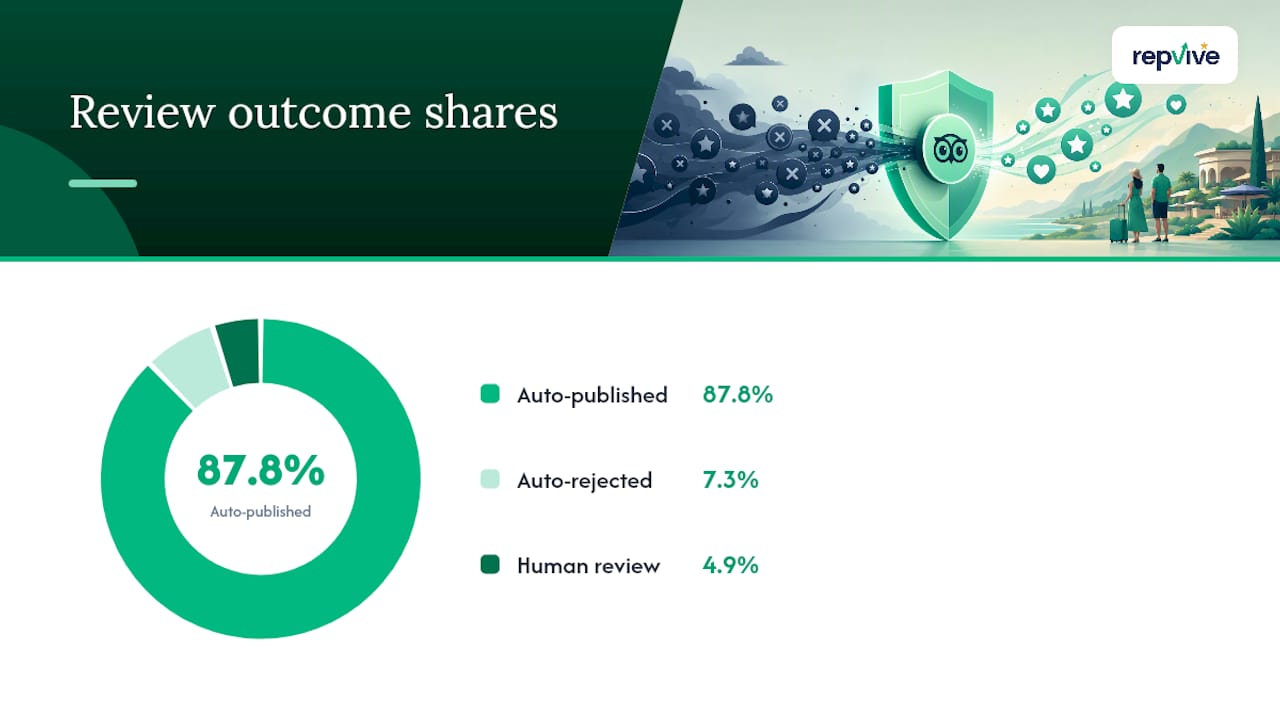
Every review submitted to TripAdvisor passes through a layered detection pipeline before it goes live. Automated systems scan first, checking for suspicious patterns like identical phrasing across multiple listings, unusual spikes in review volume tied to a single business, or submission behavior that matches known incentive schemes. Reviews that clear automated screening publish quickly. Reviews that trip a red flag either get rejected outright or routed to a human moderator for closer review.
The scale of this is documented in TripAdvisor’s own numbers. According to the 2025 Transparency Report, about 87.8% of reviews submitted in 2024 met automated posting standards outright, 7.3% were rejected by automated analysis, and 4.9% got flagged for human moderator review. TripAdvisor also blocked or removed 2.7 million fraudulent reviews that year and took down 214,000 AI-generated reviews specifically.
“Businesses cannot pay or otherwise influence their position in Tripadvisor’s rankings,” the company states in its Content Integrity Policy, framing its moderation model as multi-layered by design: automated detection working alongside human specialists and community reporting.
That layering matters because each method catches something the others miss. Automation is fast and consistent but can’t judge nuance. Human moderators handle the ambiguous cases: a scathing but plausible one-star review, a suspiciously generic five-star one. Community flags surface issues neither system caught on its own, since travelers and business owners alike can report content that looks off. One detail worth understanding: automated rejection at submission is usually final and largely unappealable, while a review flagged for human review can take longer to resolve but comes with a real evaluation behind the outcome.
How to Report a Review and Use the Management Centre
Anyone can flag a review they believe violates policy, but the process differs slightly depending on whether you’re a traveler or the business being reviewed.
- Locate the review and select “Report.” Every published review has a report option; choose the reason that best matches the violation (fake, incentivized, off-topic, and so on).
- Provide specifics, not just a complaint. Vague reports rarely move the needle. Note dates, names, or details that contradict the reviewer’s account of visiting your business.
- Business owners escalate through the free Management Centre. This is where owners submit evidence for suspected fraudulent reviews, including patterns like employee incentive programs or coordinated posting.
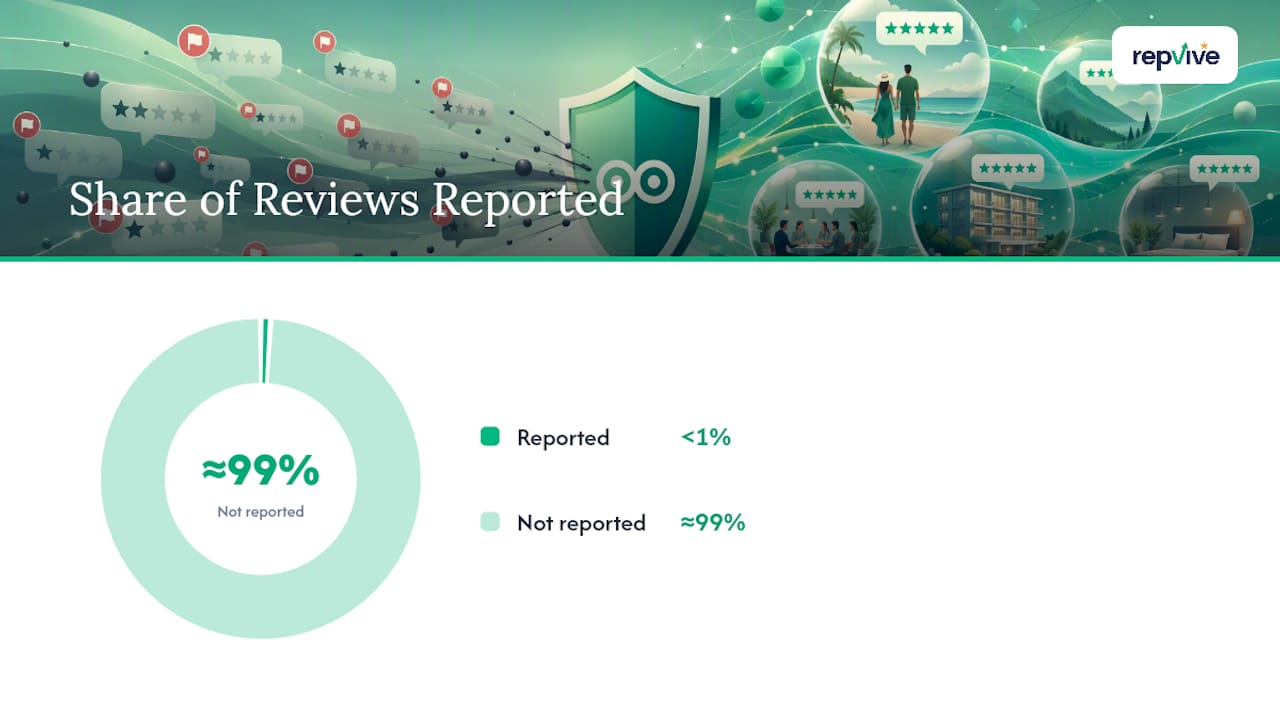
- Wait for content specialist review. TripAdvisor’s own documentation notes that fewer than 1% of all reviews get reported to moderation teams, but the ones that are get analyzed individually rather than auto-processed.
- Post a Management Response regardless of outcome. A calm, factual reply demonstrates accountability to future readers even when the review itself doesn’t come down.
Timelines vary by case complexity, and there’s no published guarantee on turnaround. A response strategy that stays professional and specific tends to do more for a business’s reputation than an angry rebuttal, since prospective guests read the response as closely as the review itself.
Pro Tip: Never argue with the reviewer in your Management Response. Address the facts, note what’s changed, and invite the guest to contact you directly. Future readers judge your tone more than the original complaint.
Penalties Businesses Face for Policy Violations
TripAdvisor’s enforcement toolkit goes well beyond simply deleting a review. Consequences scale with the severity and pattern of the violation.
- Review removal for content confirmed as fake, incentivized, or otherwise policy-violating.
- Red badge warnings attached to a business listing when TripAdvisor detects manipulation attempts.
- Exclusion from Travelers’ Choice awards for businesses caught running incentive schemes or fraud.
- Traveler Ranking penalties that push a manipulated listing lower in local search results.
- Account bans for repeat offenders or organized fraud networks.
The 2024 data gives a sense of scale: TripAdvisor removed 360,000 reviews tied to employee incentive programs and issued roughly 9,000 warnings for incentivized review activity in that same period. Review-boosting schemes accounted for the majority of detected fraud that year, which tells you where enforcement attention is concentrated. A single flagged review rarely tanks a business, but a documented pattern of manipulation can visibly damage a listing’s ranking against competitors.
Requesting a Review Removal: What Actually Works
Removal requests succeed when they’re grounded in a clear policy violation, not just disagreement with the reviewer’s opinion. Privacy breaches, plagiarized text, and demonstrable fraud (a competitor posing as a guest, for instance) are the strongest grounds for removal.
- Flag the specific review and select the violation category that matches your evidence.
- File a detailed report through the Management Centre, attaching booking records, timestamps, or correspondence that contradicts the reviewer’s claims.
- Escalate if the initial report is denied, providing any additional documentation that strengthens the fraud or privacy claim.
- If removal is still denied, shift strategy. Post a factual Management Response, keep gathering evidence in case the pattern repeats, and consider legal counsel if the content is defamatory rather than simply negative.
Realistic expectations matter here: TripAdvisor has stated plainly that it does not adjudicate factual disputes between a business and a reviewer. A review that meets behavioral and authenticity standards can remain posted even when a business insists the details are wrong.
Media, Privacy, and Formatting Rules for Reviews
Photos and video attached to a review have to be original content the reviewer actually captured, not images pulled from a business’s own marketing materials or another traveler’s post. Uploading third-party images, including a hotel’s promotional photography, violates the content guidelines and can get the whole review pulled along with the media.
Content also needs to stay family-friendly and free of anything sexually explicit or gratuitously violent. Reviews or photos that expose private or sensitive personal information, whether that’s a staff member’s full name paired with accusations or an image that identifies another guest without consent, are subject to removal on privacy grounds. If you spot this kind of content about yourself, TripAdvisor’s reporting tools accept privacy-specific takedown requests.
- Photos and videos must be original and captured by the reviewer.
- No third-party or promotional imagery.
- Content must avoid explicit or violent material.
- Reviews exposing private details about staff or other guests can be removed.
On length, there’s no strict minimum, but reviews that lack enough context (a one-line “bad service” with nothing specific) sometimes prompt TripAdvisor to ask for elaboration before publishing, since thin reviews are harder to verify as genuine.
When Professional Removal Help Makes Sense
Most disputed reviews resolve through the Management Centre and a well-written response. But certain situations genuinely call for outside help: a review containing defamatory statements presented as fact, an organized fraud campaign that keeps resurfacing under new accounts, or content that doxxes an employee or owner. These cross from “unfavorable opinion” into territory a platform report alone often can’t fix.
Attorney-led removal services build a tailored legal claim around the specific policy or law the content violates, then push that claim through direct channels rather than relying on the standard consumer report queue. Some structure this as pay-per-removal, meaning a business pays only after a review actually comes down. If you’re weighing this route, gather your evidence first: screenshots with timestamps, booking records that contradict the reviewer’s account, and any correspondence showing coordinated or incentivized posting. Combine that with your existing Management Centre report rather than replacing it. For businesses dealing specifically with TripAdvisor content, attorney-led TripAdvisor review removal works alongside platform reporting, not instead of it, and pairing legal escalation with a strong response to defamatory content tends to protect a business’s standing while the removal process plays out.
Your Data and Your Words: Privacy and Ownership in TripAdvisor Reviews
TripAdvisor collects account information, device data, and behavioral signals tied to how you browse and review, standard practice for a platform running fraud detection at this scale. That data feeds the same automated systems that catch suspicious posting patterns, which means your review history and account activity are part of what TripAdvisor cross-references when it evaluates whether a new submission looks genuine.
Personal information you include inside a review, a staff member’s name, another guest’s identity, specific medical or financial details, is treated differently from account data. TripAdvisor’s guidelines flag this kind of content for removal because it exposes third parties who never agreed to be named publicly, regardless of whether the underlying complaint is legitimate. If you’re the one identified in someone else’s review, you can request that identifying detail be addressed through the standard reporting flow rather than a separate privacy channel.
Business owners should note that the Management Centre itself operates under its own data-handling rules: evidence submitted to dispute a review (booking records, correspondence, internal logs) is used for that investigation and isn’t published or shared with the reviewing party. That separation is part of why TripAdvisor can request supporting documentation without exposing a business’s internal records to public view.
Who Owns a Review Once You Post It
You retain authorship of your own words, but posting a review to TripAdvisor grants the platform a broad license to display, distribute, and syndicate that content, including to search engines, partner travel sites, and its own promotional materials. That’s standard across nearly every review platform, not unique to TripAdvisor, but it surprises people who assume deleting their account also deletes their review history everywhere it’s been republished.
This licensing structure is also why a review doesn’t disappear the moment a business disputes it. TripAdvisor evaluates the content against its own posting rules rather than negotiating ownership or removal rights with the business being reviewed. If the review holds up under those standards, the platform’s license to keep displaying it remains intact even when the subject of the review strongly objects.
For reviewers, this means editing or deleting your own review generally remains possible through your account settings, since authorship control stays with you. For businesses, it means the practical path to addressing unwanted content runs through the violation-based removal process described earlier, not through a copyright or ownership argument, because TripAdvisor’s terms don’t treat a negative but compliant review as something the business has any ownership claim over.
The Real Gap Between TripAdvisor’s Rules and How People Use Them
Most of the friction around TripAdvisor’s review policy doesn’t come from the rules being unclear. It comes from businesses expecting the platform to referee opinions, and travelers assuming any review they write is untouchable. Neither is quite right. TripAdvisor built a policy that protects the “right to write” for genuine travelers while giving itself real enforcement teeth against manufactured content, and the 2.7 million fraudulent reviews blocked in 2024 shows that enforcement isn’t cosmetic.
Where conventional advice falls short is telling business owners to simply “report the fake review and move on.” Reporting matters, but a Management Response written the same day does more for the next hundred readers than a removal request that might take weeks to resolve, if it resolves at all. Prioritize the response first, the report second.
The harder truth: a well-written, factually accurate negative review that violates no policy is not going anywhere, and no amount of reporting changes that. Save the escalation, legal or otherwise, for content that’s actually fraudulent, defamatory, or a privacy violation. Chasing every one-star review as a policy fight wastes time you could spend building a review history strong enough that one bad post barely registers.
, Jason
Sources
- Tripadvisor’s 2025 Transparency Report reveals strong review submissions and improved fraud detection, mar 18, 2025
- Review Guidelines
FAQ
Can TripAdvisor reviews be removed?
Yes, but only when a review violates specific policy standards, such as being fake, incentivized, plagiarized, or a privacy breach. TripAdvisor generally won’t remove a review just because a business disagrees with the reviewer’s opinion.
Can anyone leave a review on TripAdvisor?
Anyone who has personally experienced a business, or was part of the traveling party that did, can leave a review, as long as they submit it within 12 months of the visit and limit themselves to one review per experience.
How can I get a refund from TripAdvisor?
Refund requests for bookings made through TripAdvisor typically go through TripAdvisor’s customer support or the original booking provider, since refund policy depends on the specific hotel, tour, or activity terms rather than the review policy itself.
Can you respond to reviews on TripAdvisor?
Yes, business owners can post a Management Response to any review through the free Management Centre, and a timely, factual response often does more to protect reputation than a removal request.