Review Gating Policy: What Google and the FTC Actually Ban
Review gating, routing your public review link only to customers you suspect are happy, is banned under Google’s Maps contribution policy and covered by the...
Review gating, routing your public review link only to customers you suspect are happy, is banned under Google’s Maps contribution policy and covered by the FTC’s final rule on fake reviews. If any part of your feedback process decides who sees the Google or Yelp link based on a rating or survey answer, stop it today. Send the exact same review request, with the exact same link, to every customer.
The risks of continuing are not theoretical:
- Individual reviews or your entire profile can be removed from Google
- Your business profile can be suspended, killing local search visibility
- The FTC can pursue civil penalties for knowing violations
- Enforcement actions tend to generate their own bad press, on top of the fines
Key Takeaways
Review gating is banned under Google’s contribution policy and the FTC’s final rule, and the fix is sending one identical, neutral review request to every customer.
| Point | Details |
|---|---|
| Stop sentiment-based routing | Send the same public review link to every customer regardless of survey answers. |
| Audit vendor tools first | Check dashboards and contracts for hidden “feedback routing” or “sentiment filter” features. |
| Document everything | Keep dated remediation logs and staff training records as proof of good-faith compliance. |
| Use neutral language | Ask for “honest feedback” instead of language that nudges toward a positive rating. |
| Remediate suspensions separately | Attorney-led removal services address past violations after profiles are already suspended. |
Table of Contents
- What Is Review Gating, Exactly?
- How Does Google’s Review Policy Handle Gating?
- What Does the FTC’s Rule on Reviews Actually Prohibit?
- What Happens If You Keep Gating Reviews?
- How Do You Audit Your Review Process for Gating?
- What Does a Compliant Review Request Look Like?
- What Should You Ask Review Software Vendors?
- When Does Remediation Make Sense After a Gating Violation?
- Sources
- FAQ
What Is Review Gating, Exactly?
Review gating is any process that routes the public review invitation based on a sentiment check you ran before asking. A customer answers a quick internal question, “How was your visit?”, and only the ones who say “great” get pointed to Google or Yelp. Unhappy customers get funneled to a private form instead, or nothing at all.
Watch for these gated flows:
- An NPS or CSAT survey that only shows the Google review button after a score of 8 or higher
- Kiosks at checkout that filter customers before handing over a review card
- Staff instructed to hand out review cards only to customers who seemed pleased
- Vendor tools with “smart feedback routing” or “sentiment filtering” features baked in
Internal surveys are fine on their own. The violation happens the moment the public review link becomes conditional on the answer.
How Does Google’s Review Policy Handle Gating?
Google’s own contribution policy is direct on this point: businesses cannot discourage negative reviews or selectively solicit only positive ones, and violating that policy can trigger consequences ranging from single-review removal to a full profile suspension.

Google doesn’t need a whistleblower to catch gating. It looks for patterns.
The signals that draw scrutiny include:
- A sudden spike of five-star reviews with almost no negative reviews mixed in
- Reviews clustered around specific timestamps that match staff shifts or kiosk usage
- Language across reviews that echoes a script, suggesting prompted or routed submissions
- On-premises devices or QR codes tied to a business account, which Google treats as a higher-risk signal for solicitation abuse
Enforcement is not limited to deleting the offending reviews. Google can strip an entire batch, apply visibility penalties that push a listing down in local search, or suspend the profile outright, which functionally removes a business from Google Maps until it’s resolved.
What Does the FTC’s Rule on Reviews Actually Prohibit?
The FTC’s Consumer Reviews and Testimonials Rule, finalized in 2024, gives the agency direct authority to seek civil penalties against businesses that manipulate reviews knowingly. This isn’t limited to gating. It covers a broader set of practices that businesses often treat as gray areas.
The rule prohibits:
- Writing, buying, or disseminating fake or false reviews
- Offering incentives conditioned on a review being positive
- Suppressing negative reviews through threats or by removing legitimate ones
- Posting employee or insider reviews of the company’s own product without disclosing the relationship
The Federal Trade Commission’s final rule frames violations on a per-instance basis, and the Federal Register text spells out how that exposure compounds when a business runs the same gated flow across hundreds or thousands of transactions. The FTC’s own guidance for platforms makes clear this applies to the software and vendors involved, not just the business collecting reviews. For businesses working with a marketing vendor, that shifts real liability onto contract terms, which is why vendor audits matter more than most owners realize.
What Happens If You Keep Gating Reviews?
A suspended Google profile doesn’t just look bad. It usually means the business drops out of the Maps pack entirely for the categories customers search most, which for a lot of local businesses is where the bulk of new customer discovery happens.
The exposure stacks up from multiple directions:
- Platform action: removed reviews, suspended profiles, or a visibility drop that outlasts the suspension itself
- Regulatory action: FTC penalties, and the public record that comes with a settlement or consent order
- Reputational fallout: local press or social media coverage of an enforcement action tends to travel further than the original bad review ever would have
- Detection risk keeps rising, since AI-driven enforcement systems are increasingly tuned to catch the exact velocity and clustering patterns gating produces
Businesses that self-correct before an enforcement action almost always fare better than those caught mid-violation. Waiting for a warning is the expensive way to learn this lesson.
How Do You Audit Your Review Process for Gating?
Most businesses that gate reviews didn’t set out to break the rules. A vendor sold them a “smart routing” feature, or a well-meaning manager built a filter to “protect the team from unfair reviews.” Either way, an audit finds it.
- Map the full customer journey. Trace every step from service completion to review prompt, and flag anywhere a conditional branch exists, even a simple “if score > 4.”
- Run test submissions. Submit a deliberately negative response through your survey or kiosk, then a deliberately positive one, and compare whether both paths land on the same public review link.
- Check vendor dashboards and API settings. Log into your CRM, texting platform, or reputation tool and look for toggles labeled “review routing,” “sentiment filter,” or “feedback gate.”
- Pull the vendor’s feature documentation and contract language. Confirm in writing what the tool does by default, not just what the sales rep described.
- Log your remediation. Save screenshots, dated change records, and staff training notes. If Google or the FTC ever asks, a documented good-faith correction carries real weight.
Pro Tip: Run the audit as if you’re the vendor’s own compliance officer, not the business owner. Vendors rarely advertise a “gating” feature by that name, so look for anything that changes what a customer sees based on how they answered a prior question.
What Does a Compliant Review Request Look Like?
The fix is simpler than most owners expect: one message, one link, sent to everyone. No filtering, no exceptions for “difficult” customers.
- Send the identical review request and link to every customer who completes a transaction, regardless of how the visit went
- Remove kiosks or staff instructions that pre-screen who gets asked
- Keep internal surveys for service recovery, but never let survey answers determine who receives the public review invite
- If you offer an incentive for leaving a review, make it unconditional (same reward whether the review is glowing or scathing) and disclose it clearly
- Avoid scripts that nudge toward a positive rating; neutral language like “share your honest experience” holds up better under scrutiny than “leave us a five-star review”
- Spread requests out over normal business hours and days rather than batching them, since unnatural review velocity is one of the clearest patterns platforms flag
| Practice | Why It Matters |
|---|---|
| Same link for everyone | Removes the sentiment-based branch that defines gating |
| Neutral request language | Avoids the appearance of soliciting only positive reviews |
| Unconditional incentives | Keeps rewards compliant with FTC disclosure rules |
| Paced sending cadence | Avoids velocity spikes that trigger automated review |
This structure doesn’t just avoid penalties. Businesses that let mixed, honest reviews accumulate naturally tend to build more durable trust than ones with a wall of uniform five-star ratings, since customers have gotten good at spotting a review page that looks too clean to be real.
What Should You Ask Review Software Vendors?
If a vendor’s tool touches your review requests, you need answers in writing before you sign anything.
- Does the platform route the public review link differently based on survey scores, and can that be disabled entirely?
- Are on-premises kiosks or QR codes configured to filter customers before displaying a review option?
- What audit logs exist to prove requests went out uniformly?
Your contract should include a compliance warranty tied to current Google and FTC rules, audit rights so you can inspect routing logic on demand, and a change-notice clause requiring the vendor to flag any update to feedback features before it goes live. Pair that with internal controls: documented staff training, a change log for any survey or kiosk update, and a standing procedure for proving remediation if a platform ever asks. Reporting tools like Paid Lens can help formalize that audit trail for agencies managing review campaigns across multiple client accounts.
When Does Remediation Make Sense After a Gating Violation?
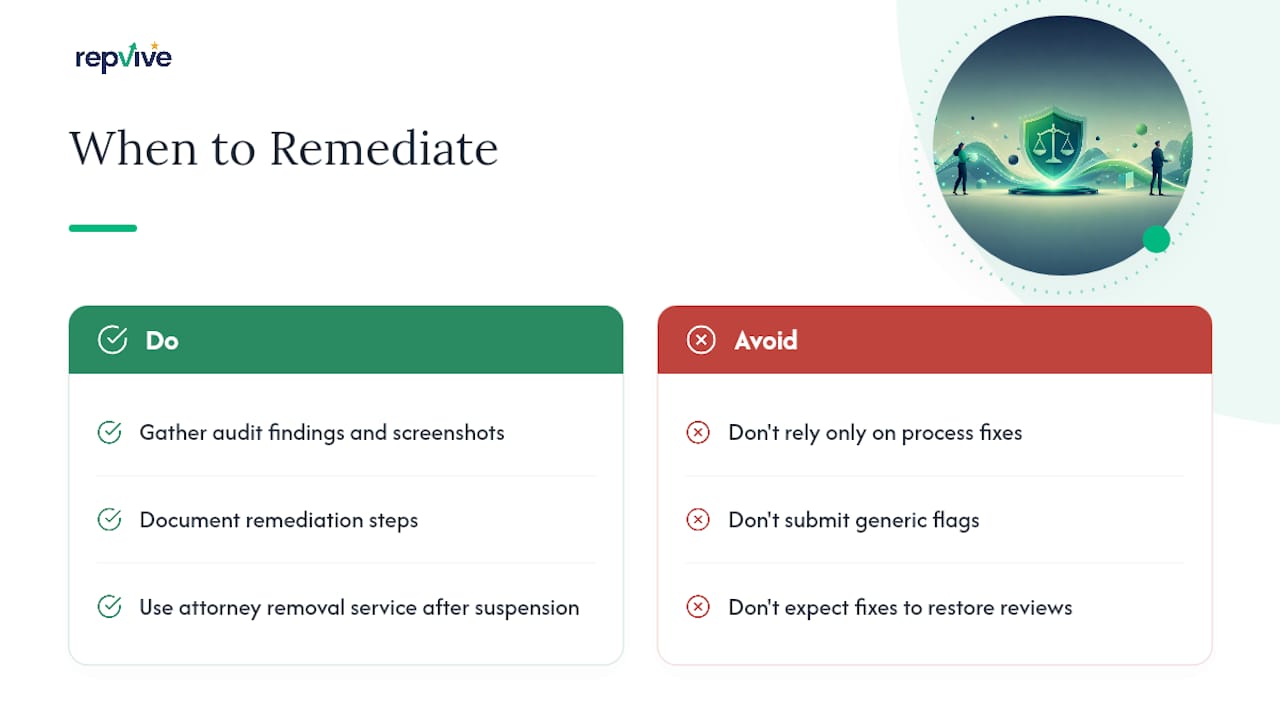
Process fixes solve gating going forward. They don’t undo reviews already removed or a profile already suspended, and that gap is where attorney-led remediation earns its place.
Services built around legally-backed removal claims, such as Repvive’s model, work each disputed review as a customized legal claim rather than a generic flag, submitted through the direct channels platforms give attorneys. That approach fits a specific moment: after a suspension or wrongful removal has already happened, not as a substitute for fixing the underlying process. Before contacting a removal provider, gather your audit findings, screenshots of the flagged reviews, and your documented remediation steps. That paperwork is what turns a removal request into a fast approval.
, Jason
Sources
- Google maps user-contributed content policy, contributions policy
- Federal Trade Commission Announces Final Rule Banning Fake Reviews and Testimonials
- Federal Register: Consumer reviews and testimonials final rule (excerpt)
FAQ
What Does Review Gating Mean?
Review gating means routing customers to a public review link only after screening their sentiment, so people who report a bad experience never see the request while happy customers do.
What Is Google’s Review Gating Policy?
Google’s Maps contribution policy prohibits discouraging negative reviews or selectively soliciting only positive ones, with enforcement ranging from review removal to full profile suspension.
Is Review Gating Illegal?
Review gating violates Google’s platform policy, and related practices like conditioned incentives or review suppression fall under the FTC’s final rule, which allows civil penalties for knowing violations.
Can You Ask Customers for Google or Yelp Reviews?
Yes. Asking every customer for a review is fine and encouraged; the violation only occurs when the request is filtered based on a prior sentiment check rather than sent uniformly.
How Often Should You Review Your Feedback Policy?
Audit your review request flow at least twice a year, or immediately after any vendor software update, since new features can quietly introduce sentiment-based routing without an obvious announcement.
Recommended
- What Counts as a Policy-Violating Review: Report & Remove | Repvive
- Can Google Remove Reviews? A 2026 Guide for Business Owners | Repvive
- The FTC Fake Reviews Rule: What U.S. Businesses Must Do Now | Repvive
- Customized Review Removal Claims: A 2026 Guide for Local Businesses | Repvive
If you would rather have this handled, our Google review removal service reviews each case first and charges only when the content comes down.