Can a Lawyer Get a Fake Yelp Review Removed?
Yes, in the right circumstances. If a Yelp review about your restaurant states false, provable facts rather than opinion, an attorney can often get it...
Yes, in the right circumstances. If a Yelp review about your restaurant states false, provable facts rather than opinion, an attorney can often get it removed. Start by preserving evidence and getting counsel involved before you respond publicly. Because Section 230 of the Communications Decency Act shields Yelp itself from liability for what users post, the legal target is almost always the reviewer, not the platform. This means tools like John Doe subpoenas to unmask anonymous posters, and services like Repvive’s attorney-led, pay-per-removal model, matter more than complaints to Yelp support alone.
Before anything else:
- Screenshot the full review, the reviewer’s profile, and the timestamp.
- Do not delete, edit, or publicly argue with the reviewer.
- Pull your reservation logs, receipts, and any staff notes from the date in question.
Quick fact: Yelp will remove content that violates its guidelines, including reviews backed by a court order declaring them defamatory, but it will not referee factual disputes on its own.
Key Takeaways
Attorney-led removal works best when a Yelp review states a false, specific fact and the business has documented evidence to prove it.
| Point | Details |
|---|---|
| Preserve evidence immediately | Screenshot the review, reviewer profile, and timestamp before anything changes or gets deleted. |
| Know the legal target | Section 230 shields Yelp, so claims and subpoenas target the individual reviewer, not the platform. |
| Escalate in order | Try platform flagging and a cease-and-desist letter before considering a subpoena or lawsuit. |
| Respond carefully in public | Keep public replies factual and brief; never argue, threaten, or mention legal action publicly. |
| Consider attorney-led services | Repvive offers pay-per-removal with no upfront fees and a high success rate for platforms including Yelp. |
Table of Contents
- Is a Restaurant Yelp Review Defamation or Just a Bad Opinion?
- What Should You Do in the First 72 Hours?
- What Legal Options Exist for a Defamatory Yelp Review?
- When Will Yelp Remove a Review Without Legal Action?
- How Long Does Attorney-Led Yelp Review Removal Take?
- How Does an Attorney-Led Removal Service Actually Work?
- How Can You Tell a Fake Review From Honest Criticism?
- Should You Respond Publicly While Pursuing Removal?
- What Are the Risks of Suing a Yelp Reviewer?
- Can You Resolve a Yelp Dispute Without Going to Court?
- How Do You Handle a Reviewer Who Keeps Posting Fake Reviews?
- What Restaurant Owners Get Wrong About Yelp Defamation
- How Repvive Handles Restaurant Yelp Review Removal
- Sources
- FAQ
Is a Restaurant Yelp Review Defamation or Just a Bad Opinion?
Defamation has four legal ingredients: a statement of fact (not opinion), publication to a third party, falsity, and resulting harm to your business. Miss any one of those and you don’t have a case, no matter how unfair the review feels.
“The service was slow and the fries were cold” is opinion. It’s subjective, unfalsifiable, and protected speech even if it stings. “The health inspector shut them down last week” or “I found a dead mouse in my soup and the manager laughed at me” are different animals entirely. Those are specific, checkable claims. If your health inspection records show no shutdown, or your kitchen logs and staff statements contradict the mouse story, you’re looking at potentially defamatory content, not a harsh critique.

Courts also want to see a prima facie showing before they’ll order a platform to unmask an anonymous reviewer. That generally means you need documentation showing the statement is false and specific, not just that it was hurtful.
Pro Tip: Before you spend a dollar on legal fees, ask whether the review could be rewritten as “I didn’t like X” and still make sense. If yes, it’s probably opinion. If the claim collapses without the false fact, it’s a stronger defamation candidate.
- Statement of fact, not opinion
- Published to others (a Yelp review qualifies)
- Demonstrably false
- Caused measurable harm
What Should You Do in the First 72 Hours?
Speed matters. Evidence disappears, reviews get buried under new posts, and reviewers sometimes edit or delete content once they sense pushback. Move fast and methodically.
- Capture everything. Full-page screenshots of the review, the reviewer’s profile, the URL, and the exact date and time. Note any related posts on other platforms from the same account.
- Pull your internal records. Reservation software logs, point-of-sale receipts, CCTV timestamps if you have them, and written statements from staff who were working that shift.
- Flag it on Yelp, but keep the language factual and unemotional. Reference specific guideline violations rather than arguing the reviewer is lying.
- Call an attorney if the review names specific false claims (health code violations, criminal accusations, fabricated incidents). Waiting weeks to consult counsel often means lost evidence and a colder trail for any subpoena to unmask an anonymous poster.
A few things to avoid:
- Don’t respond publicly with accusations or threats.
- Don’t ask employees or friends to flag the review en masse. Yelp’s algorithm often treats coordinated flagging as suspicious.
- Don’t wait for the review to “blow over.” A well-organized dossier built early makes both platform requests and legal action stronger. Repvive’s guide on documentation’s role in fighting fake reviews walks through what to preserve and how to organize it.
What Legal Options Exist for a Defamatory Yelp Review?
You generally can’t sue Yelp itself. Section 230 gives platforms broad immunity for content posted by users, so the legal path runs through the reviewer, not the site hosting the words. That single fact reshapes the whole strategy: your attorney isn’t fighting Yelp, they’re building a case against a person, even an anonymous one.
Three tools come up most often:
- Cease-and-desist letters. A letter on law firm letterhead often prompts voluntary removal, since it signals you’re prepared to litigate and have already identified potential liability. Many disputes end here.
- John Doe subpoenas. When the reviewer hides behind a fake name, counsel can file a John Doe lawsuit and subpoena Yelp or the reviewer’s ISP for identifying information, but only after making a prima facie showing that the statement is false and defamatory.
- Filing suit. Full litigation is the last resort. It opens the door to discovery, which can uncover more evidence, but it also carries anti-SLAPP risk in many states, where a court can dismiss the case early and award the defendant attorney’s fees if the claim looks like it’s targeting protected speech.
Litigation can also draw more attention to the negative review than it ever had before, so an experienced attorney will weigh publicity risk against the odds of winning before filing anything. Repvive’s overview of legal options for fake reviews breaks down when each tool actually makes sense.
When Will Yelp Remove a Review Without Legal Action?
Yelp will pull content that breaks its own content guidelines: reviews from someone with a conflict of interest (a competitor, a former employee), posts not based on an actual visit, privacy violations, and content that’s demonstrably false. A court order declaring a review defamatory is the ultimate lever, but plenty of removals happen well before that stage.
When you submit a flag, attach evidence, not outrage. Explain specifically why the statement is factually false (with your receipts or logs as backup), and point to the exact guideline it violates rather than a general “this is unfair” plea.
Yelp’s recommendation algorithm already filters some reviews out of the main count automatically based on reliability signals, so not every negative post you see is even factored into the visible star rating. If Yelp declines your removal request, that’s usually the signal to escalate to an attorney rather than repeating the same flag.
How Long Does Attorney-Led Yelp Review Removal Take?
Timelines vary a lot depending on which lever you pull. A well-documented cease-and-desist letter or a clean platform removal can resolve in days to a couple of weeks. Subpoenas to unmask an anonymous reviewer, and any litigation that follows, typically run weeks to months, since courts, ISPs, and Yelp’s legal team all have their own response windows.
Fee structures differ just as much:
- Pay-per-removal, no upfront cost. You pay only when a review is actually taken down.
- Flat-fee subpoena services. A set price to pursue unmasking, regardless of outcome.
- Hourly litigation billing. The most expensive and least predictable option, reserved for cases that need a full lawsuit.
A useful rule of thumb: if a quick platform removal or a demand letter resolves things, take it. Save the subpoena and litigation route for reviews doing serious, ongoing damage, since customer purchase decisions are shaped heavily by star ratings and review content, and one bad post rarely justifies months of legal spend on its own.
How Does an Attorney-Led Removal Service Actually Work?
The process generally runs through five stages, and understanding them helps you evaluate any provider’s claims before you sign up.
- Intake. You submit the review, your business details, and any supporting evidence you’ve already gathered.
- Evidence collection. The legal team builds a dossier: screenshots, timestamps, your internal records, and anything showing the statement’s falsity.
- Targeted legal demand. A cease-and-desist letter goes to the reviewer, often resolving the matter outright.
- Platform escalation. If the reviewer doesn’t budge, the case moves to Yelp’s moderation team with the full evidence package attached.
- John Doe subpoena, if needed. For anonymous reviewers who won’t respond, counsel pursues unmasking through the courts, then negotiates removal or seeks a court order.
When you’re comparing providers, look for real trust signals: attorney review of your specific case (not a generic template), a transparent fee schedule you can see before committing, a tracking dashboard so you know where your case stands, and a published success rate. Repvive operates on exactly this model, with a high success rate and no upfront fees, billing only after a review is actually removed.
Pro Tip: Ask any provider what happens if the removal request fails. A no-upfront, pay-per-removal structure means you owe nothing if they can’t get the job done. That’s the cleanest way to judge whether a service actually believes in its own success rate.
How Can You Tell a Fake Review From Honest Criticism?
Not every one-star review deserves a legal letter. Genuine feedback, even angry feedback, usually references specific, plausible details: a long wait, a cold entrée, a rude comment from a server. It’s uncomfortable to read, but it’s not actionable, and trying to remove it will waste your attorney’s time and your money.
Fake or malicious reviews tend to share a few tells. The account is brand new or has no other reviews. The reviewer describes a visit on a day you were closed, or references menu items you’ve never served. The language mirrors a competitor’s talking points a little too closely, or several reviews with similar phrasing appear within days of each other from accounts with no history. Sometimes a former employee posts anonymously right after termination, using details only an insider would know but framing them dishonestly.
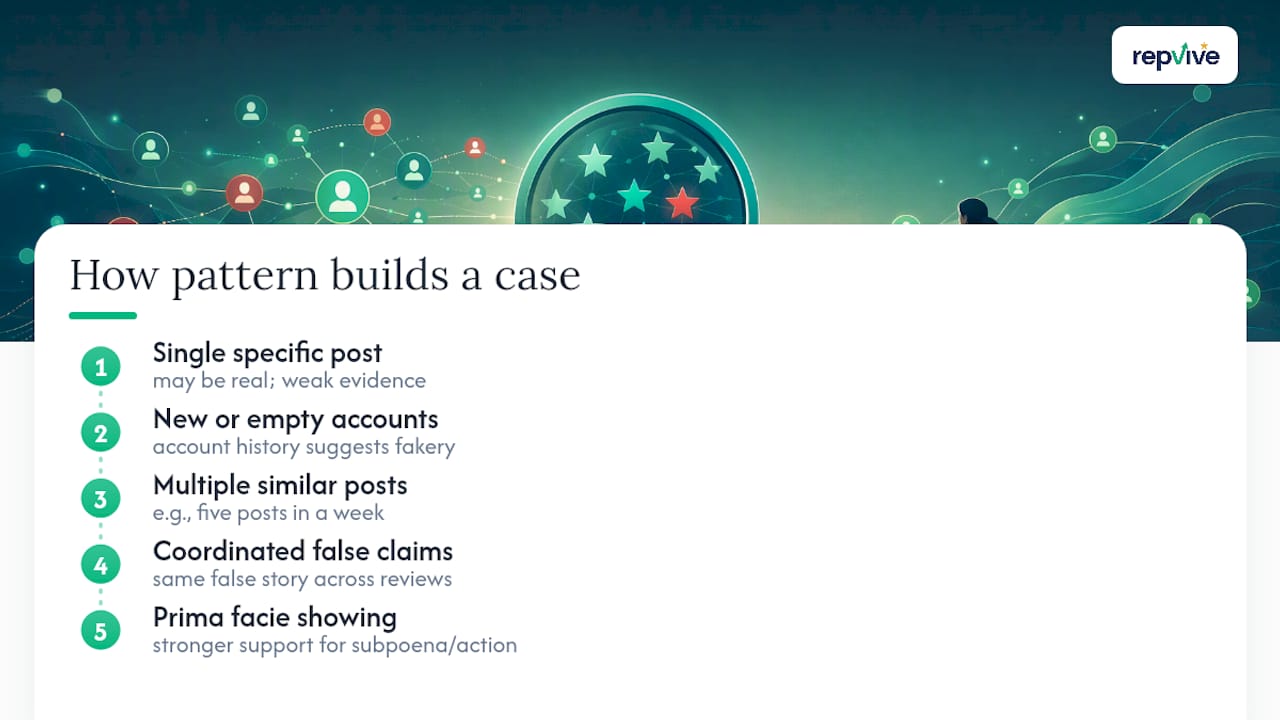
Pattern recognition matters as much as any single review. One oddly specific negative post might be a disgruntled but real customer. Five posts in a week, all hitting the same false claim (a health code violation that never happened, a foreign object that no other customer or staff member ever saw) starts to look coordinated. That pattern is exactly what strengthens a prima facie showing if you eventually need a subpoena.
The honest test: would this review survive a deposition? A real customer can describe their table, their server, their order. A fabricated review often falls apart under two or three follow-up questions, which is precisely why documentation matters before you ever get to that stage.
Should You Respond Publicly While Pursuing Removal?
Yes, but carefully. Silence can look like guilt to future customers browsing your page, and an over-defensive reply can hand a reviewer (or their attorney) ammunition later. The goal is a short, professional response that reassures other readers without conceding any of the disputed facts.
Stick to a simple structure: acknowledge the customer’s experience without agreeing to false specifics, state plainly that you have no record matching their account, and invite them to contact you directly. Something like: “We take feedback seriously and have reviewed our records for this date; we don’t have a reservation or order matching this description. Please reach out to us directly so we can look into this further.” That response does three things at once. It signals to other readers that you’re engaged and reasonable, it creates a public record that you disputed the claim promptly, and it avoids any language that could be read as an admission or a threat.
Avoid anything that reads as an attack on the reviewer’s credibility or character, even if you’re confident the review is fabricated. That kind of language can complicate a later defamation claim and gives the reviewer something to point to if the dispute escalates. Never mention that you’ve contacted an attorney in a public reply. Save that for the demand letter itself, where it carries actual legal weight instead of just sounding like a threat.
What Are the Risks of Suing a Yelp Reviewer?
Litigation against a reviewer is rarely risk-free, and any attorney worth hiring should walk you through the downside before filing anything.
The biggest risk in many states is an anti-SLAPP motion. These laws let a defendant ask a court to dismiss a defamation suit early if it looks like it’s targeting protected speech, and if the motion succeeds, the business can end up paying the reviewer’s attorney’s fees on top of its own. That’s a real financial exposure, not a theoretical one, and it’s why evaluating jurisdictional risk before filing matters so much.
There’s also the publicity problem. A restaurant that sues a customer, even a customer who fabricated a story, can end up as the villain in a local news piece or a viral social post about a “small business bullying a reviewer.” That narrative sticks regardless of who was actually telling the truth, and it can do more reputational damage than the original review ever did.
Cost is the third factor. Discovery, depositions, and expert testimony add up fast, and a case that looked strong on paper can drag for months. This is exactly why most attorney-led strategies start with a demand letter and platform escalation, reserving full litigation for cases where the harm is severe, ongoing, and clearly documented. Suing should be the last card played, not the first.
Can You Resolve a Yelp Dispute Without Going to Court?
Court is expensive and slow, and most defamatory review disputes never need to get there. A cease-and-desist letter is technically a pre-litigation tool, but it resolves a large share of cases on its own because it demonstrates the business is serious and has identified real legal exposure.
Direct negotiation is another option, particularly once a reviewer has been identified through a subpoena. Counsel can reach out with a settlement proposal: the reviewer removes the post and both sides move on, no lawsuit required. This tends to work better than public pressure campaigns, which often backfire and draw more attention to the dispute.
Some states also offer mediation services for small business disputes, and a handful of consumer complaint platforms allow for structured resolution outside the review site itself. None of these replace the subpoena process when a reviewer is anonymous and unresponsive, but they’re worth trying before committing to a courtroom. Repvive’s approach to protecting business reputation online leans into these lower-friction paths first, escalating only when a reviewer refuses to engage.
How Do You Handle a Reviewer Who Keeps Posting Fake Reviews?
Serial offenders (an ex-employee, a competitor, a customer with a personal grudge) require a different approach than a one-off fake review. The pattern itself becomes evidence, so tracking it matters as much as fighting any single post.
Keep a running log every time a new review appears from a related account or repeats similar false claims. Note account creation dates, writing style, and any overlap in specific details across posts. This log becomes critical if you eventually need a subpoena, since courts want to see the scope of the harm, not just one instance.
Google Alerts and Yelp’s own notification settings can flag new reviews as they post, but a dedicated monitoring tool catches patterns across multiple platforms (Yelp, Google, Facebook, Trustpilot) that manual checking misses. Once you’ve documented three or more coordinated posts, that repetition often strengthens a defamation claim considerably, since it undercuts any argument that a single bad review was just an honest, isolated opinion.
What Restaurant Owners Get Wrong About Yelp Defamation
Most advice on bad reviews treats every negative post the same way: respond politely, ask happy customers to drown it out, wait for it to fade. That approach works fine for legitimate criticism. It fails completely against a fabricated health code claim or a fake mouse-in-the-soup story, because volume and politeness don’t erase a false factual claim sitting at the top of your Yelp page.
The bigger mistake is waiting too long to involve an attorney. Owners often try Yelp’s flagging tool first, get denied, then sit on the problem for weeks before calling counsel, by which time screenshots have shifted, staff have moved on, and the reviewer may have edited their story. The 72 hour window matters more than most guides admit.
I’d also push back on the instinct to sue first and ask questions later. Anti-SLAPP exposure is real, and a lawsuit that draws local news coverage can cost you more in reputation than the original review ever did. The smartest owners treat litigation as the last tool in the drawer, not the first, and lean on demand letters and documented platform escalation before anything ends up in a courtroom.
How Repvive Handles Restaurant Yelp Review Removal
Repvive built its entire model around the gap most reputation advice ignores: general tips about responding gracefully don’t work on a fabricated health violation or a fake foreign-object claim. Repvive’s legal team drafts a customized claim for each individual review, rather than sending the same templated complaint to every platform.
The core offer is straightforward. Attorney-led claims across Yelp, Google, Facebook, TripAdvisor, Trustpilot, BBB, and more than 20 other platforms, backed by a pay-per-removal structure with no upfront fees, so you only pay once a review is confirmed gone. A real-time tracking dashboard shows exactly where your case stands instead of leaving you guessing. That combination matters for restaurant owners specifically, since a single fabricated food-safety claim can spread across multiple review sites within days, and chasing each one manually eats hours you don’t have during service.
Intake starts with submitting the review and any evidence you’ve already gathered, screenshots, receipts, staff notes. From there, Repvive’s legal team evaluates whether the content qualifies for removal and builds the claim accordingly. If you’re dealing with a Yelp review that’s damaging your reservations, start with Repvive’s Yelp review removal service or visit Repvive to begin the intake process.
Sources
- Department of Justice: Department of Justice’s Review of Section 230 of the Communications Decency Act of 1996
- Can I sue Yelp for defamation? - FindLaw
- Can my business sue over negative or fake online reviews? - KJK
- Will Yelp remove a false or defamatory review? - Yelp Support
FAQ
Can I Sue a Customer for a Fake Yelp Review?
Yes, if the review states false, specific facts that caused measurable harm. You generally sue the reviewer directly, not Yelp, since Section 230 shields the platform from liability for user content.
How Do I Unmask an Anonymous Yelp Reviewer?
Your attorney files a John Doe lawsuit and requests a subpoena compelling Yelp or an internet service provider to disclose identifying information, but only after making a prima facie showing that the review is false and defamatory.
Will Yelp Remove a Review Just Because It’s Negative?
No. Yelp only removes content that violates its guidelines, such as conflicts of interest, privacy violations, or demonstrably false claims, and it typically requires clear evidence or a court order for factual disputes.
How Much Does Attorney-Led Yelp Review Removal Cost?
Costs vary by approach: pay-per-removal services charge only after a successful takedown, flat fees often apply to subpoena work, and full litigation runs on hourly billing that can climb quickly.
Does Repvive Handle Yelp Reviews Specifically?
Yes.