How Review Removal Works for Dentists in 2026
Review removal for dentists is a process governed by strict platform policies and federal regulations that require clear evidence of a policy violation...
TL;DR:
- Dentists cannot delete reviews directly; removal depends on proving policy violations or obtaining court orders. Google only removes reviews that clearly violate content rules, and most genuine patient opinions remain online. Legal and compliant review practices are essential for reputation management and protection.
Review removal for dentists is a process governed by strict platform policies and federal regulations that require clear evidence of a policy violation before Google will act. Dentists cannot delete patient reviews directly. Instead, removal depends on proving that a specific review breaks Google’s content rules or, in serious cases, obtaining a court order. The FTC’s 2024 rule and Google’s April 2026 policy updates have tightened the rules further, making it critical for dental practices to understand exactly what qualifies for removal and what does not. Most negative reviews that reflect genuine patient experiences will stay online regardless of how damaging they feel.
How review removal works for dentists: the core process
Dentists cannot remove reviews by logging into their Google Business Profile and clicking delete. Google controls that decision entirely. A review gets removed only when it clearly violates one of Google’s content policies, and Google’s team confirms that violation after a flagging request.

Google’s nine prohibited review categories include spam, fake content, off-topic content, restricted content, illegal content, terrorist content, sexually explicit material, hate speech, and conflict of interest. Each category has specific criteria. A review from a competitor posing as a patient falls under conflict of interest. A review that describes a visit to the wrong business falls under off-topic. Understanding which category applies to a specific review is the first decision that determines whether a removal attempt will succeed.
Google’s AI system actively monitors for patterns like sudden review spikes and IP clustering. This means that even legitimate reviews can get caught in automated filters, and fake reviews sometimes slip through initially. The system is imperfect, which is why Google also provides human escalation paths for contested cases.
Most negative reviews that express a genuine patient experience, even harsh or unfair ones, do not qualify for removal. A one-star review saying “the wait was too long” or “the dentist was dismissive” reflects a subjective opinion. Google protects that speech. Dentists who understand this distinction avoid wasting time flagging reviews that will never be removed.
What Google’s 2026 policy updates changed
Google’s april 2026 update introduced new restrictions that directly affect dental practices. Staff review quotas, incentivized review revisions, and requests that ask patients to mention specific staff members by name are now explicitly banned. Violations can result in review removal or full profile suspension. Google now treats review authenticity as a top enforcement priority, actively penalizing practices like in-office review kiosks and staff-directed requests that were once common.
Pro Tip: When flagging a review, select the single most accurate policy category rather than flagging under multiple categories at once. Google’s reviewers respond better to a focused, well-supported claim than a scattershot approach.
What makes a dental review removable?
A dental review qualifies for removal when it clearly fits one of Google’s prohibited categories and that fit can be demonstrated with evidence. The most common removable review types for dental practices fall into four groups.
- Fake or spam reviews: Reviews posted by someone who was never a patient, or reviews that appear to come from the same source in bulk. Evidence includes IP clustering, identical language across multiple reviews, or a reviewer profile with no other activity.
- Conflict of interest: Reviews posted by a current or former employee, a competitor, or someone with a direct financial stake in the practice’s reputation. Screenshots of social media connections or employment records can support this claim.
- Impersonation: A review posted under a false identity, including someone pretending to be a patient they are not.
- Personal information violations: Reviews that include protected health information, home addresses, or other private data that violates Google’s privacy policies.
Reviews that contain threats, hate speech, or explicit content also qualify, though these are less common in the dental context. The key test is always whether the review violates a specific written policy, not whether it is unfair or inaccurate from the dentist’s perspective.
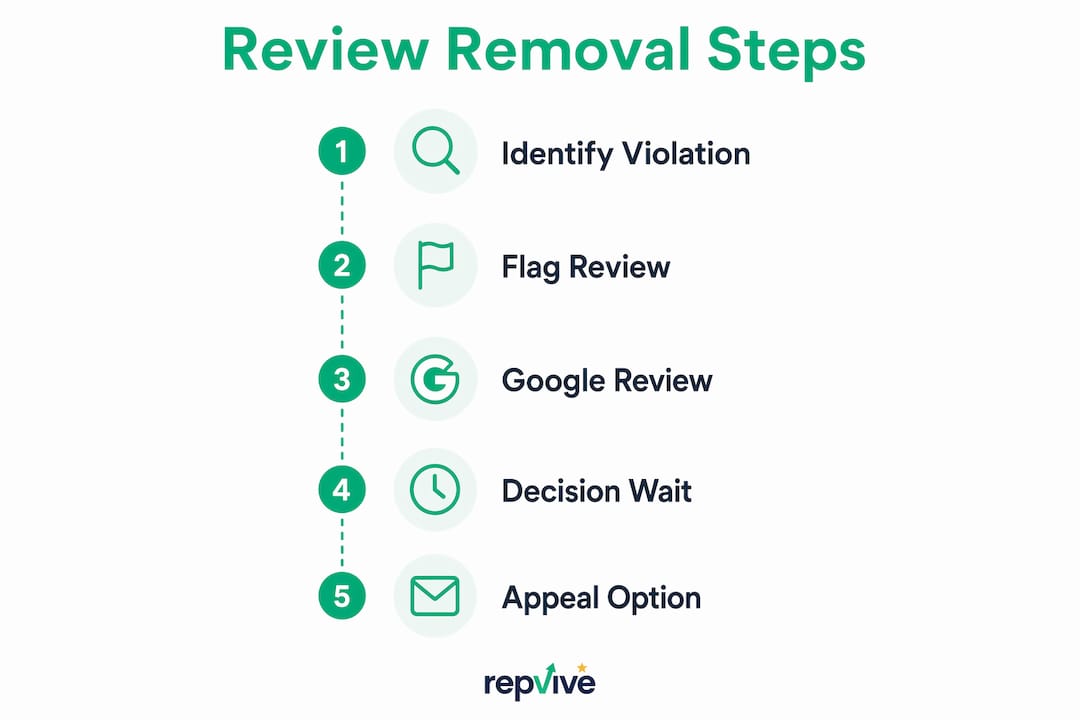
Step-by-step: how to request removal from Google
The removal process follows a clear sequence. Skipping steps or using shortcuts creates risk without improving outcomes.
-
Flag the review in Google Business Profile. Log into your Google Business Profile, locate the review, and click the flag icon. Select the most accurate policy violation category. Write a brief, factual explanation of why the review violates that specific policy. Vague flags get rejected.
-
Gather supporting evidence before submitting. Screenshots, appointment records, and any documentation that confirms the reviewer was never a patient or has a conflict of interest strengthen the case. Timely action matters because fake reviewers often delete or alter their profiles quickly, which eliminates available evidence.
-
Use the Reviews Management Tool for a formal appeal. If the initial flag is rejected, submit a detailed appeal through Google’s Reviews Management Tool. This tool allows you to provide additional context and documentation. Approximately 1 in 5 second-look requests succeed when the policy violation is evident and supported with clear evidence.
-
Escalate to the Google Business Profile Help Community. If the appeal fails, post the case in the GBP Help Community. This channel routes the request to human product experts rather than automated systems. Manual review by product experts is more effective than standard support, but the presentation must be professional and fact-based.
-
Pursue legal removal for defamation cases. If the review contains provably false statements of fact that damage your practice, consult an attorney. Only court orders from small claims or higher courts declaring a review defamatory guarantee prompt removal by Google. Google will not act on factual disputes without legal adjudication.
-
Expect a decision within 2 to 14 days. Most flagged reviews matching clear policy violations are resolved quickly. Ambiguous cases require escalation and take longer.
Pro Tip: Never use automated or mass-flagging tools. Bot-driven removal attempts violate Google’s Terms of Service and almost always result in business profile suspension. Manual, evidence-based flagging is the only safe method.
Legal and regulatory factors dentists must understand
Federal law now plays a direct role in how dental practices manage reviews. The FTC’s 2024 rule prohibits fake or incentivized reviews and carries civil penalties exceeding $53,000 per knowing violation. That penalty applies to the practice, not just the vendor or staff member who arranged the review. Dentists who pay for fake positive reviews or suppress negative ones through selective solicitation face legal exposure on top of platform penalties.
Defamation claims require a higher standard of proof than most dentists expect. A review must contain a false statement of fact, not just a negative opinion, to qualify as defamatory. Courts distinguish between “Dr. Smith botched my crown” (potentially factual and provable) and “Dr. Smith is the worst dentist I’ve ever seen” (protected opinion). Winning a defamation case requires legal representation, documented evidence, and time.
Review extortion is a real and growing threat to dental practices. Fraudsters post fake negative reviews and then contact the practice offering to remove them for payment. Engaging with these services is illegal and risks total profile suspension. Experts advise never paying or working with unverifiable removal services that use mass-reporting or false DMCA claims.
Dentists must stay vigilant against these schemes and educate their staff about the legal and reputational dangers of engaging with illegitimate removal vendors. Recognizing the warning signs of fake reviews early gives practices the best chance of building a documented case before evidence disappears.
Legal removal and platform removal are separate processes that can work together. A court order forces Google’s hand on defamatory content. Platform flagging handles spam, fake reviews, and policy violations without requiring litigation. The most effective approach uses both tools for the right situations.
Protecting your practice beyond removal
Removal is not a complete reputation strategy. Building a consistent flow of genuine, positive reviews off-premises reduces the impact of negative reviews far more effectively than repeated removal attempts. A practice with 200 reviews averaging 4.7 stars absorbs a one-star attack far better than a practice with 15 reviews.
Compliant review collection means asking patients for feedback through neutral, unpressured methods after they leave the office. Text or email requests sent within 24 hours of an appointment perform well. The request must not direct patients toward a positive outcome or screen them based on expected sentiment. That screening practice, called review gating, violates both Google’s policies and the FTC rule.
- Respond professionally to every negative review you cannot remove. A calm, factual public response signals competence to prospective patients reading the review. Never include patient details in a public response, as that creates a HIPAA exposure.
- Avoid in-office review kiosks and staff-directed requests. Google’s 2026 updates explicitly target these tactics. Practices that continue using them risk profile penalties.
- Build internal policies and train staff. Staff who understand the rules will not accidentally create violations by asking patients to “leave us a five-star review.”
- Use compliant review collection tools. Platforms like Repvive’s RepBoost are built around neutral solicitation workflows that stay within Google and FTC guidelines.
The goal is a reputation that is resilient by volume and authenticity, not one that depends on removing every critical comment.
Key Takeaways
Dental review removal succeeds only when it combines accurate policy knowledge, documented evidence, and compliant reputation-building practices.
| Point | Details |
|---|---|
| Dentists cannot delete reviews directly | Removal requires flagging a clear policy violation and waiting for Google’s decision. |
| Evidence determines success | Gather screenshots and records before flagging; fake reviewers delete profiles quickly. |
| Legal removal requires a court order | Google only removes defamatory content after a court declares it defamatory. |
| FTC penalties are significant | Civil fines exceed $53,000 per knowing violation for fake or incentivized reviews. |
| Volume of authentic reviews is the best defense | A strong base of genuine reviews reduces the damage any single negative review can cause. |
What I’ve learned watching dentists fight bad reviews
Dentists who contact me after a bad review almost always make the same first mistake. They flag the review immediately, pick the wrong violation category, and then feel stuck when Google rejects the flag within 48 hours. The window to gather evidence closes fast, and the case becomes much harder to make.
The second mistake is expecting removal to solve the problem. I’ve seen practices spend months pursuing a single defamatory review through legal channels while their overall rating sits at 3.8 stars because they stopped collecting new reviews during the dispute. The math never works in their favor.
What actually works is treating removal and reputation-building as parallel tracks. Flag the review correctly, document everything, escalate methodically, and simultaneously run a compliant review collection process. By the time the removal decision comes through, the practice has added 20 new authentic reviews and the original negative review carries less weight anyway.
The practices that recover fastest are the ones that treat a bad review as a process problem, not a personal attack. They document, they respond professionally, and they build. The ones that struggle are the ones who try to fight every review and end up violating policies in the process.
, Jason
Repvive’s approach to dental review removal
Dentists dealing with fake, defamatory, or policy-violating reviews need more than a flagging guide. They need a process that holds up under Google’s scrutiny.
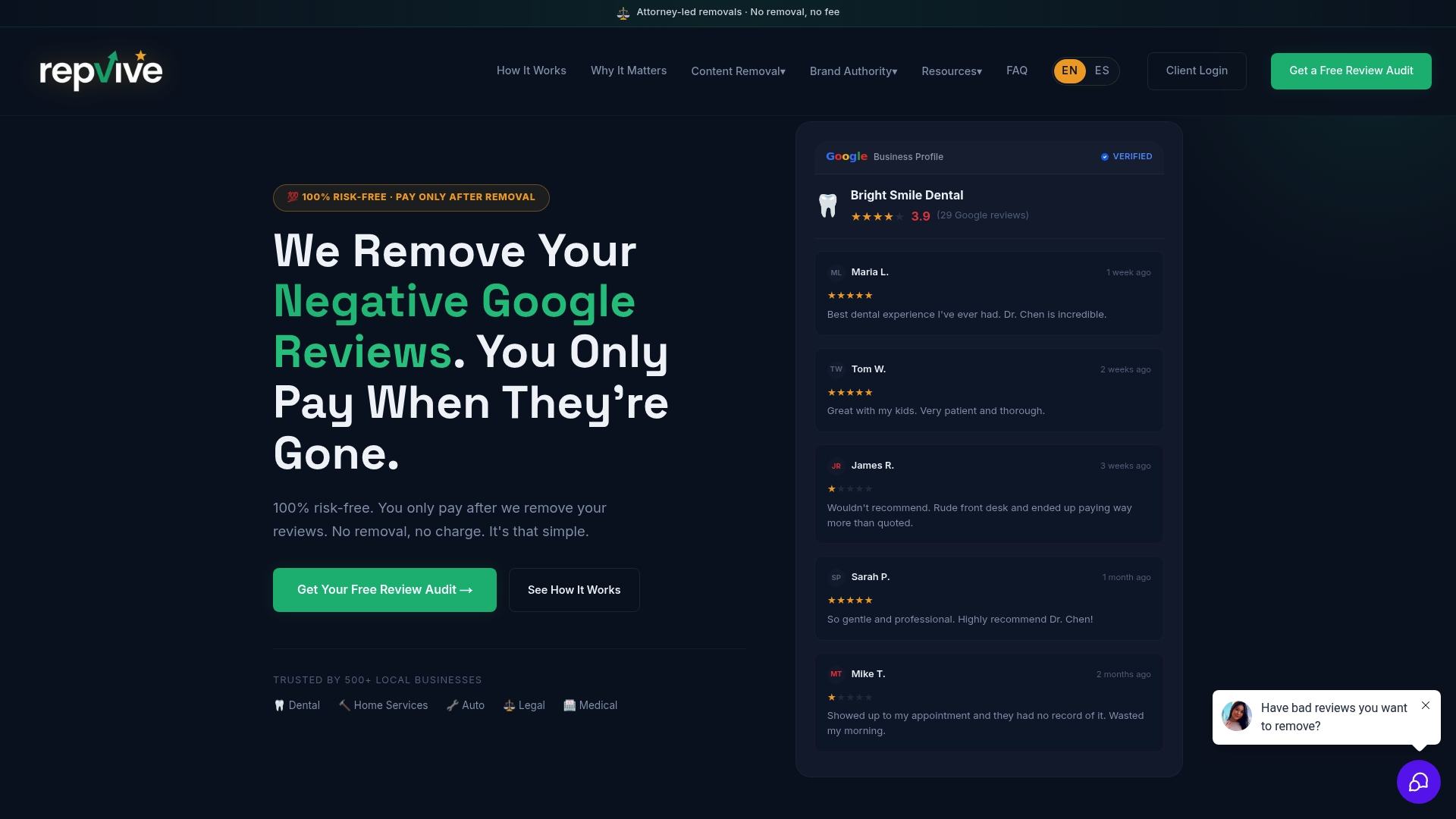
Repvive’s attorney-led review removal service builds a customized legal and policy-based case for each review, using direct channels to get removals approved by Google. The process carries no upfront fees and a 99% success rate. Repvive’s team handles the evidence gathering, appeal submissions, and escalations that most dental practices do not have time to manage internally. For practices dealing with negative Google reviews or review extortion attempts, Repvive provides a documented, compliant path to removal without risking profile suspension. Explore Repvive’s full reputation management services to see how the process works for dental practices.
FAQ
Can a dentist delete a Google review directly?
No. Google does not allow business owners to delete third-party reviews. Removal requires flagging the review for a specific policy violation and waiting for Google’s decision.
What makes a dental review removable under Google’s policies?
A review qualifies for removal when it clearly violates one of Google’s prohibited content categories, such as spam, fake content, conflict of interest, or impersonation, and that violation can be supported with evidence.
How long does Google take to decide on a review removal request?
Most flagged reviews that match clear policy violations are resolved within 2 to 14 days. Ambiguous cases require escalation through the Reviews Management Tool or the GBP Help Community and take longer.
What is review extortion in the dental context?
Review extortion occurs when someone posts a fake negative review and then contacts the practice offering to remove it for payment. This is illegal, and engaging with these services risks full profile suspension.
Does the FTC rule affect how dentists collect reviews?
Yes. The FTC’s 2024 rule bans fake, incentivized, and screened reviews with civil penalties exceeding $53,000 per knowing violation. Dentists must use neutral, unpressured review solicitation methods to stay compliant.