How Review Removal Success Rates Are Measured
Review removal success rates measure the percentage of flagged reviews that a platform actually removes after a report is submitted. The calculation is...
How review removal success rates are calculated
Review removal success rates measure the percentage of flagged reviews that a platform actually removes after a report is submitted. The calculation is straightforward: divide the number of successfully removed reviews by the total number of reviews reported, then multiply by 100. What makes this number tricky is that it tells you about policy compliance outcomes, not fairness.
Most business owners assume a high success rate means the platform agrees the review was unfair. It doesn’t. Google removes reviews only when they breach specific content policies, such as spam, fake accounts, hate speech, or conflicts of interest. A review can be completely false and still survive if it doesn’t cross one of those defined lines.

Typical removal success rates fall below 10% for standard reports across most Google policy categories. That number shocks most business owners, but it reflects how narrow the qualifying criteria actually are. The reviews that do get removed tend to fall into clear-cut categories where the violation is obvious and well-documented.
Key components that go into measuring removal success:
- Total reports submitted vs. confirmed removals (the core ratio)
- Violation type matched to the specific policy clause cited
- Report channel used (automated flag, reviews Management Tool, or formal appeal)
- Time between posting and reporting (affects evidence availability)
- Whether a human appeal followed an initial automated rejection
What factors cause review removal success rates to vary by case
Success rates shift dramatically depending on the specifics of each case. The violation type alone creates wide variation. Benchmark data shows removal success rates by category: offensive content (hate speech or profanity) achieves roughly 90%, spam or duplicate reviews around 85%, fake reviews from non-customers near 80%, irrelevant or off-topic reviews approximately 75%, and competitor or ex-employee conflicts closer to 70%.
By violation type: offensive content ~90%, spam ~85%, fake reviews ~80%, irrelevant reviews ~75%, competitor conflict ~70%.
Beyond violation type, several other factors push rates up or down:
- Accuracy of the reporting category. Misclassifying the violation is the leading cause of report denials. Google’s automated first pass evaluates your report against the exact category you selected, not the underlying violation.
- Evidence quality. Screenshots, reviewer profile data, and timestamps all strengthen a case. Evidence can disappear within days of a fake review posting, so speed matters.
- Platform moderation model. Automated systems handle the first pass and frequently reject nuanced reports. Human reviewers on appeal are more likely to catch context.
- Selection bias in third-party services. No-win-no-fee removal services selectively accept cases with high removal likelihood, which inflates their advertised success figures. The cases they decline are often the harder ones that would drag their numbers down.
- Review age. Older reviews lose supporting evidence over time, and platforms shift enforcement focus toward recent content.
Pro Tip: Before submitting any report, verify that the violation you’re citing matches the exact category label Google uses. A “fake review” and a “conflict of interest” are different categories with different evidentiary requirements.
How Google’s review policy compliance drives removal decisions
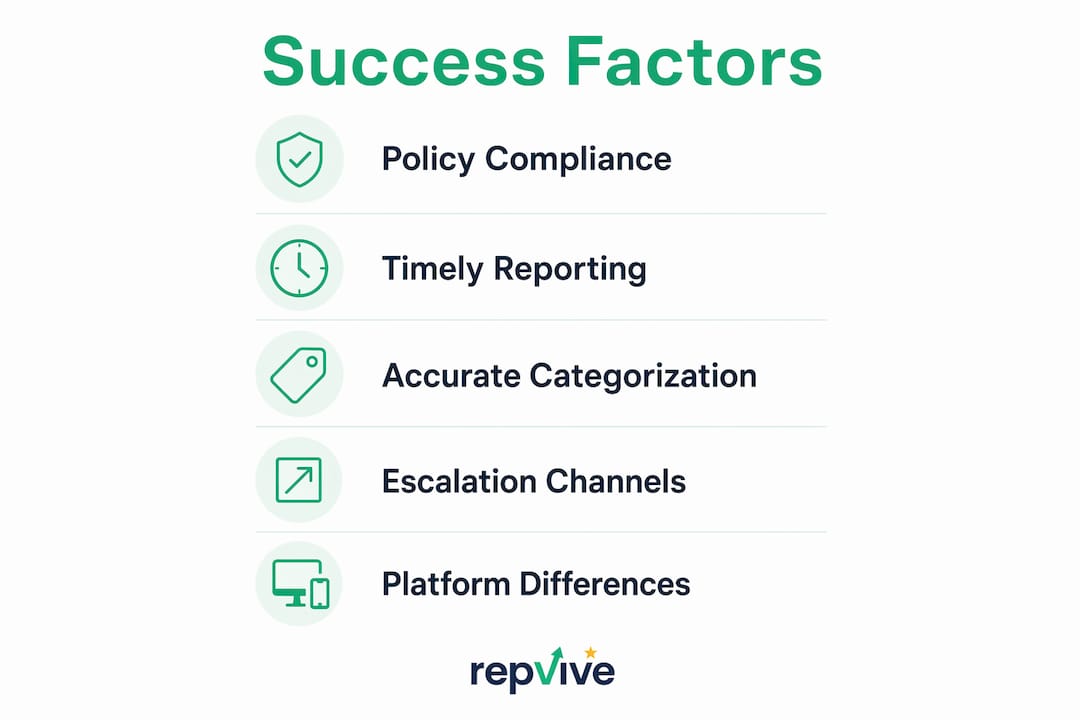
Google’s removal process is strictly compliance-based, and understanding that distinction saves a lot of wasted effort. The platform removes reviews only when they breach defined content policies, not when they are inaccurate, unfair, or damaging to your business. Emotional arguments and claims of unfairness carry no weight in the process.
Google’s content policies cover several specific violation categories: spam and fake content, off-topic reviews, restricted content, illegal content, terrorist content, sexually explicit material, offensive content, and conflicts of interest. Each category has defined criteria. A review from a competitor posing as a customer falls under “conflict of interest.” A review that was clearly never written by someone who visited your business falls under “fake content.” The distinction matters because the reporting form requires you to select one.
Automated detection handles the initial pass, and it is strictly literal. It checks whether your selected category plausibly matches the review content. Most first reports come back as “no policy violation found,” which is normal, not final. The appeal is where most successful removals actually happen, because a human reviewer reads it. Business owners who cite exact policy clauses in their appeal language consistently see better outcomes than those who submit general complaints.
Common reasons reports get rejected:
- Selecting the wrong violation category for the actual content
- Submitting a report on a negative but policy-compliant review
- Failing to include supporting evidence with the report
- Appealing without referencing specific policy language
- Reporting a review that is simply critical, not actually fake or harmful
Why timing has such a strong impact on removal outcomes
Acting fast after a problematic review appears is one of the highest-leverage moves a business owner can make. Reviews under 30 days old achieve substantially higher removal success rates in some documented removal efforts, while older reviews see drastically reduced rates as evidence disappears and enforcement attention shifts.
The 30-day window: removal success rates can reach 99.9% for reviews under 30 days old, compared to dramatically lower rates for older content.
The data on review lifespans reinforces this. Localo’s analysis of 335,520 deleted Google reviews found that the median lifespan of removed reviews has collapsed sharply in recent years, reflecting accelerated AI-driven enforcement. Google removed 292 million policy-violating reviews in 2025, and enforcement has continued to accelerate through 2026.
Two practical reasons explain why timing matters so much. First, reviewer profiles and related accounts that prove a review is fake can disappear within days of posting. Once that evidence is gone, your case weakens significantly. Second, Google’s automated enforcement waves tend to catch recent content first. A review that survives its first few weeks becomes progressively harder to remove through standard channels.
Monitoring tools that automatically flag potential violations the moment a review posts give you the best chance of acting within that critical early window.
What this means practically for small and medium local businesses
Realistic expectations are the starting point. Most reviews that feel unfair don’t actually violate Google’s policies, and submitting reports on non-violating reviews wastes time without improving your profile. The businesses that succeed at removal focus their energy on reviews that have a genuine policy hook.
Practical steps that improve your removal outcomes:
- Monitor reviews in real time. Catching a fake review within the first few days preserves the evidence you need for a strong report.
- Match the violation to the correct category. Spend time identifying which specific Google policy clause applies before submitting anything.
- Document everything. Screenshots of the reviewer’s profile, posting patterns, and any related accounts strengthen your case considerably.
- Follow up with a formal appeal. When the first automated report is rejected, escalate with a human-reviewed appeal that cites exact policy language.
- Evaluate no-win-no-fee services carefully. Some removals attributed to paid services are coincidental to Google’s background moderation. You may be paying for a removal that would have happened anyway.
For professional services firms, compliance-focused reputation strategies consistently outperform reactive approaches. The businesses that build a process around monitoring, accurate categorization, and timely appeals get better results than those who rely on one-off reports after damage is already done.
How success rates are calculated and verified
Calculating a meaningful success rate requires more than counting removals. A credible methodology tracks reports submitted, the violation category used for each, the channel through which the report was filed, and whether the removal followed a first report or a subsequent appeal. Without those variables, a “success rate” figure can mean almost anything.

The verification problem is significant. Paid removal services cannot prove causation when a review disappears. Google’s automated systems remove millions of reviews proactively, so a review that comes down after a service submits a report may have been removed by Google’s background enforcement, not the service’s application. The empty space on your profile looks identical either way.
Repvive’s attorney-led approach addresses this by building customized, policy-specific claims for each review and working through direct channels to Google. That process creates a documented chain of action tied to each removal, rather than a coincidental overlap with Google’s automated sweeps. For business owners evaluating any removal service, the right question isn’t just “what’s your success rate?” It’s “how do you verify that your actions caused the removal?”
Localo’s large-scale analysis of deleted reviews across 22,292 Business Profiles offers one of the more rigorous external benchmarks available, examining variables like review age, star rating, word count, and owner response timing to identify what removed content actually looks like.
How success rates differ across review platforms
Google dominates the conversation around review removal, but the process and outcomes vary across platforms. Google’s scale, its AI-driven enforcement, and its publicly documented content policies make it the most transparent of the major platforms. Multiple review sites operate with different moderation standards, appeal processes, and response timelines.
Yelp uses a recommendation algorithm that filters reviews it deems unreliable, rather than removing them outright. A review may still exist on the page but be hidden from the main rating calculation. That’s a different outcome than a Google removal, and it requires a different strategy. Facebook reviews (now called Recommendations) can be turned off entirely by the business, which is an option Google doesn’t offer. Platforms like Trustpilot and the Better Business Bureau have their own compliance teams and dispute processes, with varying response times and criteria.
The practical implication for local businesses is that success rates are not portable across platforms. A 90% success rate on one platform’s spam category tells you nothing about what to expect on another. Each platform requires its own understanding of policies, reporting channels, and escalation paths.
How reporting channels and escalation procedures affect measured outcomes
The channel you use to report a review directly affects your chances of success. Google offers several paths: the flag button on the review itself, the Reviews Management Tool in Google Business Profile, and formal escalation through Google’s support channels. Each channel reaches a different part of Google’s moderation infrastructure.
The flag button triggers an automated review. It’s the fastest path but the least likely to succeed on nuanced cases. The Reviews Management Tool is where most successful removals happen, because it allows you to submit a structured report with a selected violation category and supporting context. When that fails, escalating to a human reviewer through Google’s support system or the Google Business Profile community forum adds another layer of review.
Escalation procedures matter for success rate measurement because they change the denominator. A business that submits one flag per review and counts rejections will show a much lower success rate than one that follows the full escalation path: initial report, appeal with policy language, and community escalation if needed. Services that track only first-pass removals are measuring something different from services that track outcomes through the full appeal process. When you’re comparing success rate claims, always ask which steps were counted.
Key Takeaways
Review removal success depends almost entirely on policy compliance, timing, and accurate categorization, not on the strength of your emotional case against a review.
| Point | Details |
|---|---|
| Baseline success rates are low | Standard reports across most Google policy categories typically see removal rates below 10%. |
| Violation type shapes the outcome | Offensive content removes at roughly 90%; spam at about 85%; fake reviews near 80%; irrelevant reviews at approximately 75%; competitor conflict cases closer to 70%. |
| The 30-day window is critical | Reviews under 30 days old achieve dramatically higher removal rates than older content. |
| Category accuracy drives approvals | Selecting the wrong reporting category is the leading cause of report denials. |
| Causation is hard to verify | Some removals credited to paid services coincide with Google’s independent enforcement sweeps. |
FAQ
What is a typical Google review removal success rate?
Standard reports across most Google policy categories see removal rates below 10%, though clear-cut violations such as offensive content can achieve removal rates as high as 90%.
Can you get an unfair Google review removed?
Google removes reviews only when they violate specific content policies, not because they are unfair or inaccurate. A negative review that doesn’t breach a defined policy clause will stay up regardless of how misleading it is.
How many reports does it take to get a review removed?
There’s no set number. A single well-structured report citing the correct policy category can succeed, while multiple poorly categorized reports may all be rejected. The quality and accuracy of the report matters far more than the volume.
How does review age affect removal chances?
Reviews under 30 days old achieve removal rates as high as 99.9% in some documented cases, while older reviews see much lower rates as supporting evidence disappears and enforcement focus shifts to newer content.
How do you offset the impact of a 1-star review on your rating?
Google calculates ratings as a weighted average of all reviews. A single 1-star review influences your average rating differently depending on your current rating and total number of reviews. Removal of a policy-violating 1-star review is faster and more direct than trying to bury it with new reviews.