How False Repair Claim Reviews Spread Online in 2026
False repair claim reviews are fabricated or misleading ratings posted to damage or artificially boost a repair business’s online reputation. Understanding...
TL;DR:
- Fake repair reviews are coordinated attacks using fake accounts and local listing manipulation to harm business rankings. They threaten customer trust, lead to lost visibility, and often involve extortion scams that do not improve the situation. Regulatory actions now target fake review networks with severe fines and legal enforcement, emphasizing the importance of proactive documentation and professional management.
False repair claim reviews are fabricated or misleading ratings posted to damage or artificially boost a repair business’s online reputation. Understanding how false repair claim reviews spread online is the first step to protecting your business. 72% of local business owners received at least one fake review in the past 12 months. That number signals a systemic problem, not isolated incidents. The FTC’s 2024 Reviews and Testimonials Rule and a wave of 2026 enforcement actions confirm that regulators now treat fake review networks as a serious consumer protection threat.
How false repair claim reviews spread on online platforms
Fake repair reviews spread through coordinated attacks, not random one-off posts. Scammers and competitors use multiple fake accounts to post negative reviews in rapid succession, a tactic known as review velocity manipulation. Search algorithms interpret a sudden spike in reviews as a trust signal, which means a flood of one-star ratings can push a legitimate business down in local search results almost overnight.
The mechanics behind this spread follow a clear pattern:
- Fake account creation. Attackers create new or locked profiles with little to no review history. These accounts exist solely to post targeted reviews.
- Review velocity attacks. Posting five to ten negative reviews within hours triggers algorithm responses that reduce a business’s local search ranking.
- Local listing hijacking. Thousands of fictitious business profiles with fabricated addresses flood platforms like Google Maps, siphoning customers from real businesses.
- Keyword stuffing in fake listings. Fake businesses use common repair keywords and fabricated positive reviews to appear legitimate in local search results.
Coordinated fake review attacks are effective precisely because they exploit the same signals that search platforms use to rank trustworthy businesses. The speed and volume of fake posts overwhelm the slower, organic pace of genuine customer reviews. 79% of business owners suspect coordinated attacks, and 70% believe competitors inflate ratings with fake positive reviews.
Pro Tip: Check the profile age and review history of anyone who leaves a suspicious review. A brand-new account with no other reviews and vague complaint language is a strong indicator of a fake.

What impact do fake repair claim reviews have on local businesses?
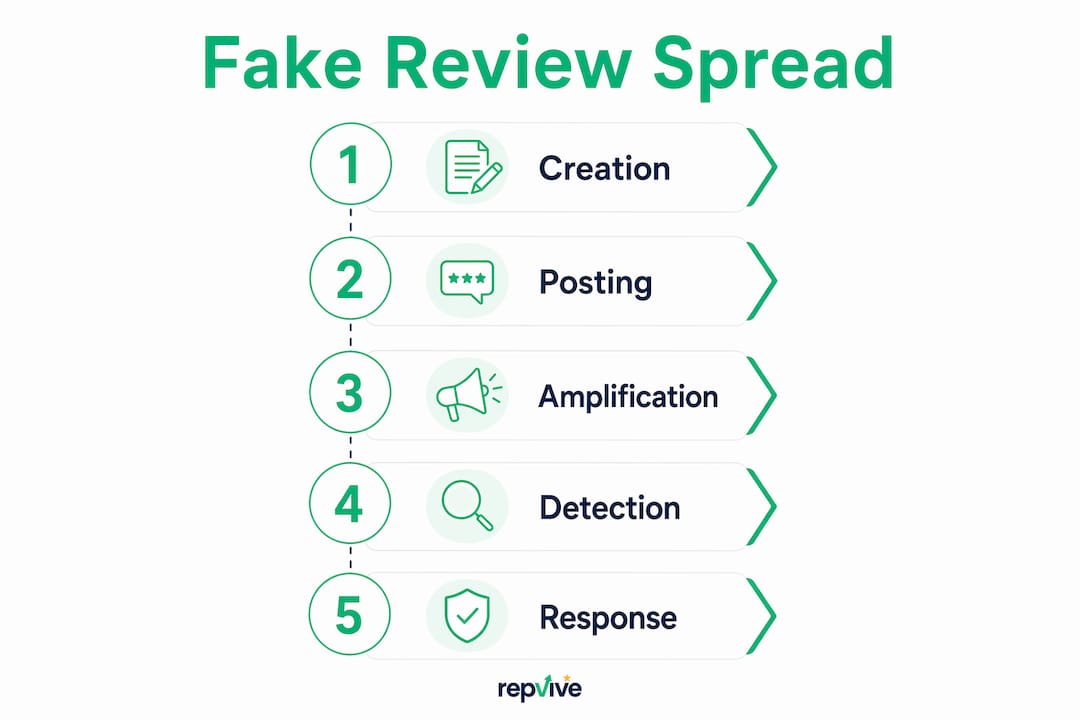
The fake repair reviews impact on a local business goes far beyond a lower star rating. A single coordinated attack can suppress your Google Business Profile in local search, redirect potential customers to fake competitors, and create a false public record that takes months to correct.
The harm shows up in three distinct areas:
- Search visibility loss. Review velocity drops your ranking in the Google Local Pack, the three-business block that captures the majority of local search clicks.
- Customer trust erosion. Prospective customers read reviews before calling. A cluster of one-star reviews with vague language still deters bookings, even when the reviews are fabricated.
- Extortion exposure. Scammers target repair businesses with fake negative reviews and then offer to remove them for a fee. Paying does not lead to removal and typically invites more attacks.
“Business owners who pay extortion scammers rarely see the fake reviews removed. The payment signals vulnerability, and attackers return with larger demands or additional fake review floods.”
The operational cost compounds quickly. Owners spend hours documenting reviews, filing platform reports, and drafting public responses, all while running their actual business. Only 31% of businesses use specialized review management platforms. That gap leaves the majority of owners relying on manual efforts that cannot match the speed of a coordinated attack.
How are regulatory agencies addressing the spread of false repair claims online?
The FTC’s 2024 Reviews and Testimonials Rule is the most significant federal response to misleading repair claims online. The rule creates civil penalties of up to $51,744 per violation. That penalty structure applies to businesses that create, buy, or distribute fake reviews, not just the platforms that host them.
| Regulatory action | Details |
|---|---|
| FTC 2024 rule | Civil penalties up to $51,744 per fake review violation |
| 2026 enforcement actions | 14 enforcement actions disclosed before mid-2026 crackdowns |
| DOJ and Illinois AG lawsuit | Targeted fake home service listing networks with thousands of profiles |
| FTC and Illinois joint action | Stopped deceptive conduct by a company creating fake local business listings |
The DOJ and Illinois AG lawsuit against Premium Home Service exposed how fake local listing networks operate at scale. The company created thousands of profiles with fabricated addresses and misleading reviews to capture repair service leads. This case signals a regulatory priority shift toward deceptive lead generation networks, not just individual fake review posters.
Federally targeted fake review networks reflect a broader consumer protection agenda. Regulators now treat fake review ecosystems as part of a larger fraud infrastructure, which means enforcement actions will continue to grow in scope and penalty size through 2026 and beyond.
Pro Tip: Keep records of every fake review you receive, including screenshots with timestamps. Documented evidence strengthens any FTC complaint or legal claim you file.
How can local businesses detect and respond to false repair claim reviews?
Detection of false repair reviews starts with recognizing the warning signs before a coordinated attack gains momentum. Most fake reviews share identifiable characteristics that distinguish them from genuine customer feedback.
- Check profile age. Fake accounts are often created within days of posting. A reviewer with no prior review history and a generic profile photo is a red flag.
- Monitor review velocity. Three or more negative reviews posted within 24 hours from different accounts signals a coordinated attack, not organic dissatisfaction.
- Analyze review language. Vague complaints without specific job details, dates, or technician names suggest the reviewer never actually used your service.
- Document everything immediately. Screenshot each suspicious review with the date, time, and reviewer profile. Proper documentation is the foundation of any successful removal request.
- Report to the platform. Google removed 188 million fake or misleading reviews in 2024, but the platform relies on business owners to flag violations through the reporting tool.
- Never pay extortion demands. Review extortion scammers follow fake negative attacks with direct payment requests. Engaging or paying signals vulnerability and escalates the attack.
The difference between posting a public response and pursuing legal or technical removal is significant. A public response manages perception but leaves the review live. Legal or technical removal, through attorney-led processes like those Repvive provides, eliminates the review entirely. Use the fake review warning signs checklist to audit your current profile before the next attack arrives.
Pro Tip: Set up a Google Alert for your business name combined with terms like “scam” or “fraud.” Early detection gives you time to document and report before fake reviews accumulate.
What long-term strategies protect businesses from viral fake review spread?
Sustainable protection against misleading repair claims online requires ongoing monitoring, not one-time responses. A single audit after an attack is not enough. Businesses that build regular review monitoring into their weekly operations catch attacks earlier and limit the damage.
- Audit your local listings monthly. Search your business name on Google Maps and check for duplicate or hijacked profiles. Fake review networks create thousands of similar profiles to dilute genuine reputations and manipulate SEO rankings.
- Vet third-party vendors and marketing partners. Some lead generation agencies use deceptive tactics that expose your business to regulatory risk. Verify that any partner you use complies with FTC guidelines.
- Implement a review request process. Consistently asking satisfied customers for honest reviews builds a larger base of genuine ratings. A higher volume of real reviews reduces the proportional impact of any fake attack.
- Train your staff on review policy. Employees should know what constitutes a legitimate review request and what crosses into incentivized or fake territory. One misstep by a well-meaning employee can trigger an FTC investigation.
- Use a reputation management platform built for repair businesses. Generic tools miss the industry-specific patterns that signal fake review attacks in home services and auto repair.
The trustworthiness of repair reviews depends on the volume and consistency of your genuine review base. Businesses with 50 or more recent reviews absorb fake attacks more effectively than those with fewer than 10. Building that base proactively is the single most cost-effective long-term defense.
Key Takeaways
False repair claim reviews spread through coordinated fake account attacks and deceptive local listing networks that exploit search algorithm trust signals, causing direct harm to local business rankings, customer trust, and revenue.
| Point | Details |
|---|---|
| Fake reviews are widespread | 72% of local business owners received at least one fake review in the past 12 months. |
| Review velocity drives damage | Rapid posting of fake reviews drops local search rankings by exploiting algorithm trust signals. |
| Regulatory penalties are severe | FTC violations carry civil penalties up to $51,744 per fake review under the 2024 rule. |
| Never pay extortion demands | Paying scammers does not remove reviews and invites escalated attacks. |
| Documentation is your first defense | Screenshot and timestamp every suspicious review before filing a platform report or legal claim. |
What I’ve learned from watching fake review attacks evolve in 2026
The pattern I see most often is this: a repair business owner gets hit with five one-star reviews in a single afternoon, panics, and either responds publicly in frustration or pays the scammer who messages them an hour later. Both responses make the situation worse. Public frustration signals distress to future customers. Payment signals that the tactic works.
What actually works is treating a fake review attack like a legal matter from the first minute. Document before you respond. Report before you engage. The businesses that recover fastest are the ones that already have a documentation habit and a clear escalation path.
The regulatory environment in 2026 is genuinely shifting in business owners’ favor. The FTC’s enforcement actions against fake listing networks show that the government now views this as organized fraud, not just a platform moderation problem. That shift matters because it gives businesses a stronger legal foundation for removal requests and civil complaints.
The gap I find most troubling is that only 31% of businesses use specialized review management tools. Manual monitoring simply cannot match the speed of a coordinated attack. Owners who rely on checking their Google profile once a week will always be reacting rather than preventing. The businesses that integrate professional reputation management into their regular operations are the ones that stop attacks before they compound.
, Jason
Repvive’s approach to removing false repair reviews
False repair reviews cause real financial harm, and a public response alone does not fix the underlying problem.

Repvive’s attorney-led Google review removal service handles the legal and technical process of getting fake reviews removed directly through Google. The team crafts a customized legal claim for each review, uses direct channels to submit removal requests, and reports a 99% success rate with no upfront fees. For local business owners dealing with coordinated attacks, extortion scams, or a damaged search ranking, Repvive provides a clear path from documentation to removal. Visit Repvive’s reputation management service to see how the process works for your business.
FAQ
How do fake repair reviews spread so quickly?
Fake repair reviews spread through coordinated attacks using multiple fake accounts that post in rapid succession. This review velocity exploits search algorithm trust signals and can drop a business’s local ranking within hours.
What are the warning signs of a false repair claim review?
Key warning signs include a brand-new reviewer profile, vague complaint language with no specific job details, and multiple negative reviews posted within the same 24-hour window. These patterns indicate a coordinated attack rather than genuine customer dissatisfaction.
Can the FTC help if my business is targeted by fake reviews?
The FTC’s 2024 Reviews and Testimonials Rule allows civil penalties up to $51,744 per violation against those who create or distribute fake reviews. Filing a complaint with the FTC creates a formal record and supports broader enforcement actions.
Should I respond publicly to fake repair reviews?
A public response manages perception but leaves the review live on the platform. Legal or technical removal through a service like Repvive eliminates the review entirely, which is the more effective long-term solution.
How many fake reviews does Google remove each year?
Google removed 188 million fake or misleading reviews in 2024. Despite that scale, the platform relies on business owners to report violations, making proactive documentation and reporting critical for removal success.