Get TripAdvisor Reviews Removed with an Attorney, Pay Only If Removed
Yes, but only when the review breaks TripAdvisor’s rules, not just because it’s unfair or unflattering. Your first move is filing a report through the...
Yes, but only when the review breaks TripAdvisor’s rules, not just because it’s unfair or unflattering. Your first move is filing a report through the Management Center with clear evidence attached. If the review makes a false factual claim you can disprove, or you can identify who posted it, that’s the point where an attorney-led approach usually beats going it alone.
TL;DR:
- The success of removing reviews relies heavily on identifying violations of TripAdvisor’s strict community standards, not simply on disputing an opinion or unfair feedback.
- Evidence such as booking records, communication logs, and surveillance footage is crucial to prove false factual claims or violations during the appeal process.
- File detailed, focused reports that specify the exact guideline broken and attach numbered, concrete evidence within 200 words for higher success chances.
- Legal action and attorney involvement are often necessary when reviews contain false facts that caused measurable damage, especially for anonymous posters or complex cases.
- Small businesses benefit most from attorney-led claims for review removal because they increase the chances of convincing the platform to act, especially in gray-area or fraudulent reviews.
Table of Contents
- What Counts as a TripAdvisor Owner Appeal (and What Doesn’t)
- How to File a TripAdvisor Owner Appeal in the Management Center
- What Evidence Do You Need to Remove a TripAdvisor Review?
- When Does a TripAdvisor Owner Appeal Need an Attorney?
- How to Respond Publicly While the Review Stays Up
- Why Attorney-Led Removal Often Wins for Small Businesses
- How Repvive Handles Attorney-Led TripAdvisor Removal
- Sources
- FAQ
What Counts as a TripAdvisor Owner Appeal (and What Doesn’t)
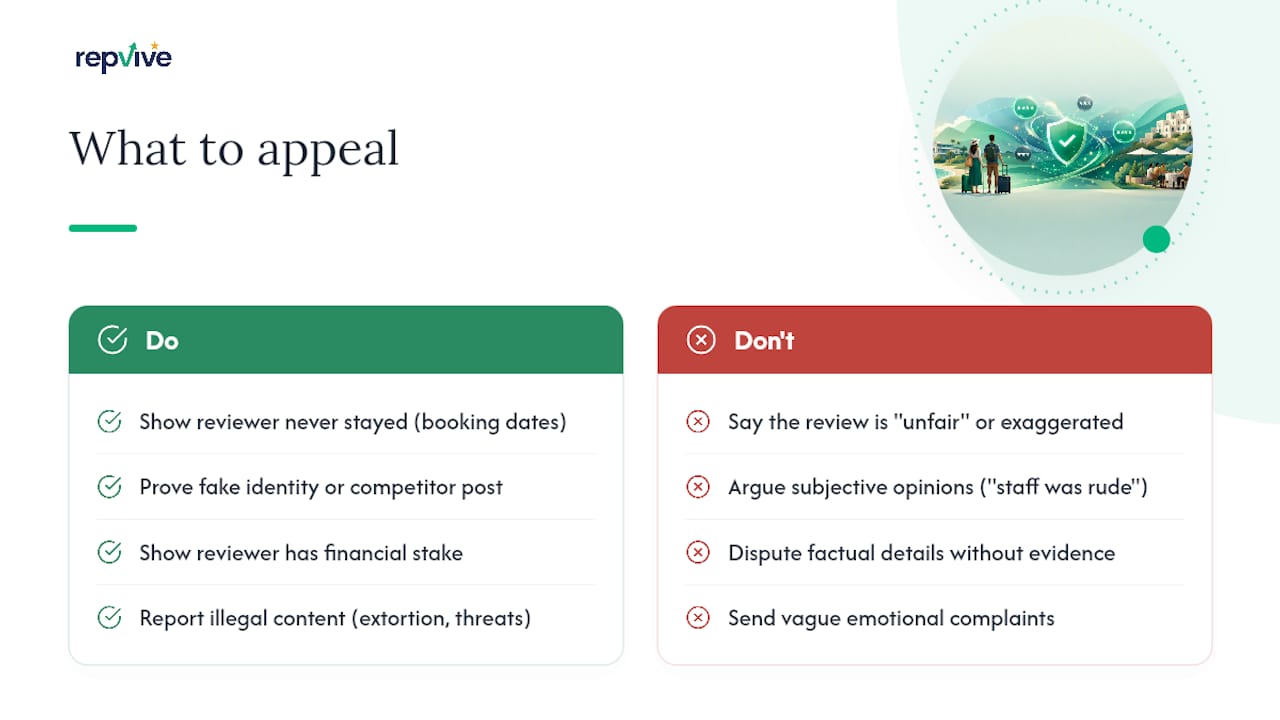
TripAdvisor only pulls reviews that violate its Community Standards, a narrow list built around fraud, impersonation, conflicts of interest, and illegal content. A one-star rating from someone who genuinely visited and hated the service, even if you think the complaint is exaggerated or unfair, almost always stays up. That’s the gap most owners misjudge: TripAdvisor doesn’t referee factual disputes between you and a guest. It only checks whether the review broke a specific rule.
Disqualifying content looks like this: a reviewer who never actually stayed or ate there, a competitor posting under a fake identity, a review written by someone with a financial stake in your business (a former employee, a rival owner), or content describing something illegal, like extortion attempts (“remove my complaint or I’ll leave more bad reviews”).
Protected opinion looks very different. “The staff was rude” or “I waited 45 minutes for a table” survives even if you dispute every word, because it reads as a first-hand account, not a policy violation.
This is why evidence matters more than outrage. Moderators aren’t reading your side of the story emotionally. They’re checking boxes: did this violate a specific rule, and can the owner prove it? A vague report saying “this is unfair” gets ignored. A report showing the reviewer’s stay dates don’t match your booking system gets attention.
How to File a TripAdvisor Owner Appeal in the Management Center
The reporting process is straightforward, but most owners rush it and get a denial they could have avoided.
- Log into the TripAdvisor Management Center and go to the Reviews tab.
- Find the review in question and click “Report a Review.”
- Select the violation category that actually matches the problem, not just the closest option. Fraud, impersonation, and conflict of interest are different categories with different evidence requirements.
- Write a short, factual statement naming the exact guideline you believe was broken.
- Attach your evidence as numbered items, referenced directly in your written statement.
- Submit and record the date.
When you write the report itself, skip the emotional appeal. Moderators respond to specifics:
- State the guideline violated in the first sentence.
- Reference each piece of evidence by number (“Exhibit 1 shows the reviewer’s stay dates don’t match any reservation in our system”).
- Keep the whole report under 200 words. Long reports get skimmed, not read.
According to FTC guidance on reporting suspicious reviews, the reporting path runs through this exact Management Center workflow, and attaching supporting evidence at submission, rather than after, materially improves your odds. Give TripAdvisor 10 to 14 business days before following up. If you get a denial that doesn’t address your evidence, or no response after three weeks, escalate by emailing contentintegrity@tripadvisor.com with your original report number attached.
What Evidence Do You Need to Remove a TripAdvisor Review?
The strength of your report lives or dies on documentation, not indignation. Here’s what to collect the moment you spot a problem review:
- Full-page screenshots showing the review text, the URL, the timestamp, and the reviewer’s username, not a cropped image of just the text.
- Booking or transaction records covering the dates the reviewer claims to have visited.
- Guest correspondence, emails, texts, or booking platform messages that contradict the reviewer’s account.
- Point-of-sale logs, CCTV footage, or staff shift records placing employees where the review claims they weren’t.
- Proof of incentivized or paid reviews, screenshots of solicitation messages, competitor social posts, or admissions in other reviews.
Records that directly disprove a factual claim carry the most weight. If a reviewer says they were overcharged on March 3, your point-of-sale record for that date is worth more than ten angry rebuttal comments.
Pro Tip: Capture screenshots using your browser’s full-page capture tool, not a phone photo of your screen. Full-page captures preserve the URL bar and timestamp automatically, which matters if this ever needs to hold up as preserved metadata in a legal claim.
Preserve everything the day you find the review, not after your first report gets denied. Evidence collected late loses credibility with both platform moderators and, if it comes to that, a court.
When Does a TripAdvisor Owner Appeal Need an Attorney?
Most fair-but-unflattering reviews don’t need a lawyer; however, small service businesses can benefit from advice on how personalized messaging builds contractor reputation to effectively manage customer feedback. Most fabricated, fraudulent, or factually false ones do, especially once the platform report alone hasn’t worked.
A claim becomes legally viable when three things line up: the statement is a false assertion of fact rather than opinion, you can show it caused measurable damage (lost bookings, a rating drop, canceled reservations), and you’re inside your state’s statute of limitations for defamation. According to legal analysis on TripAdvisor review removal, that opinion-versus-fact line is exactly where attorneys add value: they know how to frame a report so a fact claim reads as a fact claim to a moderator, not as a customer complaint.
If the reviewer is anonymous, a lawyer can pursue a John Doe subpoena to identify them through the platform or their internet service provider, a step almost no owner can take alone. From there, options usually include a cease-and-desist letter demanding retraction, or filing suit, which frequently ends in a negotiated removal agreement rather than a trial.
One limit worth understanding upfront: courts have limited power to force platforms to remove third-party content. Appellate rulings on platform liability show Section 230 usually shields platforms from liability for what users post, so legal pressure typically targets the poster, not TripAdvisor directly. A court judgment against the reviewer can sometimes prompt voluntary platform removal, but it’s rarely automatic. This is also exactly where an attorney’s formatting matters: a properly structured legal complaint or judgment, presented the way TripAdvisor’s compliance team expects, gets treated differently than a generic customer dispute. That’s the practical edge legal involvement buys you, and it’s worth comparing against options for suing over fake reviews before deciding how far to escalate.
How to Respond Publicly While the Review Stays Up
A review sitting unresolved for weeks doesn’t mean you’re powerless in the meantime.
Write a Management Response that acknowledges the situation without admitting fault: thank the reviewer for the feedback, state plainly that your records don’t match their account, and invite them to contact you directly to resolve it. Never argue in public. Future customers read your response as much as the review itself.
- Set up review alerts so you catch new posts promptly.
- Check your TripAdvisor profile on a fixed schedule, not just when someone mentions a bad review.
- Solicit reviews from recent satisfied guests to dilute the visibility of one bad post.
- Avoid publicizing a pending legal dispute; this can sometimes draw more attention to the original review.
Pro Tip: Ask for reviews right after a visibly positive interaction, a compliment at checkout, a repeat booking, a thank-you email. Timing matters more than volume. For more on crafting responses that actually shift perception, response strategy research for restaurants breaks down what tone works and what backfires.
Why Attorney-Led Removal Often Wins for Small Businesses
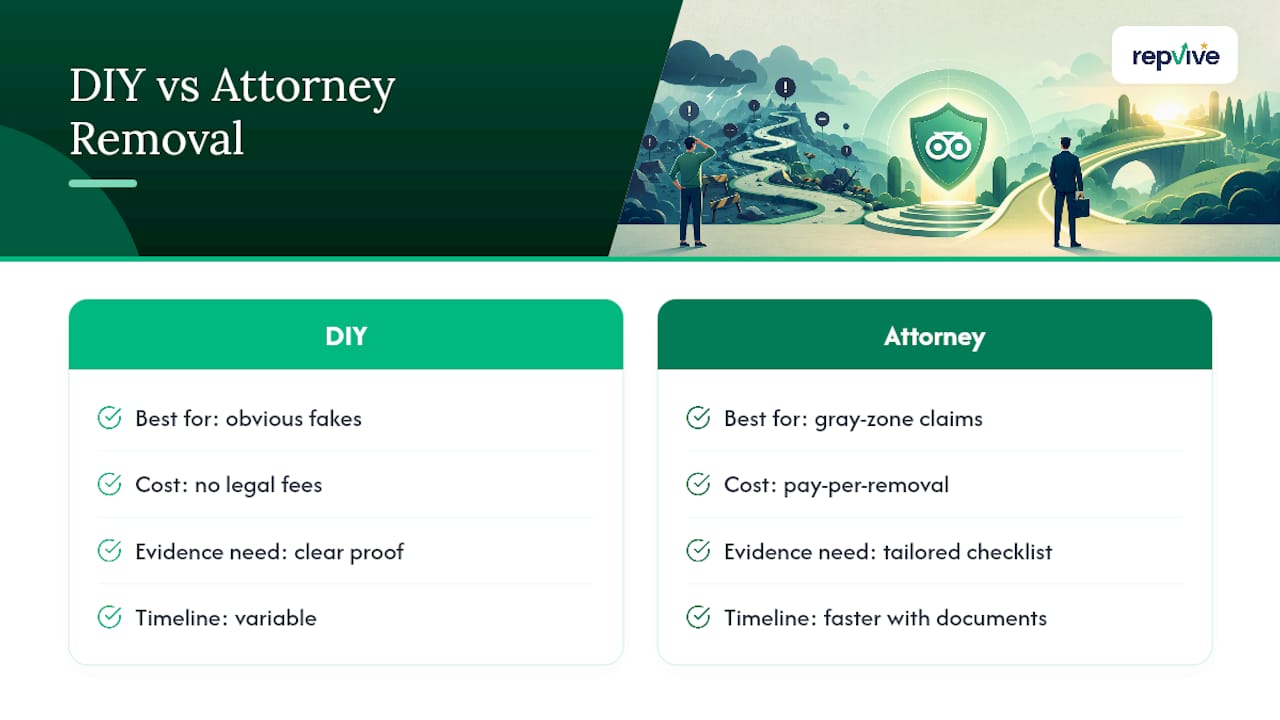
DIY reporting works fine for the clean cases: an obvious impersonation, a review from someone who never set foot in your business, a competitor sloppy enough to leave a paper trail. Where it breaks down is the gray zone, a former guest who’s rewritten the timeline, an anonymous poster making specific false claims about health violations or overcharging. That’s where attorney involvement changes the outcome, not just the odds.
The math is simple for a small business owner already stretched thin. A pay-per-removal model means you’re not paying retainer fees to find out if your case is viable. You get an evaluation, a tailored evidence checklist, and a legal claim built around your specific facts, with no upfront cost. You only pay once a review actually comes down. Timelines vary by case complexity, but the pattern holds: cases with strong documentary evidence move faster than cases built on “I know this is fake” alone.
, Jason
How Repvive Handles Attorney-Led TripAdvisor Removal
If you’ve made it this far, you already know the hard part isn’t wanting a review gone, it’s proving it qualifies for removal and then getting a platform to act on that proof. The service is built around exactly that gap: attorney-crafted claims for each review, a pay-per-removal structure with no upfront fee, and a real-time dashboard so you’re not left guessing where your case stands.
Getting started is simple. Submit the review link and whatever evidence you’ve already gathered, screenshots, booking records, correspondence, and Repvive’s legal team evaluates whether it qualifies under platform policy or a legal claim. From there, they build the case and only bill you once a review is confirmed removed. If you’re weighing whether a specific case is strong enough, the same evaluation process applies to reviews on TripAdvisor specifically, Google, Yelp, and more than 20 other platforms. Start with a free case evaluation and find out where you actually stand.
This article is general information, not a substitute for advice from a qualified lawyer. Consult a qualified legal professional about your own circumstances before acting on anything here.
Sources
- How to report suspicious online reviews (FTC guidance)
- TripAdvisor review removal: Internet defamation removal attorneys (Lexology)
- Hassell v. Bird, appellate discussion of platform removal and Section 230
FAQ
Can I get a TripAdvisor review removed just because it’s unfair?
No. TripAdvisor only removes reviews that violate its Community Standards, such as fraud, impersonation, or illegal content, not reviews that are simply negative or exaggerated.
How long does a TripAdvisor owner appeal usually take?
Initial Management Center reports typically get a response within 10 to 14 business days; cases escalated to contentintegrity@tripadvisor.com or handled through attorney-led claims can take longer depending on complexity.
What if TripAdvisor denies my first report?
Re-submit with stronger, more specific evidence tied to the exact guideline violated, and if that’s denied too, escalate by emailing contentintegrity@tripadvisor.com with your original report reference.
Can a lawyer force TripAdvisor to remove a review?
Not directly. Section 230 generally shields platforms from being ordered to remove third-party content, so attorneys usually pursue the poster through a demand letter, subpoena, or lawsuit rather than suing TripAdvisor itself.
Does RepVive charge upfront for TripAdvisor review removal?
No. Repvive works on a pay-per-removal basis, meaning you only pay after a review is successfully removed, with no upfront legal fees.