What Is Review Bombing Explained: A Business Guide
What Is Review Bombing Explained: A Business Guide
TL;DR:
- Review bombing involves coordinated posting of fake negative reviews to harm a business’s reputation quickly. Businesses can detect it early by monitoring review spikes and geographic patterns. Professional legal and platform support is often necessary to effectively remove such reviews and protect their reputation.
Review bombing is defined as a coordinated flood of negative online reviews posted rapidly to damage a product’s or business’s reputation, typically unrelated to actual customer experience. The term entered mainstream vocabulary as platforms like Steam, Google Reviews, and app stores became targets for mass protest campaigns. Understanding review bombing matters because a single coordinated attack can collapse a star rating overnight, and most business owners have no plan ready when it happens. This guide covers how these attacks work, when they cross legal lines, what damage they actually cause, and how to fight back.
What is review bombing explained: definition and core mechanics
Review bombing is a coordinated flooding of online reviews, often negative, designed to harm a business’s or product’s rating rapidly. The reviews are typically unrelated to product quality or genuine customer experience. Instead, they reflect a political stance, cultural grievance, or protest against a company decision.

Three tactics define most review bombing campaigns. First, mass-movement campaigns recruit large numbers of people through social media or forums to post negative reviews simultaneously. Second, vote brigading pushes existing negative reviews to the top of a listing by mass-upvoting them. Third, fake accounts post reviews from profiles with no purchase history or prior activity, making the attack harder to trace back to real people.
The speed of the attack is what separates review bombing from ordinary negative feedback. A legitimate wave of bad reviews builds gradually as more customers interact with a product. A review bomb arrives in hours, often with identical or near-identical language, from accounts created around the same time.
What triggers review bombing campaigns?
Review bombing often reflects larger communication failures between businesses and their audiences. When customers feel ignored, dismissed, or blindsided by a decision, a coordinated backlash becomes more likely.
Common triggers include:
- Unpopular policy changes, such as subscription price hikes or the removal of a popular feature
- Cultural or political controversies, where a brand takes a public stance that alienates part of its audience
- Regional pricing disputes, where users in certain markets pay significantly more than others
- Game updates or patches that break existing content or remove features players relied on
- Perceived dishonesty, such as a product launch that fails to match its marketing promises
Review bombing also gets used as a tool for coercion and extortion. Criminals follow review bombing with demands for money, threatening to continue posting fake negative reviews unless the business pays up. This is a criminal act in most jurisdictions, but it happens regularly to small local businesses.
Pro Tip: Set up a Google Alerts notification for your business name combined with words like “boycott” or “review.” Catching early chatter on forums gives you time to respond before the attack reaches your listing.
Is review bombing illegal?
Review bombing can be illegal when it involves fraudulent reviews, false factual claims, harassment, extortion, or coordinated competitor attacks. Honest negative opinions, even harsh ones, are generally protected speech. The law draws a clear line between expressing genuine dissatisfaction and fabricating false facts to harm a business.
The following behaviors cross legal boundaries:
- Defamation: posting false statements of fact presented as true, causing measurable harm to reputation
- Extortion: demanding payment to stop posting negative reviews
- Paid review attacks: hiring people or bots to post fake negative reviews about a competitor
- Harassment: targeting an individual employee or owner with threatening or abusive content
- FTC violations: coordinated fake review campaigns that mislead consumers about a product’s quality
“The critical distinction is between a reviewer sharing a genuine opinion and a reviewer fabricating facts or acting as part of a paid scheme. One is speech. The other is fraud. Businesses that understand this distinction are far better positioned to pursue removal or legal action when an attack occurs.”
Platforms enforce their own rules on top of legal standards. Steam, for example, flags review periods with unusual spikes and excludes those reviews from the overall rating calculation. Google’s policies prohibit fake reviews and allow businesses to flag content that violates its guidelines. Neither platform removes content automatically, which is why professional intervention often produces faster results.
What impact does review bombing have on businesses?
The impact of review bombing on sales is inconsistent, and that inconsistency is itself an important finding. Strong brand loyalty can protect against long-term financial damage even when ratings drop sharply. Slay the Spire 2 dropped to mostly negative reviews during a coordinated campaign but maintained commercial success because its existing fan base trusted the product independently of its star rating.
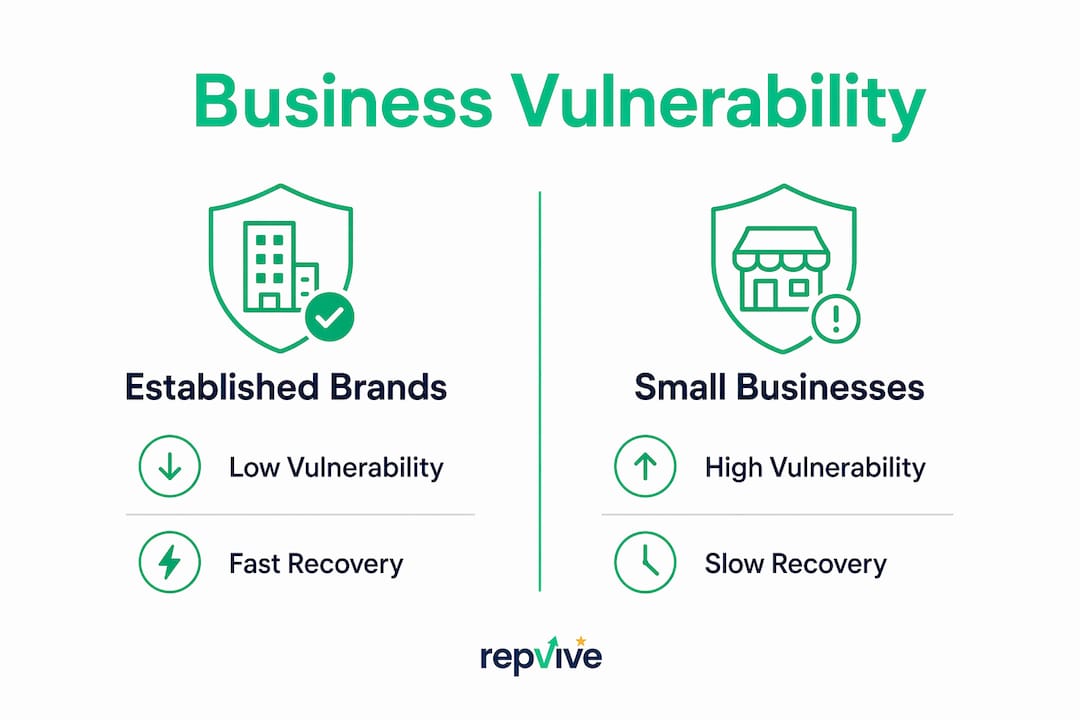
Smaller and less established businesses face a different reality. A local restaurant, law firm, or medical practice with fewer than 50 reviews can see its average rating collapse from 4.8 stars to 2.1 stars from a single coordinated attack. Potential customers searching for that business see the low rating first, before they read any context. The damage to first impressions is immediate.
| Business type | Vulnerability to review bombing | Recovery speed |
|---|---|---|
| Established brand with large review base | Lower. Rating drop is diluted across many reviews. | Faster, as new genuine reviews restore average quickly. |
| Small local business with few reviews | Higher. Each fake review carries more weight. | Slower, requires active removal or response strategy. |
| New product or app launch | Very high. No existing rating buffer exists. | Slowest, as brand trust has not yet been built. |
Beyond the rating number itself, review bombing affects consumer trust in ways that outlast the attack. Customers who see a sudden drop in ratings often assume the business did something wrong, even if they never read the individual reviews. That assumption is hard to correct without a clear, public response.
You can estimate the financial cost of a rating drop using Repvive’s revenue impact calculator, which translates star rating changes into projected revenue loss for your specific business type.
How can businesses detect and respond to review bombing?
Early detection is the most effective defense. Monitoring anomalous review velocity spikes and geographic patterns is critical for catching an attack before it fully damages your rating. A sudden spike of 20 one-star reviews in a single afternoon, all from accounts with no prior activity, is a clear signal.
A structured response follows these steps:
- Document the attack. Screenshot every suspicious review, noting the date, time, reviewer profile age, and language patterns. This documentation supports platform removal requests and any legal action.
- Flag reviews to the platform. Submit removal requests through Google’s review management tools or the relevant platform’s reporting system. Reference the platform’s specific policy the review violates.
- Monitor by language and region. A broken patch affecting one region often triggers region-specific negative review flooding. Filtering by geography reveals whether the spike is localized, which strengthens your case for removal.
- Communicate transparently. Post a public response that acknowledges the situation without being defensive. Customers who see a calm, factual response trust the business more, not less.
- Seek professional help when the attack persists. Platforms’ automated tools are helpful but insufficient. Businesses need combined efforts including legal review and direct platform engagement to resolve serious attacks.
Pro Tip: Use Repvive’s real-time review monitoring tool to track review activity across 20+ platforms simultaneously. Catching a spike within hours gives you a meaningful head start on the removal process.
One mistake business owners make is labeling all negative feedback as review bombing. Genuine complaints from real customers deserve a genuine response. Misusing the term to dismiss valid criticism damages credibility and misses an opportunity to fix a real problem.
Key Takeaways
Review bombing is a coordinated attack using fake or off-topic reviews to harm a business’s rating, and the most effective response combines early detection, platform reporting, transparent communication, and professional legal support.
| Point | Details |
|---|---|
| Definition of review bombing | A coordinated flood of negative reviews posted rapidly, unrelated to genuine customer experience. |
| Legal boundaries | Fake reviews, defamation, extortion, and paid attacks are illegal; honest opinions are protected speech. |
| Business impact varies | Established brands with large review bases recover faster than small businesses with few existing reviews. |
| Detection comes first | Monitor review velocity and geographic patterns to catch an attack before it fully damages your rating. |
| Professional help matters | Platform tools alone are insufficient; legal review and direct platform engagement produce better outcomes. |
Why review bombing is harder to fight than most owners expect
Review bombing looks simple from the outside. A flood of fake reviews appears, you report them, the platform removes them. That is rarely how it plays out.
The platforms’ reporting systems are built for volume, not nuance. A single business flagging 30 reviews gets the same automated response as someone flagging one spam comment. Without specific legal language tied to each review, removal requests often get denied on the first attempt. I have seen businesses spend weeks going back and forth with platform support, watching their rating stay buried the entire time.
What actually works is treating each review as its own case. The language in a defamatory review differs from the language in an extortion-linked review, and the removal argument for each one is different. Generic mass-reporting rarely succeeds. Targeted, policy-specific arguments do.
The other mistake I see constantly is the defensive public response. A business owner writes a long comment under a fake review explaining why the reviewer is wrong. That response signals panic to every potential customer reading it. A short, factual, calm reply is always more effective. Save the detailed argument for the platform’s removal process, not the public comment thread.
Long-term reputation resilience comes from building a large base of genuine reviews before an attack happens. A business with 400 real reviews absorbs a bomb of 30 fake ones far better than a business with 12. Start collecting verified reviews now, before you need that buffer.
— Jason
When professional review removal makes sense
Facing a coordinated review attack alone puts you at a structural disadvantage. Platforms process millions of flagged reviews and their automated systems favor speed over accuracy.
Repvive’s attorney-led approach treats each negative review as a separate legal matter. The legal team crafts a customized removal argument for every review, using direct channels to Google rather than the standard consumer reporting queue. That process is why Repvive reports a 99% success rate with no upfront fees required. For small and medium businesses where a single rating drop translates directly to lost revenue, professional Google review removal is often the fastest path back to a clean listing. Visit Repvive’s services page to see how the process works and what it costs.
FAQ
What is review bombing?
Review bombing is a coordinated campaign where large numbers of people post negative reviews rapidly to damage a product’s or business’s online rating, typically unrelated to genuine customer experience.
How does review bombing work?
Attackers organize through online forums or social media, then flood a platform with one-star reviews simultaneously. Tactics include mass-movement campaigns, fake accounts, and vote brigading to amplify the impact.
Is review bombing illegal?
Review bombing is illegal when it involves fake reviews, defamation, extortion, or paid competitor attacks. Honest negative opinions, even if posted in large numbers, are generally protected speech.
How can I tell if my business is being review bombed?
Look for a sudden spike in one-star reviews within a short time window, especially from accounts with no prior activity, similar language patterns, or geographic clustering that does not match your customer base.
Can review bombing be reversed?
Yes. Businesses can flag policy-violating reviews for removal, engage platforms directly, and use professional reputation management services. Repvive’s legal team achieves removal of fake and unfair reviews with a documented 99% success rate.