3 Removal Grounds Business Owners Must Cite Before a Yelp Review Appeal
3 Removal Grounds Business Owners Must Cite Before a Yelp Review Appeal ! Decorative Yelp review appeal title card Yelp will only remove a review if it clearly breaks a specific content guideline, not because it's unfair, harsh, or bad for business.
3 Removal Grounds Business Owners Must Cite Before a Yelp Review Appeal
Yelp will only remove a review if it clearly breaks a specific content guideline, not because it’s unfair, harsh, or bad for business. Your best move right now is twofold: file a report through your Yelp for Business Account with concrete evidence, and post a calm, factual public response. If the review is actually defamatory and Yelp won’t budge, the next real lever is a court order or attorney involvement, not another report.
TL;DR:
- Reviews from employees, competitors, or paid for in exchange are strong grounds for removal, especially if the reviewer lacks a common review history or social connection.
- Evidence such as receipts, appointment logs, timestamped photos, and CCTV footage is crucial; screenshots alone are weak evidence unless paired with system-generated documents.
- Responding publicly with calm, factual, and concise replies while waiting for review moderation helps preserve reputation and demonstrates professionalism.
- A court order is required for definitive removal of defamatory reviews, but obtaining one is costly, slow, and demands proof of falsity and harm.
- Filing a report with specific, verifiable evidence aligned with Yelp’s guidelines is often effective, but legal escalation is only justified for clear defamation cases or organized fake review campaigns.
Table of Contents
- How Do You File a Yelp Review Appeal?
- What Are Yelp’s Official Grounds for Removing a Review?
- What Evidence Should You Gather Before Reporting?
- How Should You Respond to a Bad Review While You Wait?
- When Should You Escalate to Legal Action?
- How Do You Track Your Report and Ask for a Second Look?
- Why Attorney-Led Removal Services Exist and When They Actually Help
- The Honest Take on Yelp Review Appeals
- If DIY Isn’t Cutting It: RepVive’s Removal Service
- Sources
- FAQ
How Do You File a Yelp Review Appeal?
Before you touch the report button, claim and verify your Yelp business profile if you haven’t already. Unverified accounts can’t flag reviews, and Yelp won’t process a report from an account it can’t confirm is tied to the business in question.
Once you’re in, here is the exact path:
- Log into your Yelp for Business account and navigate to your business page.
- Find the review in question and click the three dots (labeled “More options”) next to it.
- Select “Report review” from the dropdown menu.
- Choose the category that matches the violation (conflict of interest, not a firsthand experience, or inappropriate content).
- Write a short, factual explanation and attach or reference your supporting evidence.
- Submit the report and note the confirmation.
On mobile, the layout shifts slightly. The three-dot menu sometimes sits above the review text instead of beside it, so screenshot the review immediately if you’re worried it might get edited or deleted before you finish reporting it.
What you write in that report form matters more than most business owners realize. Yelp’s own guidance stresses that specific, verifiable evidence beats vague complaints every time. Skip the “this is unfair” language. Instead:
- State the timeline in one or two sentences (dates, times, what happened).
- Link or describe the proof you have (receipt number, booking ID, appointment log).
- Name the exact policy you believe was violated, not just your general objection.
Attach documentation only where Yelp’s form allows it, and keep file names simple so a moderator can match them to your explanation without guessing.
Moderation isn’t instant. Yelp aims to respond to reports promptly, but the timing can vary and some cases take longer. You can check progress by hovering over the flag icon next to the review on your dashboard, and Yelp typically follows up by email with a case reference once a decision is made.
What Are Yelp’s Official Grounds for Removing a Review?
Yelp doesn’t remove a review just because it’s negative or because you disagree with the reviewer’s account. The company has three main categories that qualify for removal: conflict of interest, content that isn’t based on a firsthand consumer experience, and material that’s inappropriate or harmful.
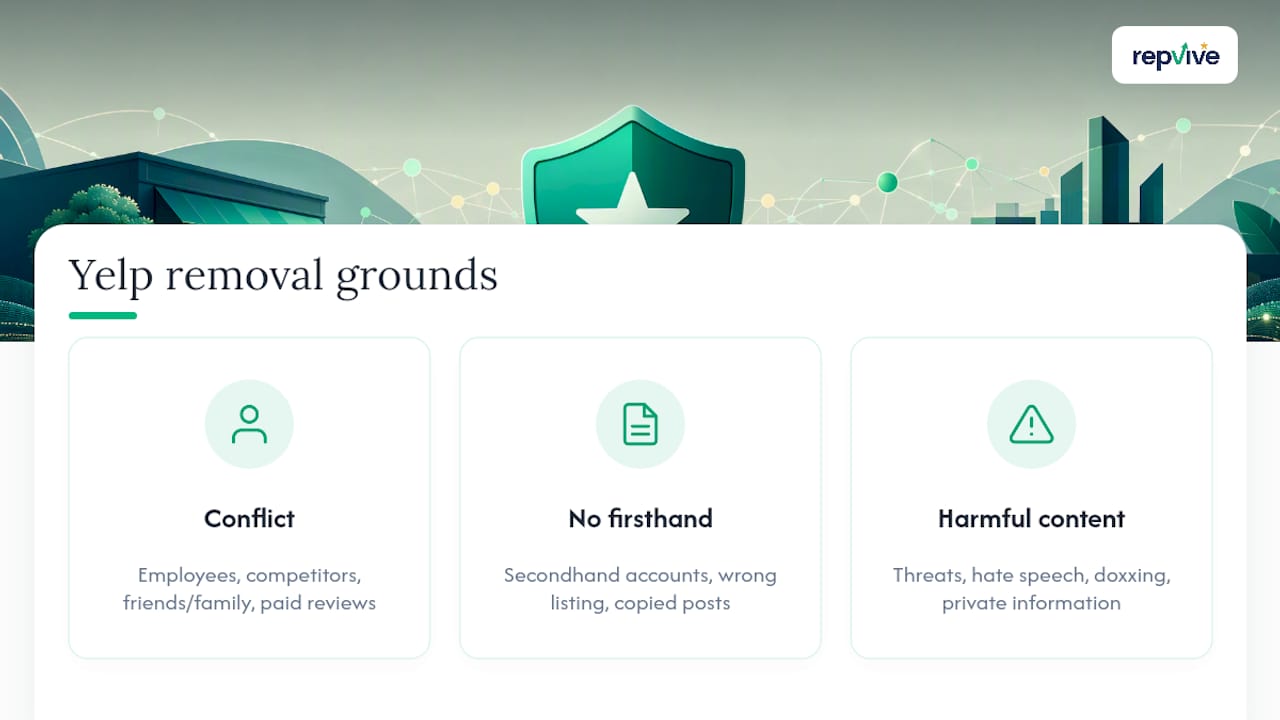
Conflict of interest covers reviews from employees, former employees, competitors, or close friends and family of the owner. It also covers reviews written in exchange for payment, discounts, or free products. If you suspect this, look for clues: an account with no other review history, a reviewer connected to you on social media, or language that mirrors a competitor’s marketing copy.
Not a firsthand experience is broader than people expect. It includes secondhand accounts (“my coworker said this place was terrible”), reviews posted to the wrong business listing, and content copied or reposted from another platform. If the reviewer never actually transacted with you, that’s your strongest angle.
Inappropriate or harmful content includes threats, hate speech, doxxing, and the sharing of private information like someone’s home address or medical details. Yelp treats this category seriously and tends to act faster on it than on disputed-fact cases.
One distinction trips up almost every business owner filing a review complaint: Yelp’s moderation team operates separately from its recommendation software. The recommendation filter is an algorithm that decides which reviews show up prominently versus in the “not currently recommended” section. It runs automatically and has nothing to do with your report. Moderators, by contrast, are people evaluating your specific complaint against the guidelines. A review can be “not recommended” by the algorithm and still visible, or fully recommended and still get pulled by a moderator. They’re two different systems solving two different problems.
What Evidence Should You Gather Before Reporting?
Strong reports lean on records a reviewer can’t fake, not on your word against theirs. Before you file, pull together:
- Transaction receipts or point-of-sale records matching the date the reviewer claims.
- Appointment logs, booking confirmations, or calendar entries.
- Timestamped photos, ideally with metadata intact rather than a plain screenshot.
- Staff schedules or CCTV timestamps showing who was on shift.
A screenshot alone is often weak evidence because it’s easy to alter and carries no verifiable timestamp. Pair it with something dated and system-generated, like a booking software export, to give it weight.
Redact sensitive information (other customers’ names, payment details) before attaching anything, and build a one-page timeline rather than a folder of loose documents. Moderators move faster through a short, dated summary than a stack of disconnected files.
Pro Tip: Build your evidence bundle as a single PDF, dates in chronological order, with a one-line caption under each item explaining what it proves. Moderators reviewing hundreds of reports a week reward clarity.
How Should You Respond to a Bad Review While You Wait?
Silence looks bad, and so does a defensive rant. Reply publicly, briefly, and factually, then let the report process run in the background.
- Mistaken identity or wrong location: “We’ve checked our records for this date and can’t find a matching visit. If you’d like to confirm the location or date, please message us directly and we’ll sort it out.”
- Genuine service failure: “We’re sorry this visit didn’t meet the standard we aim for. We’d like to make it right, please reach out to us directly so we can address it.”
- Disputed facts: “Our records for this date show something different. We’re happy to discuss the specifics privately, but we want to be clear we take this seriously.”
Keep the tone even. Never name the customer’s private details, never threaten legal action publicly, and always invite the conversation offline. A defensive or angry reply does more damage to future customers reading it than the original review did.
Use direct messaging once the customer responds, not before. A public reply that stays professional signals to everyone else reading your page that you handle criticism well, and it can shape how future reviews on your profile get received.
When Should You Escalate to Legal Action?
Yelp will generally only remove allegedly defamatory content after you produce a final, binding court order from a court of competent jurisdiction. That’s a meaningfully higher bar than a standard report. It means proving your defamation claim in court first, then presenting the resulting order to Yelp, not the other way around.
Getting there usually requires:
- Meeting your state’s defamation standard, which typically means proving the statement was false and caused actual harm.
- A documented timeline of the review, your reporting attempts, and Yelp’s responses.
- Legal counsel familiar with review management tools for hospitality businesses to navigate platform takedown procedures.
The FTC’s rule banning fake reviews and deceptive testimonials adds another layer for coordinated fake-review campaigns, giving businesses a federal enforcement angle beyond individual platform reports.
A court order compelling removal is rare not because platforms are stubborn, but because courts require the same proof any defamation case demands: falsity, harm, and a properly identified defendant. That process is slow and often costly, which is exactly why most businesses never get there and instead lean on reporting, evidence, and public response first.
Before calling an attorney, organize your prior reports, the review’s history, and every piece of evidence you’ve already submitted. It saves billable hours and strengthens your case from the first conversation.
How Do You Track Your Report and Ask for a Second Look?
Hover over the flag icon on your business dashboard to see where a report stands, and check your email for Yelp’s case number and decision notice. If Yelp denies the removal and you have new, verifiable evidence you didn’t originally submit, you can request re-evaluation through Yelp’s questionable content form.
- Only resubmit if you have something genuinely new, not a rephrased version of the same complaint.
- Reference your original case number so the second review connects to the first.
- Yelp Support’s phone and form channels both exist, but form submissions tend to generate a documented case trail that’s more useful if you escalate later.
Repeated, aggressive reporting on weak grounds can flag your account as a nuisance reporter, which slows down your future, legitimate complaints.
Why Attorney-Led Removal Services Exist and When They Actually Help
Reporting reviews yourself works when the violation is clear and your evidence is clean. It stops working when a review is defamatory, part of a coordinated attack, or tied up in a dispute Yelp won’t referee. That’s the gap attorney-led services like Repvive were built for.
That kind of help earns its cost specifically in defamation situations, organized fake-review campaigns, or cases where one bad review is doing real, measurable damage to bookings or revenue. For a single disputed review with clean evidence, the DIY path above is usually enough.
The Honest Take on Yelp Review Appeals
Most advice on this topic oversells the report button. Business owners file a report, expect a quick reversal, and get frustrated when Yelp sides with the reviewer’s “firsthand experience” defense, which Yelp explicitly protects even when businesses dispute the facts. That’s not a flaw in the system. It’s the system working as designed: Yelp isn’t a fact-finder, and it never claims to be.
The businesses that actually get reviews removed treat the report form like a legal document, not a complaint box. They lead with dates, receipts, and policy citations instead of frustration. They also respond publicly while they wait, because a professional reply protects them even if the removal never comes through.
Where the conventional advice falls flattest is on legal escalation. People assume a lawyer’s letter alone forces removal. It doesn’t. Yelp wants a court order, and getting one takes months and real money.
— Jason
If DIY Isn’t Cutting It: RepVive’s Removal Service
Repvive is the alternative for business owners who’ve reported a review correctly, followed up, and still watched a damaging or clearly fake review sit on their profile. Instead of another form submission, An attorney-led service can build a customized legal claim per review and push it through channels designed to get platforms like Yelp, Google, and Facebook to act, billing only after a review is confirmed removed, with no upfront fee.
Reach for this option when you’re dealing with a defamatory review, a suspected competitor attack, or a pattern of fake reviews that’s already cost you bookings, not a single mildly negative comment you disagree with. If you’ve hit that point, visit Repvive’s Yelp review removal page to see how the process works, or check the full range of removal and reputation services to get a sense of what’s included before you reach out.
Sources
For the policy details covered above, go straight to Yelp’s own pages: how to report a review, when reporting is appropriate, and how moderation works. For the regulatory backdrop on fake reviews, see the FTC’s final rule.
This article is general information, not a substitute for advice from a qualified lawyer. Consult a qualified legal professional about your own circumstances before acting on anything here.
- How do I remove a review? | Yelp for Business Support
- FTC announces final rule banning fake reviews and testimonials
FAQ
How Do You Get a Bad Yelp Review Removed?
Report it through your Yelp for Business account with specific, verifiable evidence tied to one of Yelp’s three removal categories: conflict of interest, not a firsthand experience, or inappropriate content. Removal isn’t guaranteed even with strong evidence, since Yelp generally won’t referee factual disputes over a genuine customer experience.
How Should You Respond to a Bad Yelp Review?
Reply publicly with a short, factual statement that avoids naming private details or sounding defensive, then invite the customer to continue the conversation privately. A calm public response protects your reputation with future readers even if the review itself never comes down.
Can You Sue Someone for a Bad Yelp Review?
You can pursue a defamation claim if the review contains false statements of fact that caused measurable harm, but Yelp typically requires a final, binding court order before removing the content, which means winning that case first. This route is slower and costlier than reporting, so it’s usually reserved for clear defamation or coordinated fake-review attacks.
Why Would a Review Be Removed From Yelp?
Yelp removes reviews for conflict of interest, content that doesn’t reflect a genuine firsthand experience, or material that violates its guidelines around threats, hate speech, or private information. Reviews that simply reflect a bad but real customer experience generally stay up, no matter how negative they read. For cases involving defamation or organized attacks that fall outside these standard categories, an attorney-led service like Repvive can pursue removal through direct legal channels.