What Is Transferable Reputation Repair? A 2026 Guide
Transferable reputation repair is the practice of using credible, existing trust assets to rebuild and protect public perception against damaging online...
TL;DR:
- Transferable reputation repair uses existing trust signals like press mentions and accurate entity data to rebuild public perception.
- It focuses on continuous asset building and ethical content correction rather than temporary suppression of negative content.
Transferable reputation repair is the practice of using credible, existing trust assets to rebuild and protect public perception against damaging online feedback. Unlike a one-time cleanup, this method treats reputation as a living system of signals, including knowledge panels, authoritative content, schema markup, and press placements, that can be redirected to counteract negative material. Individuals and business owners who understand what is transferable reputation repair gain a real advantage: they stop chasing bad reviews and start building assets that work continuously. Repvive’s attorney-led approach applies exactly this logic, using documented legal outreach and credibility-building to deliver results that last.
What is transferable reputation repair and how does it work?
Transferable reputation repair is defined as the process of identifying, strengthening, and redirecting existing credibility signals to suppress or neutralize negative online content. The “transferable” element refers to trust that moves across platforms. A positive editorial mention on a high-authority publication, for example, carries weight on Google, in AI-generated answers, and in social search simultaneously.

The core mechanism relies on entity accuracy. AI models like Gemini and GPT-4 retrieve entity data in real-time to form brand associations, which means your knowledge panel, bio, and schema markup must be consistent and accurate across every platform. Inaccurate or missing entity data creates gaps that negative content fills. Accurate entity data gives AI systems a clear, positive signal to surface instead.
Content credibility is the second pillar. Expert-backed articles, verified bios, and case studies carry more weight than generic blog posts. These assets do not just rank in traditional search. Placing brand mentions in authoritative publications that AI crawlers index frequently amplifies the transferable effect across AI-driven environments.
The third pillar is Generative Engine Optimization, or GEO. GEO is the practice of structuring content so that AI-powered search engines pick it up as a trusted source when forming brand perceptions. Businesses that ignore GEO leave their reputation narrative to chance.
Pro Tip: Audit your Google Knowledge Panel before anything else. Errors there propagate into AI-generated answers and can undermine every other repair effort you make.
What reputation management strategies enable effective reputation transfer?
Effective reputation transfer does not happen through a single campaign. Reputation repair is an ongoing operational discipline that requires fixing the behaviors that caused negative feedback, not just suppressing the content that reflects it. That distinction separates businesses that recover from those that cycle through the same problems repeatedly.
The most durable reputation management strategies share four characteristics:
-
First-page distribution control. A coordinated PR, legal, SEO, and customer experience approach fills the first page of search results with accurate, authoritative assets. The goal is not to hide negative content but to outrank it with material that reflects the real quality of your business.
-
Proactive trust asset creation. Building trust assets before a crisis makes a brand harder to damage. Bios, case studies, FAQs, and press placements all function as defensive infrastructure. When a negative review appears, these assets absorb the impact.
-
Ethical content correction. Removal requests succeed when they are grounded in documented, factual outreach. Emotional or threatening removal requests damage credibility and often make the situation worse. Repvive’s attorney-led model works precisely because it uses policy-based, respectful communication that Google’s review process recognizes.
-
Continuous monitoring and adjustment. Social listening tools, AI-powered alerts, and regular audits catch new negative signals early. Early detection means smaller fires to put out.
The operational discipline required here is significant. Businesses that treat reputation management as a quarterly task rather than a daily system consistently underperform those that embed it into standard operations.
How does transferable reputation repair compare to traditional reputation cleanup?
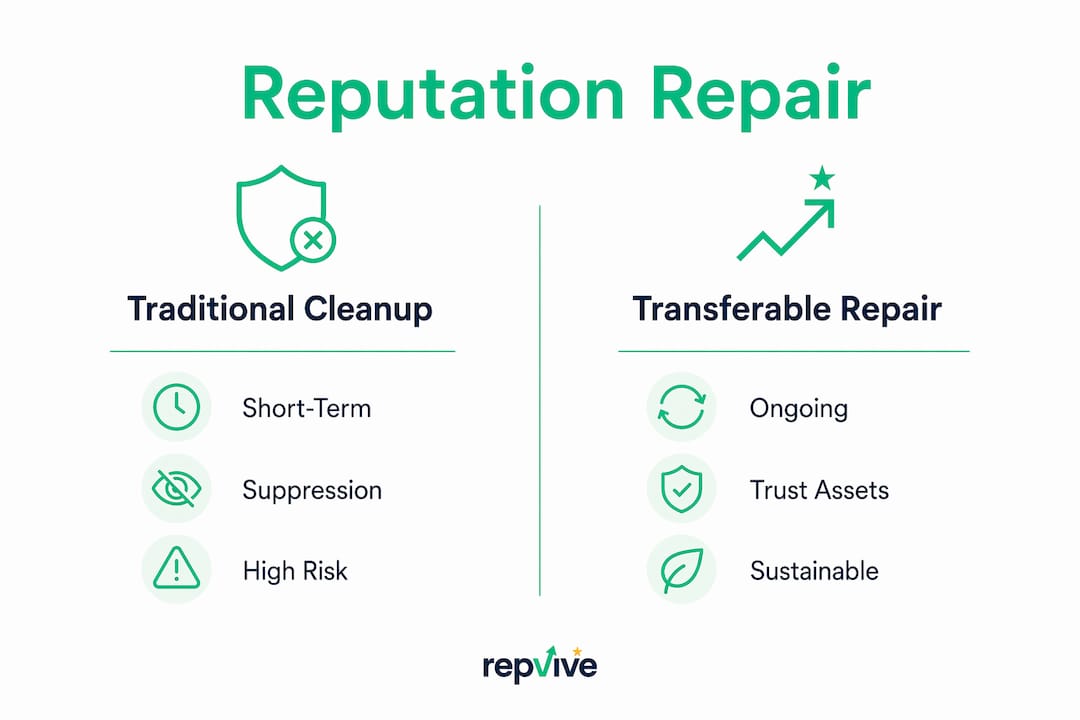
Traditional reputation cleanup is a project. Transferable reputation repair is a system. That difference determines whether results last six months or six years.
Traditional cleanup typically focuses on suppression: pushing negative content down in search results through a burst of new content, then stopping once the negative result drops to page two. The problem is that suppression without asset building is temporary. The moment content creation slows, negative material resurfaces.
Treating reputation repair as a one-time cleanup leads to failure. Building a content moat of owned, high-quality assets that consistently outrank negatives is the only approach that holds over time. A content moat includes owned bios, published case studies, FAQ pages, and press placements that collectively dominate the first page of results for your name or brand.
| Approach | Traditional cleanup | Transferable repair |
|---|---|---|
| Duration | Short-term project | Ongoing operational system |
| Core tactic | Suppression of negatives | Asset building and trust transfer |
| AI visibility | Rarely addressed | Central to the strategy |
| Durability | Fades without maintenance | Compounds over time |
| Risk level | High if tactics are aggressive | Lower with documented, ethical outreach |
Pro Tip: Think of your reputation assets the way a financial advisor thinks about a portfolio. Diversify across platforms, formats, and publications so no single negative review can move the needle significantly.
Traditional approaches also carry higher risk. Aggressive removal tactics without documented justification can backfire. Repvive’s model avoids this by building each removal claim on specific policy violations, which is why its reported success rate reaches 99%.
How can you implement transferable reputation repair step by step?
The sequential approach to reputation recovery techniques produces better outcomes than reacting to every negative mention as it appears. A disciplined workflow keeps efforts focused and measurable.
-
Audit your digital footprint first. Search your name and business name across Google, Bing, and major AI tools. Document every result on the first two pages. Note which assets you own, which you can influence, and which are entirely outside your control. Understanding how reputational harm is measured gives you a baseline to work from.
-
Correct and remove controllable negative content. Start with content you own or can edit directly: outdated bios, incorrect business listings, and old social profiles. For third-party content, use documented, factual outreach that cites specific policy violations. Sequential, disciplined execution over time produces better results than chasing every mention at once.
-
Build and publish expert-backed content. Create bios, case studies, and FAQ pages that reflect your actual expertise and track record. Publish op-eds or contributed articles on industry-relevant, high-authority sites. This content serves dual purposes: it ranks in traditional search and feeds AI models with accurate brand data.
-
Optimize for AI visibility. Verify your Google Knowledge Panel and add schema markup to your website. Consistent entity data across platforms is the foundation of GEO. Without it, AI systems default to whatever information is most readily available, which may be negative.
-
Monitor and adjust continuously. Set up alerts for your name, brand, and key products. Review your first-page results monthly. Adjust content creation and outreach based on what is gaining traction and what is slipping. Reputation recovery is not a destination. It is a maintenance schedule.
The businesses that recover fastest are those that treat this workflow as a permanent operational function, not a temporary fix assigned to one person for one quarter.
Key Takeaways
Transferable reputation repair works because it builds durable trust assets that carry positive signals across platforms, AI systems, and search engines simultaneously.
| Point | Details |
|---|---|
| Define the method clearly | Transferable reputation repair uses existing credibility signals to neutralize negative content across platforms. |
| Entity accuracy is foundational | Accurate knowledge panels, bios, and schema markup feed AI models the right brand data. |
| Ongoing discipline beats one-time cleanup | Reputation repair that fixes root behaviors outlasts suppression-only approaches every time. |
| Content moats protect long-term | Owned bios, case studies, and press placements outrank negatives and compound over time. |
| Ethical outreach gets results | Documented, policy-based removal requests succeed where emotional or aggressive tactics fail. |
Why I think most businesses are solving reputation repair backwards
Most business owners I encounter start with removal and stop there. They get a bad review taken down, breathe a sigh of relief, and move on. Six months later, another negative review appears and the cycle starts again. The root problem never gets addressed.
The businesses that actually recover, and stay recovered, do something different. They treat the negative review as a diagnostic signal, not just a threat. They ask what operational failure produced that review and fix it. Then they build content and press placements that reflect the improved reality. That sequence, fix, document, publish, is what makes reputation repair transferable. The trust built in one channel moves into others.
I have also seen businesses invest heavily in AI visibility through AI reputation management while ignoring the basics: an unclaimed Google Business Profile, a bio with the wrong city, a knowledge panel pulling outdated information. AI systems amplify whatever entity data they find. If that data is wrong, the amplification works against you.
The future of reputation repair belongs to businesses that build systems, not those that react to incidents. Proactive PR and press placement across authoritative publications creates a reputation that is genuinely hard to damage. That is the transferable trust-building approach worth investing in.
, Jason
Repvive’s approach to reputation repair that actually holds
Negative reviews do not disappear on their own, and generic suppression tactics rarely hold up past the first algorithm update. Repvive takes a different path: an attorney-led process that builds each removal claim on documented policy violations, with no upfront fees and a 99% success rate.
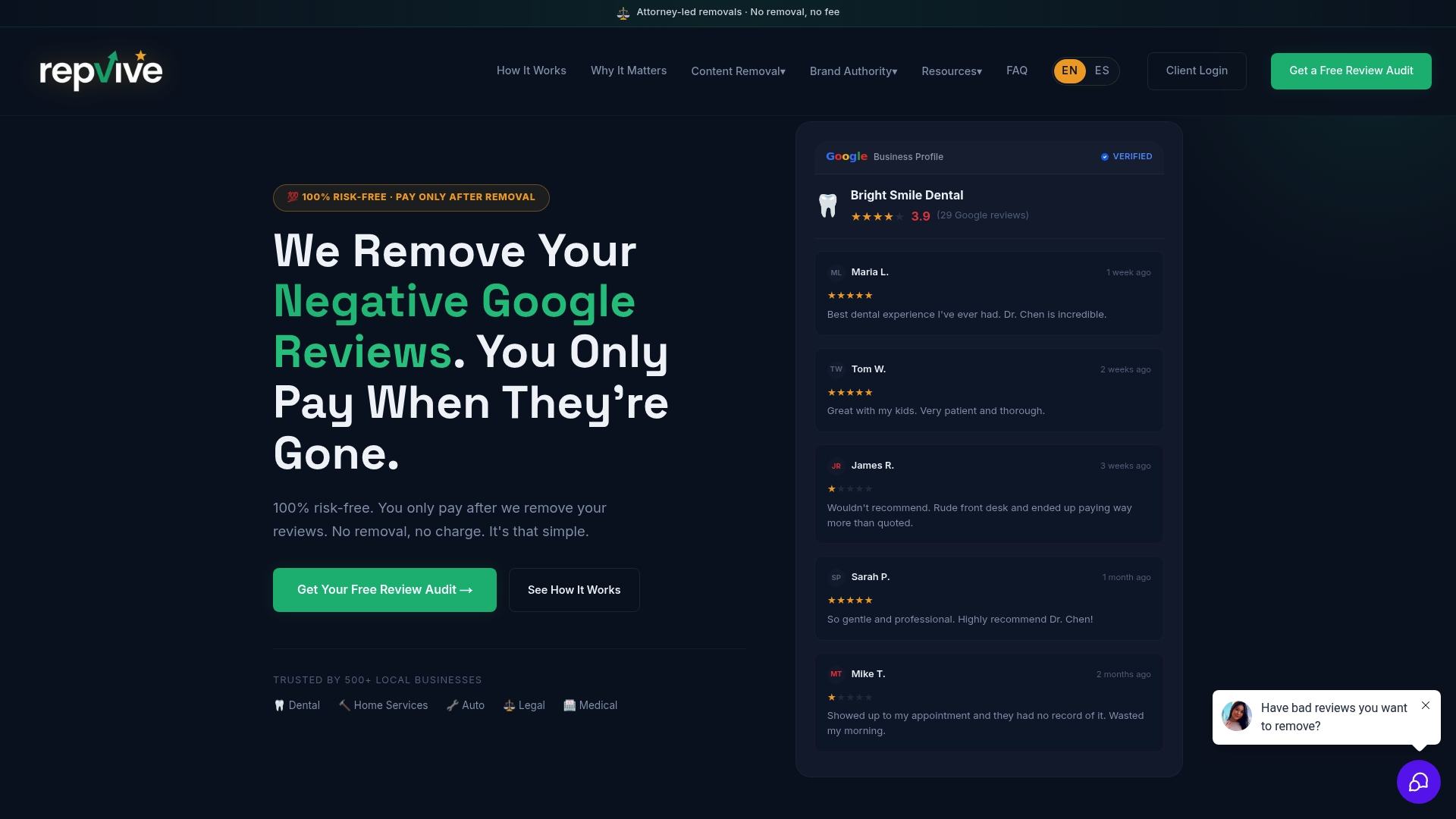
Repvive works with small and medium local businesses across industries to remove fake and unfair reviews from Google, build authoritative content assets, and improve AI visibility so that positive signals reach the right audiences. The process covers the full spectrum of reputation repair services, from review removal to press placement to knowledge panel optimization. If your business is carrying the weight of damaging reviews, Repvive’s legal team is ready to build a case specific to your situation.
FAQ
What is transferable reputation repair in simple terms?
Transferable reputation repair is the practice of using credible, existing trust assets, such as press mentions, bios, and accurate entity data, to rebuild public perception and counteract negative online content across multiple platforms simultaneously.
How long does reputation repair take to show results?
Results vary by the severity of the damage and the consistency of execution. A sequential approach that audits, corrects, and builds assets over time produces more durable outcomes than a single-burst campaign.
Does removing negative reviews count as reputation repair?
Review removal is one component of reputation repair, not the whole strategy. Sustainable repair also requires building authoritative content and correcting entity data so positive signals dominate search and AI results.
What is Generative Engine Optimization and why does it matter?
Generative Engine Optimization, or GEO, is the practice of structuring content and entity data so that AI-powered search engines surface accurate, positive brand information. Brands that ignore GEO allow AI systems to default to whatever information is most available, including negative content.
Can individuals use transferable reputation repair, not just businesses?
Transferable reputation repair applies equally to individuals. Accurate bios, published articles, and consistent entity data across platforms build a personal reputation that is resilient to negative search results or unfair online feedback.
Recommended
- Reputation Management Blog | Repvive
- How Reputational Harm Is Measured: A Business Guide | Repvive
- Review Removal Service & Online Reputation Management | Repvive
If you would rather have this handled, our reputation management services reviews each case first and charges only when the content comes down.