7 Steps to a Winning Trustpilot Review Appeal for Business Owners
7 Steps to a Winning Trustpilot Review Appeal for Business Owners ! Decorative title card for review appeal guide Yes, you can appeal most Trustpilot Content Integrity decisions.
7 Steps to a Winning Trustpilot Review Appeal for Business Owners
Yes, you can appeal most Trustpilot Content Integrity decisions. Open the decision email, click “Appeal our Decision,” and attach clear factual documentation like screenshots or invoices before you submit. Keep the appeal short and factual rather than emotional. You typically get one shot at this per decision, and the review usually stays visible while the case is under review, so speed and precision matter more than length.
TL;DR:
- Trustpilot appeals require clear, verifiable evidence like invoices or shipping records that prove the review isn’t tied to a real transaction.
- Submitting well-organized, factual documentation with descriptive filenames speeds up review and increases chances of success.
- Appeal decisions are typically made quickly once all supporting evidence is provided, but only one appeal per decision is allowed, and legal action may be necessary for fraud or defamation cases.
- Vague objections or emotional arguments are unlikely to succeed; concrete proof of misrepresentation or non-existence of the transaction is essential.
- During the appeal process, maintain professionalism in public responses and focus on gathering solid evidence, as platform appeals rarely resolve complex legal or fraudulent reviews alone.
Table of Contents
- How Do You Submit a Trustpilot Review Appeal?
- What Evidence Actually Gets a Trustpilot Review Removed?
- How Long Does a Trustpilot Appeal Take?
- Why Do Some Trustpilot Appeals Succeed While Others Fail?
- What Should You Do While Your Appeal Is Pending?
- When Does an Appeal Stop Being Enough?
- Editorial Take: Stop Treating Every Bad Review Like a Legal Emergency
- Get Attorney-Led Help When Appeals Reach Their Limit
- Official Trustpilot Resources for Filing an Appeal
- Sources
- FAQ
How Do You Submit a Trustpilot Review Appeal?
Every appeal starts in the same place: your inbox. Trustpilot sends a decision email whenever it rules on a flagged review, and that email contains the only path forward if you disagree with the outcome.
Here’s the workflow, in order.
- Find the decision email and confirm the decision type. Trustpilot’s messaging system now embeds direct links for next steps rather than expecting you to reply to the thread, a change the company rolled out specifically to reduce confusion around flagged review emails. Read the ruling carefully. Was the review kept as-is, edited, or removed? That determines what you’re actually appealing.
- Click “Appeal our Decision.” This link sits directly in the email body or footer. It opens a dedicated form rather than a generic contact page, which is where you dispute a Content Integrity Team decision.
- Write a factual timeline in 2 to 3 sentences. State what happened, when, and why the original decision doesn’t match the facts. Skip the frustration. A reviewer’s tone doesn’t matter to the Escalations Team; your documentation does.
- List your attachments and state the outcome you want. Don’t make the reviewer guess. Write something like “Requested outcome: remove review from profile because the reviewer has no matching order in our system.”
- Attach files with clear, specific names. A file named
order_12345_invoice.pdfgets processed faster mentally by a human reviewer than one namedScan001.pdf, even though the system doesn’t parse filenames automatically. Stick to PDFs and screenshots. Avoid video files, spreadsheets, or zipped folders, since these tend to slow down manual review rather than speed it up. - Save your confirmation number the moment you submit. You’ll get a ticket reference. Screenshot it and drop it into an internal folder or shared drive labeled by reviewer name or order number.
- Set a follow-up reminder for yourself, not for Trustpilot. Nobody is going to nudge you when the case status changes. Check back manually or watch for the next email in the thread.
Pro Tip: Build a one-page internal case file before you submit anything. Include the reviewer’s name or handle, the order or service date, a copy of the original review, and every attachment you sent. If Trustpilot asks a follow-up question, you’ll answer in minutes instead of digging through old email threads under a deadline.
The biggest mistake business owners make at this stage isn’t a weak argument. It’s submitting an appeal that reads like a complaint letter instead of a factual brief. Trustpilot’s Escalations Team processes a high volume of these, and a clean, evidence-first submission moves faster than a long one full of context nobody asked for.
What Evidence Actually Gets a Trustpilot Review Removed?
Evidence wins appeals. Opinions don’t. Trustpilot’s own guidance is explicit that vague objections like “I don’t recognize this reviewer” won’t move a decision. You need specific, verifiable facts that make it clear the review isn’t tied to a genuine transaction.
Here’s what tends to hold up:
- Invoices or receipts showing no matching transaction for the reviewer’s name, date, or order number
- Shipping and tracking confirmations that contradict the reviewer’s claims about delivery
- Internal support logs or CRM records showing no contact from that customer
- Screenshots with visible timestamps, order IDs, or account details that establish context, not just the review text itself
- Proof the reviewer used a competitor’s product or a different business entirely (a common source of misdirected reviews for franchises or multi-location businesses)
Annotate your screenshots. A plain screenshot of a review is weak on its own; a screenshot with a red box around the mismatched date, next to a PDF invoice showing the real transaction date, tells a story a reviewer can approve in seconds. Submit PDFs where you can. They render consistently and don’t get flagged for unusual file types.
A template that works, adapted to your situation:
“This review references an order that does not exist in our records. Attached is our full transaction log for [date range], which shows no purchase under this name, email, or order number. We also attach our shipping records for the timeframe the reviewer describes, which show a different customer entirely received that delivery. We request the review be removed as it does not reflect a genuine transaction with our business.”
Name your files the way you’d want to find them in a hurry: transaction_log_march2026.pdf, shipping_confirmation_order4471.png. Never include threats, legal language you don’t intend to back up, or unrelated personal complaints about the reviewer. Appeals read by a neutral team; anything that sounds adversarial works against you. For a deeper look at spotting fabricated reviews before you even flag them, Repvive’s guide on spotting and removing fake Trustpilot reviews walks through common fraud patterns.
Pro Tip: If your evidence involves a competitor’s business name or a lookalike location, say so explicitly in the first sentence. Misdirected reviews are one of the fastest categories to overturn because the proof is usually unambiguous.
How Long Does a Trustpilot Appeal Take?
Submitting an appeal triggers an automatic confirmation email with a ticket number, but there’s no published universal turnaround time. What you can plan around are the boundaries Trustpilot has built into the process.
- If a reviewer is asked to provide more detail or evidence to support their review, they typically have a short period to respond before Trustpilot moves forward with a decision.
- Appeals need to be filed within the window stated in your specific decision email. This window is limited and should always be confirmed in your notification rather than assumed.
- You get one appeal per decision. Once the Escalations Team issues a final ruling, that case is closed, and there’s no second bite at the same set of facts.
- Reviews flagged as harmful or illegal may be hidden immediately during investigation because of legal obligations, unlike standard factual disputes that often stay visible pending review.
Keep every piece of documentation for at least a year after a decision, even a favorable one. If a similar situation arises with a different reviewer, you’ll want the paper trail showing how you handled it the first time. If your appeal is denied and you believe the review is defamatory or fraudulent rather than simply a disagreement over facts, that’s the point to start thinking about documented legal escalation instead of a second attempt at the same appeal.
Why Do Some Trustpilot Appeals Succeed While Others Fail?
Trustpilot’s policy is built around neutrality, not business advocacy. The platform has stated plainly that it takes a neutral stance in factual disputes and won’t remove a review just because a business disagrees with how a customer describes an experience. If the review reflects a real transaction and doesn’t breach content guidelines, disagreement alone won’t move the needle.
Appeals succeed when they prove something concrete happened outside the reviewer’s telling of events:
- The reviewer has no verifiable transaction with your business at all
- The review is clearly aimed at a different company (wrong location, wrong product line, mistaken brand)
- The content shows signs of fraud, such as a pattern of accounts posting near-identical negative reviews in a short window
- The review contains content that’s demonstrably illegal or harmful, which shifts the case out of “factual dispute” territory entirely
Appeals fail when they lean on frustration instead of proof: “This customer is lying,” “We don’t remember this person,” or a long explanation of how unfair the situation feels. None of that gives the Escalations Team anything to act on.
There’s a risk on the flip side, too. Trustpilot actively monitors flagging behavior for consistency, and a business that flags every negative review while ignoring positive ones that share the same red flags can trigger account restrictions or a Consumer Warning. That warning label sits on your profile and tends to do far more damage than the original review ever would have.
What Should You Do While Your Appeal Is Pending?
The appeal is running. The review is probably still live. What you do in that window shapes how customers perceive you regardless of the outcome.
- Reply publicly, but stick to facts and stay calm. A short, professional response clarifying your side, without threatening legal action or attacking the reviewer, often does more for your reputation than the eventual removal would. Trustpilot itself frames negative reviews as a chance to demonstrate good customer service in public, not just a problem to erase.
- Ask the reviewer for clarification, if you can identify them. You can politely request an order number or date to verify the transaction. You cannot demand personal information beyond what’s needed to locate the order, and you should never imply consequences for not responding.
- Encourage genuine reviews from real customers, without paying for them or requiring them. A steady flow of authentic recent reviews dilutes the visibility of any single negative one and gives future customers more context. Incentivized reviews violate platform guidelines and can backfire into a flagging investigation of your own account.
- Know when to stop flagging and start documenting for legal review. If you’re seeing a pattern, multiple fake reviews from accounts with no purchase history, coordinated timing, or content that reads like a targeted attack rather than an honest complaint, that’s a different problem than a single factual dispute. That’s when documented takedown requests or an attorney-led process becomes the more efficient path. Repvive’s guide to responding to a defamatory review covers the specific language to avoid in public replies while a legal claim is being considered.
When Does an Appeal Stop Being Enough?
Most Trustpilot disputes are exactly what the platform designs its appeal process to handle: a factual disagreement resolved with documentation. But some cases exceed what a platform appeal form can fix.
Repeated fake reviews from a coordinated source, outright defamatory claims about illegal conduct that never happened, or reviews tied to identity fraud (a competitor posing as a customer, for instance) sit closer to a legal problem than a policy dispute. Trustpilot’s own appeal channel is built for policy violations and factual errors, not for adjudicating defamation or pursuing the reviewer directly.
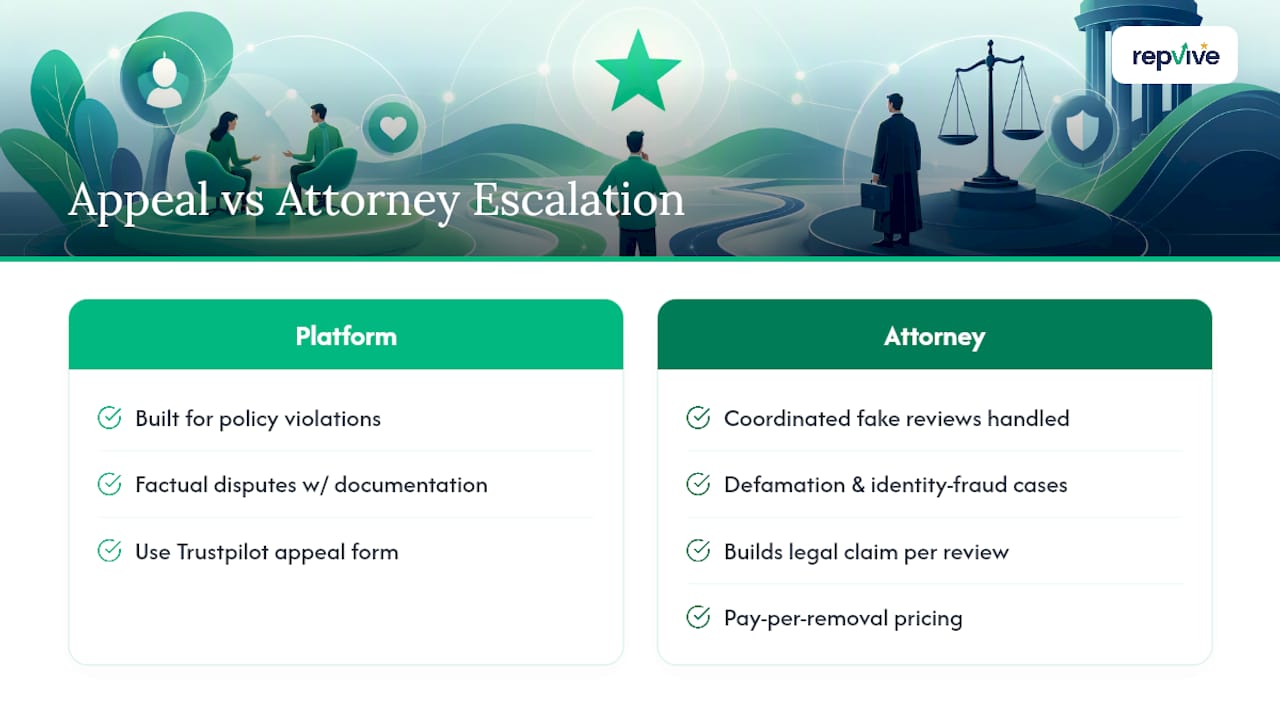
That’s the gap an attorney-led process like Repvive’s Trustpilot removal service is built to close. The approach centers on building a documented legal claim specific to the review in question, rather than resubmitting the same appeal with slightly different wording. It also comes with a pay-per-removal structure, so you’re not paying for effort, only for a result.
Before hiring anyone for this kind of work, ask direct questions: What’s their track record on this exact platform? Do they guarantee removal or just “best effort”? Is pricing tied to results or billed regardless of outcome? Vague answers to any of those should be a red flag, whoever you’re talking to.
Editorial Take: Stop Treating Every Bad Review Like a Legal Emergency
Most businesses either give up after one denied appeal or escalate to legal threats too early. Both instincts miss the point. Trustpilot’s appeal system rewards specificity, not urgency, and the research backs that up: vague objections lose, documented mismatches win.
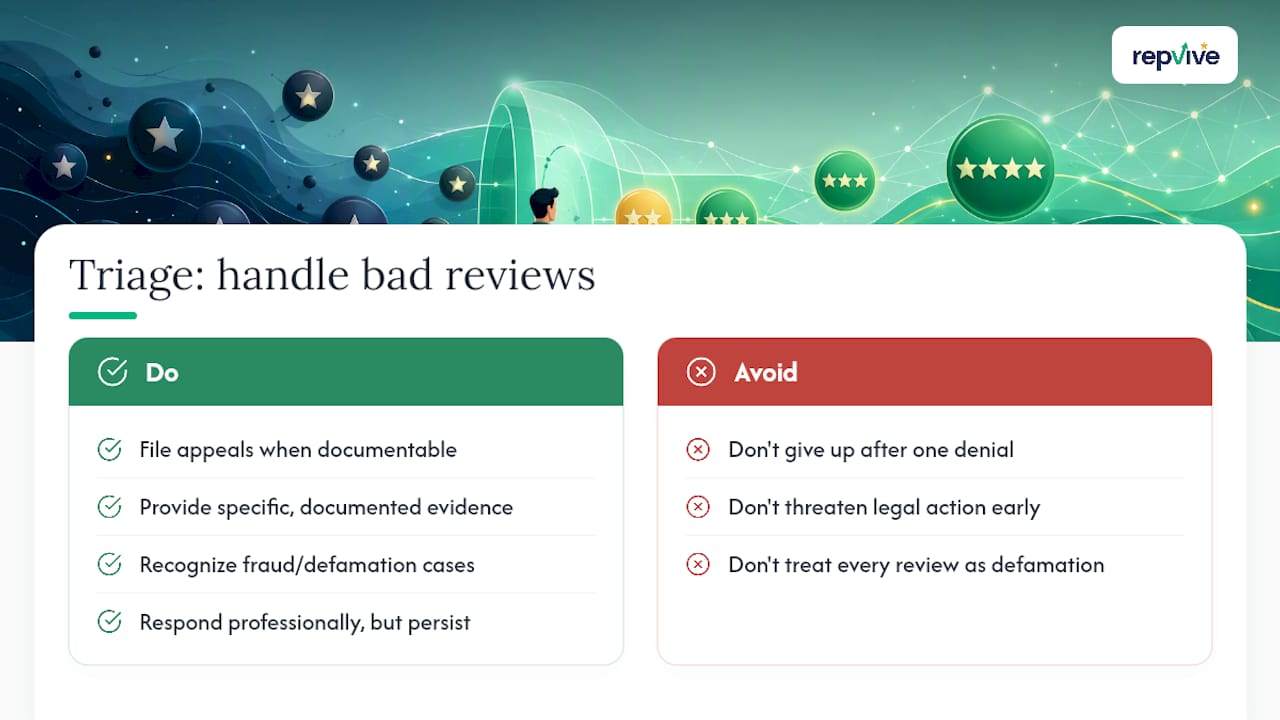
The conventional advice, “just respond professionally and move on,” undersells how much a clean, evidence-led appeal actually reverses. But the opposite advice, treating every negative review as defamation worth a lawyer, wastes resources on cases the platform’s own neutral review would likely fix for free.
The real skill business owners need is triage: file the appeal yourself when the facts are on your side and documentable, and recognize the moment a case has crossed into fraud or defamation territory that a platform form can’t reach. That second category is smaller than most business owners assume, but when it hits, waiting rarely helps.
— Jason
Get Attorney-Led Help When Appeals Reach Their Limit
Attorney-led services exist for the cases that outgrow a Trustpilot appeal form: patterns of fake reviews, identity fraud, or defamatory content that a policy dispute can’t resolve on its own.
Some attorney-led services run on a pay-per-removal model with no upfront cost, so you pay only after a review is actually taken down. Instead of resubmitting the same factual dispute, the legal team builds a customized claim for each flagged review and works through direct channels to get it approved for removal. That matters most once you’ve already tried the appeal route and hit a wall, or when you’re facing a reviewer who never transacted with your business at all and won’t respond to good-faith outreach. If you’re managing appeals across multiple platforms, not just Trustpilot, a monitoring tool that flags new reviews as they land can save you from finding out about a problem review weeks too late; a workflow tracker like this productivity resource can help keep your internal case files organized alongside it. Start by reviewing your case at Repvive to see whether your situation qualifies for removal.
Official Trustpilot Resources for Filing an Appeal
Three Trustpilot pages carry the actual rules behind everything in this guide. The Content Integrity Team appeal article explains the appeal link and one-appeal-per-decision limit directly. The Guidelines for Businesses page covers what counts as a valid flag and the three-day reviewer response window. The flagging reasons article lays out what triggers account restrictions for misuse. Bookmark all three before you file anything.
Sources
- How can I appeal a decision made by the Content Integrity Team?
- Guidelines for businesses
- Changes to flagged review emails
FAQ
How Can I Remove a Bad Review From Trustpilot?
You can request removal by proving the review breaches Trustpilot’s guidelines, such as being fake, misdirected, or not based on a genuine transaction, then submitting that evidence through the appeal link in your decision email. If the review reflects a real customer experience, Trustpilot generally will not remove it regardless of how negative it is.
Is Trustpilot Still Trustworthy for Consumers and Businesses?
Trustpilot remains widely used because it enforces content guidelines through both automated detection and human review, including a formal appeals process for contested decisions. Its neutral-stance policy on factual disputes is designed to keep the platform credible for shoppers, even when it frustrates businesses fighting a specific review.
How Do I Respond to a Bad Review on Trustpilot?
Reply publicly with a short, factual statement that addresses the specific complaint without threats or personal attacks, and invite the reviewer to continue the conversation privately. A calm, professional reply often improves how prospective customers view your business even while an appeal is pending.
How Do I Get Bad Reviews Removed if My Appeal Is Denied?
If a platform appeal fails and the review involves fraud, identity misuse, or defamatory claims, an attorney-led removal service like Repvive can pursue a documented legal claim rather than resubmitting the same dispute. That route makes the most sense when you have clear evidence the review doesn’t reflect a genuine transaction and Trustpilot’s neutral review process has already run its course.