Business Owners: One Star Review Removal, Exact Policy Steps
Business Owners: One Star Review Removal, Exact Policy Steps ! Decorative title card illustration A one-star review comes down to Google's content policies: if the review violates one of them, Google can remove it; if it's just an unhappy but real customer, it stays.

Business Owners: One Star Review Removal, Exact Policy Steps
A one-star review comes down to Google’s content policies: if the review violates one of them, Google can remove it; if it’s just an unhappy but real customer, it stays. Check the review against the policy categories below, flag it through your Business Profile with the right reason selected, and gather evidence while you wait. Google typically resolves clear violations in 2 to 14 days and if that first report fails, you still have an appeal and, for serious cases, legal options.
TL;DR:
- Only reviews that violate specific Google content policies, such as being fake, off-topic, or involving harassment, are eligible for removal, not genuine customer complaints.
- Effective reporting requires selecting the correct violation category and submitting evidence like invoices, timestamps, or reviewer profiles to strengthen your appeal.
- Public responses should be brief, calm, and fact-based, focusing on resolving issues privately rather than arguing with the reviewer publicly.
- Regularly monitoring reviews within 48 hours helps catch violations early and prevents stolen or edited reviews from impacting your reputation.
- Legal intervention is appropriate only in cases of impersonation, coordinated attacks, or extortion, with specialized services building formal claims through attorneys.
Table of Contents
- Which One Star Reviews Actually Qualify for Removal?
- How Do You Report and Appeal a One Star Review?
- What to Do When Google Won’t Remove the Review
- When an Attorney-Led Removal Makes Sense
- Removal vs. Disputing: Understanding the Difference
- Building a Habit of Monitoring Your Reviews
- How Your Public Response Affects Perception and Search Visibility
- Staying on the Right Side of the Law When Requesting Removal
- Alternatives to Removal Worth Trying First
- Do Reputation Management Tools Actually Move the Needle?
- Why Most Owners Chase the Wrong Fight
- Get Legal Help Removing Reviews That Are Hurting Your Business
- Where to Go Next
- Sources
- FAQ
Which One Star Reviews Actually Qualify for Removal?
Google doesn’t remove reviews because they’re unfair, harsh, or bad for business. It removes them because they break a specific rule. That distinction trips up almost every business owner who files a report and gets nowhere.
Google’s policy on inappropriate reviews breaks violations into a handful of concrete categories, and knowing which one applies changes how you write your report:
- Spam or fake engagement: the reviewer has no record of visiting or buying from you, often posted from a brand new account with no history.
- Off-topic content: the review complains about something unrelated to your business, like a political rant or a comment about a different location entirely.
- Conflict of interest: written by a current or former employee, a competitor, or someone with a personal grudge outside the transaction.
- Harassment or hate speech: threats, slurs, or content targeting a protected characteristic rather than describing an actual experience.
- Privacy violations: the review publishes someone’s private information, like a phone number or medical detail, without consent.
- Impersonation: posted under a fake name pretending to be a real customer or a real employee.
- Rating manipulation: part of a review-bombing wave, often with duplicate wording across multiple business listings.
Here’s the part that frustrates a lot of owners: a genuinely bad experience, described honestly by a real customer, is protected speech on Google’s platform. You can dislike it. You can’t remove it just because it’s one star.
What strengthens a removal case is a pattern. A reviewer who left identical one-star complaints on three competitor pages the same week. An account created the day before it posted. A name that doesn’t match anyone in your appointment book, POS system, or booking software. Repvive’s breakdown of common fake review warning signs walks through more of these red flags in detail.
How Do You Report and Appeal a One Star Review?
The reporting flow itself is short. The appeal, if you need one, is where most people fumble the language and lose a winnable case.
- Open the review in your Google Business Profile (or search your business name on Google Maps and find the review under your listing).
- Click the three-dot menu next to the review and select “Report review.”
- Choose the exact policy category it violates. Don’t pick “spam” if the real issue is conflict of interest. Mismatched categories get auto-rejected faster.
- Check status through the Reviews Management Tool in your Business Profile dashboard. Google will show whether it’s pending, denied, or removed.
- If denied, file the one-time appeal attached to that case, this time with evidence attached or referenced directly.
Most first-round reports get an automated denial. That’s normal, not a dead end. The appeal step is where a human actually reads the case, and it’s also where specificity wins. Quote the exact policy line Google published. State plainly that your records show no transaction, appointment, or interaction matching the reviewer’s name or timeframe. Reference invoice numbers, booking timestamps, or staff schedules rather than just asserting “this never happened.”
Keep the appeal short. A rambling defense of your business reads as emotional; a two-paragraph appeal citing a policy clause and a specific piece of evidence reads as credible.
Pro Tip: Screenshot the review the moment you see it, including the reviewer’s profile and post date. Reviews sometimes get edited or the account gets deleted before your case resolves, and you’ll want proof of exactly what it said.

What to Do When Google Won’t Remove the Review
Sometimes the review doesn’t fit any policy category. It’s just someone who had a rough visit and said so. Google isn’t going to touch it, and pushing harder rarely helps.
Your public response matters here more than the report ever did. Keep it brief and specific to the situation:
- Suspected fake reviewer: “We have no record of a visit or purchase matching this account. If you believe this was left in error, please contact us directly at [phone/email].”
- Real customer, valid complaint: “We’re sorry your experience didn’t meet expectations. We’d like to make this right, please reach out to [name/contact] directly.”
- Defamatory factual claims: “The claims in this review are inaccurate and don’t reflect our records. We’re happy to discuss this directly.”
None of these should argue with the reviewer publicly. Future customers read your response as much as the complaint itself.
Beyond the response, building review volume is the most durable fix. A steady flow of legitimate reviews through QR codes at checkout or a follow-up email after service dilutes the visibility and weight of one bad rating over time. Skip incentivized reviews entirely; Google can penalize accounts for that.
Legal escalation makes sense for defamation, coordinated attacks, or extortion attempts, not for garden-variety complaints. An attorney can send a formal legal removal request to Google or, in rarer cases, pursue small-claims action against a reviewer who published knowingly false statements.
One warning worth repeating: mass-reporting a review hoping volume forces removal, filing false DMCA claims, or hiring a gray-market “guaranteed removal” vendor can get your entire Business Profile suspended. The shortcut usually costs more than the review did.
When an Attorney-Led Removal Makes Sense
Some cases need more than a policy report, particularly defamation, impersonation, coordinated review-bombing, or outright extortion attempts where someone threatens a bad review unless paid off.
Repvive handles these cases through an attorney-led process: a licensed legal team builds a customized claim referencing the specific law or policy the review violates, then submits it through formal channels rather than the standard consumer-facing report form. Its RepBoost tool also helps businesses proactively collect new reviews to rebuild volume after a removal.
Before reaching out for a consult, gather:
- Invoices, receipts, or booking confirmations tied to the disputed timeframe
- Screenshots of the reviewer’s profile and any other reviews they’ve posted
- Employment records if the reviewer is a current or former employee
- Timestamps showing when the review appeared relative to any dispute or incident
Pro Tip: If you suspect review-bombing, save every duplicate review as it appears, not just one. Identical wording across five reviews in one afternoon is far more persuasive as a set than as a single complaint.
Removal vs. Disputing: Understanding the Difference
These two terms get used interchangeably, and that confusion sends a lot of business owners down the wrong path. Removal means the review disappears from Google entirely because it violated a policy. Disputing means you’re contesting the accuracy or fairness of a review that Google has already deemed compliant.
You can dispute all day, publicly and privately. It won’t make Google take the review down unless it also happens to fit a violation category. A one-star review from a real customer who genuinely had a bad experience isn’t going anywhere no matter how strongly you dispute the details in your response.
This is where a lot of frustration comes from: owners treat every negative review as a removal candidate when most of them are actually reputation-management situations. If the reviewer is real and the complaint is plausible, even if you think it’s exaggerated, your energy is better spent on a calm public reply and a long-term review-volume strategy than on repeated appeals that Google will keep denying.
The practical test is simple. Ask whether the review fits one of Google’s named policy categories, spam, off-topic, conflict of interest, harassment, privacy, impersonation, or manipulation. If yes, pursue removal through the report and appeal process. If no, shift entirely into response and mitigation mode. Trying to force removal on a review that doesn’t qualify wastes time and, worse, trains you to ignore complaints that might contain something worth fixing about your actual operations.
Building a Habit of Monitoring Your Reviews
Waiting until a one-star review has been sitting for three weeks makes removal harder, not easier. Evidence gets stale, reviewer accounts get deleted before you screenshot them, and the window for a fast policy match narrows.
Set up Google alerts or check your Business Profile dashboard on a fixed schedule, weekly at minimum for most small businesses, daily if you’re in a high-volume industry like restaurants or auto repair. The goal isn’t obsessive checking. It’s catching a violation-eligible review inside the first 48 hours, when the reviewer’s account is still active and the details are easy to verify against your own records.
Look for patterns across time, not just individual reviews. A sudden cluster of one-star ratings posted within hours of each other, especially with similar phrasing, is a strong signal of coordinated review-bombing rather than organic customer dissatisfaction. Track dates, reviewer names, and rating changes in a simple spreadsheet if your review platform doesn’t do it for you.
This habit pays off twice. First, it shortens your response time on genuine violations, which improves your odds with Google’s Reviews Management Tool since fresher cases tend to have cleaner supporting evidence. Second, it gives you an early warning system for legitimate service problems before they snowball into a wave of bad ratings. A single one-star review is a data point. A cluster is a signal that something in your operation needs attention regardless of whether any individual review gets removed.

How Your Public Response Affects Perception and Search Visibility
The way you reply to a one-star review does two jobs at once: it shapes what the next potential customer thinks, and it feeds Google’s ranking signals for your listing.
On the perception side, a calm, specific, non-defensive response often matters more to a browsing customer than the original complaint. People reading reviews expect some negative ones. What they’re actually evaluating is how the business handled it. A response that argues, deflects, or gets defensive confirms the reviewer’s complaint in the reader’s mind, even if the original review was exaggerated. A response that acknowledges the issue and offers a direct line to resolve it does the opposite.
On the search side, Google has said engagement signals, including how actively a business responds to reviews, factor into local ranking and profile quality. Responding consistently, not just to the negative ones, also keeps your profile looking active and maintained, which matters when Google is deciding which businesses to surface for local searches.
Keep every public response under three sentences where possible. Longer replies read as defensive even when the content is reasonable. State the fact, offer a private channel to resolve it, and stop. Never argue specifics in public, that’s what direct contact is for, and never confirm details about a customer’s visit, purchase, or personal situation in a public reply, since that itself can become a privacy violation on your end.
Staying on the Right Side of the Law When Requesting Removal
Pushing back on a bad review can cross into legal risk if you’re not careful, particularly if you’re the one initiating contact with a reviewer or threatening legal action publicly.
Never accuse a reviewer of lying in a public response unless you have documented proof. Calling someone a liar without evidence can itself expose you to a defamation counterclaim, flipping the entire situation against you. Stick to factual, verifiable statements: “our records show no appointment on this date” is safe; “this person is lying” is not.
If you’re pursuing a formal legal removal request or considering small-claims action, that process should go through an attorney, not a personal email to the reviewer. Direct contact demanding a review be taken down, especially if it references consequences, can be read as harassment or, in extortion-adjacent cases, expose you to counterclaims of coercion. Legal counsel knows how to frame a request that stays within the reviewer’s own rights while still asserting yours.
Document everything before you initiate any legal step: the original review text, timestamps, your business records contradicting the claim, and any prior communication with the reviewer. An attorney will need this to build a credible claim, and a thin paper trail is the most common reason legitimate defamation cases stall.
Alternatives to Removal Worth Trying First
Removal isn’t the only lever. For borderline cases, a direct conversation with the reviewer sometimes resolves things faster than any formal process.
If you can identify the reviewer, a polite private message asking them to reconsider or update their review, after you’ve actually addressed their complaint, works more often than owners expect. Google doesn’t let businesses pay or pressure someone into changing a rating, but a genuine resolution followed by a genuine request is fair game. Some reviewers will edit or delete a review once they feel heard.
Third-party mediation is another underused option, particularly for B2B disputes or service industries where a trade association, licensing board, or industry mediator can weigh in on a factual disagreement. This won’t touch the Google listing directly, but a documented resolution through a neutral party strengthens any future appeal if the review later gets flagged for containing false claims.
For reviews sitting in a gray area, not clearly policy-violating but not obviously fair either, a free eligibility checker tool can help you triage whether it’s worth the time to file a formal report at all before you invest hours writing an appeal that was never going to succeed.
Do Reputation Management Tools Actually Move the Needle?
Software alone won’t get a review removed, that still runs through Google’s policy and appeal system, but the right tools change how fast you catch problems and how consistently you respond to them.
Monitoring tools that alert you the moment a new review posts shrink your response window from days to hours, which matters both for gathering evidence while a fake reviewer’s account is still active and for getting a calm public reply up before the review sits unanswered and looks ignored. Review-generation tools that automate follow-up requests after a completed sale or service keep your review volume climbing steadily instead of arriving in random bursts, which is the single most reliable long-term buffer against the damage of any individual one-star rating.
Where these tools fall short is in anything requiring actual legal or policy judgment: deciding which category a violation fits, drafting appeal language that references specific policy clauses, or building a documented legal claim. That’s a different skill set, closer to case-building than software, and it’s the gap an attorney-led service is built to fill. The practical approach for most small businesses is layering both: automated monitoring and generation for the day-to-day volume, and a documented, evidence-based process, in-house or through a service like Repvive, for the reviews that actually need a formal claim.
Why Most Owners Chase the Wrong Fight
The instinct after a one-star review lands is to fight that specific review. Report it, appeal it, argue with it in the replies. That instinct is usually misdirected. The review itself is rarely the problem worth solving.
What actually protects a business long-term is a system: accurate reporting when a review genuinely violates policy, a calm and brief public response when it doesn’t, and a steady pipeline of real customer reviews that makes any single bad rating statistically irrelevant. Chasing every one-star with a formal dispute burns hours that would do more good building that pipeline.
Document everything as a habit, not a reaction. The businesses that win removal cases aren’t the ones who write the angriest appeals, they’re the ones who already had timestamps, invoices, and screenshots sitting in a folder before they even needed them.
— Jason
Get Legal Help Removing Reviews That Are Hurting Your Business
Not every bad review is worth a fight, but the ones involving impersonation, coordinated attacks, or outright extortion deserve more firepower than a standard policy report gives you. That’s the gap Repvive fills. Repvive’s attorneys build a customized legal claim for each case and submit it through formal channels rather than the same consumer report form every other business owner is using, and you pay nothing unless the removal actually goes through.
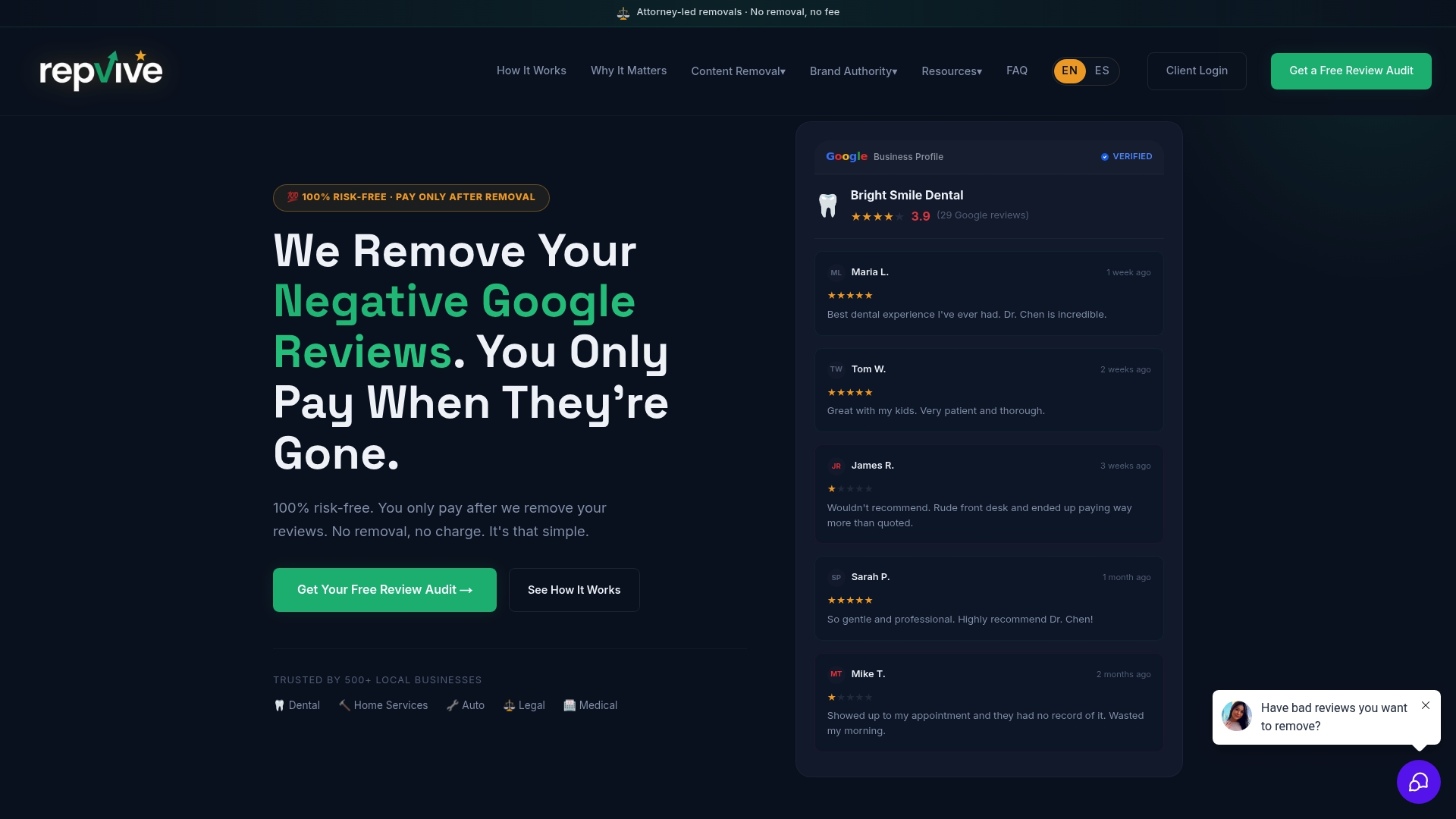
Reach out if you’re dealing with a fake reviewer with no transaction history, an employee posting under a false name, a coordinated review-bombing wave, or someone threatening a bad review unless you pay up. A first consult walks through your specific case, what evidence you already have, what you still need to gather, and whether it’s a strong candidate for a formal legal claim. Start by requesting a review audit through Repvive’s website and find out where your case actually stands.
Where to Go Next
Bookmark Google’s review reporting page and the eligibility checker tool for quick reference. Save screenshots and timestamps the moment you spot a suspicious review, before the account or content disappears.
Sources
- Report inappropriate reviews - Google Business Profile Help
- How to Remove Bad Reviews From Google My Business (2026)
- How to Remove Google Reviews From Your Business: The 2026 Guide
- Guide to reputation management — Neil Patel
FAQ
Can You Get Rid of a One Star Review?
Only if it violates one of Google’s specific content policies, like being fake, off-topic, or posted by someone with a conflict of interest. A genuine complaint from a real customer usually can’t be removed, only responded to.
Can You Delete a One Star Review on Google Yourself?
No. Businesses can’t delete reviews directly; only Google can remove a review after a policy violation is confirmed, or the reviewer can delete their own post.
Should You Respond to a One Star Review?
Yes, always. A brief, calm, factual public response protects your reputation with future customers even when Google won’t remove the review itself, and it can support local search visibility.
How Many Five Star Reviews Does It Take to Offset One One Star Review?
There’s no fixed number since Google’s rating is a weighted average, not a simple count, but building steady review volume over time is the most reliable way to shrink the visible impact of a single low rating.
When Should You Consider an Attorney for Review Removal?
Consider legal help for cases involving defamation, impersonation, coordinated review-bombing, or extortion, situations where a standard policy report is unlikely to be enough. Services like Repvive specialize in building these claims for eligible cases.