When to Hire a Review Removal Attorney: U.S. Vetting Checklist
When to Hire a Review Removal Attorney: U. S.
When to Hire a Review Removal Attorney: U.S. Vetting Checklist

Yes, but only in specific situations. A review removal attorney can secure removal when a review violates platform policy, contains provably false statements, or when unmasking and litigating against an anonymous reviewer forces a retraction. Google, Yelp, and similar platforms retain final say under Section 230 protections, so no lawyer can force a takedown by demand alone. Legal help makes sense for provable defamation, coordinated anonymous smear campaigns, extortion attempts, or cases where you have already exhausted platform escalation without results.
TL;DR:
- Platform reporting often resolves clear policy violations quickly and at no cost, but it fails if the review is factual or from a non-violating opinion.
- Legal options like subpoenas or defamation suits can unmask anonymous reviewers or remove false claims, but they are expensive, slow, and limited by platform protections.
- Most reviews are legally unremovable if they are honest opinions or non-factually false statements, making legal action unnecessary in many cases.
- Before escalating legally, gather evidence, flag the review, and consider dispute services or appeals, which can often resolve issues without legal costs.
- Publicly attacking reviewers risks drawing more attention, so discreet legal measures and private negotiations are usually the most effective and least damaging.
Table of Contents
- Your Options for Business Review Removal, Ranked by Leverage
- When Do You Actually Need a Negative Review Lawyer?
- What Cease-and-Desist Letters, Subpoenas, and Lawsuits Actually Do
- Practical Steps to Try Before Calling a Lawyer
- What Legal Help for Reviews Actually Costs and How Long It Takes
- How to Choose a Review Removal Attorney
- Mediation and Arbitration Before You File a Lawsuit
- Protecting Your Reputation After a Review Comes Down
- How Repvive Approaches Attorney-Led Review Removal
- Discretion Beats a Public Fight, Every Time
- Sources
- FAQ
Your Options for Business Review Removal, Ranked by Leverage
Most business owners start in the wrong place. They call a lawyer before trying the free tools that solve a surprising number of cases on their own.
- Platform reporting is step one for a reason. Google’s Business Profile support explains that flagging a review triggers a policy review, and businesses get a one-time appeal through the Reviews Management Tool if that first flag gets rejected. It costs nothing and works well for reviews that clearly break the rules, like ones from someone who never used your business.
Pay-per-result removal services sit in the middle. These firms build a policy-based case, gather evidence, and file the escalation for you. They charge only when a review comes down, and they do not have some private channel into Google’s systems. They simply know which policy language applies and how to present it cleanly.
Attorney-led routes are the heaviest tool. A lawyer can send a cease-and-desist, subpoena an anonymous reviewer’s identity, or file a defamation lawsuit. This is where real legal leverage comes from because you are dealing with the reviewer, not just the platform.
- Platform reporting: free, self-service, works only for clear policy violations
- Pay-per-result services: no upfront cost, handles evidence and escalation for you
- Attorney-led legal routes: costs money, but creates enforceable consequences
One warning before you escalate anything publicly: aggressive public pushback against a reviewer often backfires. This is sometimes called the Streisand effect, where trying to suppress something draws more attention to it. A quiet, evidence-based legal process almost always beats a public fight.
When Do You Actually Need a Negative Review Lawyer?
Not every one-star review needs a lawyer. Most don’t. The trick is telling the difference between a review you dislike and one that is legally actionable.
Start with this distinction: opinion is protected, false statements of fact are not. “Worst service I’ve ever had” is opinion, however unfair it feels. “This contractor stole $4,000 from me and never finished the job” is a factual claim you can potentially disprove, and that’s where defamation law applies.
A few situations consistently justify legal help over DIY attempts:
- A review makes specific, checkable false claims (wrong dates, fabricated transactions, claims you were never a customer)
- Multiple anonymous accounts post coordinated negative content that looks like an organized attack
- Someone threatens a bad review unless you pay them or give a refund they aren’t owed
- A former employee or competitor is impersonating a customer to damage you
- The review has caused measurable financial harm, like lost contracts or a documented revenue drop
Pro Tip: Screenshot everything the moment you see a suspicious review, including the reviewer’s profile and posting history. Reviews get edited or deleted before you can prove what they originally said, and that history often matters in a legal case.
If none of those apply and the review is just a harsh but honest opinion, save your money. No attorney can remove a review simply because it hurts your feelings or your rating average.
What Cease-and-Desist Letters, Subpoenas, and Lawsuits Actually Do
Each legal tool solves a different problem, and understanding what each one can realistically deliver keeps expectations grounded.
- Cease-and-desist letters. A lawyer identifies the reviewer (when possible) and sends a formal letter demanding retraction, citing the false statements and potential legal exposure. These are relatively inexpensive and often prompt voluntary removal, especially when the reviewer is identifiable and doesn’t want a legal fight.
- John Doe subpoenas. When the reviewer is anonymous, an attorney petitions a court to compel the platform to disclose account details, IP addresses, or registration data. Courts generally require a prima facie showing that the review is defamatory before approving this, and platforms comply with valid court orders even though they won’t hand over data on request alone.
- Defamation litigation. This requires proving the statement was false, presented as fact, damaging to your reputation, and made without adequate care for the truth. It’s the slowest, most expensive option, reserved for serious or repeated harm.
Here’s the part most people miss: Section 230 of the Communications Decency Act generally shields platforms from liability for what users post, so you typically cannot sue Google or Yelp directly for hosting a bad review. Legal pressure has to target the reviewer, not the platform. A court order against the author, once obtained, is what eventually gets content removed or forces a settlement.
Many review removal cases resolve without ever reaching a courtroom. Once a subpoena unmasks the author, the reviewer frequently retracts or settles rather than face a defamation claim once their identity and exposure become real.
Practical Steps to Try Before Calling a Lawyer
Before you spend a dollar on legal fees, run through this sequence. It resolves a meaningful share of bad-review problems on its own.
- Match the review to a specific policy violation. Google’s guidelines cover conflicts of interest, off-topic content, harassment, and fake engagement. A vague “this is unfair” complaint gets rejected; citing the exact policy language that was broken gets read.
- Collect proof. Pull booking records, invoices, appointment logs, and any messages that show whether the reviewer was actually a customer.
- Flag it through the correct channel. Use your verified Business Profile to flag the review, then file the one-time appeal if the first flag fails.
- Escalate with new evidence, not repetition. If you appeal again, add something you didn’t include before. Filing the identical complaint repeatedly rarely changes the outcome and can flag your account for excessive reporting.
- Consider a pay-per-result review dispute service if the DIY process stalls. These services are worth trying before litigation when the review is a clear policy violation but your appeals aren’t landing.
What Legal Help for Reviews Actually Costs and How Long It Takes
Set your expectations by route, because the gap between a quick flag and a lawsuit is enormous.
- Platform flag or appeal: days to a few weeks, no cost, works only for clear violations
- Pay-per-result services: typically weeks, fee charged only on successful removal
- Subpoena and unmasking: roughly 30 to 90 days and commonly $3,000 to $10,000 or more, depending on court backlog and platform cooperation
- Full litigation: several months to over a year, with costs ranging widely based on complexity and whether it settles early
Cease-and-desist letters remain the cheapest legal lever, often running a few hundred to a couple thousand dollars with a real chance of voluntary compliance. That’s usually the first call an attorney makes before recommending anything more expensive.
How to Choose a Review Removal Attorney
Not every attorney who advertises reputation work has done a John Doe subpoena or handled a platform escalation. Ask specific questions before signing anything.
- Have you filed subpoenas to unmask anonymous reviewers, and how many have you handled?
- What’s your fee structure: flat fee, hourly, or pay-for-results, and what triggers billing?
- What’s your realistic timeline for my specific situation, not a generic estimate?
- How do you handle confidentiality if litigation becomes public record?
- Can you walk me through a comparable case type and its general outcome?
Pro Tip: Be wary of any online reputation attorney who guarantees removal before reviewing your case. Legitimate lawyers investigate the review’s content, your evidence, and platform policy fit before promising anything, because platforms retain final discretion no matter what legal pressure exists.
Red flags include upfront retainer demands with no clear scope, vague answers about past case outcomes, and promises that skip past Section 230’s real limits.
Mediation and Arbitration Before You File a Lawsuit
Litigation isn’t the only path once you’ve identified who posted a false review. Mediation and arbitration offer a faster, cheaper middle ground worth considering before a formal lawsuit.
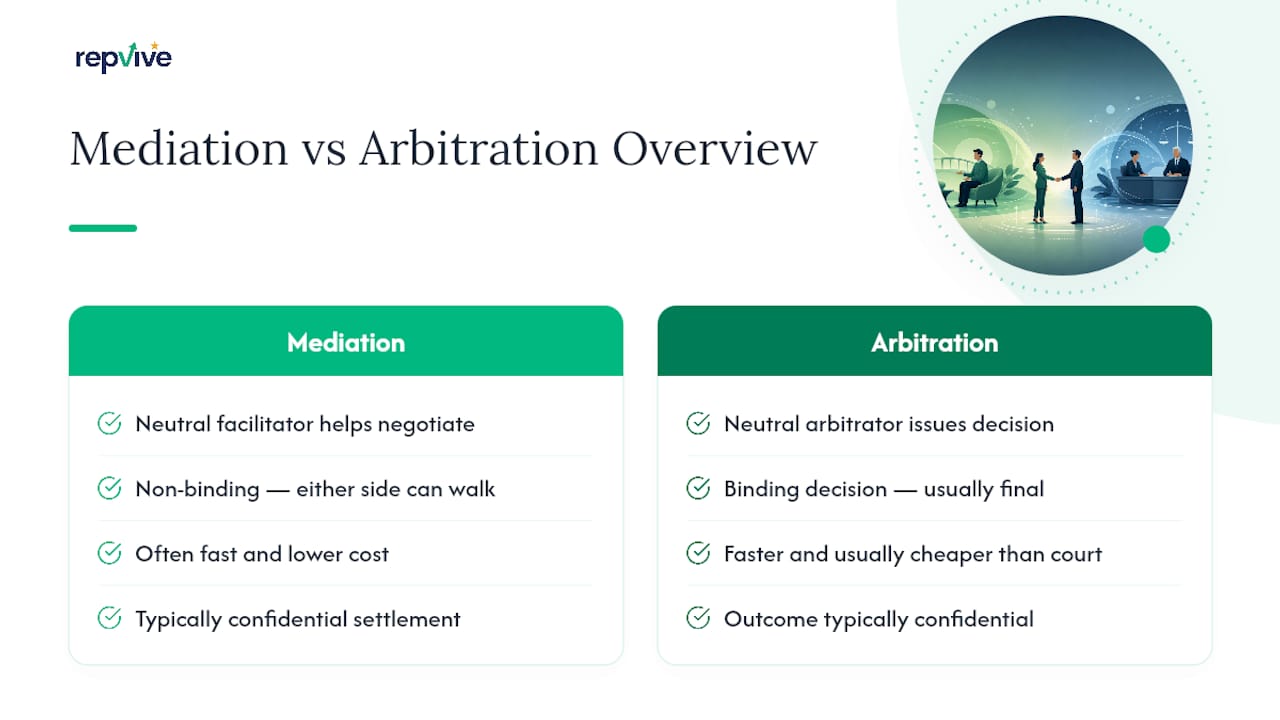
Mediation puts you and the reviewer in a room, virtual or otherwise, with a neutral third party who helps negotiate a resolution. It’s non-binding, meaning either side can walk away, but it’s often where an attorney pushes hard once a subpoena has revealed a reviewer’s identity. Many disgruntled customers or former employees back down once they understand the legal exposure and get a chance to save face through a private settlement instead of a public court record.
Arbitration is more formal. Both parties agree to let a neutral arbitrator make a binding decision, skipping the courtroom entirely. It’s faster than litigation and usually cheaper, though you give up the right to appeal in most cases. Some review platforms and business contracts already include arbitration clauses that apply if a dispute involves a business relationship gone wrong, like a contractor or client conflict that turned into a retaliatory review.
The appeal of both options is speed and privacy. A defamation lawsuit becomes part of the public record, which means the underlying dispute (and the original accusation) can resurface in search results years later. A mediated settlement or arbitration outcome typically stays confidential, letting you resolve the matter and move on without creating a permanent paper trail that’s arguably worse than the original review.
Most attorneys who handle review disputes will raise this option once identity is established, particularly when the financial stakes don’t justify a drawn-out court fight.
Protecting Your Reputation After a Review Comes Down
Getting a review removed solves the immediate problem, but it doesn’t repair the dent it left while it was live. Smart business owners treat removal as step one, not the finish line.
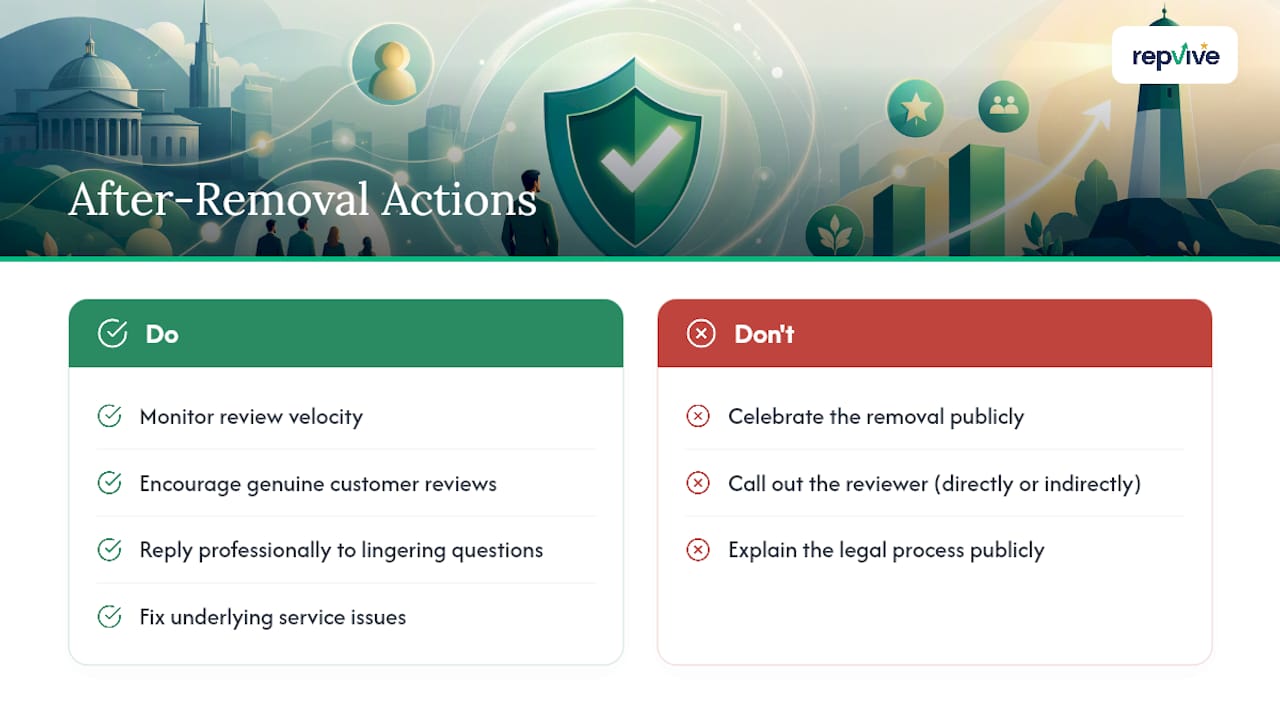
Check your review velocity in the weeks after removal. A sudden gap where a negative review used to sit can look suspicious to sharp-eyed customers who noticed it before, so keep encouraging genuine reviews from real customers to refresh your public profile naturally. This also dilutes the statistical weight of any future negative review that slips through.
Resist the urge to publicly celebrate a removal or call out the reviewer, even indirectly. That kind of post reads as vindictive and can reignite attention on a conflict your customers had already forgotten. Quiet is almost always better than a victory lap.
If the review generated any local buzz, whether through social media shares or word of mouth, a short, professional response to any lingering questions helps more than silence. You don’t need to explain the legal process. A simple statement that the matter was resolved and you remain committed to customer satisfaction covers it.
Finally, use what you learned. If the review stemmed from a real service gap, even a partially exaggerated one, fix the underlying issue. The best reputation defense isn’t legal, it’s operational: fewer legitimate complaints means fewer opportunities for someone to exaggerate one into something damaging.
How Repvive Approaches Attorney-Led Review Removal
Some attorney-led services skip the guesswork most business owners face when a bad review shows up: no upfront fees, no retainer, and payment only after a review is actually removed. The legal team builds customized claims for each review, based on specific platform policies or false statements, then pushes those claims through direct legal channels rather than generic mass-reporting templates.
The service covers multiple platforms, which matters if negative reviews aren’t confined to one site. If your reputation problem extends beyond reviews into search results themselves, Repvive also offers search deindexing and link suppression for content that’s harder to pin to a single platform’s report button.
If you’re dealing with a review that’s clearly false, policy-violating, or posted by someone with an axe to grind, start with a free evaluation of your case to see whether it qualifies for attorney-led removal before you spend money elsewhere.
Discretion Beats a Public Fight, Every Time
The instinct to fire back publicly at a bad review is understandable and almost always the wrong move. A defensive comment thread or a public callout of the reviewer tends to draw more eyes to the accusation, not fewer, and it rarely reads well to the neutral customers watching from the sidelines.
The attorneys and firms that get results in this space share one habit: they work the problem quietly. A cease-and-desist letter, a subpoena, a policy-based escalation, none of that requires a public statement or a defensive post. It solves the root cause (a false or policy-violating review) without turning a single bad review into a bigger story about how your business handled criticism.
That’s the trade-off worth understanding before you do anything: the fastest path to reputational damage is often not the original review, it’s the response to it.
— Jason
Sources
- Report a policy-violating review – Business Profile Help
- How to Get Google Reviews Removed: What Actually Works in 2026
This article is general information, not a substitute for advice from a qualified lawyer. Consult a qualified legal professional about your own circumstances before acting on anything here.
FAQ
Is It Legal to Remove Bad Reviews?
Yes, when the removal happens through legitimate channels: platform policy reporting, a negotiated retraction, or a court order tied to proven defamation. It becomes illegal, or at least legally risky, when a business fakes reviews, pays someone to remove honest negative feedback improperly, or threatens a reviewer outside a proper legal process.
How Do I Get a Bad Review Removed?
Start by flagging it through your platform’s reporting tool and citing the specific policy it violates, then use the one-time appeal option if the first attempt fails. If the review contains false factual claims and platform reporting doesn’t work, a review removal attorney can send a cease-and-desist or pursue a subpoena to unmask an anonymous reviewer.
Can You Sue for a Bad Review?
You can sue the reviewer for defamation if the review contains false statements of fact, not protected opinion, that caused measurable harm. You generally cannot sue the platform itself, since Section 230 shields companies like Google and Yelp from liability for user-posted content.
How Much Do Lawyers Charge for Cancellation or Removal of a Review?
Cease-and-desist letters typically run a few hundred to a couple thousand dollars and often succeed on their own. Unmasking an anonymous reviewer through a subpoena commonly costs $3,000 to $10,000 or more and takes roughly 30 to 90 days, while full litigation can run into the tens of thousands depending on complexity.