U.S. Owners: Remove Nextdoor Recommendations, Pay Only After Removal
You cannot delete another user’s Nextdoor recommendation yourself. Only the author can edit or remove it through their own three-dot menu. That said, you have real options: report guideline violations, message the author directly, respond publicly, preserve evidence, and escalate to an attorney-led service if the post is defamatory. Nextdoor typically reviews reports within a few business days, but subjective negative feedback that doesn’t break the rules usually stays up.
TL;DR:
- Recommendations on Nextdoor cannot be deleted by businesses; only the original author has that ability through their post menu.
- Reporting guideline violations requires detailed evidence, including screenshots, timestamps, and prior communication attempts, which should be preserved before any action.
- Most guideline violations are limited to false statements of fact, threats, or harassment, while honest negative feedback usually remains visible after review.
- Private messaging and polite public replies that acknowledge concerns and offer solutions often prompt authors to remove or edit problematic recommendations.
- Escalation to a legal or attorney-led removal service is appropriate only for demonstrably false claims, threats, or harassment that cannot be resolved through reporting or outreach.
Table of Contents
- How to Remove a Nextdoor Recommendation: Immediate Steps
- How Do You Report a Recommendation to Nextdoor?
- How Do You Ask the Author to Edit or Delete a Recommendation?
- Should You Respond Publicly on Nextdoor?
- Where Do Recommendations Show Up, and Does It Matter?
- When Should You Escalate to Legal or Attorney-Led Removal?
- What Owners Get Wrong When a Bad Recommendation Hits
- Get Help Removing a Nextdoor Recommendation That Crosses the Line
- Sources
- FAQ
How to Remove a Nextdoor Recommendation: Immediate Steps
Before you do anything else, lock down the evidence. Recommendations sometimes disappear or get edited once an author realizes you’ve noticed, and you want a record either way.
- Screenshot everything. Capture the full recommendation, the author’s profile, timestamps, and the exact URL. A cropped screenshot without a date is close to worthless if you need it later.
- Pull your own records. Match the post against service tickets, invoices, appointment logs, or payment history tied to that customer or interaction.
- Find where it lives. Check whether it’s sitting on your business page’s “What neighbors say” tab or surfaced as a tagged mention buried in someone else’s post. Visibility changes your urgency.
- Report it to Nextdoor. File a report with your evidence attached and save the confirmation or report ID for your files.
- Message the author privately. A short, polite ask for a correction or deletion often works faster than waiting on a platform review.
- Start mitigation now, not later. Ask a couple of recent happy customers for recommendations while you’re working the rest of this list.
How Do You Report a Recommendation to Nextdoor?
Nextdoor removes content for guideline violations, not for being unflattering. Name-calling, personal attacks, and false statements of fact can qualify under the platform’s Community Guidelines. A customer saying your contractor showed up two hours late and did sloppy tile work, even if it stings, is a factual account and generally stays up.
To file the report, open the post’s three-dot menu, select the flag or report option, and choose the violation category that actually matches the content. Vague reports get deprioritized.
Include with your report:
- Annotated screenshots showing the specific language that violates guidelines
- The direct link or post identifier
- A short timeline of what happened, in plain chronological order
- Any prior message you sent the author trying to resolve things
Nextdoor generally reviews flagged content within a few business days, though volume and category can stretch that. If your report gets rejected, it’s usually because the post, however unpleasant, doesn’t cross the line into name-calling or false claims.
How Do You Ask the Author to Edit or Delete a Recommendation?
Direct outreach works more often than owners expect, mostly because most people who post a bad recommendation aren’t trying to destroy your business. They’re venting about one bad experience. Approach them like you’d want to be approached.
- Send a private message first. Public confrontation invites an audience; a direct message doesn’t.
- Stay short and specific. Reference the exact issue, not their character.
- Offer a real fix. A refund, a redo, a comped visit, whatever’s appropriate, gives them a reason to reconsider.
- Follow up once, politely, after 48 to 72 hours. If there’s no response after that, stop. Repeated messages read as pressure.
Template A (private message): “Hi [Name], I saw your Nextdoor post about [issue]. I’d like to make this right. Would you be open to [specific remedy]? If we can resolve it, I’d appreciate you updating or removing the post.”
Template B (public reply): “Thanks for flagging this, [Name]. I’d like to sort it out. Can you message me directly so I can make it right?”
Pro Tip: Document every outreach attempt with a timestamp, even the ones that go nowhere. If you escalate later, showing you tried to resolve this in good faith carries real weight, both with Nextdoor and with an attorney.

Should You Respond Publicly on Nextdoor?
Yes, in most cases, and the structure matters more than the wording. A good public reply does three things: acknowledges the experience, offers a concrete next step, and moves the conversation offline.
- Acknowledge without conceding fault you don’t owe: “I’m sorry this didn’t go the way you expected.”
- Offer a fix: “I’d like to look into what happened and make it right.”
- Invite offline contact: “Please message me directly so we can sort this out.”
Example for a service complaint: “Sorry to hear this, [Name]. That’s not the experience we aim for. Please send me a message so I can look into it and make it right.”
Example for a billing dispute: “I want to get to the bottom of this charge with you. Can you message me your invoice number so I can review it directly?”
A calm, specific reply reads well to the neutral neighbors watching the thread, and constructive public engagement sometimes prompts the author to soften or delete the post themselves. Stop replying publicly the moment the exchange turns into a back-and-forth argument. At that point you’re feeding the post’s visibility, not resolving anything.
Where Do Recommendations Show Up, and Does It Matter?
Not every negative post carries the same weight, so triage before you spend hours on something barely anyone will see.
- Business page mentions. Recommendations under your “What neighbors say” tab are the most visible and most worth your immediate effort.
- Tagged mentions elsewhere. A complaint buried inside someone else’s unrelated post reaches a smaller, more incidental audience.
- Check the author’s audience setting. Nextdoor lets users choose whether their posts reach only their immediate neighborhood or anyone on the platform, which changes how far a complaint actually travels.
- Prioritize accordingly. A neighborhood-only post from someone with 40 connections deserves a lighter touch than a platform-wide recommendation sitting on your business page.
When Should You Escalate to Legal or Attorney-Led Removal?
Most negative recommendations, however frustrating, are opinion and don’t meet a legal bar. Escalation makes sense for a narrower set of cases: demonstrably false statements of fact, threats, doxxing, or a coordinated pile-on that looks organized rather than organic.
Before contacting anyone, assemble:
- Preserved screenshots with visible timestamps
- The author’s username or profile link
- Transaction or service records that contradict the false claim
- Any prior messages you exchanged trying to resolve it
Clear, documented evidence and calm outreach increase the odds of a successful outcome, whether that’s a platform report or a formal legal request. Attorneys reviewing these cases need the same paper trail you’d already want for your own files.
A U.S. attorney-led service like Repvive builds a formal claim tailored to the specific violation and works direct platform channels, typically billing per removal rather than charging a large fee upfront. It won’t touch an honest, if harsh, opinion. But for content that crosses into false factual claims or harassment, it’s a real path when direct outreach and reporting stall out.
What Owners Get Wrong When a Bad Recommendation Hits
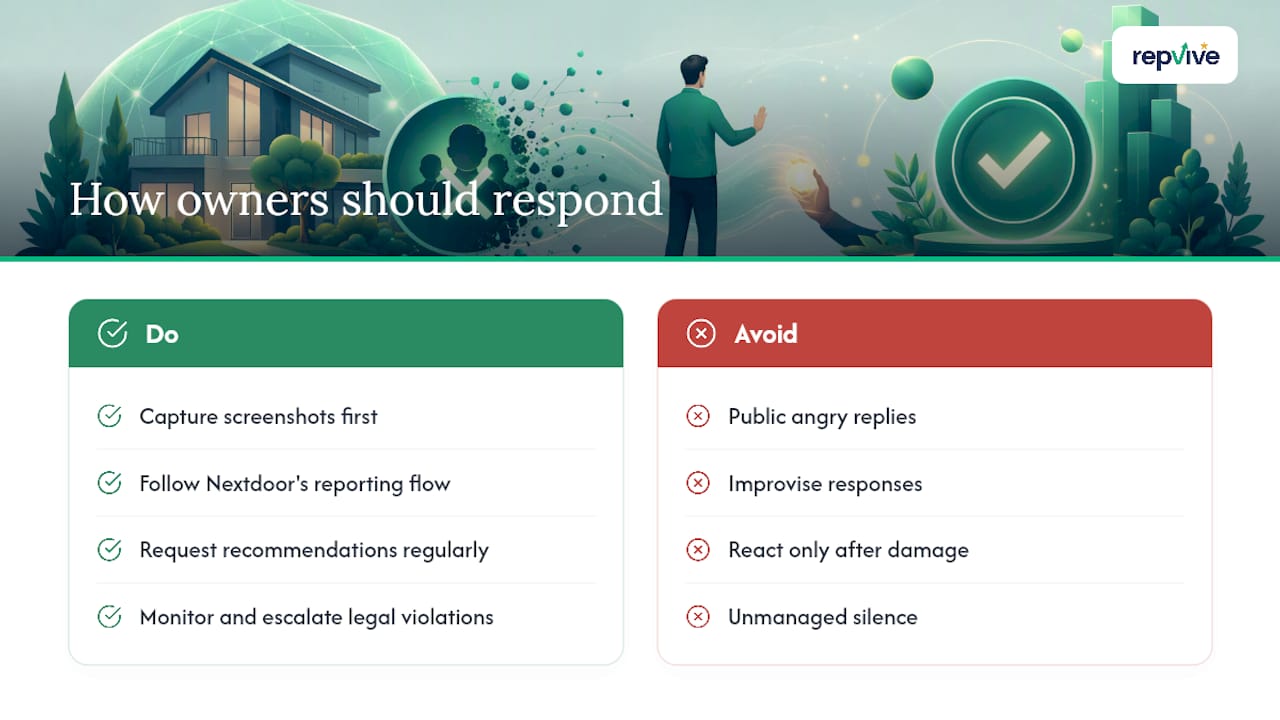
The biggest mistake isn’t the recommendation itself. It’s the reaction. Owners fire off an angry public reply within minutes, before they’ve screenshotted anything, and that reply becomes its own liability.
The fix is almost boring in its simplicity: capture evidence first, follow Nextdoor’s reporting flow exactly as written rather than improvising, and ask your best customers for recommendations on a regular cadence , not just when you’re in crisis mode. Firms that pair ongoing monitoring with legal escalation for genuine violations get more reliable removals than owners who only react after the damage is visible. A single bad post rarely sinks a business. A pattern of unmanaged silence does.
— Jason
Get Help Removing a Nextdoor Recommendation That Crosses the Line
An option for local businesses when direct outreach and platform reporting have gone as far as they can go is to use an attorney-led service that builds a customized legal claim for each removal and works direct channels with the platform, with payment only after a removal is confirmed. There is no upfront fee or retainer paid while waiting.
Before reaching out, gather your screenshots, the author’s profile link, service or transaction records, and any messages you already sent trying to resolve things. That packet is what turns a vague complaint into a defensible claim. If a Nextdoor recommendation includes false factual statements or harassment rather than an honest bad review, start with Repvive’s review removal service and get a sense of whether your case qualifies.
Sources
- About-Recommendations (Nextdoor help)
- How to manage your online reputation (Nextdoor business blog)
- Nextdoor: Here’s How to Change Who Can See Your Recommendations (Adweek)
FAQ
Can a business delete a Nextdoor recommendation?
No. Only the person who wrote the recommendation can edit or delete their own post using the three-dot menu on their post.
How long does Nextdoor take to review a reported recommendation?
Nextdoor generally reviews flagged content within a few business days, though the exact timeline varies with report volume and category.
What kind of recommendation qualifies for removal?
Content that violates Community Guidelines, such as name-calling, personal attacks, or false statements of fact, qualifies for review. A negative but honest account of a real experience typically does not.
Can an author remove just the “recommendation” label and keep the text?
Yes. Nextdoor lets authors remove the recommendation label while leaving the underlying post visible, which is worth checking before you assume a removal fully resolved the issue.
When should I contact an attorney-led removal service like Repvive?
Escalate when the post contains demonstrably false factual claims, threats, or harassment rather than a subjective opinion; Repvive builds a tailored legal claim for cases that meet that bar and bills only after a confirmed removal.