Small Business Fix: Reply in 48 Hours to One Star Reviews With No Comment
Small Business Fix: Reply in 48 Hours to One Star Reviews With No Comment ! Decorative title card for review response article Reply publicly within 48 hours with a short, calm message that invites the reviewer to reach out privately.
Small Business Fix: Reply in 48 Hours to One Star Reviews With No Comment
Reply publicly within 48 hours with a short, calm message that invites the reviewer to reach out privately. Then check whether the rating breaks platform rules and, if not, start collecting evidence while you shore up your review pipeline. If the rating looks like part of a coordinated attack, gather proof and escalate through platform moderation or a specialized removal service.
TL;DR:
- Most blank one-star ratings come from automated prompts or voice assistants, making them nearly impossible to dispute if they follow platform policies.
- Public responses should be brief, calm, and invite offline contact with no apologies or accusations; timing within 24 to 48 hours is critical.
- Low-profile or suspicious reviewers often have new accounts or show patterns like multiple ratings in a short period, signaling potential malicious intent.
- Platforms like Google rarely remove star-only reviews unless policy violations are proven, while Amazon’s removal process is often less favorable for sellers.
- Building a solid case involves collecting screenshots, timestamps, transaction logs, and a clear summary before escalating or seeking professional removal services.
Table of Contents
- How Do You Respond to a One Star Review No Comment?
- Is the One-Star Rating Fake, Accidental, or Targeted?
- Can You Get a Star-Only Review Removed From Google or Amazon?
- When Should You Bring in a Lawyer or Removal Service?
- How Do You Prevent and Recover From Blank One-Star Ratings?
- What Evidence Should You Collect Before Reporting a Review?
- When to Stop Chasing a Bad Rating and Focus on Growth
- How Repvive Handles Reviews Platforms Won’t Remove
- Where to Read More on Reporting and Legal Options
- Sources
- FAQ
How Do You Respond to a One Star Review No Comment?
The strongest public replies follow the same three-line shape: acknowledge the rating, invite the person into a private channel, sign off with your name or title. That’s it. No apology for something you can’t verify, no guesswork about what went wrong, no defensiveness.
Here’s why the structure matters more than the wording. A blank one-star rating carries no evidence, but it still shapes how future customers read your profile. A short, calm public reply that invites offline contact tends to neutralize a blank one-star rating because readers judge your business by how you handled it, not by the empty complaint itself. Silence reads as guilt. A composed reply reads as confidence.
Templates that work across most situations:
- Unknown customer: “We take all feedback seriously and would like to understand what happened. Please reach out to us at [email/phone] so we can make this right.”
- Likely mistaken identity: “We couldn’t locate an order matching this review. If you’d contact us directly at [email/phone], we’d like to sort this out.”
- Healthcare or sensitive-industry setting: “We’re sorry to see this rating. Patient privacy prevents us from discussing details publicly, but please call our office directly so we can address your concerns.”
- Product listing rating (no review text): “We noticed a low rating without details. If something arrived damaged or didn’t meet expectations, contact our support team and we’ll fix it.”
Timing matters almost as much as tone. Reply within 24 to 48 hours. Waiting a week signals indifference, and replying within the first hour while you’re still frustrated tends to produce a reply that sounds defensive instead of composed.
Avoid three things every time: don’t apologize for a specific incident you can’t confirm happened, don’t name competitors or suggest the reviewer left the wrong business, and don’t accuse the reviewer of lying in the public thread even if you strongly suspect it. Save that argument for your report to the platform, not your public response.
Pro Tip: Keep a saved document with five or six reply variations ready to go. When a blank one-star lands on a Friday night, you want to post something composed in minutes, not draft one from scratch while annoyed.
Is the One-Star Rating Fake, Accidental, or Targeted?
Before you spend an hour drafting a report, spend five minutes figuring out what you’re actually dealing with. Most blank one-star ratings fall into one of three buckets, and each one calls for a different response.
- Check the reviewer’s profile. A brand-new account with no profile photo, a generic username, and zero other reviews is a mild red flag on its own. It’s not proof of anything, but it shifts the odds toward accidental or malicious rather than a genuine unhappy customer who just skipped the text field.
- Look at timing and clustering. One blank one-star showing up on a quiet Tuesday is normal business noise. Several hitting your profile within hours of each other, or the same pattern showing up across your listings on multiple platforms, is a different story entirely.
- Understand the platform mechanics behind rating-only entries. Plenty of blank ratings aren’t suspicious at all. They come from one-tap prompts triggered by mobile nudges or voice assistants, where a customer taps a star rating without ever opening a text box. These are technically verified purchases, which makes them nearly impossible to dispute on legitimacy grounds.
- Run your internal checks. Search your booking system or order history around the timestamp on the rating. Cross-reference staff logs if you run a service business. If nothing lines up with a real transaction on that date, you have a stronger case that the rating is misdirected or fabricated.
The goal isn’t to prove malice. It’s to decide, in ten minutes or less, whether this is worth a platform report, worth watching for a pattern, or worth simply letting your reply stand and moving on.
Can You Get a Star-Only Review Removed From Google or Amazon?
Platforms allow star-only ratings on purpose. Google, Amazon, and most review sites treat a rating without text as a valid customer opinion, not a policy violation by default. That’s the uncomfortable truth most business owners run into the first time they try to report one.
Google permits star-only ratings, and removal only happens when the review breaks a specific content policy such as being posted by someone with no connection to your business, containing harassment, or coming from a competitor with a conflict of interest. The absence of a comment, by itself, is not grounds for removal.
To report a rating on your Google Business Profile:
- Open the review in your Business Profile dashboard and select “Flag as inappropriate.”
- Choose the policy category that fits (spam, conflict of interest, off-topic content).
- Attach whatever evidence supports your claim, screenshots of your order system, a note about the reviewer having no account with you, timestamps that don’t match any visit.
- Expect a review cycle that can take anywhere from a few days to several weeks, and expect a denial if you can’t point to an actual policy breach.
Amazon works differently and, frankly, less favorably for sellers. Rating-only entries are hard to remove because standard reporting flows often require an order ID, and a blank rating frequently doesn’t carry one in a form you can search. Sellers in Amazon’s forums describe submitting cases only to get an automated response saying the rating doesn’t qualify for removal because no policy was violated.
When you do escalate, package your case tightly: one paragraph of context, your evidence attached in order, and a direct citation of the specific policy you believe was broken. Vague complaints about unfairness get ignored. Specific, documented policy violations get a second look.
When Should You Bring in a Lawyer or Removal Service?
Suing over a blank one-star rating almost never works, and it’s worth understanding why before you spend money on a consultation. Defamation claims require a false statement of fact, and a star rating with no text makes no factual claim to dispute. There’s nothing to prove false. Courts have consistently found this bar difficult to clear for opinion-only content, and a bare star rating is about as close to pure opinion as online feedback gets.
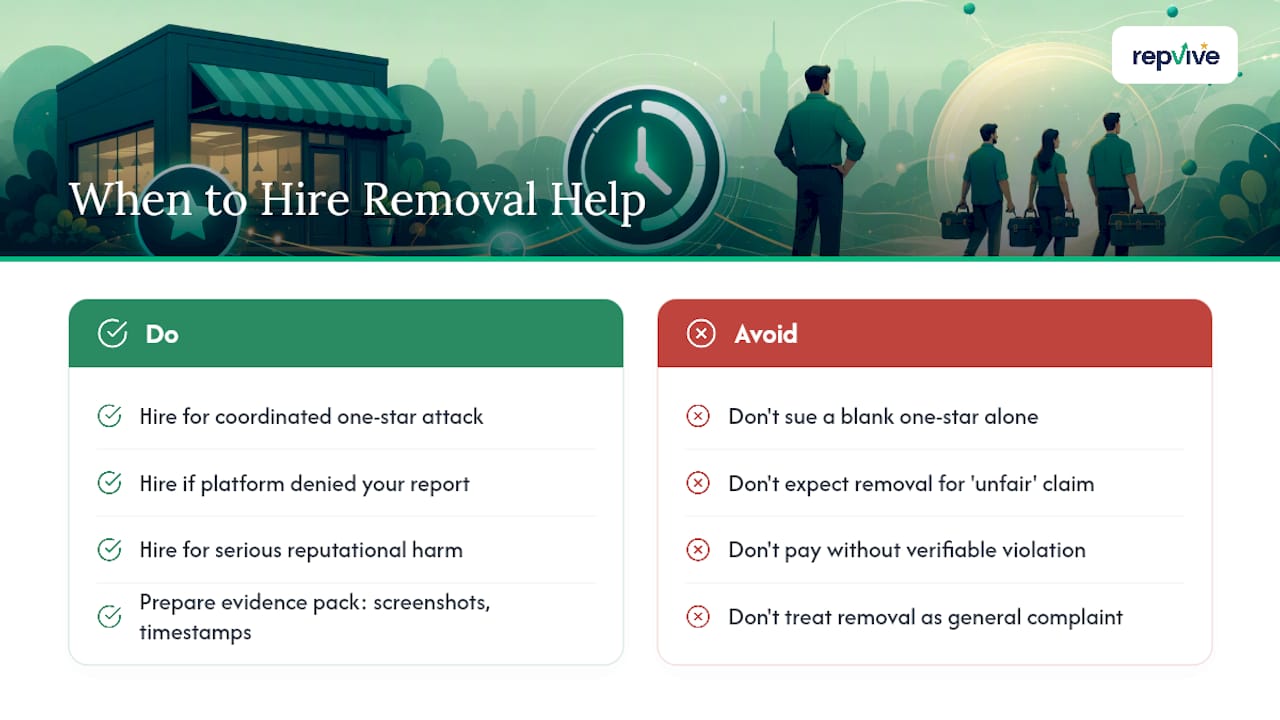
That doesn’t mean legal or professional help is pointless. It means the approach has to target something more specific than “this rating is unfair.” Attorney-led removal services work by identifying an actual platform policy violation, a fake account, a competitor posting under a false identity, a reviewer with no verifiable relationship to your business, and building a documented claim around that violation rather than around the low score itself.
This approach makes sense when you’re facing a coordinated attack (several suspicious blank one-stars in a short window), when a platform has already denied your own report and you believe the denial was wrong, or when the reputational and financial damage is serious enough to justify the cost of professional intervention.
When a coordinated or high-impact reputational hit occurs, attorney-led removal services typically work on a pay-per-removal basis and need a precise evidence pack to succeed. They do not address a general complaint about the rating being unfair.
What these services usually ask for is straightforward: a compact evidence pack (screenshots, timestamps, order records), a timeline of when the rating appeared relative to any known incidents, and any communication logs tied to the reviewer if you have them. Repvive’s approach to responding to defamatory reviews outlines how the line between a defamatory claim and a simple negative opinion gets drawn, which is the same distinction that determines whether a removal request has any legal footing at all.
How Do You Prevent and Recover From Blank One-Star Ratings?
The single highest-leverage move available to most small businesses isn’t fighting the bad rating. It’s making it statistically irrelevant.
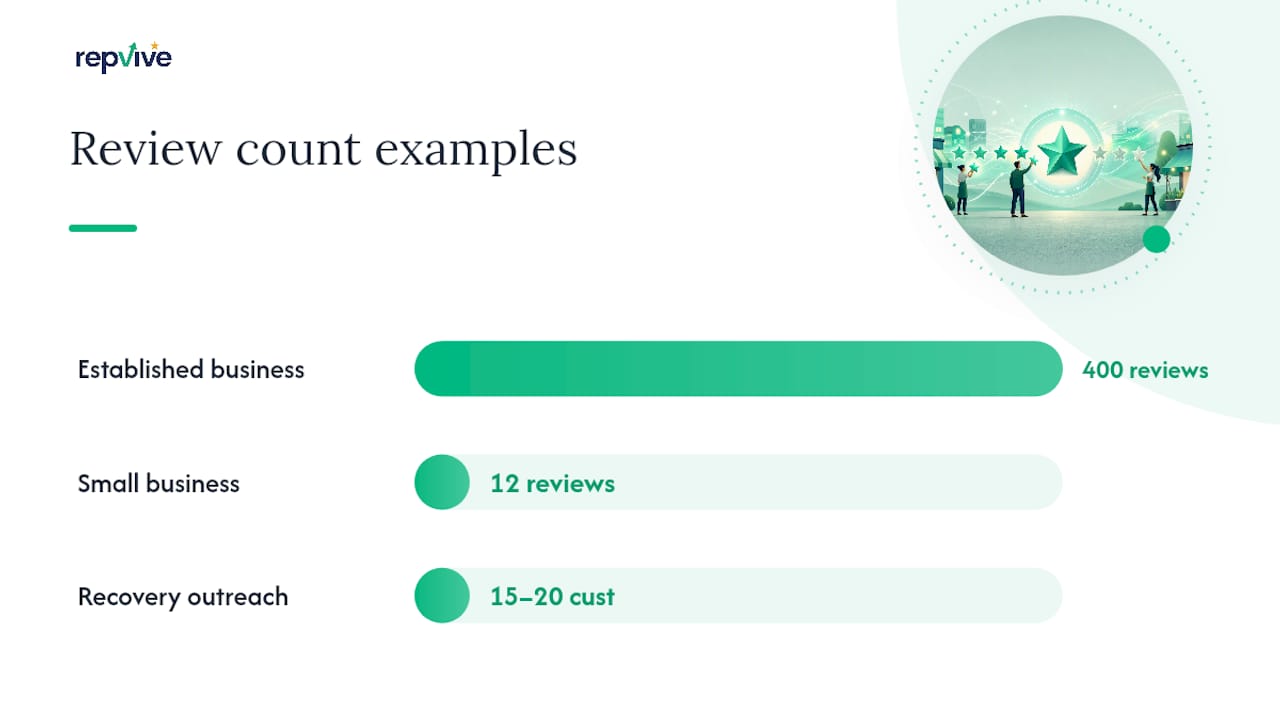
Practical prevention, consistent monitoring paired with an ethical, steady cadence of review requests, is the strongest defense most owners have. A business with 400 reviews and a 4.7 average barely notices one blank one-star. A business with 12 reviews takes a visible hit from the same rating.
- Set up alerts for new reviews on every platform you’re listed on, most platforms offer free notification settings buried in account preferences.
- Ask satisfied customers for a review within 24 to 48 hours of a completed job or purchase, while the experience is still fresh.
- Send one follow-up reminder about a week later if they haven’t responded, then let it go.
- Prompt happy customers in person or at checkout with a simple QR code or printed card rather than relying on email alone.
- Run a short, targeted recovery campaign after a bad-review spike: reach out to your last 15 to 20 satisfied customers and ask directly for a review.
Automation earns its keep here specifically because review requests are easy to forget during a busy week. Categories worth exploring include review-monitoring alerts, automated post-purchase request tools, and CRM integrations that trigger a review ask the moment a job closes. A Google Business Profile audit can also flag gaps in how your profile is set up to collect reviews in the first place.
Pro Tip: Track your review velocity, not just your average rating. A business adding two or three new positive reviews a week recovers from a bad hit in days. One that gets a review every few months stays exposed for months.
What Evidence Should You Collect Before Reporting a Review?
Whether you’re filing a platform report or building a case for a removal service, the evidence you gather determines whether anyone takes action. Assemble this before you file anything, not after a request gets denied.
- Screenshot the review and the reviewer’s profile immediately. Ratings and accounts can be edited or deleted, and you want a record of exactly what existed and when.
- Note the exact timestamp the rating posted, in as precise a format as the platform provides.
- Pull your booking, order, or point-of-sale logs for the date and time window around the rating to check for any matching transaction.
- Gather staff logs or security footage if you run a physical location and suspect the reviewer never actually visited.
- Export your platform activity records, most business dashboards let you download review history and any related support case numbers you’ve already opened.
- Write a one-page summary that states the date, the rating, why you believe it violates policy or lacks a legitimate basis, and lists your attached evidence in order.
A detailed walkthrough of the exact policy steps for one-star removals covers how to format this packet so platform support or legal counsel can act on it quickly instead of sending it back for more information.
When to Stop Chasing a Bad Rating and Focus on Growth
Most owners burn hours on a single blank one-star that a platform was never going to remove. Run the simple math: reply publicly first, always. Report only if you spot an actual policy violation. Escalate to a professional only when there’s a real pattern or serious reputational damage on the line.
Hiring counsel or a removal service makes sense when you’ve been denied once already and have solid evidence, or when several suspicious ratings land at once. Outside of that, your time is better spent asking three more happy customers for a review than drafting a fourth appeal to platform support.
— Jason
How Repvive Handles Reviews Platforms Won’t Remove
When a blank one-star rating survives your public reply and a platform denies your report anyway, you’re left with limited options on your own. There are attorney-led removal services built around customized legal claims for each review, with no upfront fees and payment due only after a removal is confirmed.
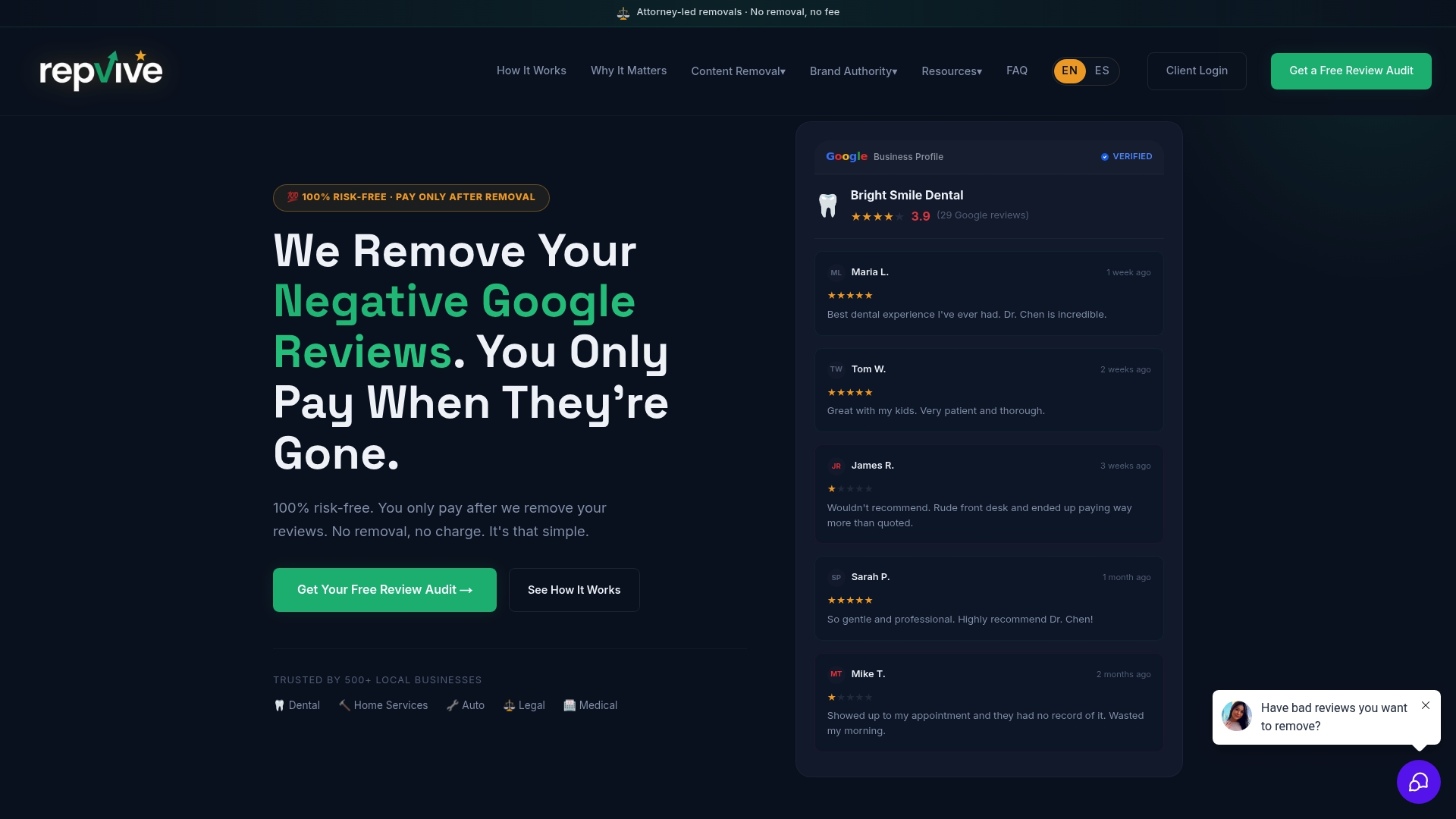
This route makes the most sense when you’re facing a coordinated cluster of suspicious ratings, when Google or Amazon has already denied your own report, or when the reputational and financial stakes are high enough that a DIY appeal isn’t worth the risk of another denial. The team reviews submitted evidence, including screenshots, timestamps, and order records, and builds a claim tailored to the specific policy or legal grounds the rating violates. The process may also include monitoring tools that flag new reviews as they land, helping to detect further issues promptly.
If a blank one-star is sitting on your profile and platform support has already told you no, start with Repvive’s review removal service to see what a tailored claim looks like for your situation.
Where to Read More on Reporting and Legal Options
- K&K’s analysis of suing over fake or negative reviews breaks down the defamation standard in plain terms.
- The Google Business Profile community thread on textless negative reviews shows real moderator responses to removal requests.
- Amazon Seller Forums discussions on rating-only one-stars document what sellers actually experience when they escalate.
- A Google Maps rank checker helps you track whether review activity is shifting your local search visibility over time.
Sources
- Can my business sue over negative or fake online reviews? | K&K
- False Negative review without any text - Google Business Profile Community
- i got 1 star rating but no review given please help — Amazon Seller Forums
- Respond to a 1-Star Review With No Comment: 15 Examples | Resparo
FAQ
Can I sue for a one-star review?
Rarely with success. Defamation law requires a false statement of fact, and a bare star rating with no text makes no factual claim you can dispute in court.
Why is my one-star Google review not posted or not removed?
Google allows star-only ratings by default and only removes them when they violate a specific policy, such as coming from someone with no connection to your business. Lacking a comment isn’t a violation by itself.
How many five-star reviews does it take to offset a one-star rating?
There’s no fixed number, but the math favors volume: a business with hundreds of reviews barely feels one blank one-star, while a business with a dozen reviews sees its average shift noticeably. Focus on steady review collection rather than chasing a specific ratio.
How should I respond to a one-star rating with no comment?
Post a short, calm public reply that acknowledges the rating and invites the reviewer to contact you privately, without apologizing for specifics you can’t verify. Keep it under three sentences and post it within 24 to 48 hours.
When should I contact a removal service instead of handling it myself?
Consider a service like Repvive when a platform has already denied your own report, when you’re facing multiple suspicious ratings at once, or when the reputational damage is serious enough that a DIY appeal isn’t worth another denial.