What to Do About a Mistaken Identity Review on Google
If a review clearly targets the wrong business, act in this order: flag it through Google, screenshot everything before it can change, post a calm public...
If a review clearly targets the wrong business, act in this order: flag it through Google, screenshot everything before it can change, post a calm public reply that states the facts, and escalate through the Reviews Management Tool if the flag gets denied. Save legal action for cases where the review makes a false statement of fact, not just a harsh opinion.
- Flag the review immediately using the exact policy category it violates.
- Screenshot the review, the reviewer’s profile, and the URL before anything changes.
- Post a short, factual public reply within the same day.
- Escalate through the appeal tool if the first report is denied.
Most flagged reviews get an automated decision in 2 to 14 days, and a denied report can go through one additional human appeal.
Key Takeaways
Removing a mistaken identity review works best when you flag it precisely, document evidence immediately, and escalate through Google’s appeal system before considering legal action.
| Point | Details |
|---|---|
| Flag with the right category | Choose “Off topic” or “Not about the business” rather than a generic complaint category. |
| Document before you report | Screenshot the review, reviewer profile, and URL before anything can be edited or deleted. |
| Use the one-time appeal | The Reviews Management Tool allows appeals on up to 10 reviews with specific evidence attached. |
| Know the legal threshold | Escalate to an attorney only when a review states a false fact, not just a harsh opinion. |
| Hire an attorney-led service when stuck | Repvive builds customized legal claims per review with no upfront fees. |
Where to go for official help
For direct action, use Google’s inappropriate review reporting page or read Repvive’s step-by-step dispute guide for sample appeal language.
Table of Contents
- How to Handle a Mistaken Identity Review in the First 48 Hours
- How Does the Reviews Management Tool Appeal Process Work?
- What Evidence Do You Need to Prove Mistaken Identity?
- When Should You Escalate to Legal Action?
- How Should You Respond When a Review Won’t Come Down?
- When Is It Time to Hire a Professional Removal Service?
- Repvive Handles the Cases DIY Can’t Fix
- Sources
- FAQ
How to Handle a Mistaken Identity Review in the First 48 Hours
Speed matters here, but precision matters more. Google rejects a lot of removal requests simply because the business owner picked the wrong policy category or filed a vague complaint instead of pointing to a specific violation.
- Open the review on Google Maps or your Business Profile, click the three-dot menu next to it, and select “Report review.”
- Choose the closest matching policy category, for mistaken identity cases, that’s usually “Off topic” or “Not about the business,” not “Spam” or “Harassment.”
- Screenshot the full review before reporting it, including the reviewer’s name, star rating, date, and any photos attached. Save the direct URL to the review too.
- Store the files somewhere outside your phone’s camera roll, a dated folder in Google Drive or Dropbox works, since you may need these weeks later for an appeal.
- Post a public reply the same day. Something like: “Thanks for your feedback, but we’re unable to locate any record of your visit or purchase. This review may be intended for a different location. Please contact us directly at [phone/email] so we can look into it.”
Pro Tip: Never mass-report other reviews on the same reviewer’s profile hoping to get lucky, and never file a false DMCA claim to force a takedown. Google tracks reporting patterns, and abusing the flagging system can get your future reports ignored or your profile flagged for review.
How Does the Reviews Management Tool Appeal Process Work?
Once you’ve flagged a review, Google’s Reviews Management Tool lets you track its status and, if needed, file one human appeal. This is the step most business owners skip, and it’s usually where mistaken identity cases actually get resolved.
The tool shows one of three statuses after you report a review:
- Decision pending, still in automated or early review.
- Report reviewed, no policy violation found, the automated system denied your claim; this is when you file the one-time appeal.
- Escalated, check your email for updates, a human moderator is now looking at it.
You can appeal up to 10 reviews at once, and each appeal should include the exact policy category, a direct quote of the offending line, and hard proof of mismatch: a menu that doesn’t list the item they complained about, a services page that doesn’t offer what they described, or transaction logs showing no record of that customer on the stated date. Vague appeals (“this isn’t fair”) get denied fast. Specific ones with dates and documents get escalated for manual review far more often.
What Evidence Do You Need to Prove Mistaken Identity?
Evidence quality decides whether a removal request works, whether an appeal gets escalated, and whether an attorney can act if it comes to that. Loose screenshots on a phone rarely hold up; an organized folder does.
Build a file with these items:
- The review’s permalink and a full-page screenshot, including date and star rating.
- The reviewer’s profile page, screenshotted separately (their review history often shows the same mistake made elsewhere).
- Transaction, appointment, or CRM logs from the date in question showing no matching customer.
- Any emails, texts, or booking confirmations that prove the visit didn’t happen at your business.
Label each file with the date you captured it and what it shows, and redact customer phone numbers or payment details before sharing anything externally. Organized, timestamped evidence is exactly what precise flagging and documentation requires, and it’s the difference between a report that gets escalated and one that sits in “no violation found” limbo.
Pro Tip: If the review mentions a product or service you’ve never offered, screenshot your actual menu or services page next to the complaint. That side-by-side comparison is often the single most convincing piece of evidence in an appeal.

When Should You Escalate to Legal Action?
Legal escalation only works when a review makes a false statement of fact, not when it’s simply a harsh or unfair opinion. Saying “the food was cold” is opinion. Saying “they gave me food poisoning and I went to the hospital” when no such visit occurred is a factual claim you can potentially challenge.
Three paths exist once you’ve hit that threshold:
- A legal removal request sent directly to Google, often through an attorney, citing defamation law.
- A John Doe subpoena to unmask an anonymous reviewer, typically filed when you need their identity to pursue a claim.
- A court judgment or small claims ruling that platforms will generally honor once it’s finalized.
| Escalation Path | Typical Use Case | Rough Cost Range |
|---|---|---|
| Legal removal request | Clear factual falsehood with documented harm | Varies by attorney, often a flat fee for a demand letter |
| John Doe subpoena | Anonymous reviewer needs to be identified | Several thousand dollars in court and legal fees |
| Small claims judgment | Local, lower-dollar defamation claim | A few hundred to a few thousand dollars in filing and prep |
Costs and timelines vary widely depending on jurisdiction and how contested the case gets, and litigation can run from a few thousand to tens of thousands of dollars depending on how far it goes. Section 230 protects platforms from liability for user content, which is exactly why suing Google directly rarely works. Talk to a local attorney before filing anything.
How Should You Respond When a Review Won’t Come Down?
Not every mistaken identity review gets removed, even with a clean appeal. When that happens, your public reply becomes the permanent record future customers see, and it matters more than people think.
- For a clear case of mistaken identity: “We’ve checked our records and can’t find any visit matching this description. This review may be intended for a different business. Please reach out to us directly so we can help clarify.”
- For an off-topic or unrelated complaint: “This review references [product/service] that we don’t offer. We’d welcome the chance to sort out any confusion. Please contact us at [phone/email].”
- For anything you want resolved privately: “We take this seriously and would like to understand what happened. Please call or email us directly so we can look into this.”
A calm, factual public reply reassures anyone reading the review later and gives you a documented paper trail if you need to escalate. If removal never happens, lean on mitigation instead: collect more verified reviews from real customers, and use basic SEO and PR to push the older content further down your search results.
Pro Tip: Never argue or get defensive in a public reply, even if the review is obviously fake. Future customers judge your response more than the review itself.
When Is It Time to Hire a Professional Removal Service?
DIY works for straightforward cases. Hire professional help when your appeal gets denied, when you’re facing a coordinated attack from multiple fake accounts, when the reviewer is anonymous and clearly defamatory, or when the review is causing measurable damage to bookings or revenue.
Attorney-led services like Repvive build a customized legal claim for each review rather than filing generic template complaints, and they use direct channels to Google that most business owners don’t have access to on their own.
Before hiring anyone, ask what specific legal or policy basis they’ll use for your case, whether they charge before or after removal, and whether they can show a track record with cases similar to yours. Vague promises of “guaranteed removal” with no explanation of method are a red flag.
- Appeal already denied through Google’s standard process.
- Multiple suspicious reviews appearing in a short window.
- Anonymous reviewer making specific, false factual claims.
- Measurable drop in calls, bookings, or foot traffic tied to the review.
A quick note from Jason
Most owners lose their case by reacting emotionally instead of documenting first. The pattern I see most: a business flags a review with no evidence attached, gets denied, and gives up instead of appealing.
Repvive Handles the Cases DIY Can’t Fix
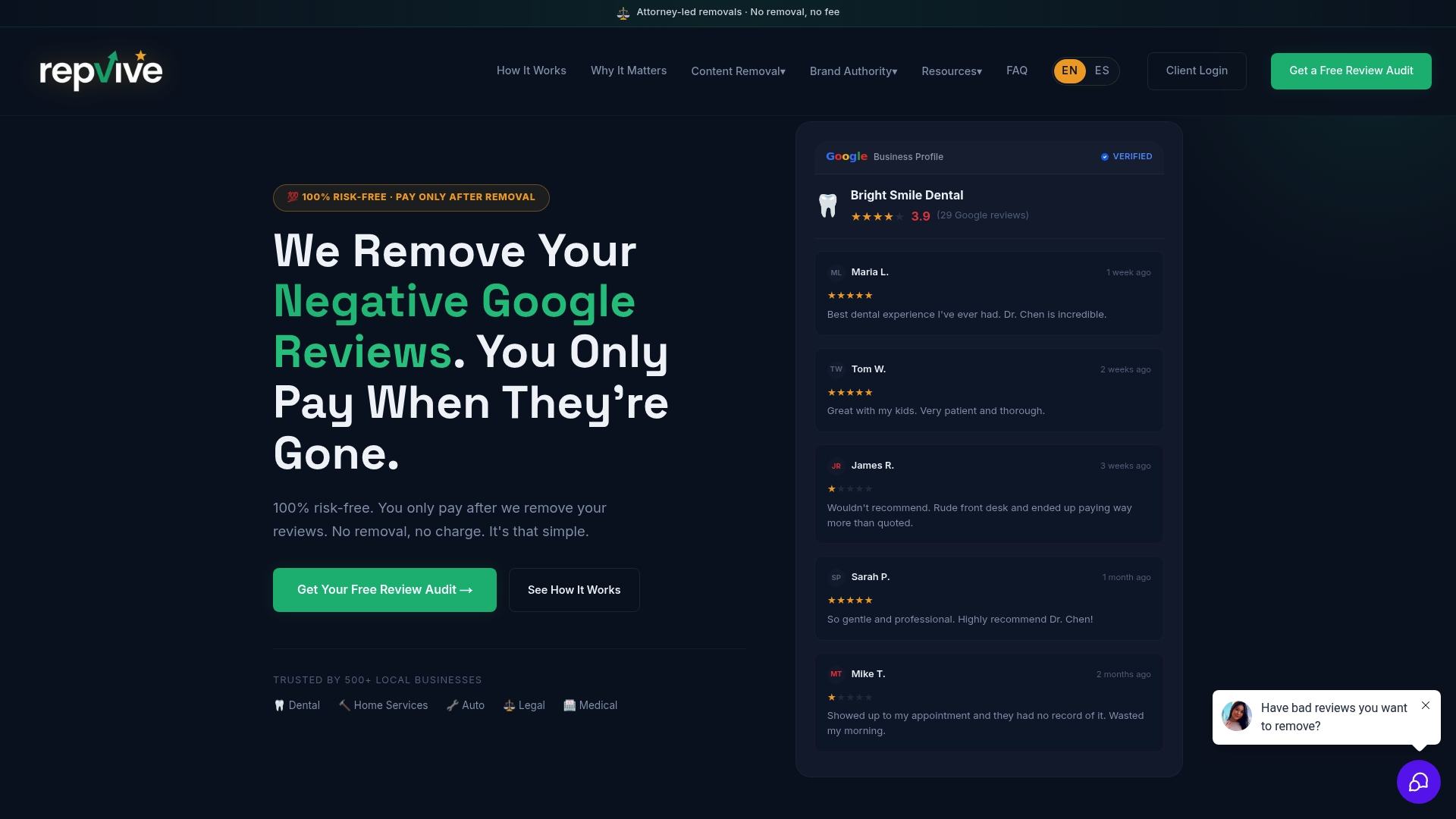
Repvive exists for the moment your own flagging and appeals hit a wall. Its attorney-led model builds a specific legal claim around your review, uses direct channels to Google most owners never see, and charges nothing upfront, you pay only after a removal is confirmed.
Before reaching out, gather the same evidence this article walks through: the review’s permalink, your dated screenshots, and any transaction or appointment logs that prove the reviewer was never your customer. That packet is what lets Repvive’s legal team move fast instead of starting from scratch. If your appeal through Google’s own review removal service has already been denied, or you’re facing a review that’s clearly costing you business, visit the Repvive landing page and start a case review with your evidence in hand.
Sources
- Report inappropriate reviews on your Business Profile, Google Business Profile Help
- How to Remove Bad Reviews From Google My Business (2026)
- How to Remove Negative Google and Yelp Reviews: A Practical Guide
- How to Report and Remove Fake Google Reviews for Good, social Czars
FAQ
What counts as a mistaken identity review?
It’s a review left for the wrong business, often because the reviewer confused your name, location, or franchise with a similar one nearby.
How long does Google take to remove a flagged review?
Most automated decisions come back within 2 to 14 days, and a denied report can go through one additional human appeal.
Can I appeal a denied review removal request?
Yes. The Reviews Management Tool allows one appeal per denied review, and you can submit appeals for up to 10 reviews at once.
When should I hire an attorney instead of appealing myself?
Hire professional help once your own appeal has been denied, you’re facing a coordinated attack, or the review makes a specific false factual claim causing measurable harm, which is where a service like Repvive typically steps in.
Will a public reply help if the review can’t be removed?
Yes. A calm, factual reply reassures future customers reading the review and creates a documented record that supports any later appeal or legal escalation.