You Can't Delete a BBB Complaint, But You Can Get It Resolved
You Can't Delete a BBB Complaint, But You Can Get It Resolved ! Decorative title card illustration You cannot delete a BBB complaint yourself.

You Can’t Delete a BBB Complaint, But You Can Get It Resolved
You cannot delete a BBB complaint yourself. No business login, phone call, or polite email makes a filed complaint disappear from public view. What you can do, and what actually protects your rating, is push the complaint toward a “Resolved” closure or convince the complainant to withdraw it. Both outcomes are within your control if you move fast.
Here’s what to do in the next hour:
- Log in to your BBB Business Account and read the complaint in full before drafting anything.
- Pull every relevant record: invoices, texts, emails, contracts, timestamps.
- Draft a short, factual response, no defensiveness, no admission of fault you don’t owe.
- Call or email the customer directly, outside the BBB portal, to work toward a fix.
- Note the filing date so you know exactly how many of your 30 calendar days remain.
The first 72 hours set the tone. A business that responds within a day or two, and offers something concrete, converts far more complaints to “Resolved” than one that waits out the clock.
Key Takeaways
Businesses cannot delete a BBB complaint themselves; the realistic path to protecting your reputation is a prompt, documented response that earns a “Resolved” closure or a consumer withdrawal.
| Point | Details |
|---|---|
| Deletion isn’t an option | Only BBB, under narrow administrative rules, or the complainant through withdrawal, can remove a complaint from public view. |
| The 30 day window is real | Respond through your BBB Business Account within 30 calendar days, or risk an “Unanswered” label. |
| Resolution beats argument | Offer a specific, time-limited fix and a direct contact method, then ask the satisfied customer to confirm resolution with BBB. |
| Preserve evidence before writing | Pull contracts, timestamps, and logs first so your response is factual, not reactive. |
| Escalate false complaints legally | For fabricated or repeated malicious complaints, attorney-led services like Repvive offer a pay-per-removal path built around legal claims and direct platform access. |
Table of Contents
- How to Remove a BBB Complaint: The Response Playbook
- How Long Does BBB Give You to Respond to a Complaint?
- Can a Complainant Withdraw a BBB Complaint?
- What to Do When a BBB Complaint Is False or Malicious
- Managing Your Reputation While the Complaint Is Still Public
- The Part of BBB Complaint Handling Most Advice Skips
- When It’s Time to Bring In RepVive
- Sources
- FAQ
How to Remove a BBB Complaint: The Response Playbook
Removing a BBB complaint isn’t really a removal process. It’s a resolution process, and BBB has a specific portal, timeline, and tone that reward businesses who follow the format instead of improvising.
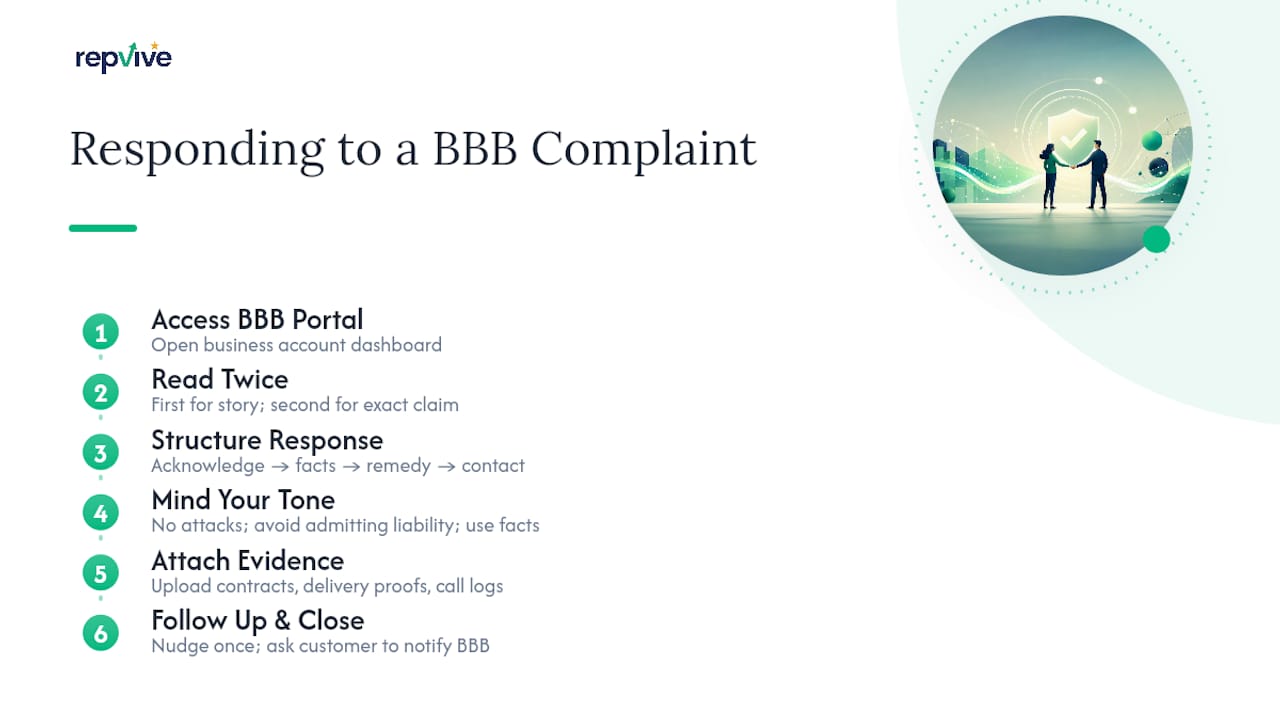
1. Access your BBB Business Account. Every accredited and many non-accredited businesses can register for a free account at bbb.org. The complaint appears in your dashboard with the consumer’s full narrative and any documents they attached. This portal, not email or phone, is where BBB expects your official response.
2. Read the complaint twice before writing anything. The first read is for the story. The second is for the specific claim: refund, defective product, missed appointment, billing error. Respond to that exact claim. A response that ignores the actual complaint reads as evasive to both the consumer and anyone browsing your profile later.
3. Structure your response in four parts. Open with a brief acknowledgment (“We appreciate you bringing this to our attention and take it seriously”). Follow with a factual account of what happened, dates and details only, no editorializing. Then state the specific resolution you’re offering: a refund amount, a replacement timeline, a corrected invoice. Close with a direct contact method, your cell, a manager’s email, so the exchange can move off the public record.
4. Watch your language. Skip anything that reads as a personal attack on the customer, even if you believe they’re wrong. Never admit liability you don’t actually owe just to sound conciliatory; a vague “we’re sorry for everything” can be read as an admission in later disputes. Stick to verifiable facts and a concrete offer.
5. Attach your evidence directly in the portal. Signed contracts, delivery confirmations, call logs, screenshots of texts. If the complaint alleges something your records contradict, show it instead of arguing it.
6. Follow up if you don’t hear back within a few days. One polite nudge through the same offline channel you offered, phone or email, is enough. Don’t spam the customer.
7. Ask the satisfied customer to close the loop. Once they’ve accepted your resolution, ask them plainly: “Would you mind letting BBB know this has been resolved?” Most consumers who feel actually heard will do this without pushback, since they have no reason not to.
Pro Tip: Offer a narrow, time-limited fix rather than an open-ended apology. “We’ll refund the $180 service charge within five business days” gets accepted faster than “we’ll make this right,” because the consumer knows exactly what to expect and when.
Responding promptly and professionally, and putting a real resolution on the table, measurably increases the odds a complainant accepts and closes the case. Businesses that stall, or respond with a generic denial, tend to end up with complaints marked “Unanswered,” which reads worse to a prospective customer than almost any resolved dispute.
How Long Does BBB Give You to Respond to a Complaint?
BBB forwards a new complaint to your business within about two business days of filing, through the same Business Account portal you’ll use to reply. From that point, the clock is running.
- Day 0 to 2: BBB reviews the complaint and forwards it to your business account.
- Day 2 to 30: You have a 30 calendar day response window to answer.
- After your response: The consumer gets a chance to reply, accept your resolution, or dispute it.
- Closure: BBB assigns a status label once the exchange settles or the window closes.
Complaints are generally closed within roughly 30 calendar days of filing, though a genuinely disputed case can run longer if both sides keep responding.
The closure label is what matters for your reputation. “Resolved” means the consumer confirmed the business’s fix satisfied them. “Answered” means you responded with a factual account, but the consumer either didn’t reply, didn’t accept the offer, or the two sides simply disagree on the facts. “Unanswered” means you never responded at all, and it’s the single worst label a complaint can carry because it signals indifference, not just conflict.
Accredited businesses face a sharper consequence: BBB local offices can flag accreditation for review if a business repeatedly ignores complaints.
One thing surprises a lot of business owners: BBB doesn’t scrub the complaint text just because you disagree with it. The narrative generally stays visible, though BBB does redact personal identifying information and strip out abusive or obscene language before publishing. A complaint that violates those content rules can be edited or withheld, but a complaint that’s simply unflattering and factually disputed usually stays up, response and all, for anyone to read.
Can a Complainant Withdraw a BBB Complaint?
Yes, but only the person who filed it can do that. You can’t submit a withdrawal request on their behalf, no matter how the dispute resolved. A complaint can’t be deleted by the business directly, only the consumer can withdraw it, or the case can close as “Resolved” once they confirm your fix worked.
Here’s the practical sequence once a customer agrees your resolution solved the problem:
- Ask them directly, by phone or email, to contact BBB and either withdraw the complaint or confirm satisfaction on the case.
- Get that confirmation in writing on your end, an email reply saying “this resolves it” is enough, and keep it in your file.
- Forward that written confirmation to your BBB case manager or upload it to the portal so BBB has a paper trail matching what the consumer reports.
- Don’t assume silence means withdrawal. If BBB hasn’t updated the status, follow up with your case manager directly rather than guessing.
A few narrow administrative removal paths exist outside consumer withdrawal. BBB may remove or edit a complaint containing someone’s personal identifying information, language that violates its posting standards, a duplicate submission of the same complaint, or, in some cases, a dispute that’s moved into active litigation. These are exceptions BBB applies at its own discretion, not a request you can file simply because a complaint hurts your rating.
A simple script works better than a long email: “Thanks again for confirming the refund worked for you. Since this is resolved on our end, would you mind letting BBB know so they can close the case as resolved?” Direct, low pressure, and it gives the customer an easy action to take.
What to Do When a BBB Complaint Is False or Malicious
Not every complaint is a legitimate service dispute. Sometimes it’s a competitor, a disgruntled former employee, or an attempt at extortion dressed up as a consumer complaint. The response looks different when the underlying claim is fabricated rather than just disputed.
1. Preserve everything immediately. Contracts, transaction records, appointment logs, timestamped communications, and, if you suspect impersonation, server logs and IP data tied to the account or session. These technical artifacts are what actually move a takedown request, preserving IP and payment records early makes a legal or platform-level correction far more likely to succeed later.
2. Submit that evidence through your BBB response, formally. State plainly, with dates, why the complaint doesn’t match a real transaction, and attach proof rather than asserting it. BBB isn’t positioned to adjudicate fraud claims the way a court is, so your response is often the only correction that ends up attached to the public record.
3. Know when the complaint has moved past what BBB can fix. A single disputed refund is an operational problem. A pattern of coordinated fake complaints, an impersonation attempt, or language that crosses into defamation is a legal problem.
4. Weigh escalation against cost. Litigation over a single complaint rarely pencils out for a small business; legal fees can exceed whatever reputational damage the complaint caused. An attorney-led removal service built specifically around platform removal claims is usually the more proportionate option for demonstrably false or malicious posts, especially when speed matters more than a courtroom win.
Pro Tip: Screenshot everything the day you notice a suspicious complaint, before the complainant has a chance to edit their account, delete their profile, or change identifying details that would otherwise help you prove the claim is fabricated.
Managing Your Reputation While the Complaint Is Still Public
A complaint sitting on your BBB profile for a few weeks doesn’t have to define how prospects see you, if you handle the surrounding picture deliberately.
- Post your public response using the same acknowledge, explain, resolve structure you used in the private reply, so anyone reading the thread sees a business that took it seriously.
- Ask happy customers for reviews through normal, unprompted channels; never offer an incentive tied to a positive review, which violates most platform policies.
- Check your BBB profile and major review sites on a set schedule, weekly at minimum, so a new complaint doesn’t sit unanswered for days.
- Fix the operational gap that caused the complaint. If three complaints trace back to the same scheduling error, retrain the staff handling that process before it generates a fourth.
The businesses that recover reputation fastest treat one complaint as a symptom to investigate, not just a fire to put out.
The Part of BBB Complaint Handling Most Advice Skips
Most guidance on this topic treats a BBB complaint like a five-star review problem: respond nicely, offer a discount, hope it goes away. That undersells how mechanical the actual process is. BBB isn’t grading your tone. It’s checking whether you responded inside the window, whether your response was published (not withheld for violating standards), and whether the consumer confirmed satisfaction. Charm doesn’t move any of those three levers. Specificity does.
The overlooked risk is treating BBB complaints and reviews as the same threat. A negative review doesn’t touch your BBB rating; a complaint does. Businesses that pour effort into review management while ignoring an open complaint are protecting the wrong metric.
My honest read: preservation of evidence is the most underrated step in this entire process. Most owners start writing their response before they’ve pulled a single record. Pull the paper trail first, write second. And if a complaint is clearly fabricated, don’t spend three weeks negotiating with BBB’s general process. Legal escalation exists for exactly that scenario, and waiting rarely improves your position.
When It’s Time to Bring In RepVive
There’s a point where negotiating with a complainant, drafting the perfect BBB response, and preserving evidence yourself stops being the efficient move, especially when the complaint is fabricated, tied to identity fraud, or repeating across platforms while you’re trying to close new customers. That’s the scenario Repvive was built for.
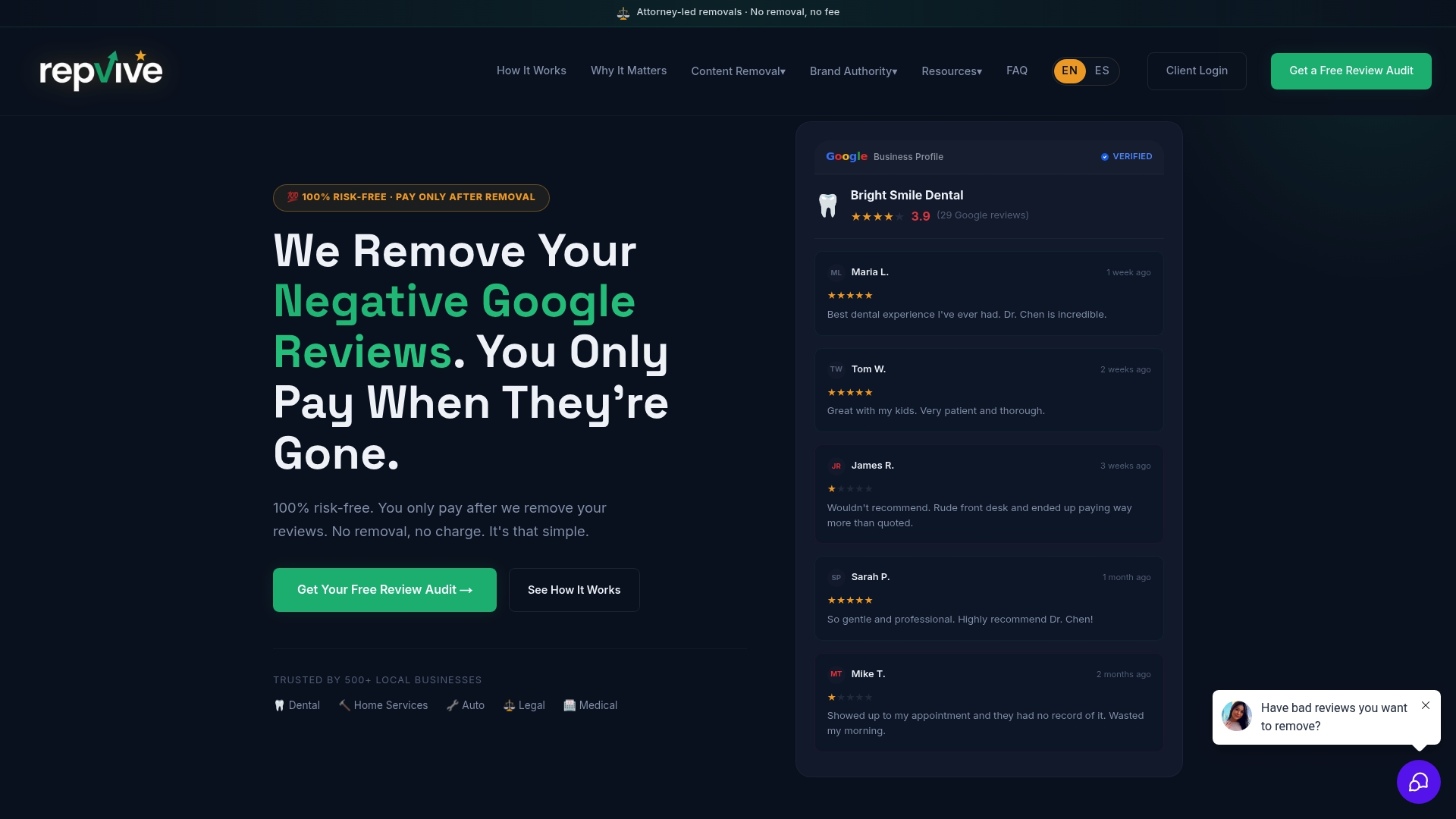
Repvive’s attorney-led team builds a customized legal claim for each complaint rather than submitting a generic dispute, and works direct platform channels most businesses don’t have access to on their own. The model is pay-per-removal: no upfront fee, no retainer, you pay only once a removal is confirmed. Onboarding starts with sending over the complaint details and whatever documentation you already have, contracts, transaction records, prior BBB correspondence, and Repvive’s team evaluates whether it qualifies for a legal claim. Every case gets tracked through a real-time dashboard, so you see the status of your BBB complaint removal request without chasing updates by email. If your business is dealing with a complaint that’s clearly false, malicious, or part of a repeated pattern, start by requesting an evaluation at Repvive.
FAQ
Can a BBB rating or accreditation be revoked?
Yes. BBB accreditation can be reviewed and revoked if an accredited business repeatedly fails to respond to complaints or violates BBB’s standards for trust.
Do businesses take BBB complaints seriously?
They should. An unanswered complaint publicly signals indifference, while a prompt, professional response that offers real resolution protects both the individual rating and the business’s broader reputation.
How do I cancel a BBB complaint I filed?
Only the person who filed the complaint can request its withdrawal, by contacting BBB directly and confirming the issue is resolved; a business cannot cancel a complaint on the consumer’s behalf.
How do I close my BBB business account?
Contact your local BBB office directly to discuss closing or deactivating your business account; this is separate from resolving individual complaints, which stay tied to your business record regardless of account status.
What’s the difference between a BBB complaint and a BBB review?
A complaint factors into your BBB rating while a review does not, and a consumer generally files one or the other for the same experience, not both.