Stop Non-Customer Google Reviews: DIY Steps and Attorney Escalation
Stop Non-Customer Google Reviews: DIY Steps and Attorney Escalation ! Decorative Google review removal title card Google removes reviews when they break its content policies, and non-customer reviews frequently do.
Stop Non-Customer Google Reviews: DIY Steps and Attorney Escalation
Google removes reviews when they break its content policies, and non-customer reviews frequently do. If someone who never bought from you posted a one-star rant, screenshot the review now, pick the correct policy reason, and flag it through your Business Profile or Google Maps. If Google denies that flag, and the post contains false factual claims or private information, you escalate from there.
TL;DR:
- Google typically removes reviews that lack transaction evidence or are posted by non-customers, such as employees, impersonators, or competitors.
- Reporting reviews involves selecting the correct policy violation and submitting evidence, with most decisions made within two to fourteen days.
- If Google denies removal, a manual re-review, legal requests, or court orders are possible options, though legal measures are costly and less reliable due to platform protections.
- Responding publicly to remaining reviews should be calm and professional, sticking to factual corrections or requesting offline resolution within forty-eight hours.
- Professional review removal services are advisable only for complex cases like coordinated attacks, false factual claims, or clear impersonation, where documented evidence is crucial.
Table of Contents
- What Counts as Non-Customer Review Removal on Google?
- How Do You Report a Fake Review on Google?
- What If Google Won’t Remove the Review?
- How Should You Respond Publicly When a Review Stays Up?
- When Should You Hire an Attorney-Led Review Removal Service?
- How Repvive Handles Non-Customer Review Removal
- Sources
- FAQ
What Counts as Non-Customer Review Removal on Google?
Not every bad review qualifies. Google’s moderation team looks for specific violations, not just unfairness, so knowing the signals matters before you file anything.
Watch for these red flags:
- No transaction evidence. The reviewer describes an experience that doesn’t match your service, location, or hours.
- Employment language. Phrases like “management treats staff badly” or “don’t work here” signal an ex-employee review, not a customer complaint.
- Impersonation. The reviewer poses as a client using a fake name tied to a competitor or disgruntled insider.
- Duplicate posting. The identical review shows up on Yelp, Facebook, and your Google profile within hours.
- Conflict of interest. A competitor, former vendor, or someone with an obvious grudge left the post.
- Incentivized or paid content. The review reads like a swap for a discount rather than a real opinion.
Each of these maps to one of Google’s nine content policy categories: spam, conflict of interest, off-topic content, impersonation, personal information, or restricted content. Before reporting anything, save screenshots showing the full review, the timestamp, the reviewer’s profile, and any cross-posted duplicates elsewhere.
How Do You Report a Fake Review on Google?
Reporting a review takes minutes once you know the path. Here’s the sequence:
- Open your Business Profile or Google Maps and locate the review.
- Click the three-dot menu next to it and select Report review.
- Choose the policy category that best matches the violation (not just “I disagree with this”).
- Submit and note the date, since you’ll want to track how long moderation takes.
Most flagged reviews get a decision within 2 to 14 days, though high-traffic categories like spam sometimes move faster. If Google denies the flag, you get a one-time manual appeal through the Reviews Management Tool. That appeal is your best shot, so make it count: quote the exact offending text, link any cross-posted duplicates on other platforms, and attach timestamped screenshots proving the reviewer never transacted with you. Practitioners who submit tight, well-documented appeal packets convince human reviewers in a meaningful share of otherwise-rejected cases.
Pro Tip: Don’t write a paragraph explaining your frustration in the appeal box. Google’s reviewers skim. Lead with the policy violation, then the proof, in two sentences or less.
For a platform-specific breakdown of this workflow, Repvive’s Google Business Profile removal guide walks through common denial reasons and how to fix them.
What If Google Won’t Remove the Review?
A denied flag isn’t the end of the road, but your remaining options carry real trade-offs in cost, time, and likelihood of success.
- Manual re-review. Reopen the case with stronger evidence, more specific policy language, and cross-platform proof. This costs nothing and is worth trying before anything else.
- Legal removal requests. Sending a formal request directly to Google works only when you can document a specific, narrow violation, like a review containing someone’s home address or a fabricated legal claim.
- Subpoenas and court orders. These can unmask an anonymous reviewer or compel takedown, but Section 230 of the Communications Decency Act shields platforms from liability for user content, which makes legal unmasking slow, expensive, and far from guaranteed.
- DMCA takedowns. These apply to copyright infringement, not opinion or factual disputes, so they almost never fit a typical bad review.
Platforms like Indeed set the removal bar even higher for opinion-based employer reviews, requiring documented proof of fraud, impersonation, or personal information before they’ll act. When none of these routes clear that bar, suppression through positive review generation and a professional public response often protects your reputation faster than a drawn-out legal fight.
How Should You Respond Publicly When a Review Stays Up?
A calm, professional reply often does more for your reputation than the removal fight itself, especially when prospective customers read the exchange and judge how you handle criticism.
Three short templates cover most situations:
- Mistaken identity or non-customer: “We’ve reviewed our records and can’t find an account matching this visit. Please contact us directly at [phone/email] so we can look into this.”
- Disputed factual claim: “We take this seriously and want to address the specifics. Our records show [brief factual correction]. We’d welcome the chance to discuss this directly.”
- Harassment or personal attack: “We’re sorry you’re upset. We’d rather resolve this offline. Please reach out to [contact] so we can talk through what happened.”
Post within 48 hours when possible, stay professional even when the review is unfair, and never accuse or expose the reviewer’s identity publicly. That kind of confrontation tends to escalate rather than resolve, and it can look worse to future readers than the original review. For longer, attorney-informed response templates, Repvive’s guide to responding to bad reviews breaks down tone and timing in more detail.
Pro Tip: Screenshot your own reply after posting. If the reviewer edits their original post later to look more sympathetic, you’ll have proof of what they actually said first.
Beyond individual replies, request reviews consistently from real customers and check your profiles on a regular schedule. A tool built for ongoing review management can flag new posts the day they go live, which matters because the faster you spot a fake review, the faster you can gather evidence before the reviewer edits or deletes it.
When Should You Hire an Attorney-Led Review Removal Service?
DIY flagging handles plenty of cases, but certain situations call for professional intervention. Coordinated attacks from a competitor’s network, a review with demonstrably false factual claims, clear impersonation, or repeated policy-violating posts from the same source are the clearest signals you’ve outgrown the free tools.
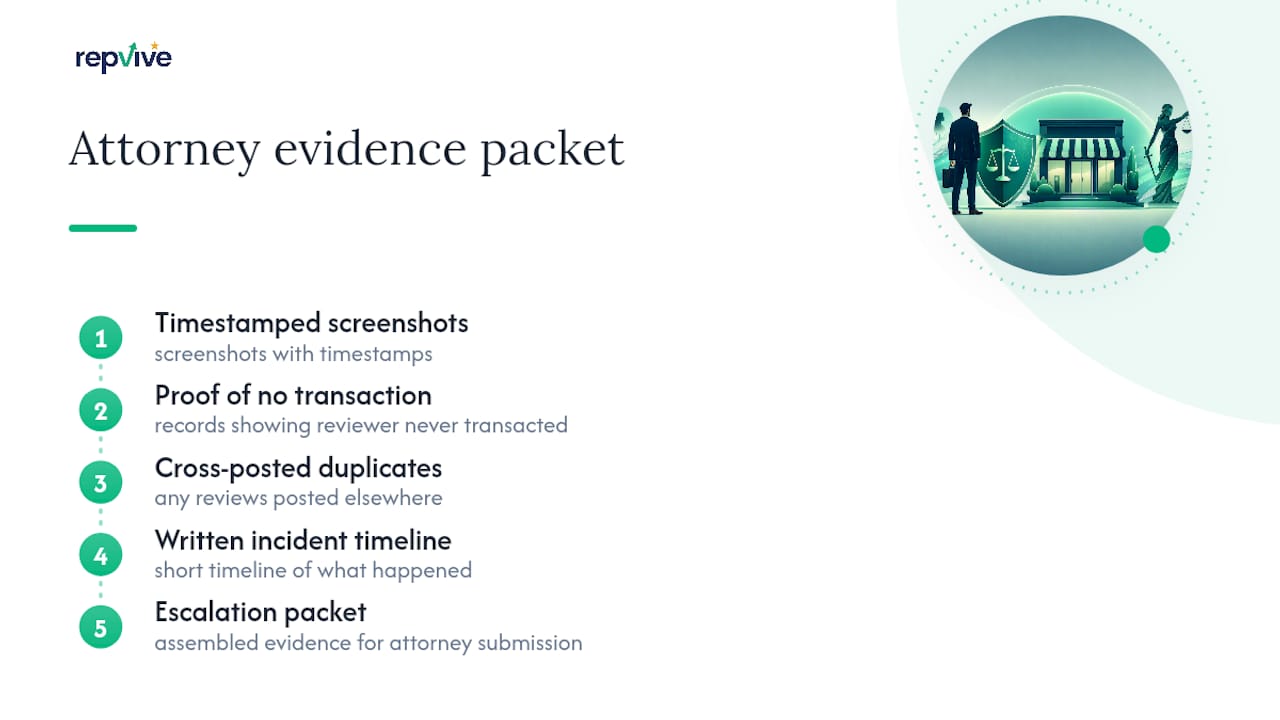
Attorney-led services build a legal claim around the specific violation, assemble documented evidence, and escalate through trust-and-safety channels that individual business owners typically can’t reach directly. Before contacting one, gather your evidence: screenshots with timestamps, records proving the reviewer never transacted with you, any cross-posted duplicates, and a short written timeline of what happened. That packet is what turns a maybe into a removal.
— Jason
How Repvive Handles Non-Customer Review Removal
Some removal services build their process around exactly the cases DIY flagging struggles with. Attorney-led teams craft customized legal claims for each review, rather than submitting the same generic flag every other tool uses, and may work on a pay-per-removal model without upfront fees, so payment occurs only after a review is removed.
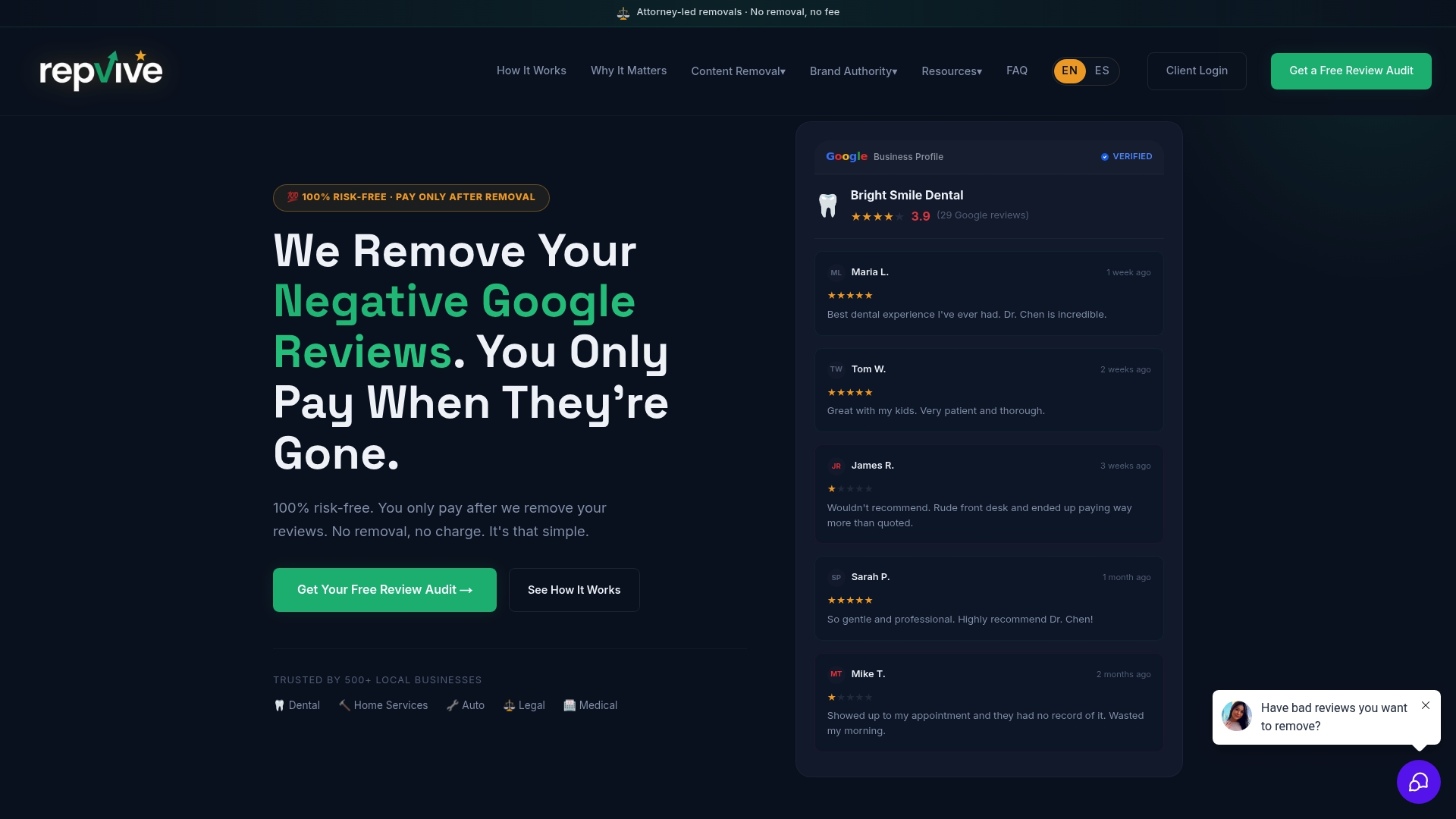
Once you send over your evidence, screenshots, transaction records, timestamps, and any cross-posted copies, a removal service’s team may package that documentation into a legal removal request and push it through direct channels with the platform’s trust-and-safety team. Many provide a real-time tracking dashboard to keep you informed about your case status. Some services also offer ongoing monitoring tools that flag new posts before they cause lasting damage.
If you’re facing a non-customer review that survived a flag and an appeal, start with Repvive’s review removal service and send over your documentation to see whether your case qualifies.
Sources
- Report inappropriate reviews on your Business Profile — Google Business Profile Help
- EFF — Section 230
- How to Remove Bad Reviews From Google My Business (2026) — UENI
- Can employers remove Indeed reviews? — LegalClarity
FAQ
Is It Illegal to Remove Bad Reviews?
No, removing a review that genuinely violates platform policy is legal and encouraged. What’s illegal is paying for fake positive reviews or using deceptive tactics to suppress honest ones, practices the FTC’s rule on fake reviews specifically targets.
Can You Pay to Have Negative Reviews Removed?
You can pay a service to help build and submit a legal removal request, but no legitimate company can pay a platform to delete a review that doesn’t violate policy. Services like Repvive charge for the legal and evidentiary work, not for guaranteed deletion of protected opinion.
Can Companies Really Remove Bad Reviews?
Yes, when the review violates a documented policy such as spam, impersonation, personal information, or off-topic content. Reviews reflecting genuine customer opinions, even harsh ones, generally stay up regardless of who requests removal.
Which Company Is Best for Removing Non-Customer Reviews?
Attorney-led services that build a specific legal claim per review, rather than mass-flagging with generic language, tend to get better results. Repvive uses this approach with a pay-per-removal structure, so cost is tied directly to a successful outcome.
How Long Does Google Take to Remove a Reported Review?
Most flagged reviews receive a decision within 2 to 14 days. If your flag is denied, the one-time manual appeal typically takes a similar window to resolve.